Liddel Strength: Seat of the English Barony of Liddel
Site at a Glance
- Popularity
- Medium
- Country
- United Kingdom
- Primary era
- Medieval
- Eras represented
- Medieval
- Civilizations
- English
- Site type
- Military
- Remains
- Castle
On this page9 sections
History
Liddel Strength is a medieval castle near Carwinley in the United Kingdom. It served as the seat of the English-side Barony of Liddel, a territorial estate held by a baron. Ranulf le Meschin, an Anglo-Norman magnate, is thought to have established the barony in or before the first decade of the 12th century, when a fortification was probably needed to defend it.
The barony and the first recorded castle
Ranulf granted the barony to Turgis Brandos. It passed to Turgis’s son William Brandos, probably also known as William of Rosedale, and later to Turgis or Turgot de Rossedale. In 1165, Guy de Rossedale granted land to Canonbie Priory, including fishing rights in the Liddel from the castle ditch to the church. The first definite mention of the castle came in 1174, when William the Lion, King of Scots, took it during his campaign through Northumbria while besieging Carlisle.
By then, the castle belonged to Nicholas de Stuteville, whose family had displaced the de Rosedales by an uncertain route. The Stutevilles appear to have enjoyed the favor of Henry II. Members of the family held responsibilities at other castles taken during the campaign, and one was among the knights who captured William the Lion at Alnwick later that year. Although the family held the Barony of Liddel, its principal seat was at Cottingham in Yorkshire.
Liddel Strength should not be confused with Liddel Castle in Upper Liddesdale. That castle was the original seat of the Scottish Barony of Liddesdale, held first by the de Soules family and later superseded by Hermitage Castle. The medieval border was unsettled, so the two castles could at times belong to different kingdoms from those on whose sides of the modern border they now stand. Canonbie, just upstream, also contributes to the name confusion: it takes its name from a religious community once called the religious house of Liddel, and its church was sometimes known as the church of Liddel.
Claims of an earlier stronghold
A pre-Norman origin for Liddel Strength has been proposed, but the place-name evidence is uncertain. In the 19th century, William Forbes Skene suggested that Carwinley came from Caer Wenddolau, meaning ‘Gwenddoleu’s Fort’. He connected the name with a stronghold of Gwenddoleu, a Celtic ruler killed in 573 at the Battle of Arfderydd, which is now generally identified with Arthuret. A 15th-century manuscript also tells of St Kentigern meeting the naked, hairy Lailoken, sometimes identified with Merlin, after a battle on the plain between Liddel and Carwannock.
A Roman fort called Castra Exploratorum, about a mile from Carwinley in Arthuret parish, was another proposed location for Caer Wenddolau; Netherby Hall later obliterated its remains. At an antiquarian meeting in 1926, R. W. Collingwood rejected the idea that Liddel Strength itself predated the Norman Conquest.
Stuteville and Wake lordship
The Stuteville estates passed through marriage to the Wake family. In 1300, John Wake held both the Barony of Liddel and the Scottish Barony of Liddesdale from the English king, though his holdings were described as the lands of Liddel and Hermitage. By 1346, the barony belonged to Sir Thomas Wake. He had led an English incursion into Scotland in 1337, but bad weather confined it to 12 days. Wake was among the ‘Disinherited’, men deprived of Scottish lands after the Scottish victory at Bannockburn in 1314, and he also fought at Dupplin Moor during the Scottish succession struggle of 1332.
The siege and destruction of 1346
In October 1346, David II of Scotland attacked Liddel Strength during a French-backed invasion of England that ended in defeat at Neville’s Cross. Philip VI of France had urged the invasion, reasoning that Edward III’s commitment to the siege of Calais left northern England vulnerable. David’s army numbered about 12,000, with some troops equipped with modern weapons supplied by the French.
The Scottish vanguard, led by William Douglas, Lord of Liddesdale, reached the castle on the morning of 6 October. David and the main army arrived that evening, and the attack began on the fourth day. The Scots assaulted the defenses from all sides, filling the ditches with timber, earth, stones and fascines, bundles of brushwood used in siege works. Under cover of shields, they used iron tools to break through the wall bases. They then entered with little further resistance and killed nearly everyone they found.
The garrison was commanded by Sir Walter de Selby, a knight who had served on both sides of the border. He had held Mitford Castle for Robert the Bruce, surrendered it during a truce, and was imprisoned in the Tower of London before his release in 1327. Edward III later pardoned him and restored some of his lands. Selby was made, or was being considered for, the post of constable at Bothwell Castle in 1337; the Scots retook and damaged that castle later in the year. In 1345 or 1346, Selby was one of five local knights assigned to investigate an English raid across the Esk and the seizure of Scottish livestock and goods valued at £1,000.
Accounts differ over Selby’s execution. Geoffrey the Baker says that Selby pleaded for mercy, apparently hoping to be held for ransom, and that David had two of Selby’s sons strangled before ordering Selby’s beheading. The Lanercost Chronicle instead says that Selby asked for a weapon so he could die fighting as a knight, but David refused and had him executed without confession. In 1357, Selby’s son James claimed the Barony of Plenderleith, saying he had been captured when his father was killed and held for eight years or more.
After the castle’s destruction
Liddel Strength was never rebuilt. When Thomas Wake died in June 1349, the manor of Liddel was valued at £70 16s. 2d., while the castle site was valued at sixpence. The title passed to Margaret, who died within three months. Thomas’s widow, Blanche, held Liddel for life until her death in 1380. By then, the property was described as worthless because the Scots had destroyed the castle. It subsequently passed to Henry, Earl of Derby, later King Henry IV, and eventually became part of the Duchy of Lancaster, the landed estate associated with the English sovereign.
Remains
Setting and earthworks
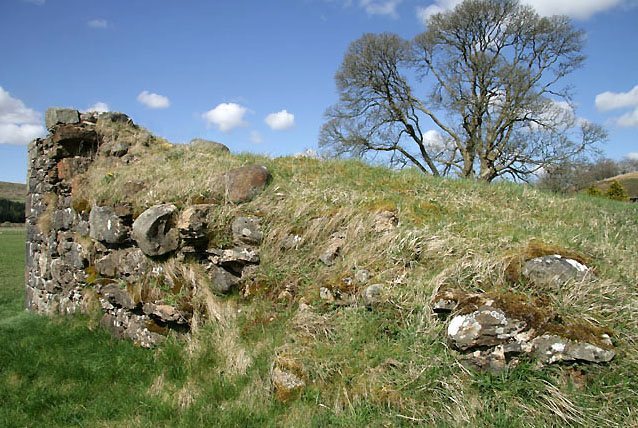
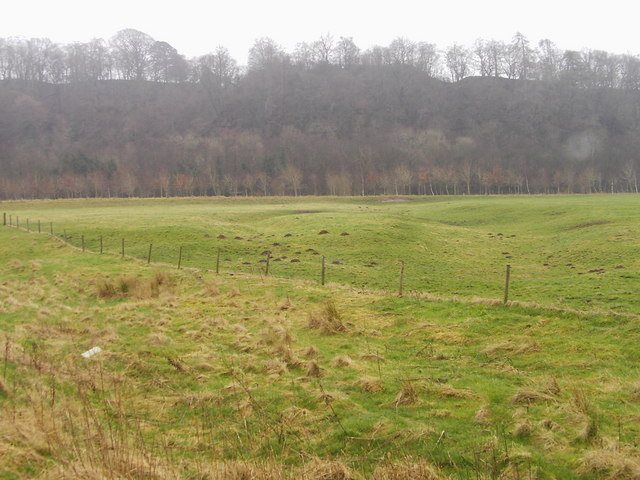
The surviving earthworks occupy a cliff on the south bank of the Liddel Water, overlooking its meeting with the River Esk. The site stands on the last high ground before the Esk reaches the Solway Plain. Upstream of the confluence the Liddel Water, and downstream the Esk, form the modern Anglo-Scottish border; in the past these rivers marked the southern edge of the Debatable Lands, a border region contested by England and Scotland. A Roman road running up Eskdale passed just east of the castle. The defenses enclose about 1.5 hectares, or 3.5–4 acres, and comprise a raised mound, or motte, within an inner bailey, an enclosed courtyard, with a less strongly fortified outer bailey attached. The inner earthworks form a semicircle about 48 by 58 metres and rise roughly 8 metres from the ditch bottom to the top of the surviving bank. On the north, a steep drop of about 50 metres to the river provided the natural defense.
Timber buildings and defenses
The castle was a timber motte-and-bailey fortification, with a wooden palisade, a defensive fence of stakes. An earlier ringwork, an enclosure defended chiefly by a bank and ditch rather than a raised mound, may have preceded the motte, though this remains uncertain. In the 1280s, the castle included a timber hall with two solars, private upper rooms for the household, and cellars. Other buildings, probably timber, included a kitchen, granary, cattle shed, agricultural building, and chapel; some were in poor repair. A repair agreement from 1300 provided for work on the mound, ditches, fortified tower and palisades, as well as lodgings in the mound for the garrison if needed. The agreement refers to a pele tower, a fortified tower type associated with the Anglo-Scottish border. Its construction date is unknown, but fragmentary remains are associated with the site. The defenses extended beyond a tower alone. The name ‘Strength’ may reflect a medieval Latin term for a small fort; medieval records also call the castle the Peel of Liddel or the Castle of Liddel, while Liddel Moat is another name reflected in the Moat Quarter of Kirkandrews-on-Esk parish.