Mangerton Tower: An Armstrong Border Tower House in Scotland

Site at a Glance
- Rating
- 3.3
- Popularity
- Very Low
- Country
- United Kingdom
- Primary era
- Early Modern
- External website
- Open
- Eras represented
- Early Modern
- Civilizations
- Kingdom of Scotland
- Site type
- Military
- Remains
- Castle
On this page6 sections
History
Mangerton Tower is a ruined stone tower castle house in the United Kingdom, at Mangerton near Newcastleton in the historic Anglo-Scottish Border region. Formerly associated with the Armstrong family, it stood in a politically volatile landscape where armed raiders, local landowners, and royal officials contested authority across the border.
The Armstrongs and the border
The Armstrong family of Mangerton was part of a wider network whose relatives held land on both sides of the border. In this region, a border reiver was an armed raider involved in cross-border attacks, reprisals, and efforts by officials to impose order. An early figure associated with the family was Johnnie Armstrong, the brother of Thomas Armstrong, Laird of Mangerton. James V captured and hanged Johnnie at Caerlanrig in 1530.
The family also appeared in the intelligence and raiding activity of the period. In December 1540, Mungo Armstrong acted as a spy for the English border official Thomas Wharton. While at Hermitage Castle, he received a ballad from Edinburgh, carried it to Carlisle for Wharton, and permitted John Thomson, the mayor of Carlisle, to copy it. In 1541, Archibald Armstrong, then the young Laird of Mangerton, and his one-eyed servant John Grey entered England with others and burned William Carnaby’s grain at Halton.
In 1543, the English commander Ralph Eure burned Mangerton in retaliation for fire-raising in Tynedale. Hector Armstrong later murdered Bartye Young, whose friend had guided Eure to the tower. These events brought the house and its occupants directly into the cycle of violence between border communities and the officials seeking to control them.
Royal reprisals and destruction
In March 1569, Regent Moray, James Stewart, came from Kelso into Liddesdale to punish the border communities. Moray governed Scotland for the infant James VI. He was accompanied by Lord Home, Ker of Cessford, Ker of Ferniehirst, Scot of Buccleuch, and 4,000 men. After unsuccessful talks with local leaders, the force burned the farmsteads of Liddesdale. Moray stayed at Mangerton before destroying the house with gunpowder, although Armstrong of Mangerton escaped capture.
The family’s political connections continued to place the tower at risk. In 1592, the Laird of Mangerton supported the rebel Francis Stewart, 5th Earl of Bothwell. James VI travelled to Jedburgh intending to punish Bothwell’s supporters and demolish Mangerton, Whithaugh, and other houses. The Duke of Lennox began demolishing Whithaugh, another Armstrong house north of Mangerton, but stopped after its laird submitted to him. Armstrong of Mangerton made peace with the king, and Mangerton was spared.
Final border conflicts
On 8 June 1597, the Armstrongs of Whithaugh crossed into England and attacked travellers heading towards Newcastle on Turnlippet Moor. In September 1601, the English border warden Lord Scrope laid waste to Mangerton in retaliation for raids that followed the murder of Sir John Carmichael. In a letter to James VI, Scrope justified capturing 16 notorious raiders and spoilers at Mangerton’s stone house.
The family remained connected to wider Scottish affairs after these conflicts. The Laird of Mangerton and Christie Armstrong of Barngleis were imprisoned in Edinburgh Castle in October 1588. In July 1591, the Laird was ordered to surrender John Jokke Armstrong as a pledge for the group known as the “gang of Mangertoun.” In 1617, Archibald Armstrong, a relative of the Mangerton family and court jester to James VI and I, secured a royal pension of £50 a year for his Scottish kinsman John of the Syde, an Armstrong from Mangerton. James VI became James I of England and Ireland in 1603.
Remains
Surviving tower house
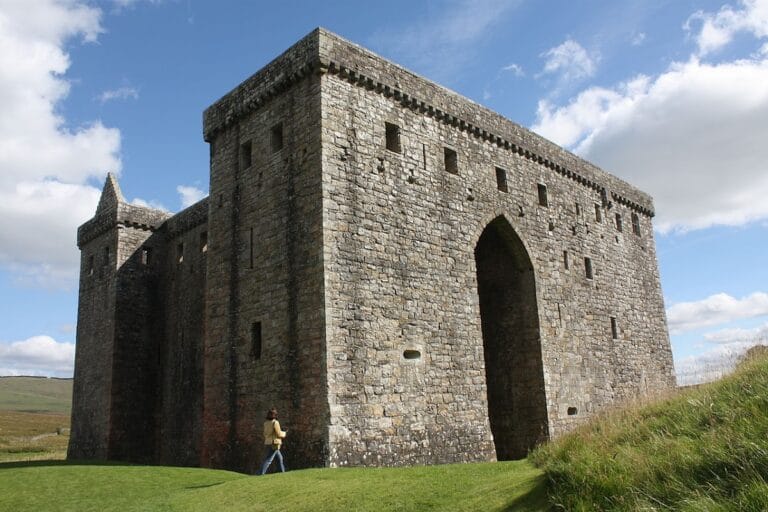
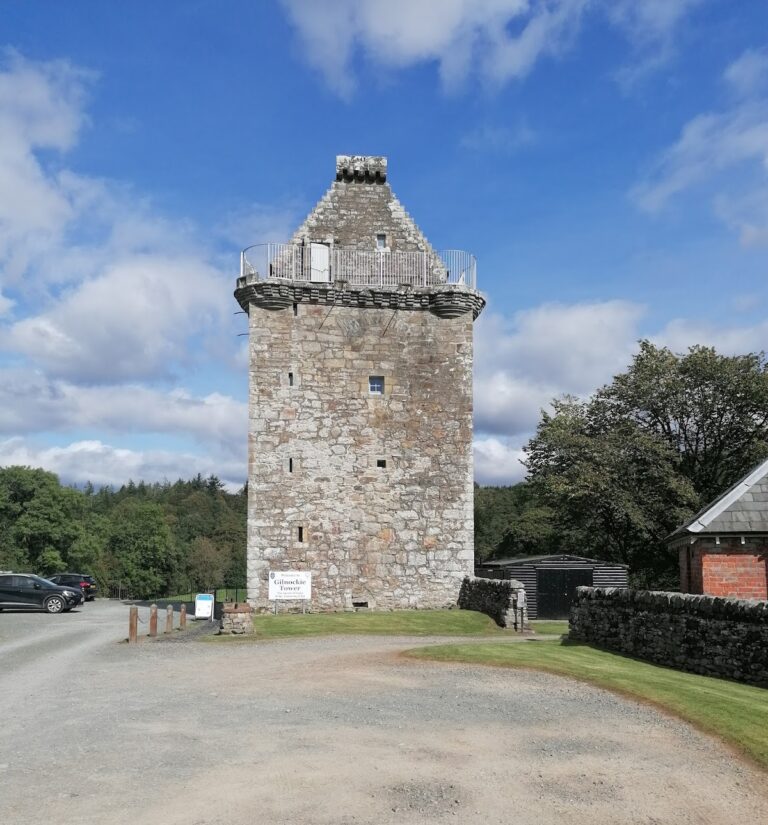
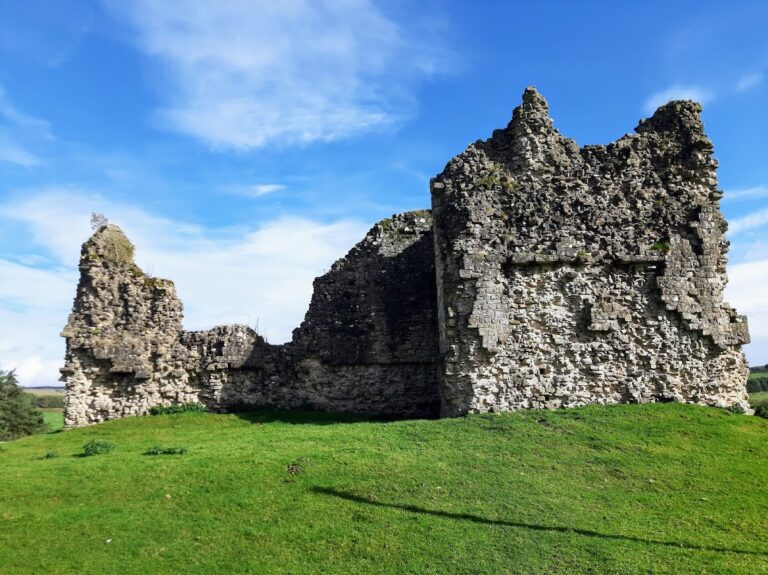
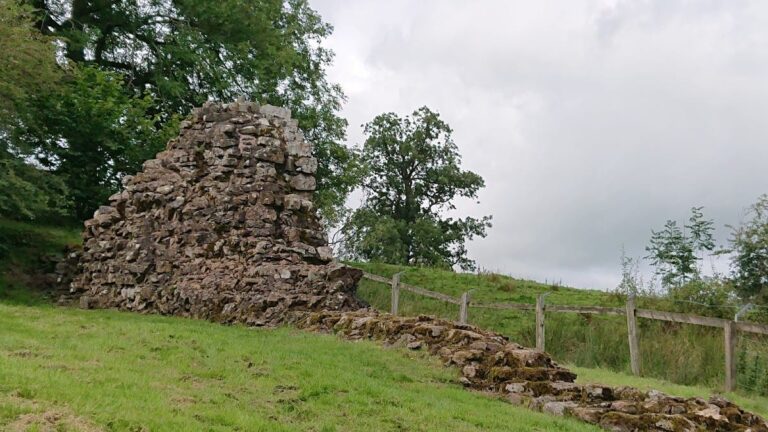
Mangerton Tower stands at Mangerton in Newcastleton, in Castleton parish of Roxburghshire, close to the English-Scottish border and beside the Liddel Water. It was built as a stone tower castle house. Only part of the ground floor survives, reflecting the destruction and later loss of the building’s fabric.
A stone panel associated with the tower carries a coat of arms and a date with initials, but the reading is uncertain. One interpretation gives the date as 1563 with the initials “SA” and “E”; another reads 1583 with “SA” and “FF.” The panel preserves a link between the surviving structure and the Armstrong family’s period of occupation, while its exact inscription remains unresolved.
Nearby sites