Castle Rožmitál pod Třemšínem: A Bohemian Noble and Archbishopric Residence
Site at a Glance
- Rating
- 3.7
- Popularity
- Low
- Country
- Czechia
- Primary era
- Early Modern
- External website
- Open
- Eras represented
- Medieval, Early Modern
- Civilizations
- Holy Roman Empire, Kingdom of Bohemia
- Site type
- Domestic
- Remains
- Castle
On this page17 sections
History
Castle Rožmitál pod Třemšínem in Czechia was founded in the first half of the thirteenth century by Oldřich of the Buzic family. Originally known by the German name Rosenthal, meaning “valley of roses,” it became the source of the name used by the Lords of Rožmitál, the Bohemian noble family that held the estate during much of its medieval and early modern history. The castle began as a fortified residence on marshy ground and later developed into a Renaissance complex.
Foundation and divided ownership
Oldřich was the first member of his family to use the designation “of Rožmitál.” In the Middle Ages, castles were sometimes given German names even in regions where most inhabitants spoke Czech, which explains the early form Rosenthal. The castle’s ownership changed substantially in 1347, when Oldřich’s relative Sezima transferred half of the castle, the town, and all its villages to the Archbishopric of Prague, the senior Roman Catholic ecclesiastical institution based in Prague.
The division produced a prolonged dispute between Sezima’s brother Zdeněk and Archbishop Arnošt of Pardubice. The archbishops retained their share until the Hussite Wars, the fifteenth-century religious and political conflicts in Bohemia associated with the followers of Jan Hus. As archbishopric authority weakened during those conflicts, King Sigismund mortgaged the ecclesiastical half in 1436 to Jan and Václav Zmrzlík of Svojšín for 2,000 kop of groschen. The Lords of Rožmitál later recovered that portion by a process whose details are uncertain, bringing the castle and estate together again until 1545.
Late Gothic change and the Renaissance rebuilding
Major alterations took place during the tenure of Zdeněk Lev of Rožmitál. These works prepared the way for the later Renaissance transformation, but the family’s financial position deteriorated. Zdeněk Lev’s sons, Zdeněk, Jan, and Adam, accumulated heavy debts and eventually surrendered the family property, including the Rožmitál estate, to their creditors. They then left Bohemia for Moravia.
Between 1550 and 1555, Florián Gryspek of Gryspach gradually purchased the estate from its creditors. A nobleman of Bavarian-Austrian origin and a senior royal official, he commissioned a rebuilding in the Italian Renaissance style between 1559 and 1564. The work enlarged the residential complex and gave the castle a more developed economic role. Under Gryspek, the estate acquired a brewery, bakery, granaries, and a water system leading from the nearby hill at Voltuše. He also obtained privileges for the town, including the right to hold markets, maintain its own magistrate, and exercise criminal jurisdiction.
The Gryspeks held Rožmitál until September 1622. Their participation in the Estates Revolt, the Bohemian uprising against the Habsburg monarchy that began in 1618, led Emperor Ferdinand II to confiscate their property. In 1623, the king granted the castle and estate to Arnošt Vojtěch, Count of Harrach, the Archbishop of Prague, with orders to convert the local rebellious population to Catholicism.
Archbishopric rule and religious conflict
Non-Catholic pastors had served in Rožmitál during the Gryspek period, and the attempt to impose Catholicism met strong resistance. In 1627, the imperial reform commissioner Jan Přibík Jeníšek arrived with Jesuits and soldiers. People were detained in the castle prison for conversion, while many others escaped into the surrounding forests. Arnošt of Harrach himself did not support violent re-Catholicization.
The Archbishopric of Prague retained the castle and estate until nationalization in 1948. Rožmitál served mainly as a summer residence for the archbishops rather than their permanent seat. Fires repeatedly altered the buildings. A blaze in 1660 was followed by repairs ordered by Harrach. Another fire in 1724 required roughly four decades of work, supervised by Archbishop Jan Mořic Gustav of Manderscheid-Blankenheim. During this restoration, the tower was lowered by one storey.
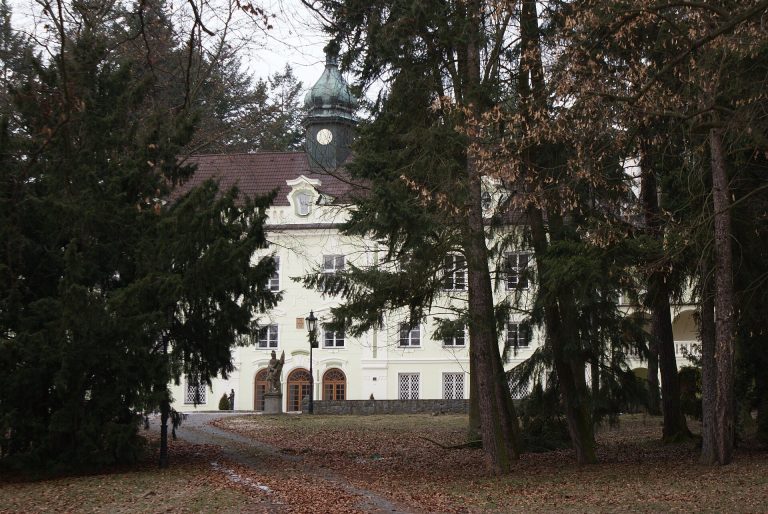
Between 1793 and 1810, Archbishop Vilém Florentin, Prince of Salm, reshaped a former marsh into an English-style castle garden. The grounds remained open to the public from their creation until the 1850s. Salm also wished to be buried at Rožmitál. After his death at Hahnbach in 1810, local people tried to keep his body for burial there, but soldiers from Březnice recovered it. The participants were punished in the castle courtyard, and the reeve Václav Stránský was removed from office and imprisoned in Prague with other participants.
Fire, war, and nationalization
On 27 October 1813, burning barns caused a third major fire to spread to the castle. The repairs that followed were inadequate, and in 1893 the director of the archbishopric estates described the buildings as being in very poor and neglected condition. At the beginning of the twentieth century, the archbishopric repaired roofs and facades, installed a water supply, and roofed the gallery on the tower.
During the Second World War, Wehrmacht soldiers occupied rooms in the castle. After the war, German soldiers and Gestapo informers were imprisoned there. Earlier wartime damage also led to a serious fire. On the night of 4–5 March 1940, the second floor of the Gryspek Palace burned when a timber beam enclosed in a chimney caught fire as soldiers heated the stoves heavily. Repairs continued until the summer of 1941. They included work on the tower gallery and the reopening of a pedestrian gate beside the main entrance, which had been blocked after the 1724 fire.
Nationalization in 1948 ended archbishopric ownership. Czechoslovak State Forests converted rooms into apartments for employees, and residents remained there until the early 1970s. Some furnishings were stolen during the war; other pieces were moved to different castles or discarded. In 1958, the castle received protection as a cultural monument.
Restoration efforts and present management
The town of Rožmitál took over the castle in 1974. After the remaining residents moved to a new housing estate, inserted partitions and lowered ceilings were removed to permit structural stabilization. SÚRPMO, a Prague organization involved in heritage conservation and building research, offered professional and financial assistance. Its architectural-historical survey of 1973, led by architect Miroslava Baštová, examined the castle and valuable historic buildings in the town. The assessment of Dobroslav Líbal, chairman of the commission for the classification of monuments, helped support applications for funding through Sazka and Sportka.
The reconstruction stabilized the Gryspek Palace and tower, removed later interior structures, and improved the neglected garden. Plans for a cultural program included a hall devoted to Jakub Jan Ryba, a regional-history exhibition, and a display of nineteenth-century material from Nelahozeves Castle. During the late 1970s and early 1980s, additions associated with the former nineteenth-century brewery and other service buildings were demolished. A later scheme proposed a toy museum, collections from the Brdy Memorial, and a Rožmitál regional exhibition drawing on holdings from the National Museum in Prague and the Příbram District Museum. Approved in 1987, the plan was interrupted by the Velvet Revolution and never resumed.
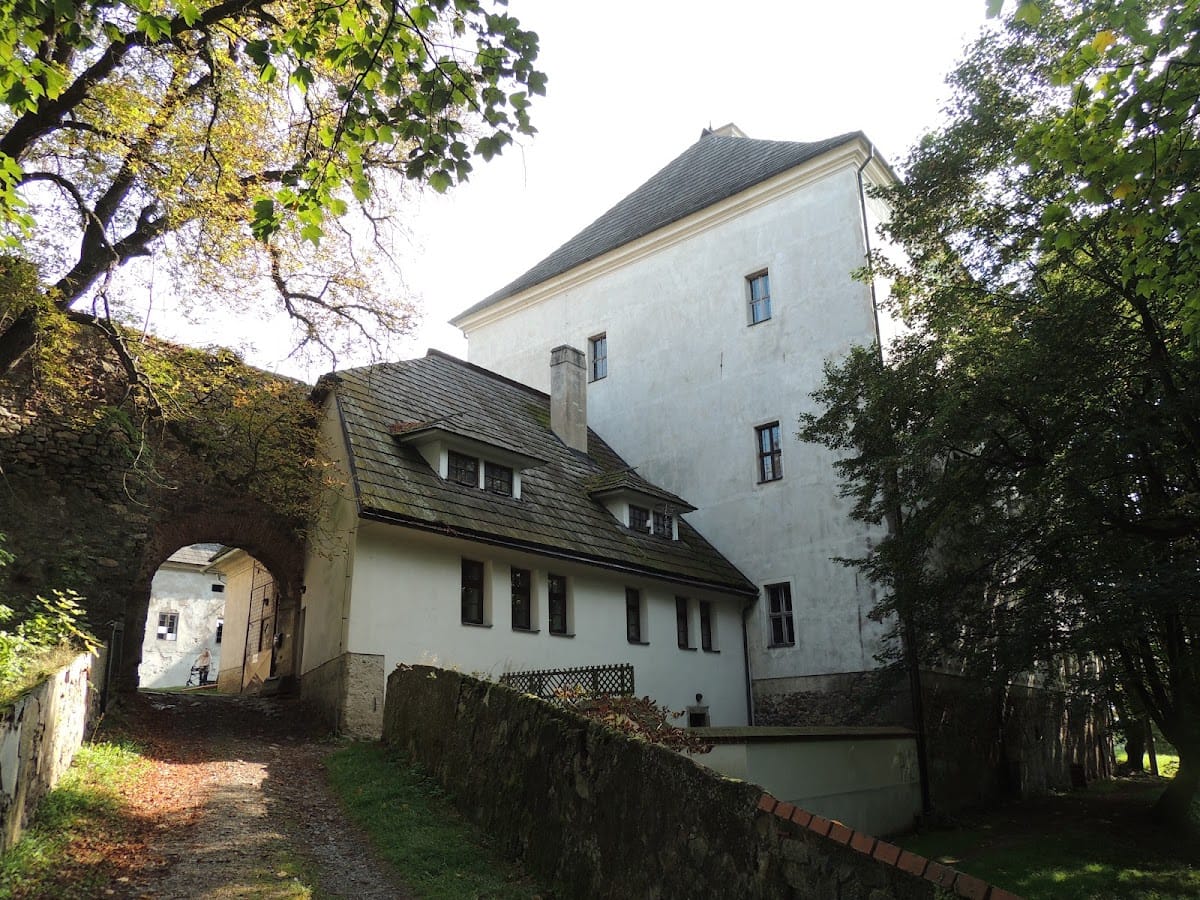
After 1989, the town lacked funds and had no settled use for the unfinished complex. It offered the castle to the Prague Archbishopric in February 1990, but the offer was declined. Further repairs followed in the mid-1990s with assistance from the Ministry of Culture. In 1998, the town made another offer as part of a transfer of other immovable property. The archbishopric accepted because a prospective investor had been identified, and the castle passed to the private company Trinity Coop. Structural stabilization continued and the caretaker’s house was repaired, but work stopped in 2006.
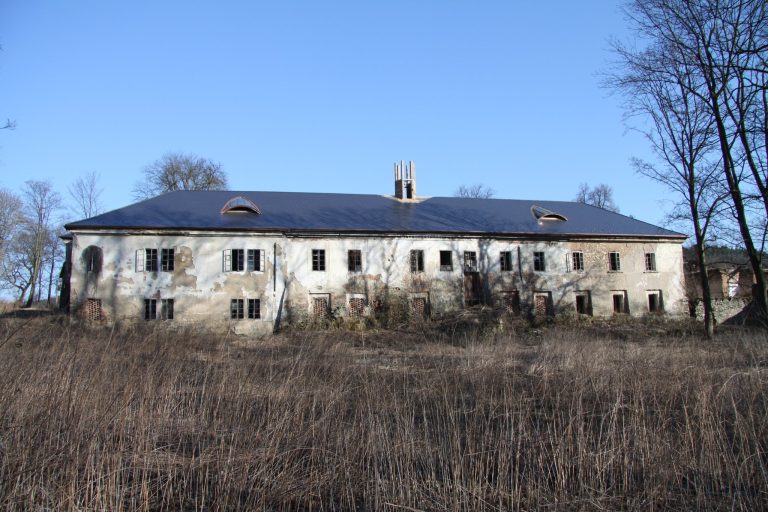
Later deterioration prompted new local initiatives. On 9 June 2013, vandalism contributed to the collapse of the roof and ceilings of a barn beside the castle, and the town demolished the unsafe ruins. On 23 October 2014, part of the roof over the oldest section, which was later used as the brewery, collapsed. The Civic Initiative for the Rescue of Rožmitál Castle appealed to the owners in 2017. With support from the Czech National Trust, the Rožmitálský zámek association was founded in 2019 to open the castle to the public and connect its care with community activity.
Volunteers and the town removed invasive vegetation and rubbish dumps, undertook necessary repairs, and appointed a new caretaker. The castle reopened on 22 December 2018 and also opened during the Queen Johana Festival in 2019 with the owners’ consent. Since 2019, the voluntary association has managed seasonal public access and organized cultural work and volunteer activity. Visitor contributions, sponsorship, and grants have supported minor repairs. New main-gate doors were installed in 2021, and parts of the roof covering on the Old and Small Palaces were replaced in 2023 and 2024. Trinity Coop remains the private owner, while Rožmitálský zámek is responsible for voluntary management.
Remains
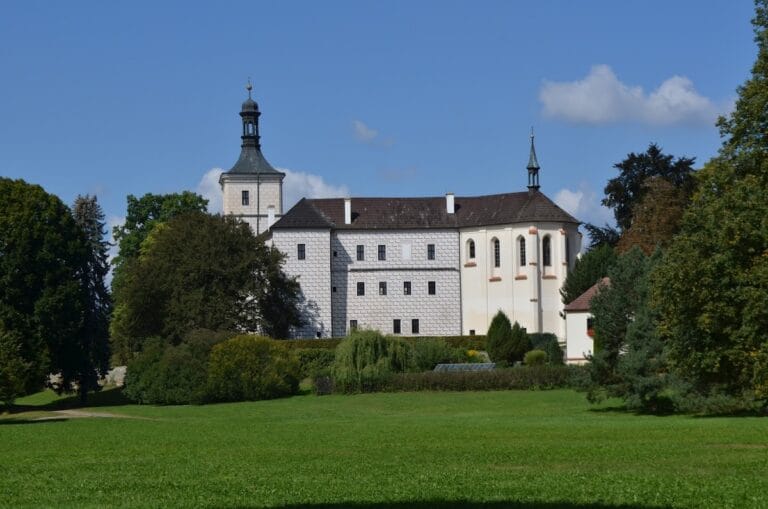
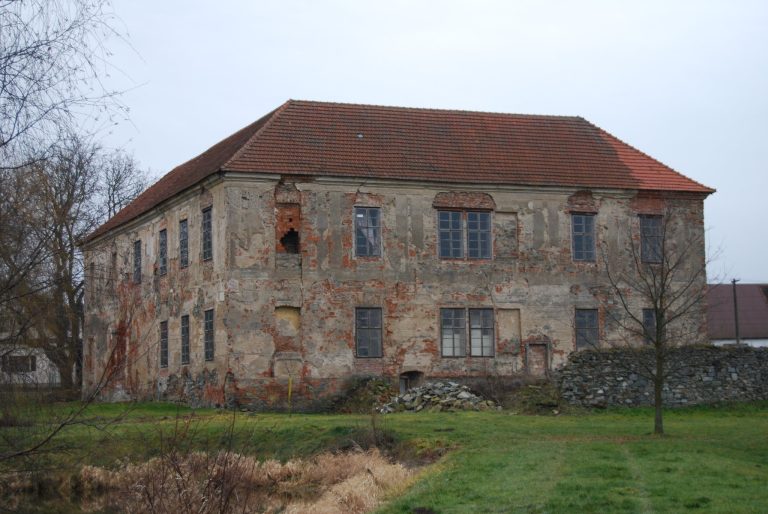
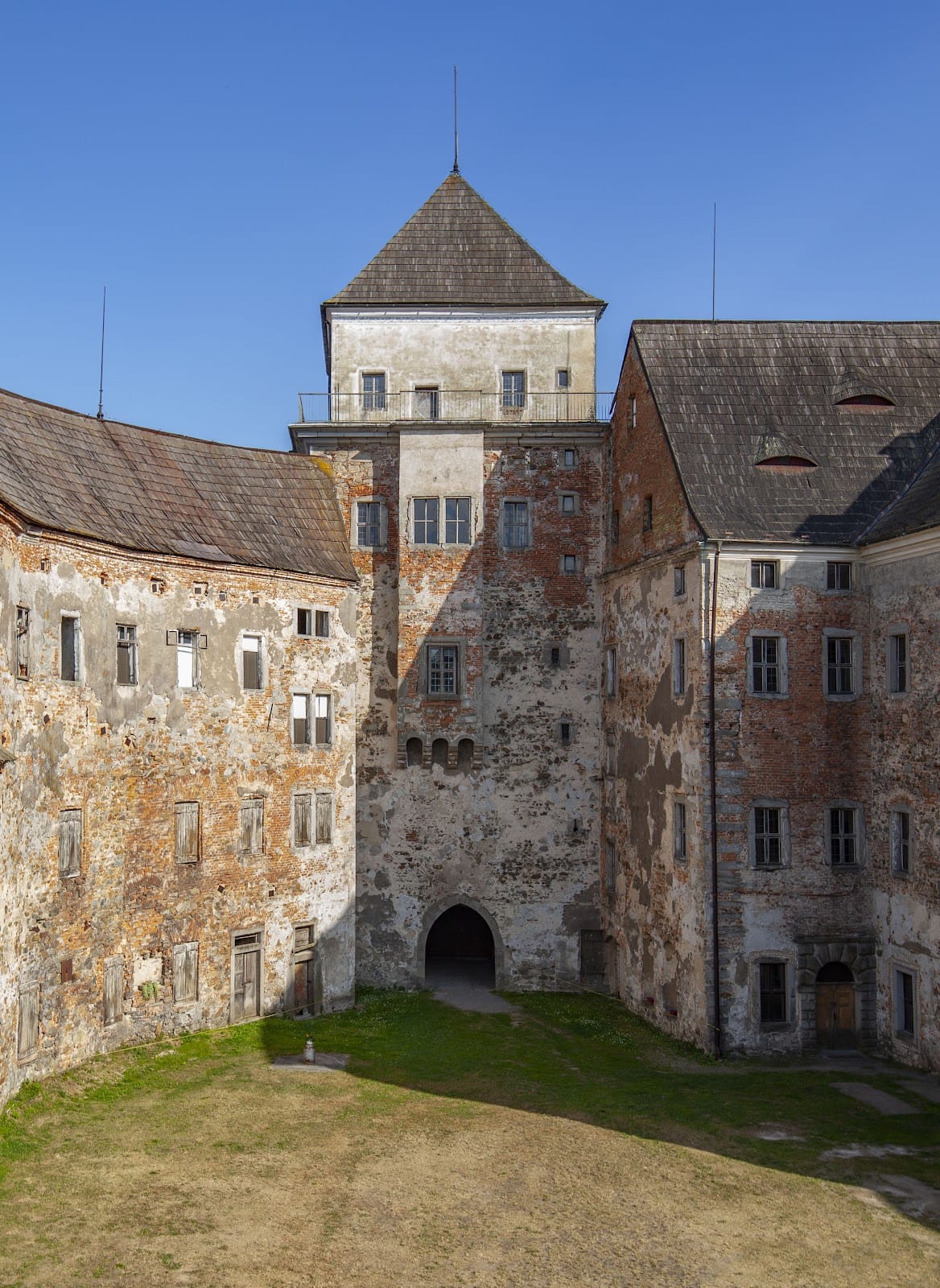
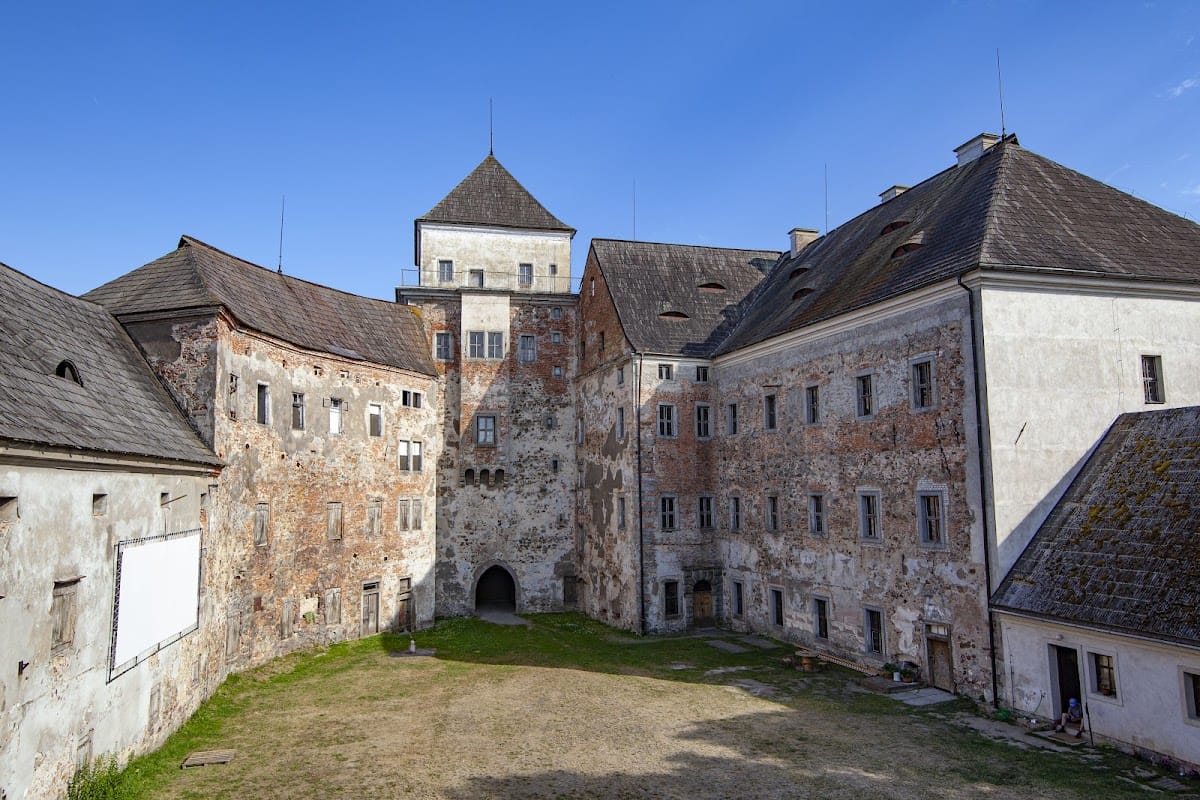
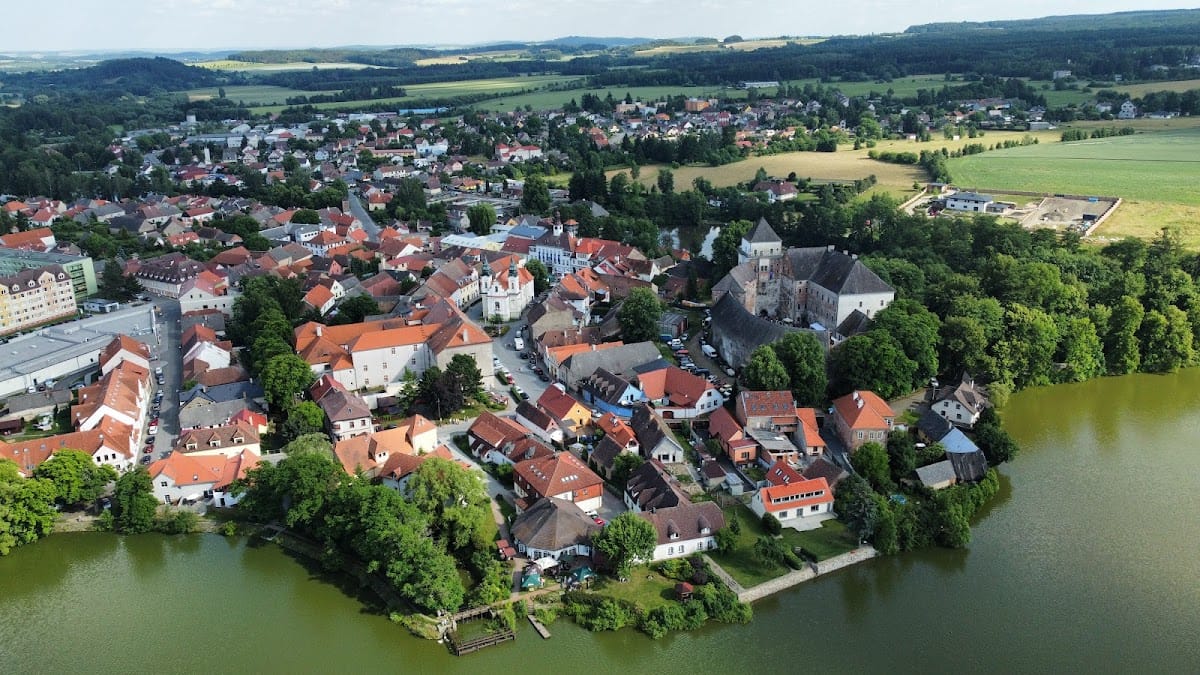
The surviving castle is a three-winged, two-storey complex arranged around an asymmetrical courtyard. It occupies ground that was originally marshy, where water formed part of the defensive system. The earliest building phase survives in the masonry of a perimeter wall enclosing an approximately oval area. Its recorded corner lies on the south-west side, where an unidentified building may have stood. Some masonry in the eastern wing may also date to the thirteenth century.
Medieval fortifications and palaces
Perimeter wall and tower
During the Late Gothic period, the final phase of Gothic architecture before the Renaissance, a large tower was added to the castle. It had bay windows and was probably accompanied by ramparts and a wall strengthened with round bastions or towers. These defenses stood around the earlier oval enclosure and formed the medieval framework later altered by the Renaissance rebuilding.
Old and Small Palaces
Probably during the time of Zdeněk Lev of Rožmitál, a younger large palace with four rooms was built after part of the perimeter wall had been demolished. The present three-winged arrangement preserves the results of these successive changes. Parts of the roof covering on the Old and Small Palaces were renewed in 2023 and 2024 as part of continuing conservation.
Renaissance court and tower
Gryspek Palace
The two-storey Great Palace, also called the Gryspek Palace, belongs to Florián Gryspek’s rebuilding of 1559–1564. It projects beyond the line of the original oval fortifications and retains traces of rustic plaster on its facades. The palace suffered fire damage in 1940, when its second floor burned, and later reconstruction helped stabilize the building while removing inserted structures associated with its use as employees’ housing.
Tower gallery and decoration
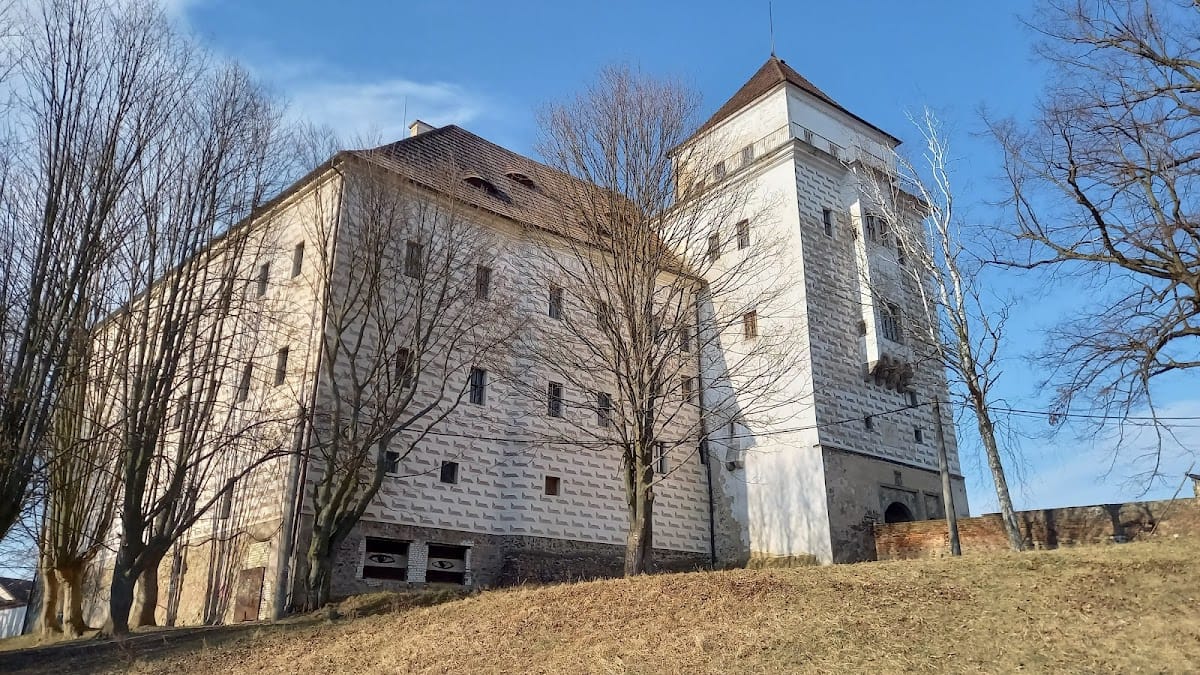
The tower was raised by two storeys during the Renaissance work and later reduced by one storey after the fire of 1724. Its surviving decoration includes sgraffito, a surface pattern made by scratching through one coating to expose another beneath, together with windows framed by scrollwork dating from the 1570s. A covered gallery on the tower was restored after the 1940 fire. A painting in the Green Room of Blatná Castle is said to show the medieval castle, although its identification with Rožmitál remains uncertain.
Water system and estate buildings
Courtyard water supply
Florián Gryspek’s water system used wooden pipes to carry water from the nearby hill at Voltuše to a fountain in the castle courtyard. The supply formed part of the sixteenth-century improvement of the residence and its working estate.
Brewery and malt-production areas
Gryspek founded the castle brewery in the second half of the sixteenth century. By 1565, beer was served in the Lord’s House, the town hall, and a tavern on the outskirts. The brewery expanded chiefly after the second half of the nineteenth century, when it included a malt house for producing malt from grain, a drying kiln, grain stores, a beer-filling room, an ice cellar, and accommodation for the brewmaster. A cooper’s workshop and dwelling stood at the end of the castle garden. Brewery leases also included the right to distill spirits and were granted for six-year periods.
Three extensive hop gardens belonged to the estate by 1740. Production reached 656 barrels in 1750 and approximately 4,000–5,000 hectolitres annually during the 1880s, when the brewery made an average of two brews each week. Output had fallen to 2,600 hectolitres by 1936. The Ministry of Economics and Labour ordered an indefinite closure from 1 July 1942 as part of industrial concentration. A proposed reopening in 1945 failed because raw materials were scarce, and brewing never resumed. The equipment was assessed in 1947 and sold in 1948 to a brewery in Nitra, Slovakia. The drying kiln was demolished in 1979, while the malting floor, its original vat, and the lagering cellars survive. The main brewery building lost part of its roof in 2014.
Garden, chapel, and later fabric
The castle complex historically included a chapel, bakery, brewery, malt house, granaries, beehives, hop gardens, and a beer tavern. The former marsh was converted into an English-style garden between 1793 and 1810. The caretaker’s house was repaired during the post-1998 investment program, and later conservation included new main-gate doors in 2021. The castle’s surviving buildings therefore combine medieval defensive masonry, Renaissance residential architecture, nineteenth-century brewing facilities, and repairs that reflect its changing uses.
A local tradition places a secret underground passage between the castle and Třemšín Hill. The story was often linked to a depression behind the passage beneath the tower, but the tunnel there served to drain the courtyard.