Sloup Castle: A Medieval Rock Fortress and Baroque Hermitage in Czechia


Site at a Glance
- Rating
- 4.7
- Popularity
- Medium
- Country
- Czechia
- Primary era
- Early Modern
- External website
- Open
- Eras represented
- Medieval, Early Modern
- Civilizations
- Holy Roman Empire, Kingdom of Bohemia
- Site type
- Military
- Remains
- Castle
On this page13 sections
History
Sloup Castle is a medieval rock fortress in Czechia, established by the Ronovec family in the early 14th century at Sloup v Čechách. It stood beside a salt-trading route linking Meissen with Česká Lípa and was first documented during the 14th century. The rock had been occupied earlier, and archaeological finds from the summit area and the substantial deposit at its foot include pottery associated with the Eneolithic Globular Amphora culture, the Lusatian culture, and the La Tène period. A prehistoric hillfort may also have occupied the summit.
Medieval fortress and Hussite-era conflict
Čeněk of Lipé was among the early documented holders of Sloup. After 1330, the castle passed to the related Berka family of Dubá. Its position beside an important trading route gave the fortress a strategic setting, while its natural sandstone rock provided a defensible foundation that could be strengthened with artificial barriers.
Around 1427, during the Hussite Wars, religious and political conflicts in Bohemia that began in the early 15th century, the robber knight Mikeš, also called Mikuláš, Pancíř of Smojno, established himself at Sloup. Protected by the Vartenberg family, he used the castle as a base for raids into Lusatia.
A Lusatian punitive army besieged Sloup in 1444 but failed to take it. During a second siege in 1445, the defenders capitulated after their food supplies were exhausted. The attackers demolished the stone fortifications and burned the wooden buildings. Mikeš pledged not to rebuild the castle, yet he reconstructed it after the army withdrew and continued raiding the surrounding lands for another three years. In 1455, he transferred Sloup to his sons.
Berka ownership and destruction
Members of the Berka family of Dubá bought Sloup again at the beginning of 1471. Their intention was to maintain it as a refuge in dangerous times rather than as a base for raids. By the 16th century, the fortress had become increasingly unsuitable for comfortable residence and was deserted, allowing it to decay.
During the Thirty Years’ War, the major European conflict fought from 1618 to 1648, Swedish troops commanded by General Johan Banér captured and completely destroyed Sloup in 1639. The medieval fortress was never restored in its earlier military form.
Baroque hermitage and later estate
In 1679, Count Ferdinand Hroznata of Kokořov acquired the Sloup estate, including the rock and its ruins, and gave the site to hermits. A hermitage was a religious retreat where hermits lived apart from ordinary monastic communities. Six members of the brotherhood inhabited Sloup successively, adapting the ruined fortress to religious and secluded life.
Construction and alteration of the Baroque complex continued under several owners and hermits. The Baroque was a major European artistic and architectural period of the 17th and 18th centuries, known in part for elaborate forms and decoration. The builder Konstantin participated in planning the transformation of the rock, while the painter and hermit Václav Rincholín created a sundial there. Work stopped after Ferdinand Hroznata’s death in 1708, but Štěpán Vilém Oldřich later continued the project and commissioned terraces on the southern and eastern sides.
Joseph II officially dissolved the hermitage in 1785 as part of the Josephine reforms, which reorganized religious institutions and closed some contemplative establishments. Afterward, Count Filip Josef Kinský converted the former castle and hermitage into a recreational site for his guests. He moved the main entrance to the southeastern part of the rock and created a small park. Recorded guests included Archdukes Franz Karl and Stephan Franz of Habsburg-Lorraine, King Frederick Augustus I of Saxony, and, in 1847, the future Emperor Franz Joseph I with his brothers.
Ownership and protection
The Kinsky family retained the estate until 1940. Following the death of August František Kinsky, the hermitage and village passed to Vilém Emanuel Preysing. His property was confiscated and nationalized in 1945, after which the rock and its structures were abandoned.
Sloup Castle was declared a cultural monument in 1953. Its surroundings were gradually put in order, and several walking routes were laid out. In September 2013, erosion caused part of the southeastern gallery to collapse, and the damaged section was repaired in spring 2014. The municipality of Sloup v Čechách now owns the complex, whose medieval ruins and later Baroque alterations remain protected as a cultural monument.
Remains
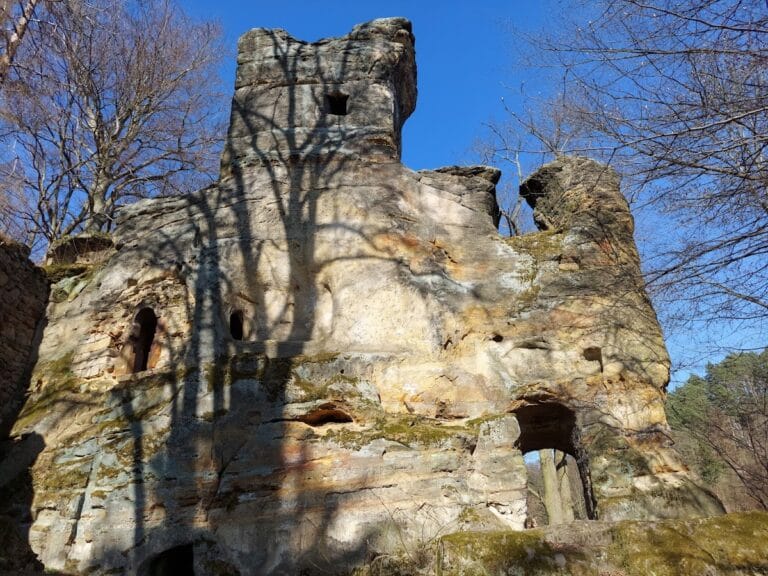
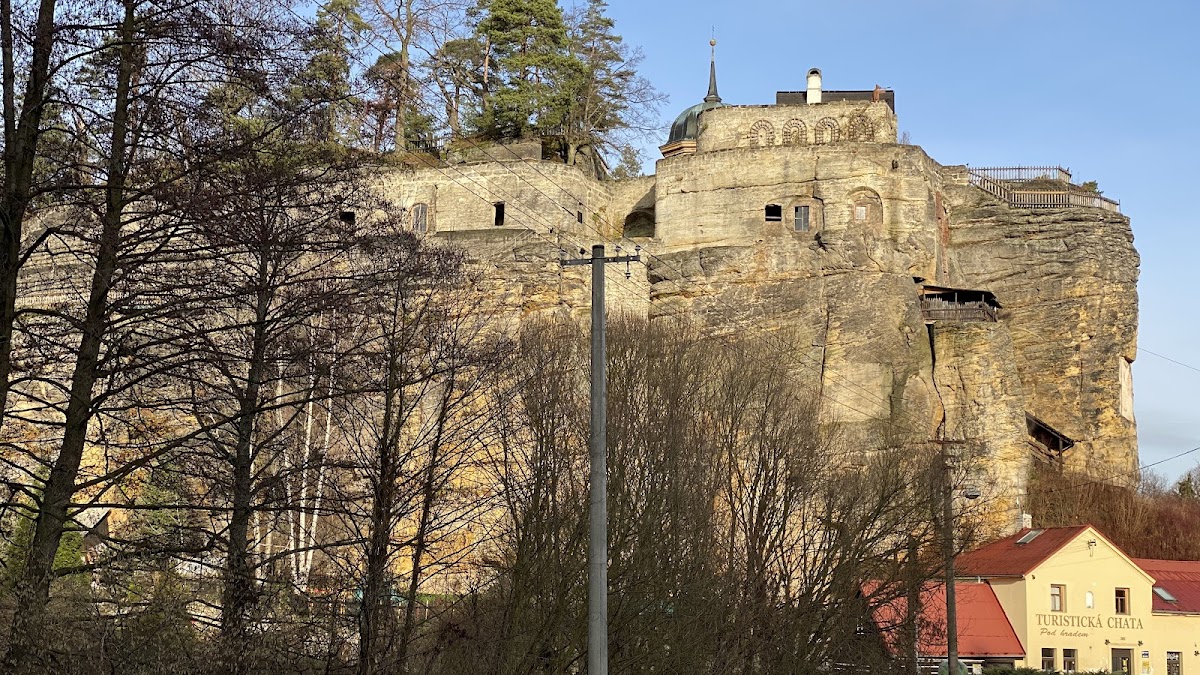
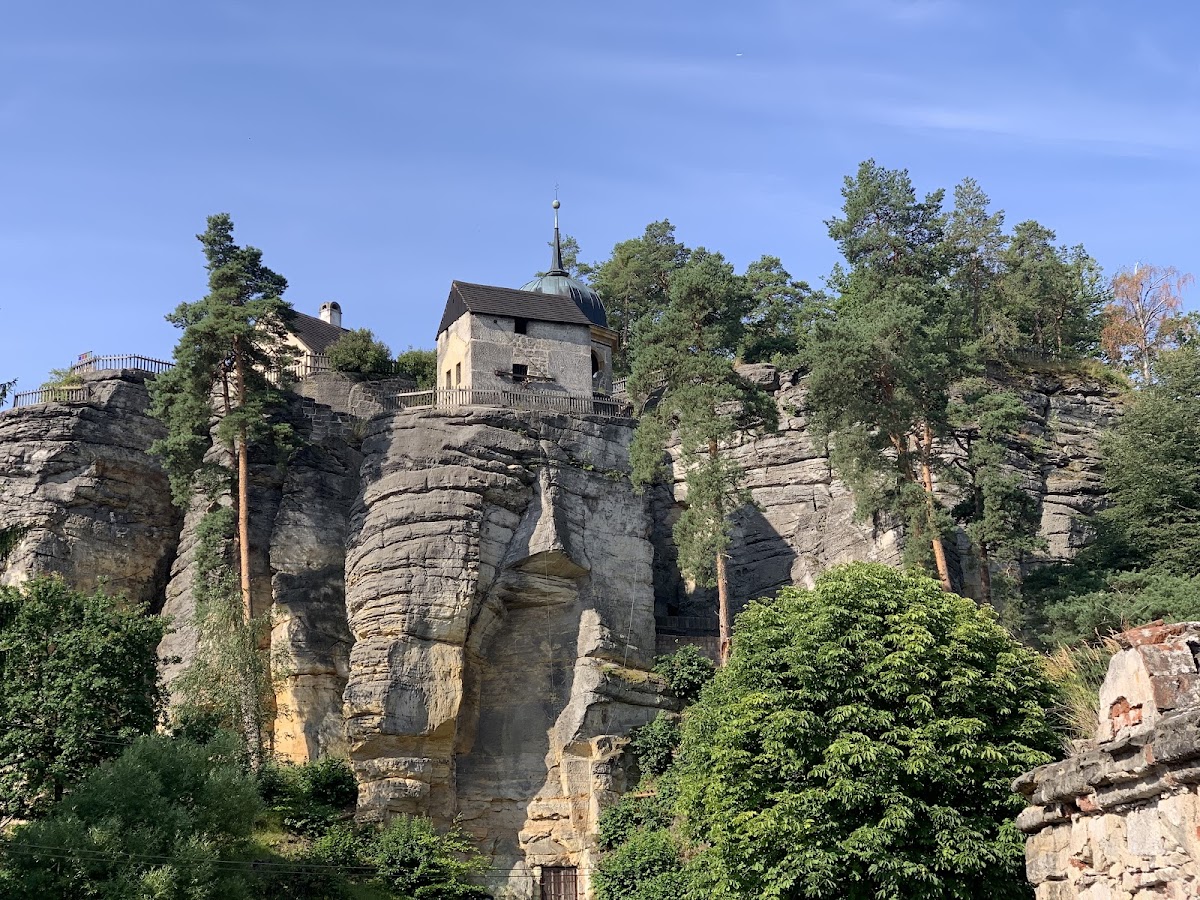
Sloup Castle occupies a freestanding sandstone rock about 35 metres high. Its name refers to the column-like appearance of this natural formation. The medieval fortress combined the rock with constructed defenses. Edges of the level summit were carved to resemble castle walls and fitted with loopholes, while some gullies were filled with masonry. Trenches could be flooded, creating an additional barrier around the stronghold. Because much of the medieval construction was wooden and later disappeared through fire or decay, the original extent and plan of the castle remain uncertain.
Medieval rock fortress
Defensive summit
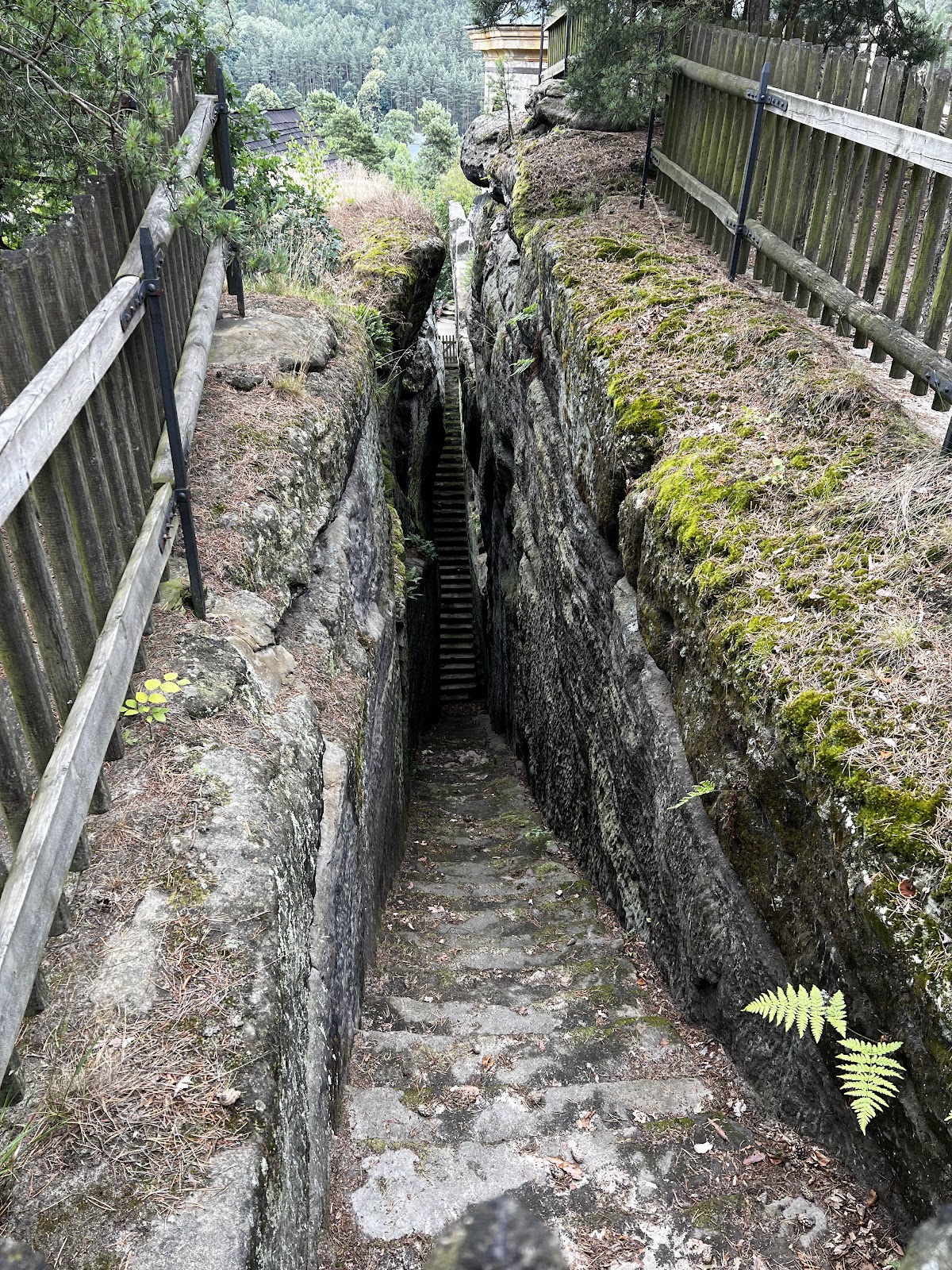
Fragments of medieval walls survive around the rock, together with several rooms near the summit. Stairs cut into the sandstone connect parts of the formation, and other spaces were excavated directly into the rock. One surviving underground installation has been interpreted as a dungeon, a grain store, or a water cistern. These features belong to the fortress’s use of the natural rock as both foundation and defensive structure.
Prison or dungeon carvings
Carvings made by former prisoners survive on the walls of the former prison or dungeon. They form part of the physical evidence associated with the castle’s enclosed underground spaces and preserve traces of later human use within the medieval rock complex.
Baroque religious complex
Rock church and chapel
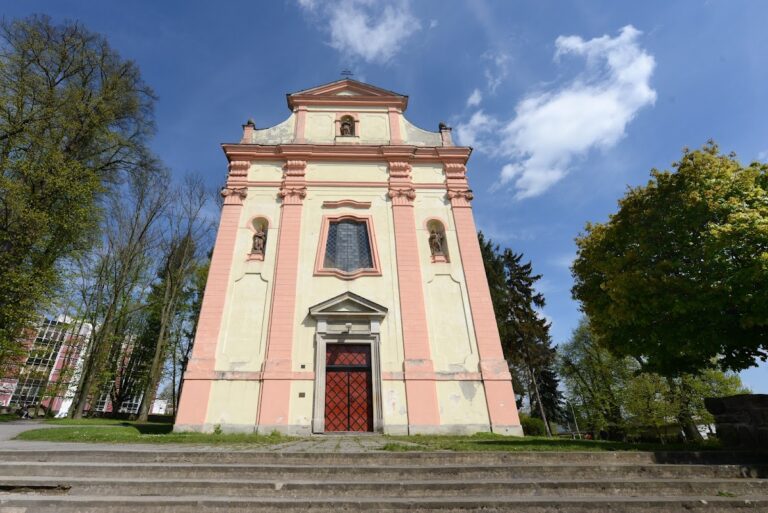
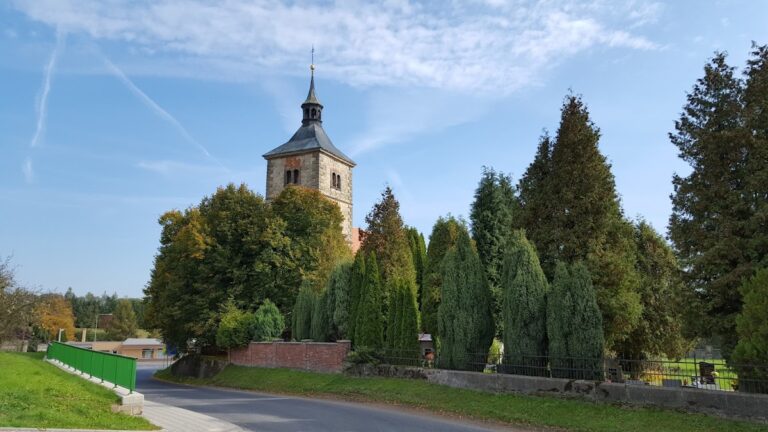
The later complex includes a church cut into the rock, a chapel, former hermit cells, a cloister, galleries or passages, terraces, and three artificial caves or grottos. A chapel in the rock dates from 1693. Its interior furnishings were later transferred to the new Church of Saint Catherine of Alexandria in the nearby village, linking the former hermitage with the later parish setting.
Hermit cells and devotional spaces
The hermits carved additional rooms and recesses into the sandstone. Some recesses were associated with the Stations of the Cross, a sequence of devotional representations commemorating stages of Christ’s Passion. Terraced walkways were formed along the southern and eastern sides of the rock, and the principal entrance was later relocated to the southeastern side.
Galleries, grottos, and memorial statue
A statue of a hermit holding a telescope stands in one of the galleries. It commemorates Samuel Görner, a local native who lived for a time in a nearby cave. The present statue is described as the second replica of a wooden original destroyed by Prussian forces in 1866. Görner is also associated with growing grain on the plains around the castle and vines on the southern terraces.
The three grottos formerly contained sculptures made between 1719 and 1726 and placed there by Karel Kinsky. Together with the galleries, terraces, carved rooms, and religious spaces, they preserve the Baroque transformation of a ruined medieval fortress into a secluded complex shaped by hermit life and later estate use.