Špilberk Castle: Royal Residence, Fortress, and Prison in Brno

Site at a Glance
- Rating
- 4.7
- Popularity
- High
- Country
- Czechia
- Primary era
- Modern
- External website
- Open
- Eras represented
- Medieval, Early Modern, Modern
- Civilizations
- German, Habsburg, Holy Roman Empire, Kingdom of Bohemia, Margraviate of Moravia
- Site type
- Military
- Remains
- Castle
On this page19 sections
History
Špilberk Castle is a Gothic royal stronghold and later fortress in Brno, Czechia, founded by the Přemyslid ruler Přemysl Otakar II on a rocky hill above the city’s historic centre in the second half of the thirteenth century. It served as a centre of royal power and as a residence for the rulers of Moravia. The earliest written references date from 1277 to 1279, and the castle took its name from the hill on which it stands.
Royal foundation and the Moravian margraves
Přemysl Otakar II belonged to the Přemyslid dynasty, the ruling house of Bohemia, and was both margrave of Moravia and later king of Bohemia. He conceived Špilberk as a leading royal castle in Moravia, although Bohemian rulers visited it only occasionally. In 1337, Blanka of Valois, the first wife of Charles IV and later queen, stayed at the castle.
Špilberk became the permanent residence of the Moravian margraves in the mid-fourteenth century under John Henry, who ruled from 1350 to 1375. His son Jobst of Moravia continued the family’s residence there after becoming margrave in 1375. Jobst was briefly elected King of the Romans in 1410, a position commonly associated with the future Holy Roman Emperor, but he died at Špilberk three months later. The autonomous rule of John Henry and Jobst, representing the Moravian branch of the Luxembourg dynasty, lasted from 1350 to 1411 and formed the most important medieval chapter in the history of the castle.
Military stronghold and decline
After Jobst’s death, Špilberk ceased to function as a residential castle. Under Sigismund and his son-in-law Albert of Austria, its military role grew, and it later served as a military centre during the Hussite Wars, the fifteenth-century religious and political conflicts centred in Bohemia and neighbouring lands.
Viktorin of Poděbrady, the son of King George of Poděbrady, used Špilberk as his headquarters while serving as provincial governor. Brno had previously besieged the castle after supporting Matthias Corvinus. In 1469, Corvinus captured Špilberk after a siege lasting several months and then took control of Moravia.
From the late fifteenth century, the castle deteriorated as it was repeatedly pledged to temporary holders who neglected its maintenance. The Moravian Estates bought Špilberk and its domain in 1560 to prevent its transfer to foreign owners, and later sold the castle itself to the city of Brno. Municipal ownership continued until 1620, when Emperor Ferdinand II confiscated the property after the defeat of the Bohemian Estates’ uprising and returned it to the Crown.
Fortress during the seventeenth and eighteenth centuries
During the Thirty Years’ War, the major European conflict of 1618 to 1648, Špilberk initially held only a small garrison. Its military importance changed when Swedish forces occupied parts of Moravia and threatened Brno in 1643 to 1645. In 1645, Brno and Špilberk, commanded by Colonel Raduit de Souches, resisted a three-month siege by a much larger Swedish army.
After the siege, the fortifications were strengthened in successive stages. By the middle of the eighteenth century, Špilberk had become the most powerful and important Baroque fortress in Moravia, forming a single defensive system with the fortified city of Brno. In March 1742, during the War of the Austrian Succession, the eighteenth-century conflict over Maria Theresa’s inheritance of the Habsburg territories, Brno and Špilberk resisted the forces of Frederick II of Prussia. The defence preserved Brno’s position as a centre of resistance in occupied Moravia and helped maintain the Habsburg monarchy. This was the last major military conflict in which Špilberk played a significant role.
From fortress prison to European symbol of imprisonment
A prison existed within the fortress from an early period. After the defeat of the 1620 uprising, leading Moravian participants were confined there for several years. From the last quarter of the seventeenth century until the early 1780s, military prisoners included the Austrian generals Bonneval and Wallis and the pandur colonel Franz von der Trenck, who died at Špilberk in 1749.
In 1783, Emperor Joseph II ordered the fortress prison to become a civil prison for the most serious criminals. Joseph II was a Habsburg emperor known for broad administrative, religious, and penal reforms. The first prisoners entered the converted upper level of the northern casemates in June 1784. In December of that year, life prisoners were placed in the lower level, where 29 individual cells were made from heavy beams and boards and the prisoners were permanently shackled.
The upper level of the southern casemates became a prison in the second half of 1785 and was known as the Leopold Wing. In May 1790, Emperor Leopold II abolished the life-prisoner facility and the punishment of shackling, introducing more lenient conditions. The upper casemates continued to serve as a prison until the early 1830s.
Špilberk also held political prisoners from the eighteenth century onward. They included the French revolutionary Jean-Baptiste Drouet, the Hungarian Jacobin writer Ferenc Kazinczy, and Italian patriots associated with the Carbonari and Young Italy. The Carbonari were members of a secret Italian political movement that opposed absolutist rule and promoted constitutional or national reforms. Young Italy was a nineteenth-century Italian nationalist movement. Silvio Pellico’s memoir My Prisons made the prison known throughout Europe. Pellico was imprisoned at Špilberk from 1822, and after his release in autumn 1830 his memoirs further publicized the institution.
The entire fortress began to be converted into a civil prison around 1820, and a special wing for state prisoners was built in 1822. Emperor Franz Joseph I abolished the civil prison in 1855 and returned the complex to military use, including barracks and a military prison. This military function continued for roughly a century. The departure of the Czechoslovak army in 1959 definitively ended Špilberk’s military role.
Wartime damage and modern museum use
French forces under Napoleon destroyed important parts of the fortifications while withdrawing from occupied Brno in 1809. The damage reduced the fortress’s military importance. The well was filled in during the same period and later cleared again.
Špilberk was used for imprisonment during both world wars and the Nazi occupation. During the First World War, soldiers and civilian opponents of the Austrian regime were held there. In the first year of the Nazi occupation of Czechoslovakia, several thousand Czech patriots were imprisoned at the castle, and some died there. The Gestapo, Nazi Germany’s secret state police, used the prison for resistance fighters and other opponents, many of whom were killed or later transported to concentration camps.
Between 1939 and 1941, the German army made extensive alterations for military purposes. During the Second World War, the casemates were adapted as protective shelters, and barracks were created in a romantic-historicist style that reflected the architecture and ideology of the period. These changes affected interiors and historicist details while largely unifying the complex without fundamentally altering its exterior appearance.
After the army left in 1959, Špilberk was transferred to the Brno City Museum in 1960, which established its seat there. The castle and surrounding park became a national cultural monument in 1962. Extensive renovation from 1987 to 1992 sought to restore the complex to the condition of the late eighteenth century, before its conversion into the Josephine prison. Reconstruction between 1995 and 2000 strongly shaped the present appearance, especially in the eastern wing, although aspects of that work remain debated. Špilberk is now part of the Brno City Museum and serves as a museum and cultural venue, with exhibitions on the castle’s architectural development, Baroque fortifications, prison history, and the history of Brno.
Remains
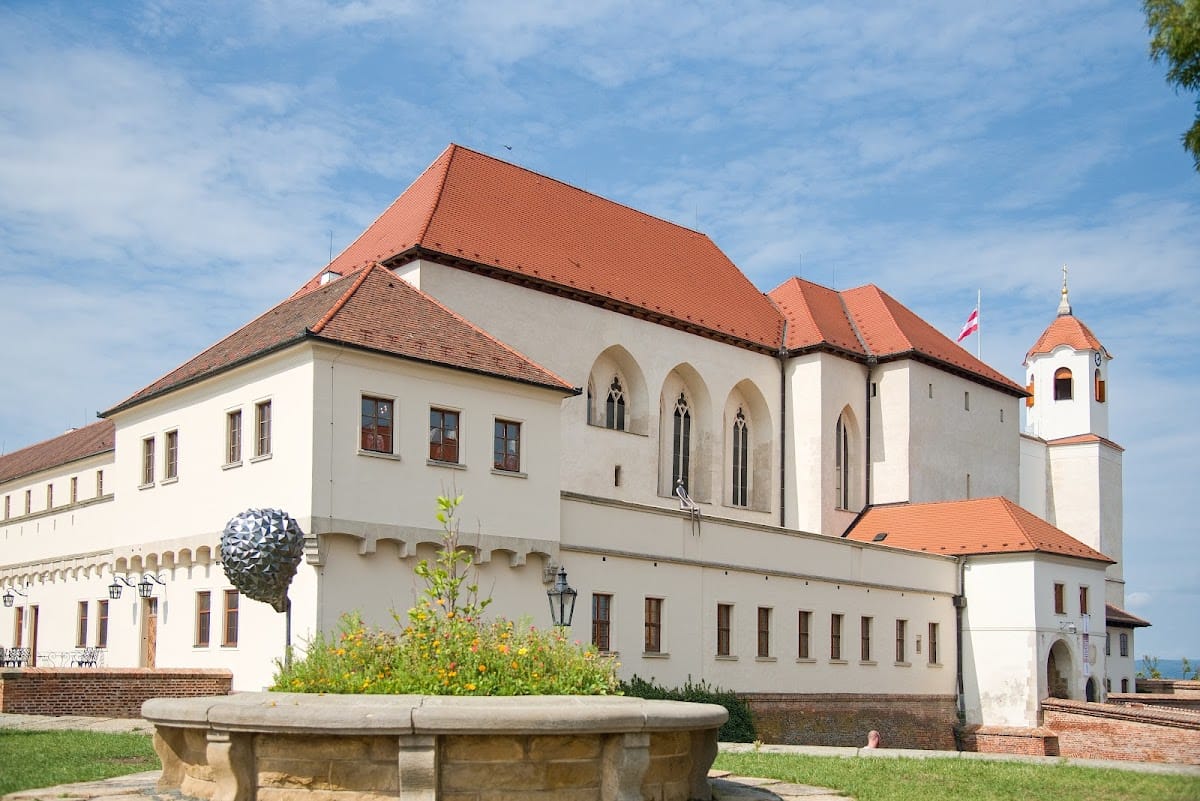
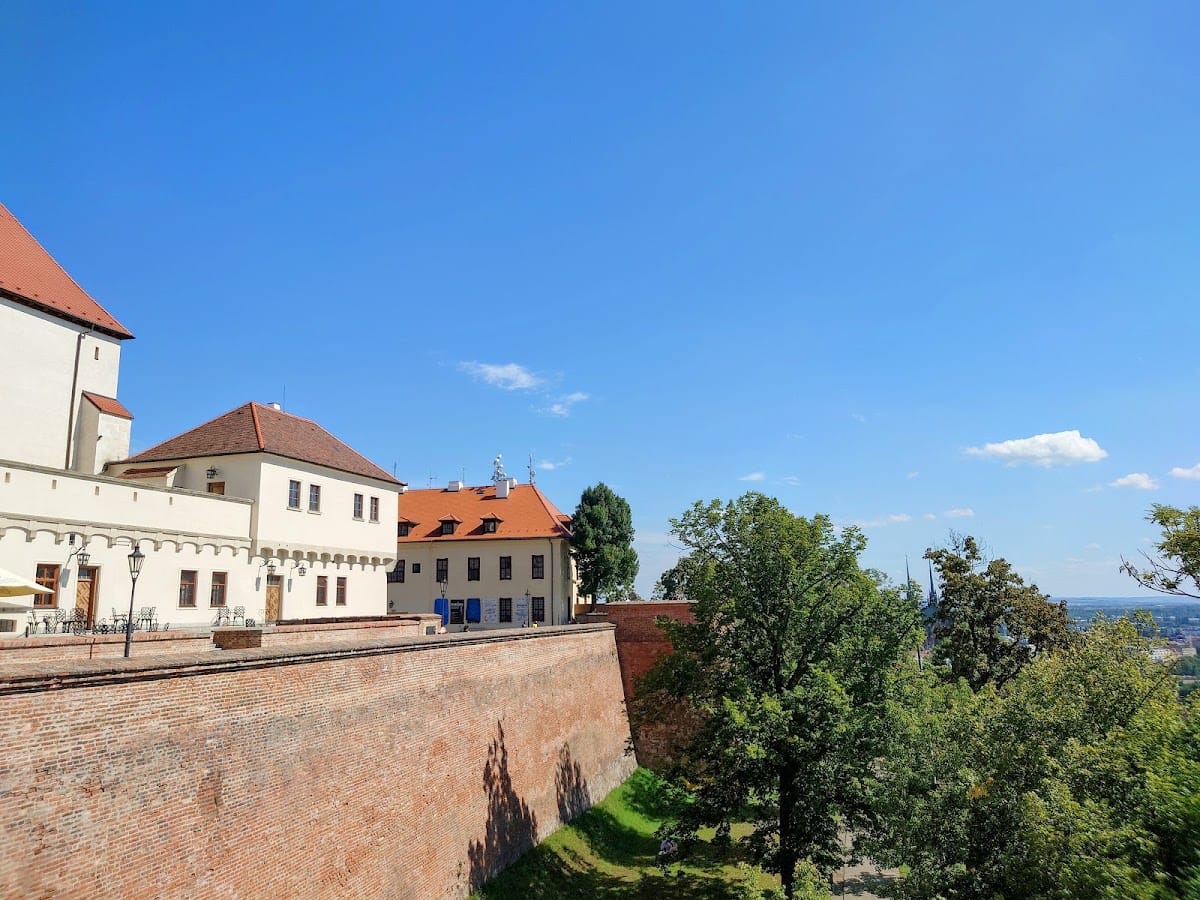
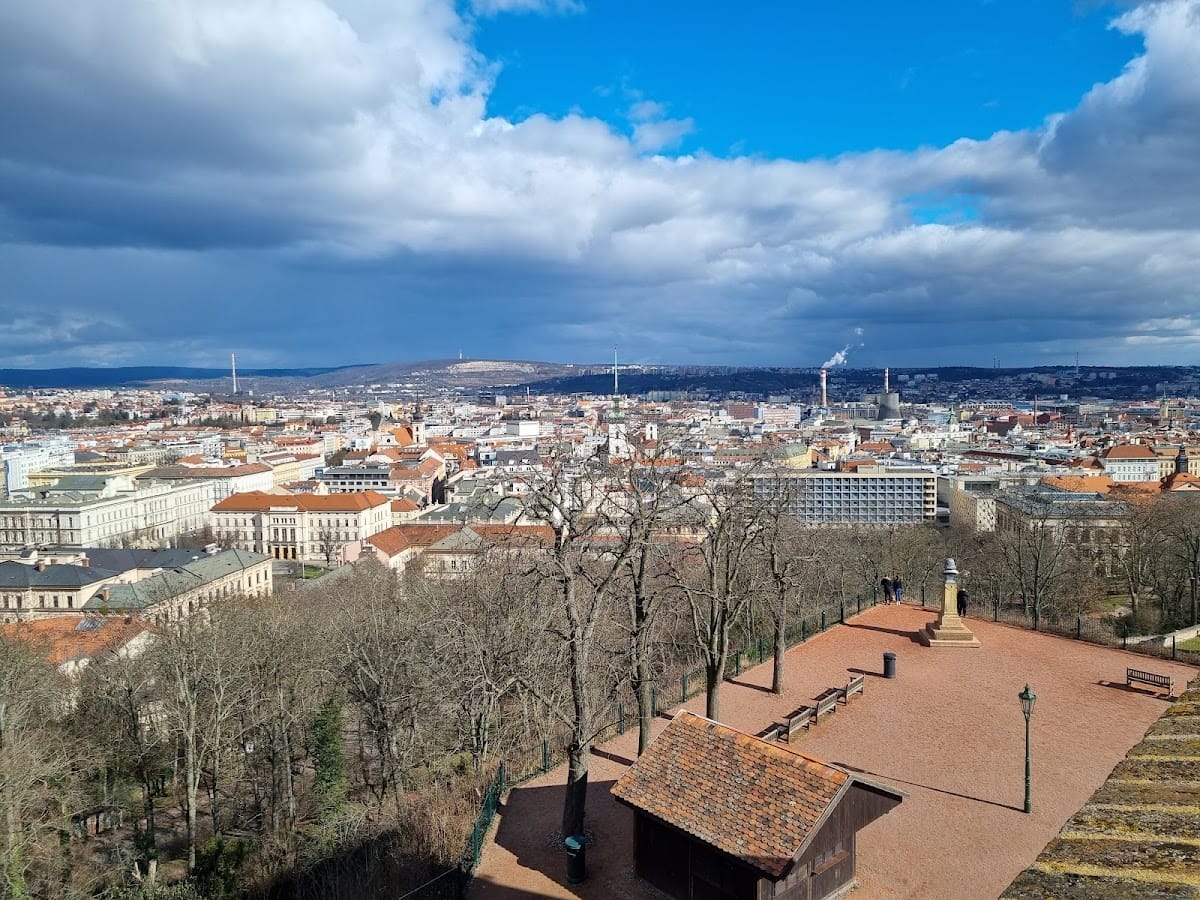
Špilberk occupies the summit of its namesake hill, a rocky elevation approximately 282 metres above sea level. The castle and fortress rise above Brno’s historic centre as a connected complex. The medieval Gothic castle forms its core, while the Baroque fortress developed around it through curtain walls, projecting bastions, masonry ditches, and casemates. Later prison construction added wings around the central spaces and shaped much of the present layout.
Medieval castle and Baroque fortress
Eastern wing
The original Gothic castle developed between the thirteenth and fifteenth centuries. Medieval fabric is concentrated principally in the eastern wing, whose present Gothic appearance was strongly shaped by the reconstruction carried out from 1995 to 2000. This wing represents the surviving architectural focus of the earlier royal and margravial castle within the later fortress complex.
Fortification system
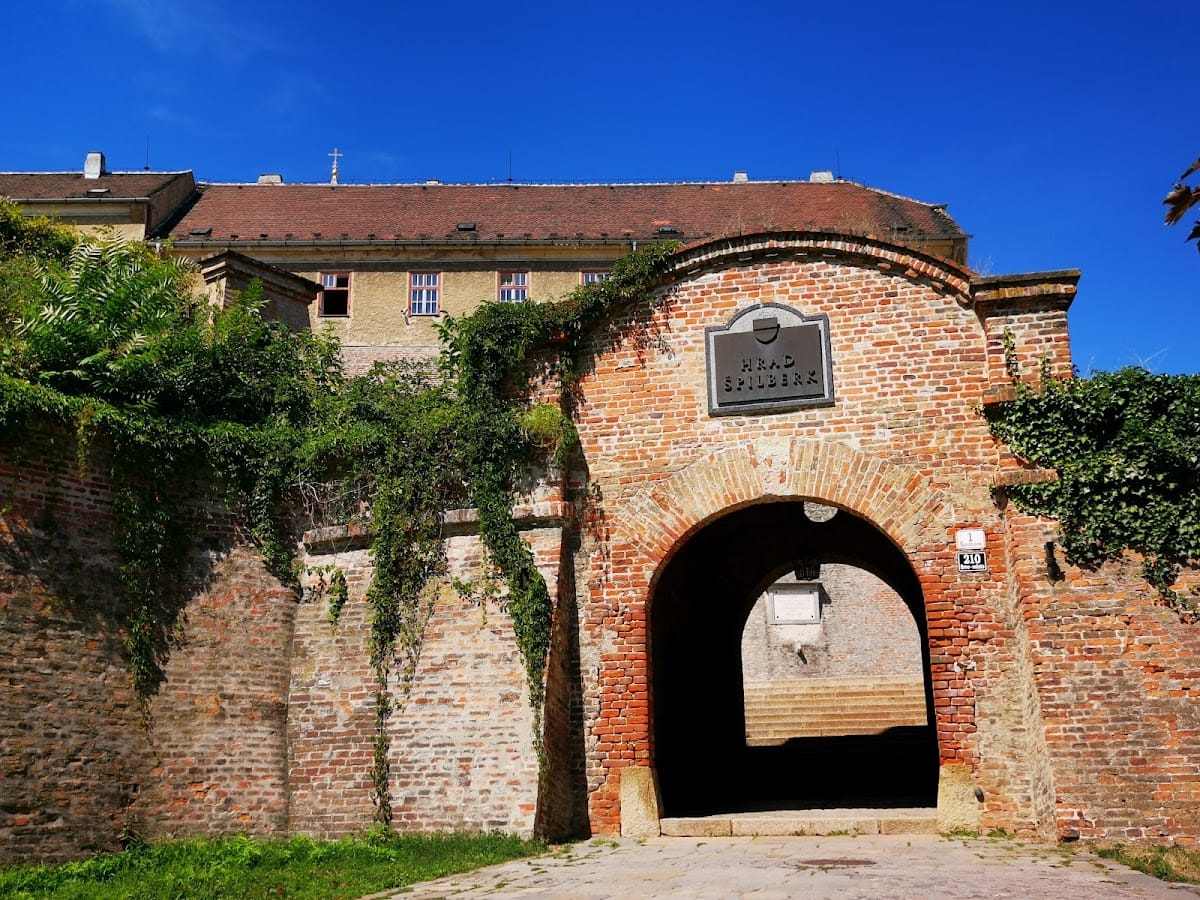
The Baroque fortress was built around the medieval castle from the middle of the seventeenth century and expanded in stages until the middle of the eighteenth century. Its defensive system combined curtain walls with bastions, projecting structures designed to permit fire along adjoining walls, masonry ditches, and protected casemates. Low, single-storey barracks and service buildings were constructed around the outer wall of the medieval castle in the mid-eighteenth century. A central wing later divided the former large courtyard into two parts.
Prison-era wings
Most of the present buildings date from the extensive conversion of the fortress into a prison during the 1830s. The southern, western, and northern wings, together with the central wing, were built during this phase. Their construction replaced much of the earlier fabric and gave the complex its later institutional arrangement.
Casemates and prison spaces
Military casemates
The casemates were completed in 1742 as a two-storey military shelter beneath the castle buildings. A casemate is a fortified vaulted chamber used for protection, military storage, artillery, or imprisonment. The Špilberk casemates were designed to protect a corps of approximately 1,200 men. They later served mainly as storage depots for military material before being converted partly into prison space.
Josephine and Leopold wings
The upper northern level was converted into the Josephine Wing in 1783 and 1784. In its lower level, 29 individual cells were constructed from heavy beams and boards for life prisoners. The upper southern level became the Leopold Wing after its conversion in the second half of 1785. These spaces preserve the physical arrangement associated with the prison reforms of Joseph II and the later changes ordered by Leopold II.
Wartime alterations
The German army substantially modified the casemates between 1939 and 1941 for use as protective shelters. The alterations formed part of the complex’s wartime military adaptation and affected some interior spaces and historicist details. The casemates now accommodate exhibitions concerning the fortress and the culture of the Josephine prison.
Water installations
Castle well
The castle well is medieval in origin. Its original depth of 39 metres was increased to approximately 112 metres in 1716 and 1717, taking its bottom below the water level of the Svratka River in Old Brno. The upper section is built of natural stone and brick, while the lower section is cut through rock. The shaft has an average diameter of approximately 3.5 metres, and its water level lies around 90 metres, producing a volume of more than 1,000 cubic metres. Two horizontal shafts at the bottom measure approximately 17 and 26 metres.
A well house with a wooden wheel once stood above the shaft, and prisoners operated the wheel to raise water. The German army demolished the well house between 1939 and 1941. The well was cleared and investigated in 1990 and 1991, when 308 cubic metres of material were removed. Finds from this work are displayed in the castle museum, including the skeleton of an unidentified soldier from the late nineteenth century.
Baroque cistern
A Baroque cistern beside the well collected rainwater from the roofs surrounding it. Together with the deepened well, it formed part of the fortress’s water-supply infrastructure.
Courtyard and museum interiors
A 15-bell carillon has stood against the rear wall of the castle courtyard since 1990. The bells weigh between 16 and 220 kilograms. The inner part of the complex also contains an observation tower, a restaurant, and museum exhibition rooms devoted to the architectural development of Špilberk, the history of its prison, and Baroque fortification architecture.
A chapel built during the German period contains photomontages by John Heartfield, a German artist known for politically critical work opposing Nazism. The courtyard is used for concerts and other cultural events, while the casemates provide exhibition space focused on the fortress and the Josephine prison.