Zbiroh Castle: A Medieval Fortress and Neo-Renaissance Chateau in Czechia



Site at a Glance
- Rating
- 4.6
- Popularity
- Medium
- Country
- Czechia
- Primary era
- Modern
- External website
- Open
- Eras represented
- Medieval, Early Modern, Modern
- Civilizations
- Austria-Hungary, Habsburg, Holy Roman Empire, Kingdom of Bohemia
- Site type
- Domestic
- Remains
- Castle
On this page17 sections
History
Zbiroh Castle is a medieval fortress and later chateau in Zbiroh, Czechia. Its foundation is uncertain, but the castle probably originated in the second quarter of the thirteenth century and belongs among the early noble castles of Bohemia. The earliest indirect reference dates from 1230, when Chřena of Zbiroh, a member of the Sulislavic family, witnessed a charter for Plasy Monastery. The historian Dobroslava Menclová connected this reference with a castle known as Old Zbiroh, while the archaeologist Tomáš Durdík associated the foundation with Břetislav of Zbiroh, mentioned in 1247.
Medieval owners and royal connections
The castle passed through the hands of several powerful families and rulers. Its owners included the Drslavics, among them Děpolt of Zbiroh, followed by King Přemysl Otakar II of the Přemyslid dynasty, one of the most powerful medieval ruling houses of Bohemia. The Rosenbergs, the Zajíc family of Hazmburk, John of Luxembourg, King Sigismund, the Kaplíř family of Sulevice, and the Kolowrats subsequently held Zbiroh.
During the ownership of Hanuš II of Kolowrat, an ecclesiastical ban against King George of Poděbrady was proclaimed in the castle chapel on 9 August 1469. This placed Zbiroh within the religious and political conflicts surrounding the Bohemian king. The castle later came into the possession of Emperor Rudolf II, the Habsburg ruler and patron of Renaissance culture, who ordered its transformation into a Renaissance chateau.
Renaissance transformation and royal prison
Rudolf II’s rebuilding changed the character of the medieval fortress. A park and an extensive hunting preserve were added, and Zbiroh became one of the large chateaus of Bohemia, with 224 rooms. The property later passed to the Sternbergs, the Lobkowicz family, and the Colloredo-Mansfeld family.
In the seventeenth century, Zbiroh also served as a royal prison. After the Battle of White Mountain, the 1620 defeat that strengthened Habsburg control over Bohemia, six Czech nobles who had escaped execution were imprisoned there. Wilhelm Popel of Lobkowicz was among them. The prisoners were pressured to convert to Catholicism and to submit to the government of the Habsburg monarchy. During the Thirty Years’ War, Swedish forces captured and burned the chateau.
Strousberg and the Neo-Renaissance chateau
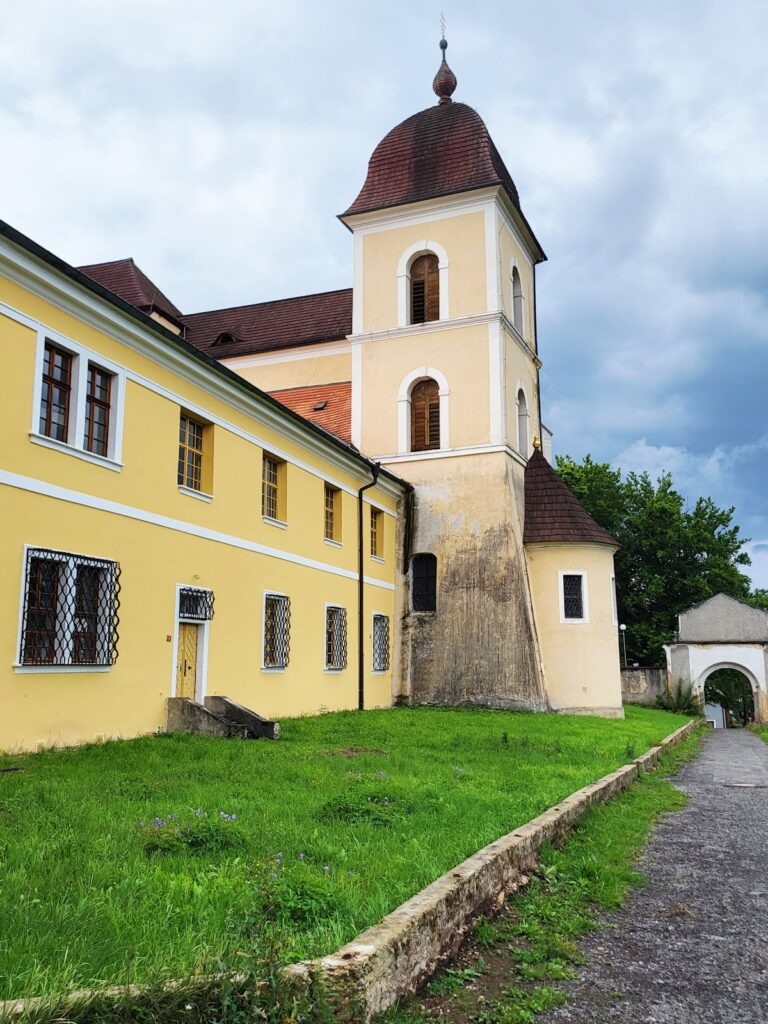
Baron Bethel Heinrich Strousberg, an entrepreneur, bought Zbiroh from the Habsburgs in 1868 for 9.5 million gulden. Between 1869 and 1870, he commissioned a radical remodeling in the Neo-Renaissance style, an architecture that revived Renaissance forms, following designs by the architect August Orth. The reconstruction removed some older elements, including the square gate building at the entrance to the outer bailey.
Strousberg’s bankruptcy left the chateau empty until the Colloredo-Mansfeld family purchased it in 1879. The family retained the property until the postwar transfer of the complex into state ownership in Czechoslovakia.
Alfons Mucha and the twentieth century
The Czech painter and designer Alfons Mucha lived with his wife and two children in the east wing from 1912 to 1928. He rented the large hall beneath its glazed roof and created The Slav Epic, his monumental cycle of paintings on Slavic history and identity, there. From 1962 to 2011, the cycle was exhibited at the chateau in Moravský Krumlov.
Mucha also photographed local residents, especially members of Sokol, a Czech physical-education and civic organization, as well as amateur theatrical groups. He arranged them in poses and used the photographs as models for figures in his paintings. His membership in a Czech Masonic lodge, a local branch of the international fraternal organization Freemasonry, also drew Freemasons from other countries to Zbiroh.
From 1943 to 1945, the chateau housed the headquarters of the SS, Nazi Germany’s principal paramilitary and security organization. Cellars beneath the area known as the Hermitage were reportedly used by SS personnel for mystical rituals. The choice of the location was linked to a belief in a force emerging from a fissure deep within the earth.
Military occupation and renewed public use
After the Second World War, the Czechoslovak state transferred the complex to military use. Its position on the edge of the Brdy military area made it a tightly guarded site closed to the public. Tamara, Ramona, and Vera, Soviet-bloc radar and radio-technical surveillance systems, were installed to detect aircraft movements by NATO and other forces in western Europe. Their information was sent to Warsaw Pact headquarters in Moscow. Military occupation damaged parts of the complex, including Mucha’s former apartment.
Soldiers began leaving the chateau in 1997. The town of Zbiroh acquired it in 2004 and later sold it to Gastro Žofín. Zbiroh opened to the public on 18 June 2005. It has been protected as a cultural monument of the Czech Republic since 1964 and is currently owned by the agency NKL, serving as the seat of the Sovereign Order of the Temple of Jerusalem association. Vineyards established under Rudolf II, which had been abolished during military occupation, were restored in 2018.
Local traditions add two legends to the castle’s history. One explains the name Zbiroh through a story in which a noble hunting party awoke in the forest among scattered deer antlers, which its lord ordered collected. Another concerns the Zbiroh goblin. In the spring of 1821, a tailor returning from Jablečno allegedly encountered a fiery figure that followed him to a cellar beneath the chateau before disappearing.
Remains
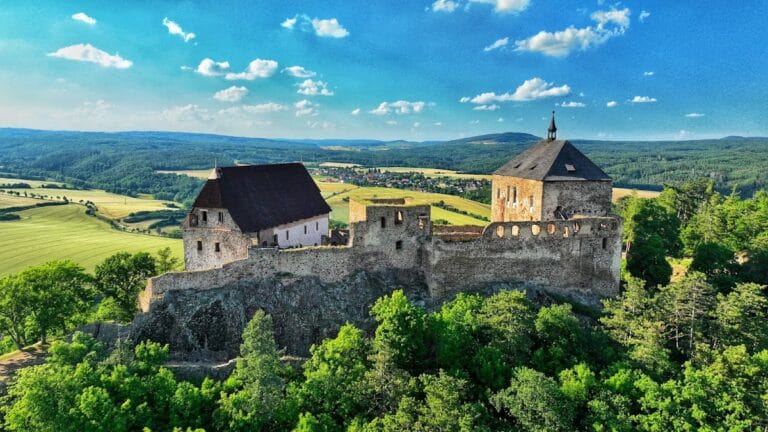
The complex combines the remains of a two-part medieval fortress with Renaissance rebuilding and Orth’s nineteenth-century Neo-Renaissance remodeling. Its main medieval core was an inner castle with five sides, surrounded by an outer bailey, a fortified area outside the main castle. The surviving buildings preserve elements from several periods, including the freestanding defensive tower, the palace, the chapel, artillery defenses, the deep well, and later halls and salons associated with the chateau.
Medieval castle core
Inner castle and defensive tower
The original fortress had a five-sided inner castle and a freestanding circular bergfried, a defensive tower used in many medieval Central European castles. The tower belongs to the first construction phase. The courtyard contains a tower described as the oldest freestanding tower in the Czech Republic. Other parts of the complex remain unexplored, including an underground chamber reportedly sealed during the Nazi period behind more than six metres of concrete.
Palace and chapel
A palace occupied the longest side of the inner castle. Its first floor preserves a fourteenth-century chapel. The eastern end of the chapel was formerly closed by a bay window covered with a ribbed vault, a ceiling supported by intersecting stone ribs. This chapel later became associated with the proclamation of the ecclesiastical ban against King George of Poděbrady in 1469.
Outer bailey and artillery defenses
Late Gothic alterations strengthened the outer bailey with several round artillery bastions, fortified platforms designed for firearms and cannon. One of these bastions survives in rebuilt form. Entry into the bailey originally passed through a square gate building, which was demolished during the 1869 to 1870 reconstruction.
Well and underground spaces
Deep castle well
A 163-metre-deep well reaches through exceptionally hard lydite rock within the chateau. Tradition assigns it to the twelfth century and describes it as the deepest hand-excavated castle well in the Czech Republic, although the well at Kyffhausen reaches 176 metres. Miners from Příbram spent 70 to 80 years excavating the shaft. Its helical course reflects the difficulty of cutting through the rock.
Military occupation left waste filling about one-third of the well. Cleaning lasted a year and a half and removed material equivalent to 30 truckloads, including parts of a motorcycle and a gate. Workers also recovered seven Second World War crates containing an SS archive and historical weapons.
Side passage and Hermitage cellars
An unexplored side passage leads from the well below the water level. It was blocked with kaolin during the Nazi period and has cables leading from it. The idea that explosives may have been hidden there remains speculative. Local tradition claims that the passage runs for about one kilometre to Flusár Pond, supposedly demonstrated when a duck released into the well was later seen in the pond.
Chateau interiors and grounds
Mucha hall and exhibition rooms
The large hall with a glazed roof, where Mucha created The Slav Epic, now serves as a concert and exhibition hall. Two salons are devoted to Mucha, one to his Masonic activities and the other to his painting. Other exhibition areas present the history of the chateau from the Přemyslid period through the Art Nouveau era, an international movement known for ornamental lines and stylized natural forms, and depict life in different historical periods.
Vineyards and Hermitage cellars
The chateau’s vineyards lie at about 550 metres above sea level, placing them among the high-elevation vineyards of the Czech Republic. The cellar spaces beneath the Hermitage contain a wine cellar. The complex also includes a hotel, tavern, wellness facilities, and a historical dungeon used for overnight accommodation.
Nearby sites