Pozzo sacro di Sa Testa: A Nuragic Sacred Well in Sardinia
Site at a Glance
- Popularity
- Medium
- Country
- Italy
- Primary era
- Bronze Age
- Eras represented
- Bronze Age
- Civilizations
- Nuragic
- Site type
- Religious
- Remains
- Sanctuary
On this page12 sections
History
Pozzo sacro di Sa Testa is a Nuragic sacred well near Olbia in Sardinia, Italy, probably founded in the final centuries of the second millennium BCE. Its builders belonged to the Nuragic civilization, a prehistoric Sardinian culture named for its distinctive stone towers. The well is regarded as one of Sardinia’s most important sacred sites. Its precise construction date is uncertain: its earliest forms are tentatively assigned to the Final Bronze Age (1200–900 BCE), while finds indicate that it remained in use into Roman times.
Nuragic and later use
Material from the well points to activity during the Nuragic, Phoenician-Punic, and Roman periods, possibly continuing into the early Roman Empire. The term Phoenician-Punic describes phases associated with Phoenician and later Punic cultures in the western Mediterranean.
Discovery and restoration
Shepherds searching for water found the well in the 1930s beside the coastal road between Olbia and Golfo Aranci. Italian archaeologist Francesco Soldati excavated it in 1938. Ercole Contu, a scholar of Sardinian prehistory, restored the monument in 1969.
Remains
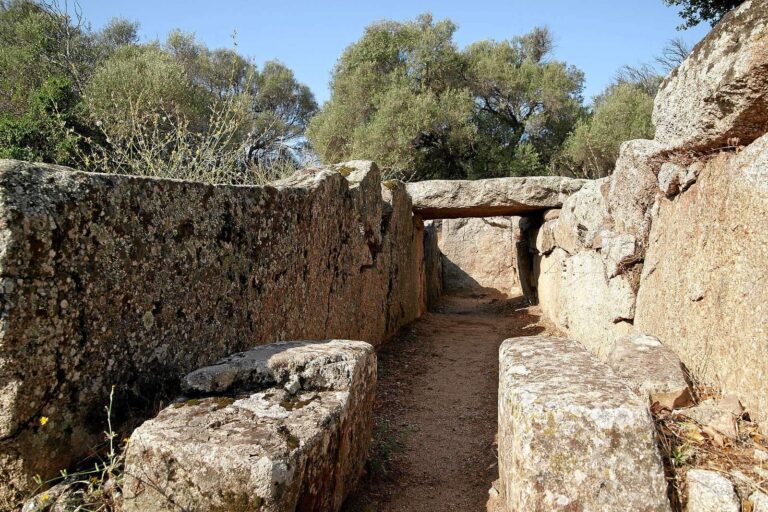
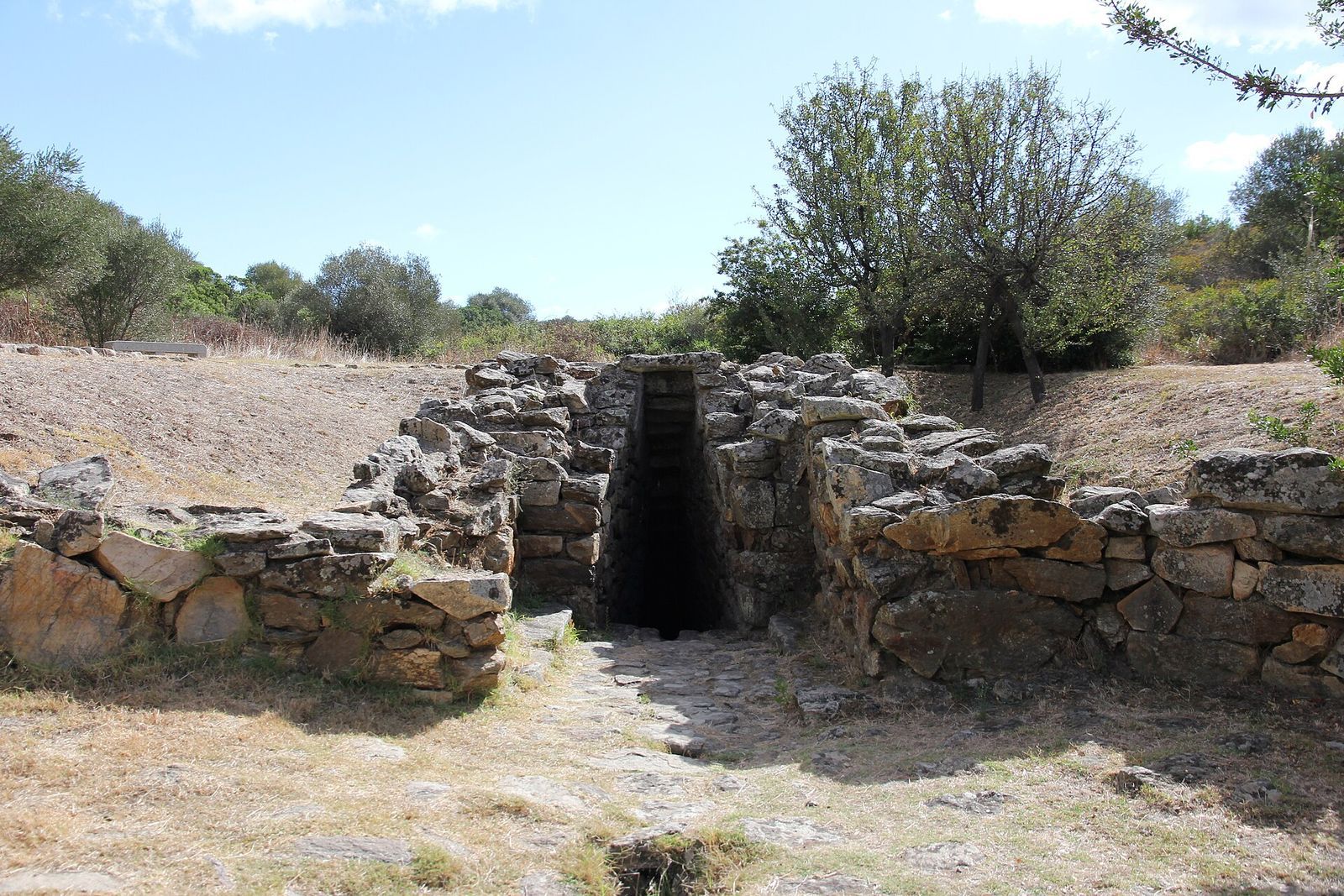
The complex stands 26 metres above sea level on a gently sloping saddle between low hills, near Olbia’s industrial port and along the road toward Pittulongu. Built of dressed granite and schist blocks, it extends 17.47 metres on an alignment from north-northwest to south-southeast. Its principal elements are a circular court, a descending stairway, a trapezoidal chamber, and a covered spring.
Architectural layout
Enclosed court
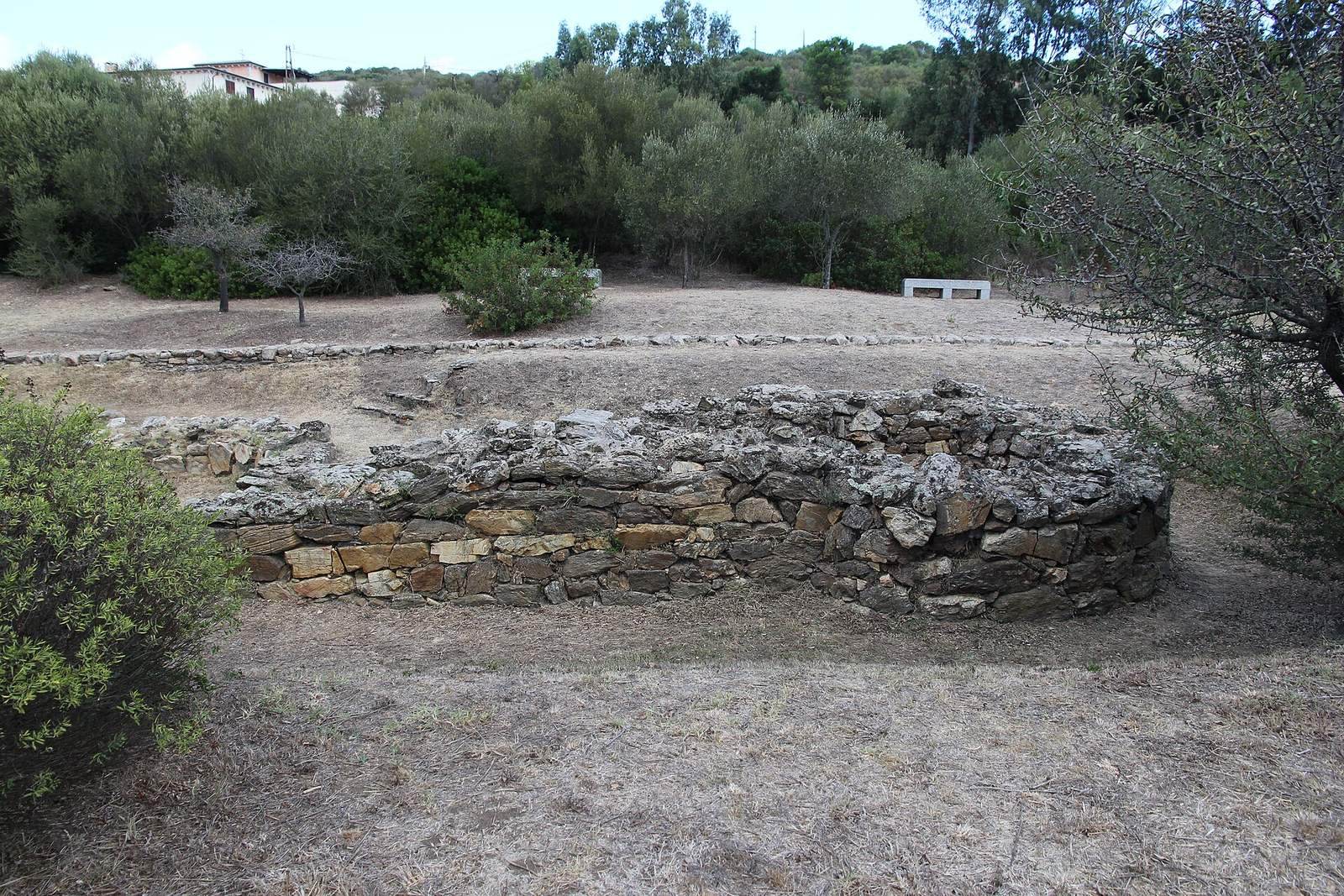
The paved court measures 8.30 by 7.41 metres and was probably used for rituals. A low circular temenos, or enclosed sacred precinct, surrounds it. The surviving boundary is 30 centimetres high, and its enclosing wall is 94 centimetres thick. A drainage channel crosses the court, while part of a bench-like altar survives beside the inner wall.
Descent and chamber
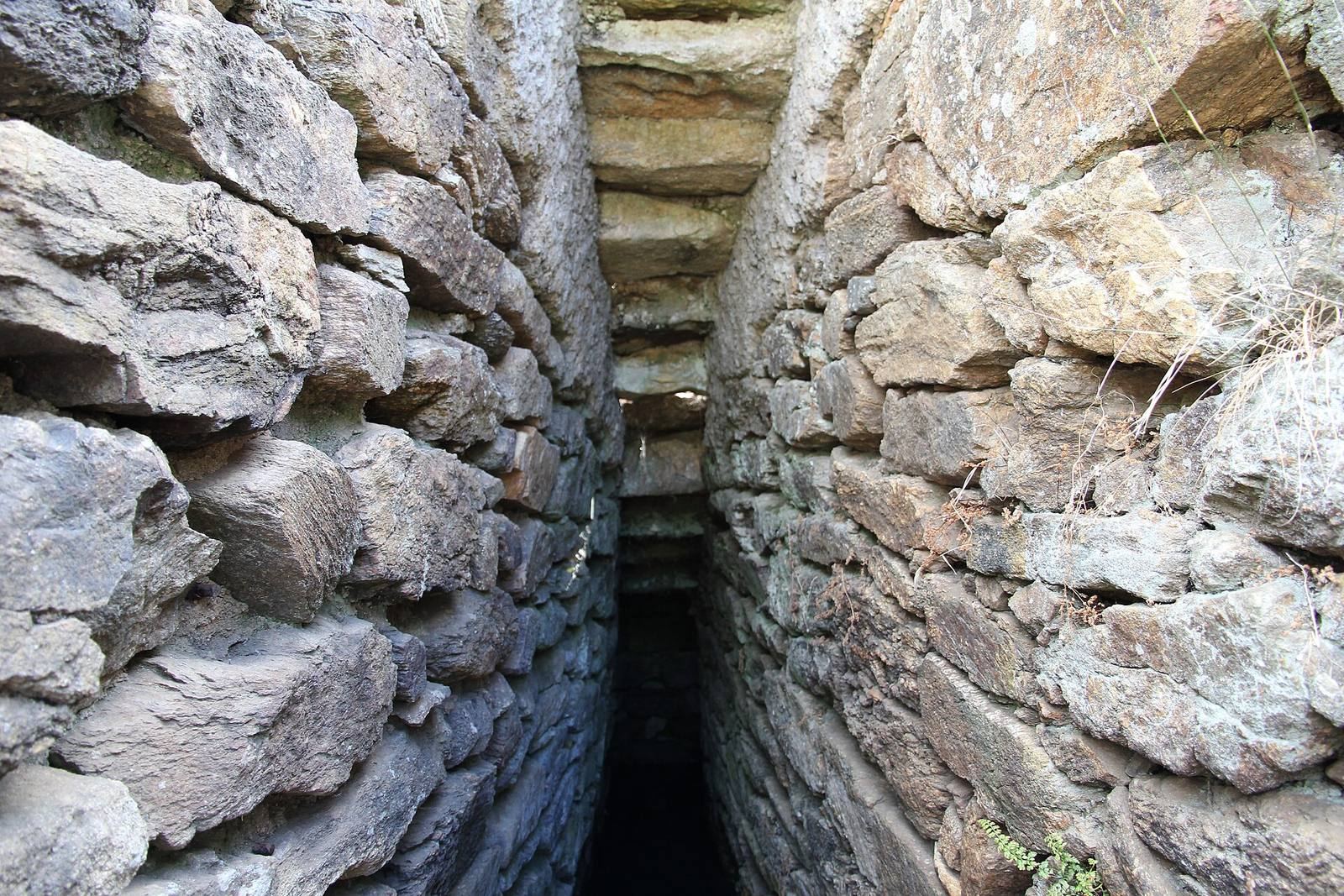
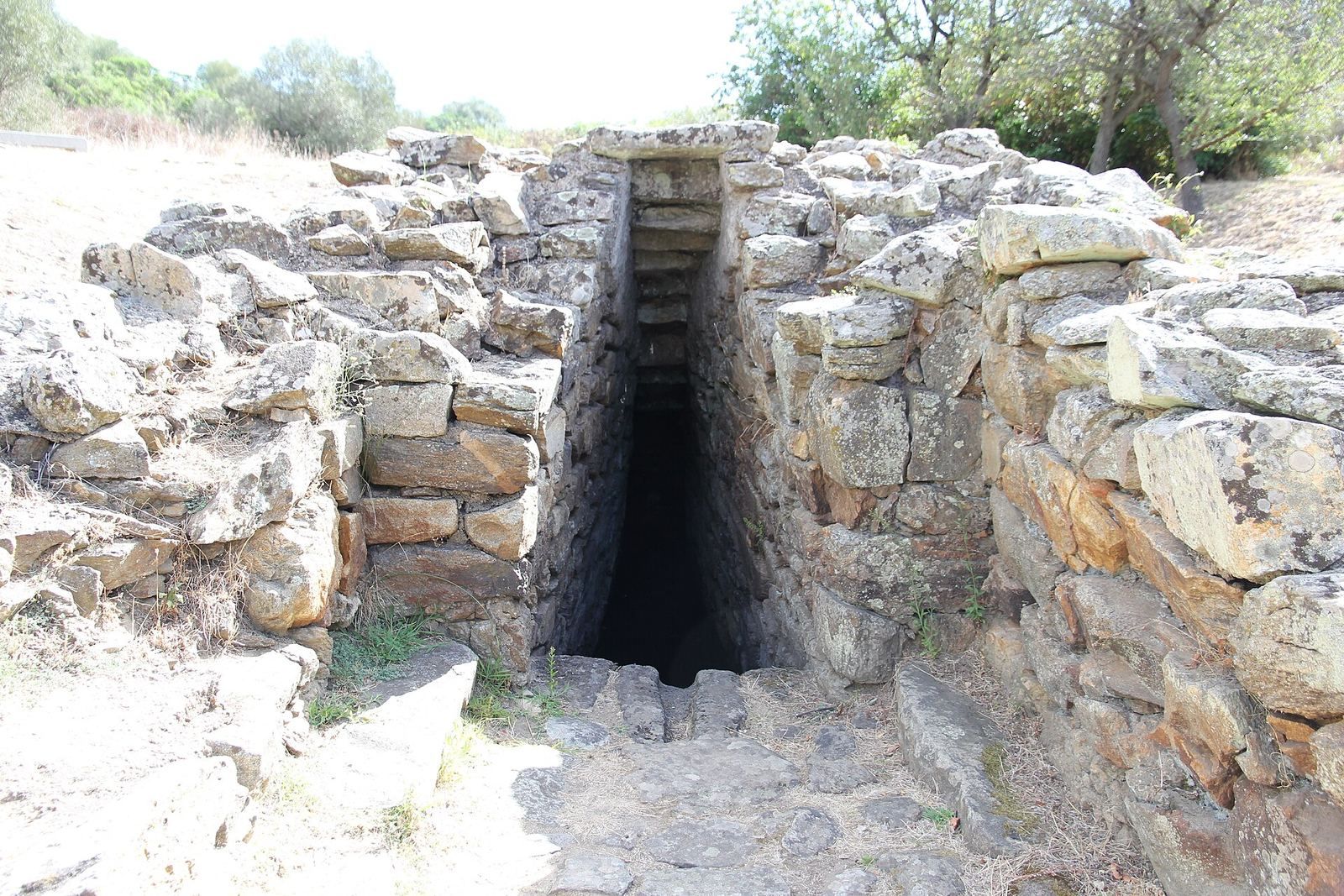
Four steps on the north side lead down into the court. A granite stairway of 17 steps then descends toward the spring, narrowing as it goes. Below the court is a paved trapezoidal chamber, 2.65 metres long, measuring 1.87 metres across at the front and 2.62 metres at the rear. It has a drainage channel and bench-like altars along its sides.
Spring and domed structures
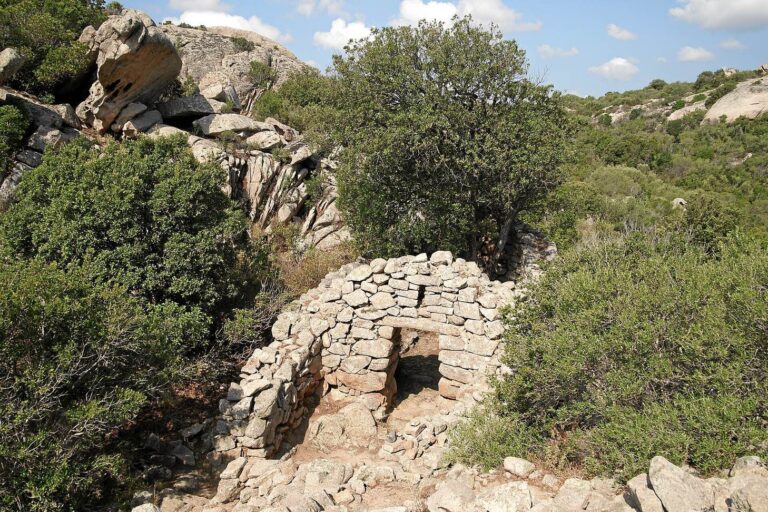
A tholos, a domed or corbelled circular structure, covers the spring and narrows upward to a round opening. That opening originally connected with a second domed structure at ground level. Only a few courses of its small granite blocks survive. Other structural elements shield the spring from surface water. The incomplete upper structure leaves unresolved whether the well aligned with the Moon’s northernmost and southernmost positions during its 18.6-year cycle.
Archaeological finds
Nuragic objects
Finds from the Nuragic period include many fragments of drinking cups and several bronze objects: a band bracelet, a small ring, a spiral needle, and a small dagger with a gamma-shaped hilt.
Phoenician-Punic objects
This period yielded numerous cup fragments, decorated black-glazed plates, and fine-clay jugs. A juniper-wood statuette, dated from the late seventh to the middle of the sixth century BCE, is interpreted as an archaic cult image of a young woman in a style combining Greek and eastern Mediterranean influences. Three incense burners, as well as a head and mask in Hellenistic style, also belong to this phase. Hellenistic art developed during the era of Greek cultural influence that followed Alexander the Great’s conquests.
Roman objects
Roman-period finds include smaller vessels, many fragments of a large amphora, and a fine pottery cup made in the tradition associated with Arretium, modern Arezzo. The excavated objects are held at the National Archaeological Museum of Cagliari.