Aa Church: Bornholm’s Romanesque Parish Church
Site at a Glance
- Popularity
- Low
- Country
- Denmark
- Primary era
- Medieval
- Eras represented
- Medieval, Early Modern, Modern
- Civilizations
- Danish
- Site type
- Religious
- Remains
- Church
On this page15 sections
History
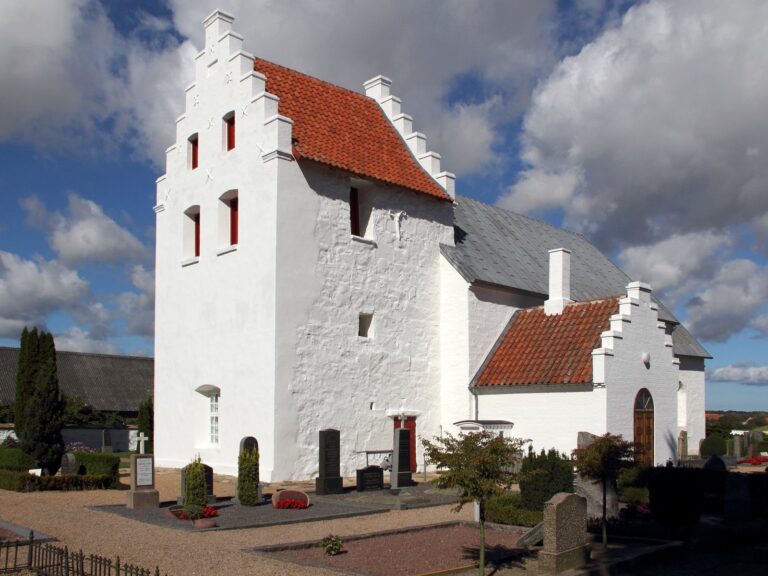
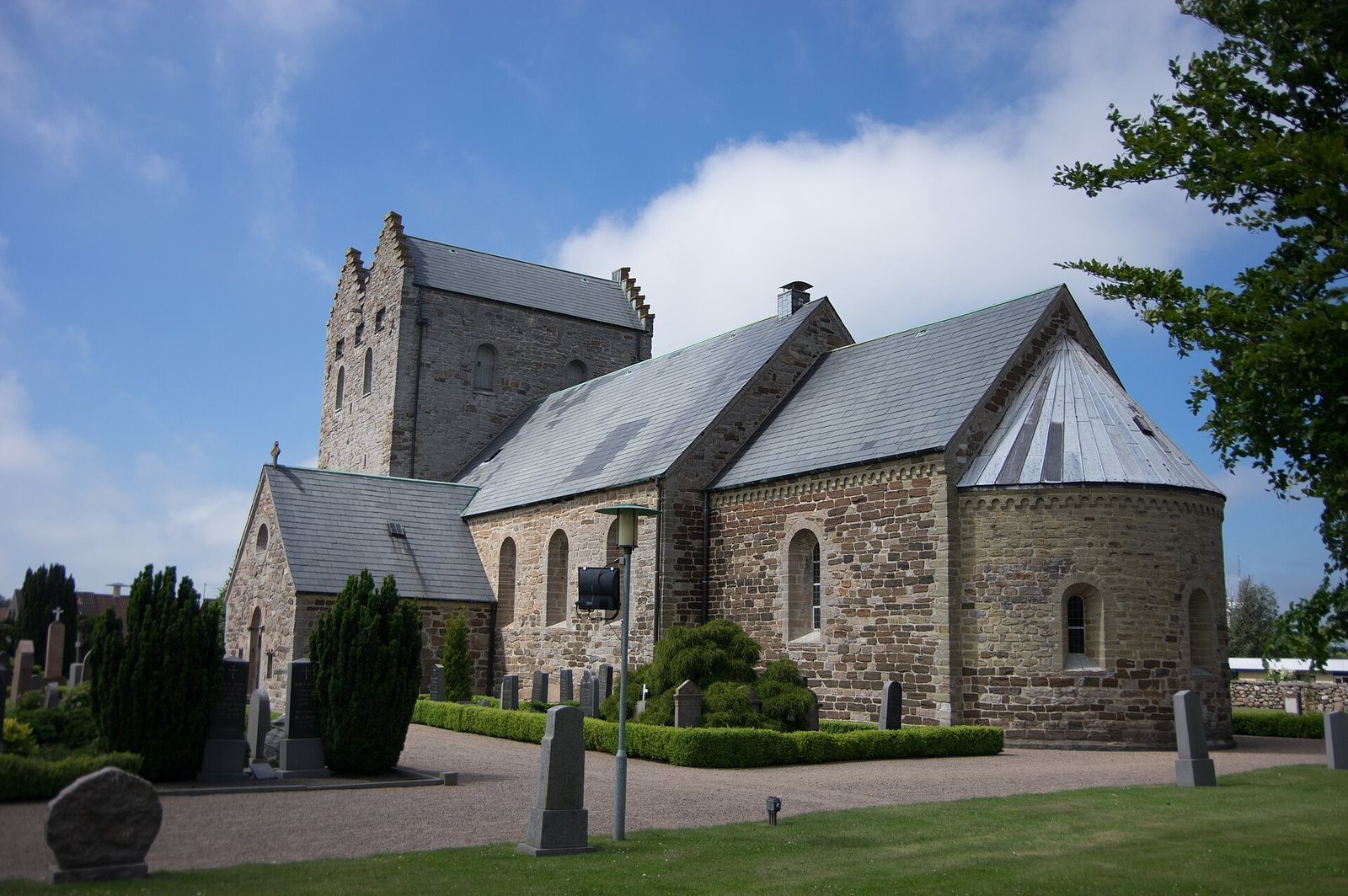
Aa Church is a Romanesque church in Aakirkeby on Bornholm, Denmark, built in several phases during the latter half of the 12th century. It is described as the island’s largest and probably oldest church, and formerly served as Bornholm’s principal church.
Ecclesiastical and civic role
The name Aa means “stream church,” referring to the Læså and Grødby streams beside the building. Aakirkeby itself takes its name from the church. For many centuries, the Bornholm Landsting, the island’s regional governing assembly, met there.
Dedicated to John the Baptist, the Christian figure known for baptizing Jesus, the church was originally called St John’s Church. It serves as the parish church of Aaker Parish and belongs to the Danish People’s Church, Denmark’s established Evangelical Lutheran church, in the Diocese of Copenhagen.
Later changes
A gilded figure of John the Baptist once stood inside the church. In 1706, a priest buried it in the churchyard after it attracted unwanted attention from Catholic prisoners during the Great Northern War, a conflict in northern and eastern Europe that lasted from 1700 to 1721.
The tower’s vaulted rooms were used to store food. The bells were once kept in a separate tower south of the church, but were later moved into the church tower. A major restoration in 1874 shaped the interior’s present form, and further restoration took place in 1968.
Remains
Exterior and tower
Church fabric
The church has a massive Romanesque form, with small windows that have been interpreted as suggesting a defensive character. Its oldest surviving sections are the choir, the area around the altar, the apse, the curved end of the sanctuary, and the lower nave, the main body of the church. These parts are built of greenish sandstone and rust-brown shale gathered beside Grødby Stream. Limestone was used for the nave’s western end and the tower.
Tower
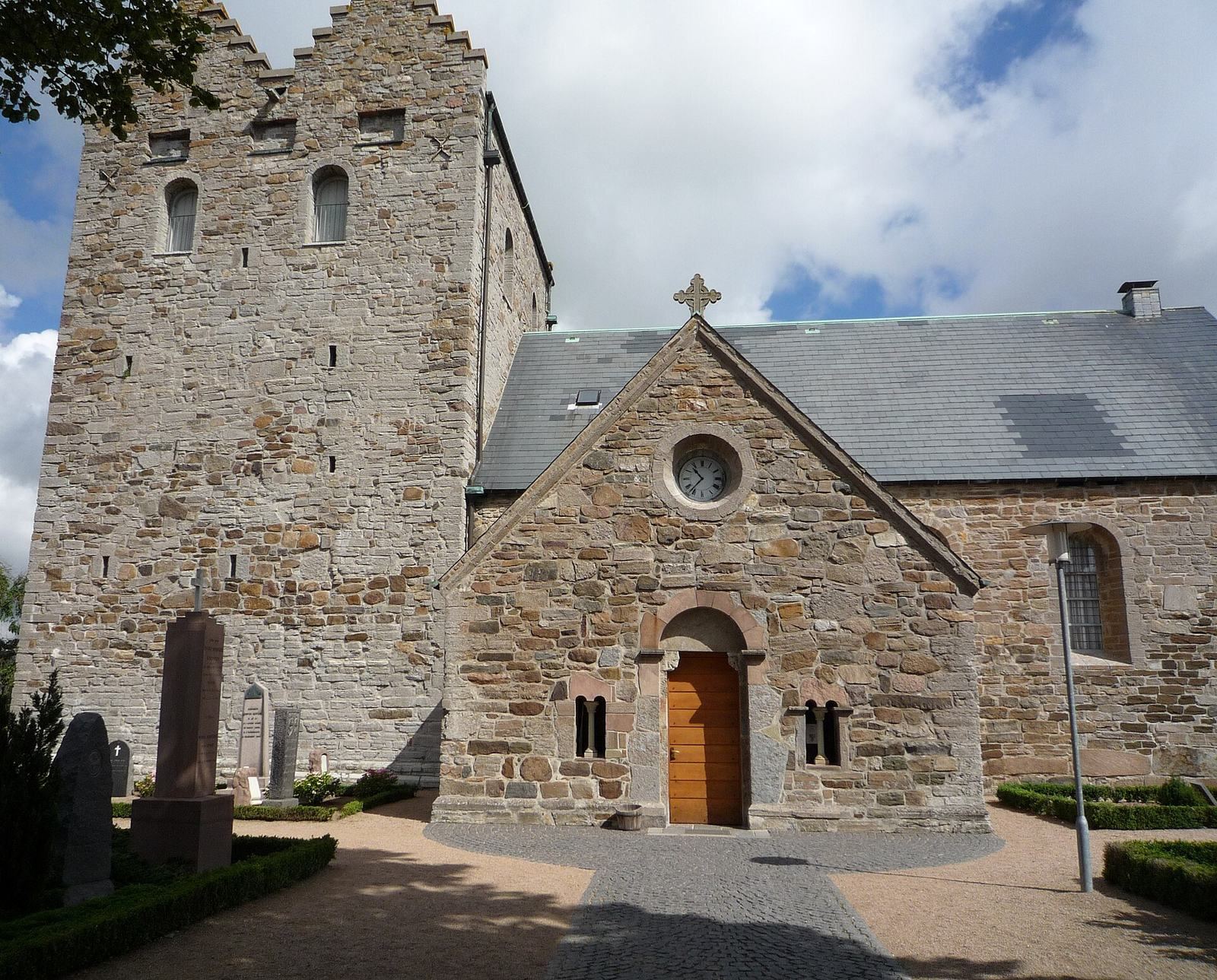
The tower was first narrower on its western side and was widened during the Romanesque period to measure 13 by 11 metres. It has four storeys and stands 22 metres high. Its twin roofs date to the 14th century and have small stepped gables. They probably replaced a four-sided pyramidal roof.
Doorways and porch
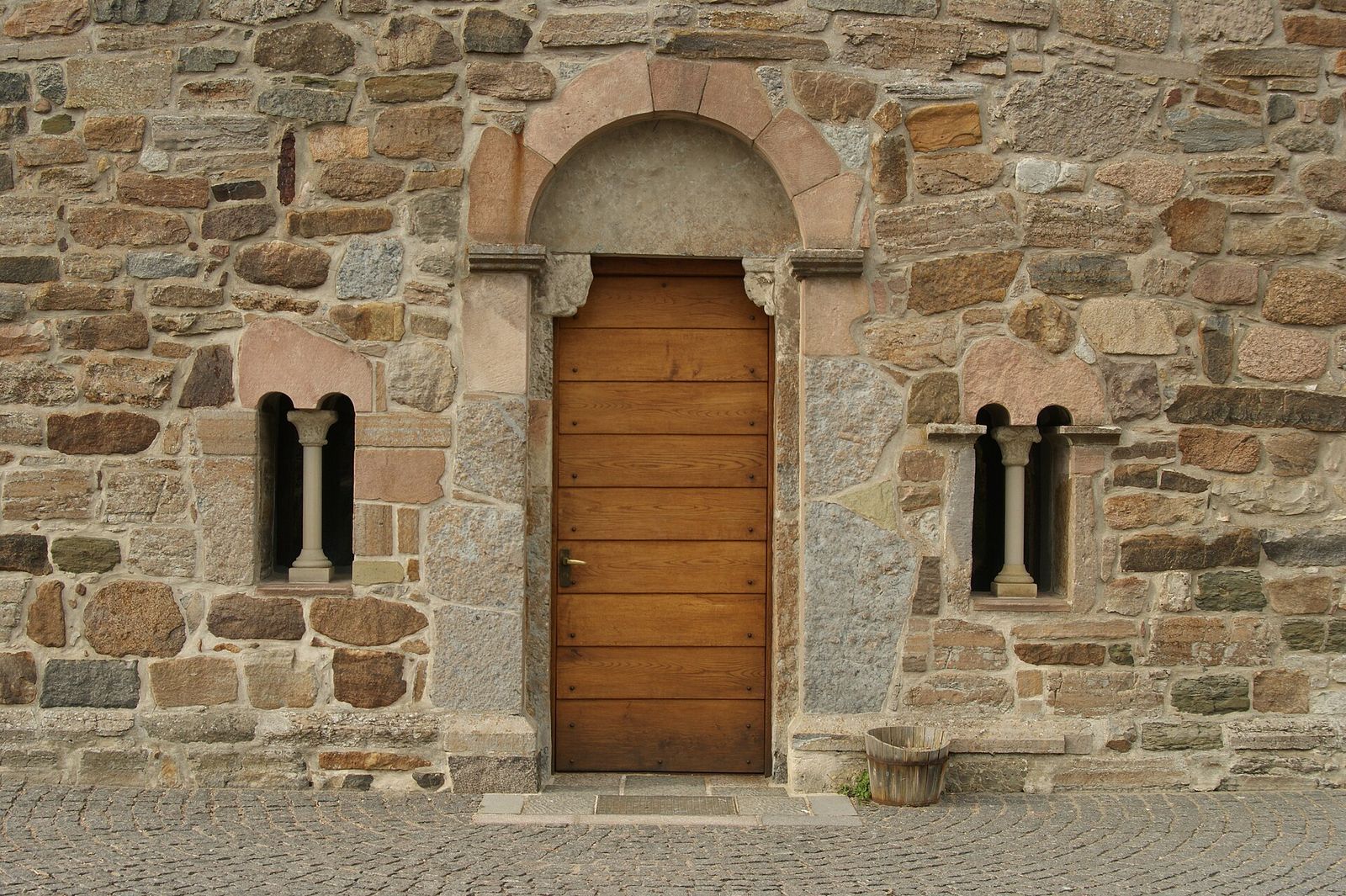
The southern doorway was intended for men and the northern one for women. Both survive, although the northern entrance has been converted into a window. The sandstone porch, built with stone from the Nexø area around 1200 to 1235, is described as the oldest on Bornholm.
Interior and furnishings
Nave and choir
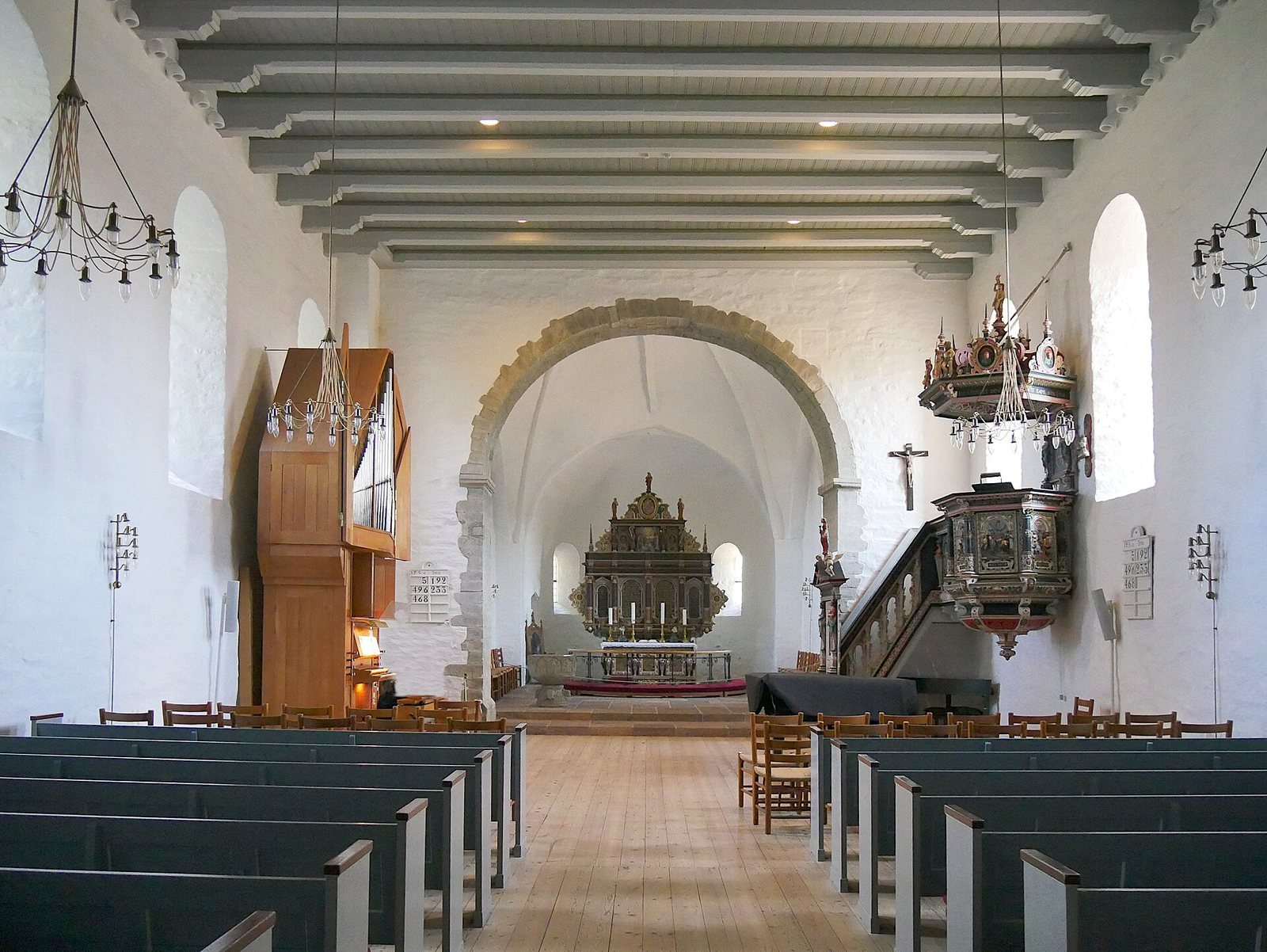
The large nave has a flat wooden ceiling. Arcade walls once divided it, and a gallery served the nobles of Lilleborg Castle, now in ruins. The choir and apse have Gothic vaulted ceilings, an arched form of ceiling associated with a later medieval style, dating to around 1350. Four rectangular pillars at the corners support them.
Baptismal font
A sandstone baptismal font dating to around 1200 bears eleven relief scenes from the life of Jesus. It is attributed to Sigraf, a medieval sculptor from Gotland, an island in the Baltic Sea.
Pulpit
The pulpit dates to the early 17th century and was made by Jacob Kremberg, a sculptor from Scania in southern Sweden. Its five panels have painted reliefs depicting the Nativity, Crucifixion, Resurrection, Ascension, and Pentecost. A hexagonal sounding board, a canopy above the pulpit, carries figures and heraldic cartouches, decorative framed emblems.
Altar
The altar is dated 1608 and comes from Kremberg’s workshop. Its central field contains a crucifix between Corinthian columns, columns with ornate leafy capitals, alongside panels with gold lettering. The inscriptions include the words of institution of the Lord’s Supper in Danish and quotations from John 6 and 1 John 1:7 in Latin. Above this field, a relief shows the baptism of Christ. Four flanking herms, sculpted figures on tapered supports, represent prudence, fortitude, justice, and temperance. The upper section displays the Danish coat of arms within a cartouche.
Organ
The organ stands at floor level at the front of the nave, opposite the pulpit. Built by Marcussen & Søn in 1965, it replaced a 16-stop instrument made by I. Starup in 1941. The present organ has 15 stops, two keyboards, and a pedal.
Porch memorials
The porch contains a grave slab in half-relief showing a man and two women, a runestone, and a devotional image of the Crucifixion with its donors. Several old gravestones are also associated with the church.