Missunde Passage Grave: A Neolithic Tomb in Germany
Site at a Glance
- Popularity
- Very Low
- Country
- Germany
- Primary era
- Stone Age
- Eras represented
- Stone Age, Modern
- Civilizations
- Unclassified
- Site type
- Burial
- Remains
- Tomb
On this page7 sections
History
The Missunde Passage Grave is a Neolithic megalithic tomb near Missunde in Germany, with a burial chamber reached by a passage. Communities of the Funnel Beaker culture, a northern European culture named for its pottery, built it between 3500 and 2800 BC.
In 1842, part of the mound’s southern side was removed and the chamber was emptied. The grave was exposed and restored in 1961–62. It stands within a memorial to German dead from the Battle of Missunde.
Remains
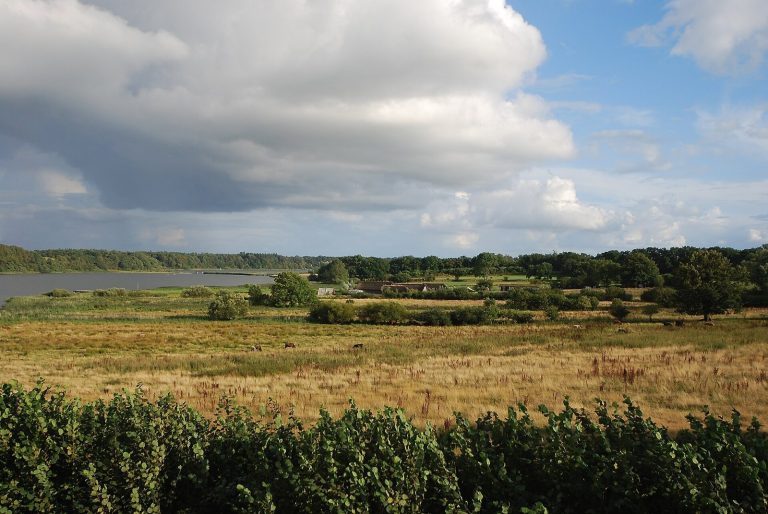
The grave lies about 100 metres south of Missunde on the Svans peninsula in South Schleswig. Its trapezoidal chamber sits within a round mound, a form characteristic of passage graves in Schleswig-Holstein. Similar forms occur in Mecklenburg-Vorpommern and Scandinavia.
Mound and chamber
Mound and outer construction
The mound measured 30–35 metres across and stood at least 3 metres high. Perimeter stones edged it. Around the chamber, a sloping layer of stones ranging from fist-sized to head-sized rose about a metre beneath the earth mound. Gaps between the chamber’s supporting stones were packed with dry-laid stonework, and a broad layer of clay mixed with flint grit covered its exterior.
Burial chamber
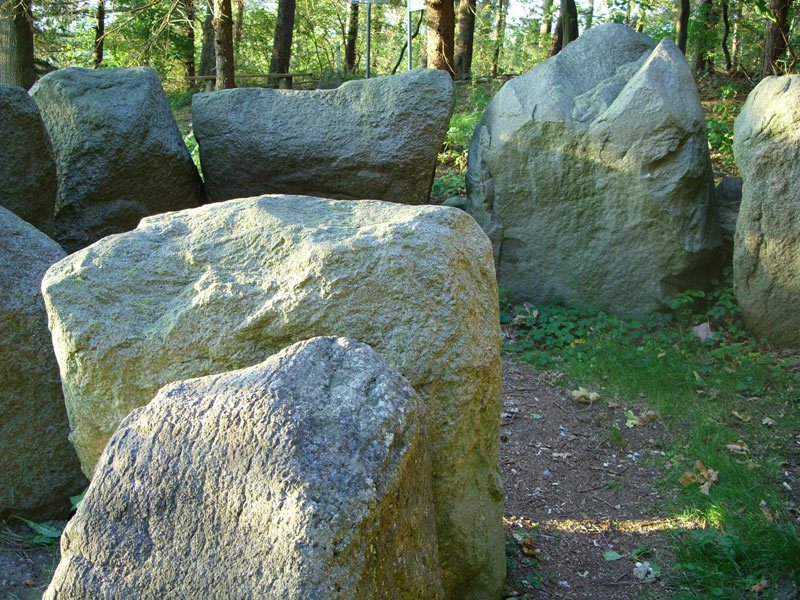
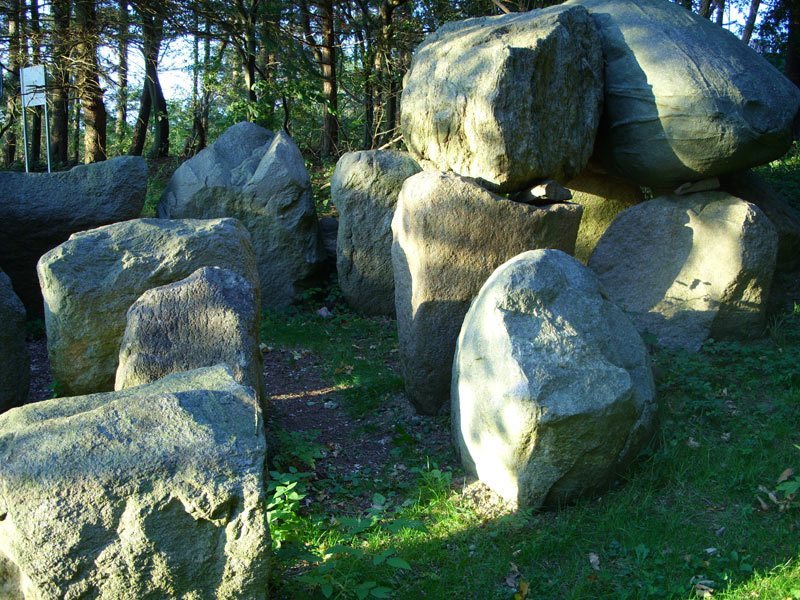
The east–west chamber is of the Holstein type, a regional form of megalithic burial chamber. It measures 5.25 metres long and narrows from 2.2 metres at its western end to 1.68 metres at the eastern end. Its western end is formed by two stones and its eastern end by one; the interior is about 1.3 metres high. Eleven supporting stones carried four capstones. Two capstones remain intact and a third survives as a fragment. In the restoration, the fragment replaced a missing support at the southwest corner, while the two intact capstones, no longer in their original positions, were laid over the narrower eastern end for safety.
Floor and burial features
The floor was laid over natural ground and a thin burnt layer. Hand-sized, mostly flat stones formed a pavement mixed with and covered by heat-altered flint. Thin layers of burnt clay and pale sand lay above it. Those upper layers survive only in places; the floor’s four layers together were about 16 centimetres thick.
Four upright slabs in the western chamber section enclosed an angled compartment measuring 2.2 metres by 0.9–1.1 metres. Comparable compartments occur in six known tombs in Schleswig-Holstein and are also found in Mecklenburg-Vorpommern and Sweden. A pottery vessel was reportedly found in this compartment in 1842. Work in 1961–62 recovered remains of amber beads and flint blades there. In the eastern main chamber, excavators found a few pottery fragments with deep-pit decoration, made by pressing deep pits into the vessel’s surface, and flint blades, alongside badly decayed human remains. A bowl with the same pottery decoration was found at the inner entrance to the passage.
Entrance passage
A 0.65-metre-wide entrance, centred on the chamber’s southern long side, leads to a south-facing passage about 0.8 metres wide inside. A stone found within the chamber, but no longer in its original position, may have served as the threshold. Capstones roofed the passage, which was closed with stone slabs. It was probably almost 7 metres long in 1842. Today, only a few passage stones, 1.0–1.2 metres high, remain; footing traces exposed in 1961 show that the passage originally extended farther.