Mayburgh Henge: A Prehistoric Enclosure at Eamont Bridge
Site at a Glance
- Popularity
- Medium
- Country
- United Kingdom
- Primary era
- Stone Age
- Eras represented
- Stone Age, Bronze Age
- Civilizations
- Unclassified
- Site type
- Civic
- Remains
- Megalithic Monument
On this page9 sections
History
Mayburgh Henge is a prehistoric circular enclosure at Eamont Bridge in the United Kingdom. Henges are typically marked by a bank and an internal ditch. Nearby axes from the Neolithic, the later Stone Age, and the Bronze Age, when bronze became widely used, suggest that Mayburgh dates to one of these periods, but its precise age is uncertain.
Proposed purposes
The monument’s original function is unknown. One interpretation is that it served as an exchange point on a route used to move stone axes from Great Langdale, a center of prehistoric axe production. Its position near the meeting of the Eamont and Lowther rivers supports this possibility.
A ritual role has also been proposed. The nearby spring and rivers have prompted suggestions of water-related funerary practices or rites marking stages of life. A cosmological purpose is another interpretation.
Landscape and investigation
Mayburgh and King Arthur’s Round Table, about 400 metres away, belong to the group known as the Penrith Henges. In this landscape of steep valleys and fast-flowing streams, routes from Shap, the Upper Eden and the Petteril valley converge at Eamont Bridge on their way toward Carlisle and the Solway. William Stukeley noted the spring between the two henges, which connects the ground between them with the River Eamont. Two burial mounds lie across the river.
In 1992, English Heritage and Geophysical Surveys of Bradford carried out a magnetometer survey, which measures variations in the magnetic field to help identify buried features. The work investigated possible stone settings within the enclosure and examined whether an internal or external ditch formed part of the monument. English Heritage cares for Mayburgh, which was designated a Scheduled Ancient Monument in 1882, a category of legally protected historic or archaeological site in England.
Remains
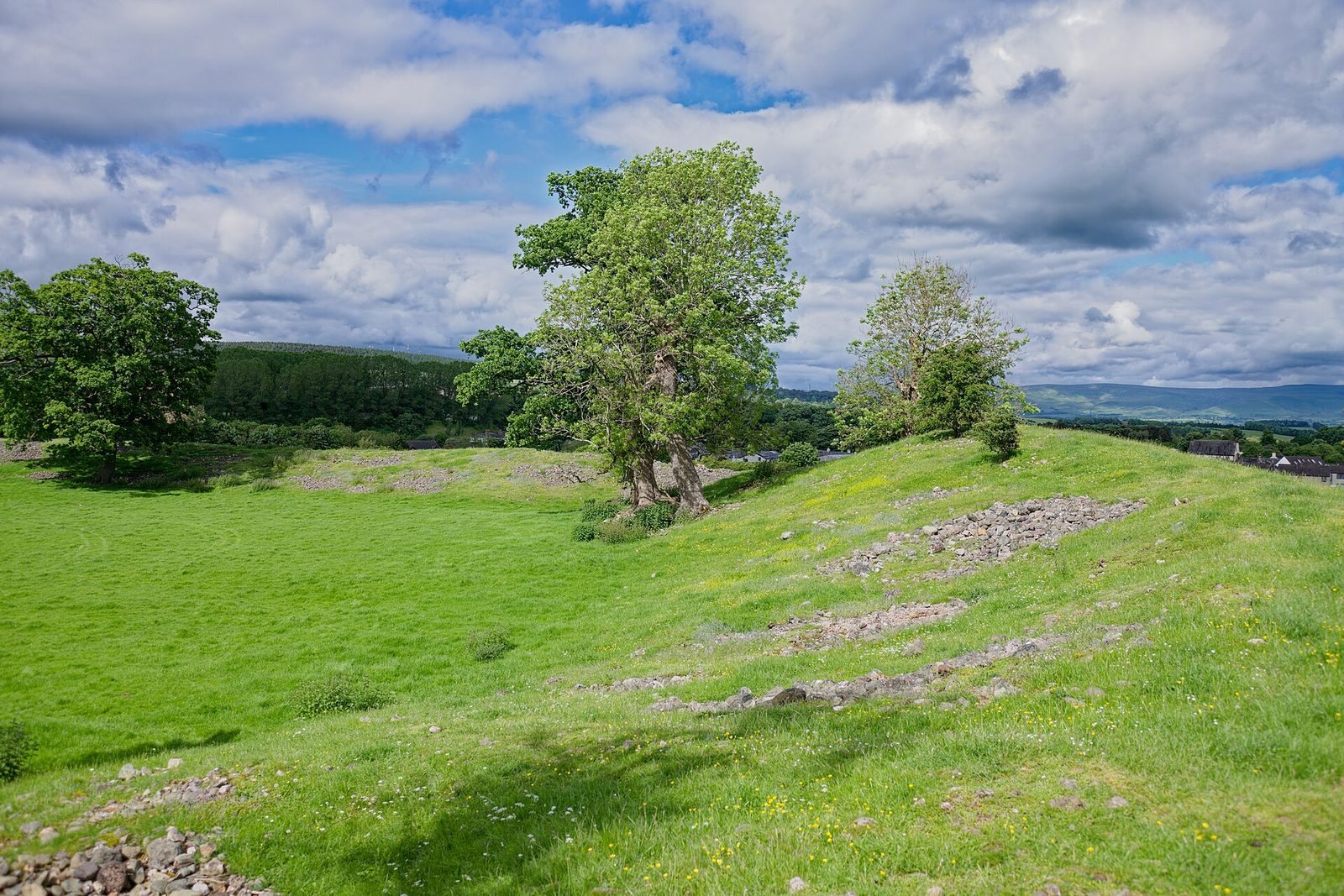
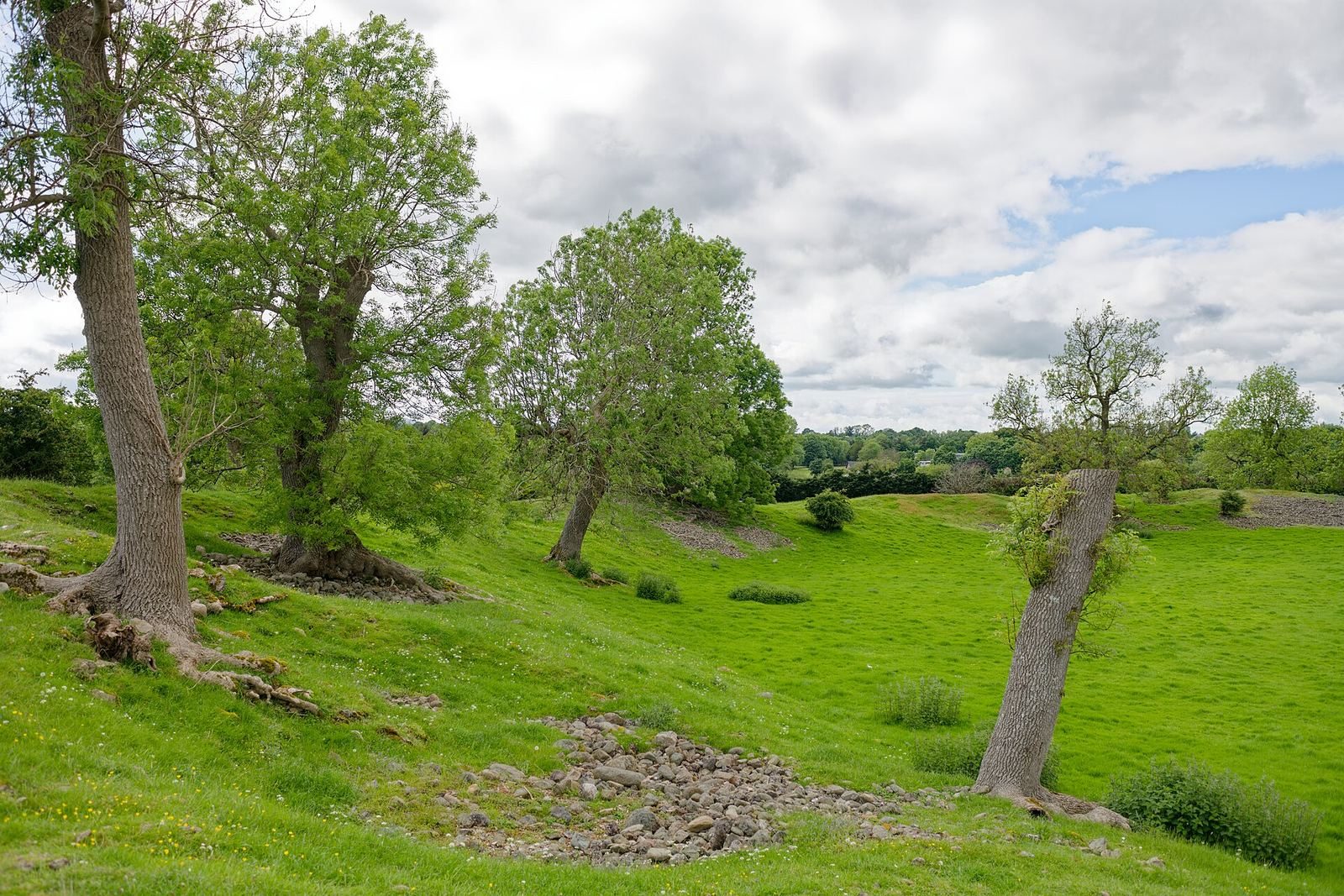
Mayburgh stands on a knoll near the confluence of the Eamont and Lowther rivers, about 1.5 kilometres south of Penrith. Its main feature is a large circular bank enclosing a slightly domed center, where a single standing stone survives.
Earthwork and central stone
The circular bank
The bank measures about 117 metres across and rises roughly 6.5 metres. At its base it is nearly 50 metres wide. Its stone content has been estimated at about 20,000 tons. The bank may have been built from cobbles gathered from nearby rivers; another interpretation is that builders reshaped a glacial mound. Many stones have been taken away over time for other uses.
Central stone and former settings
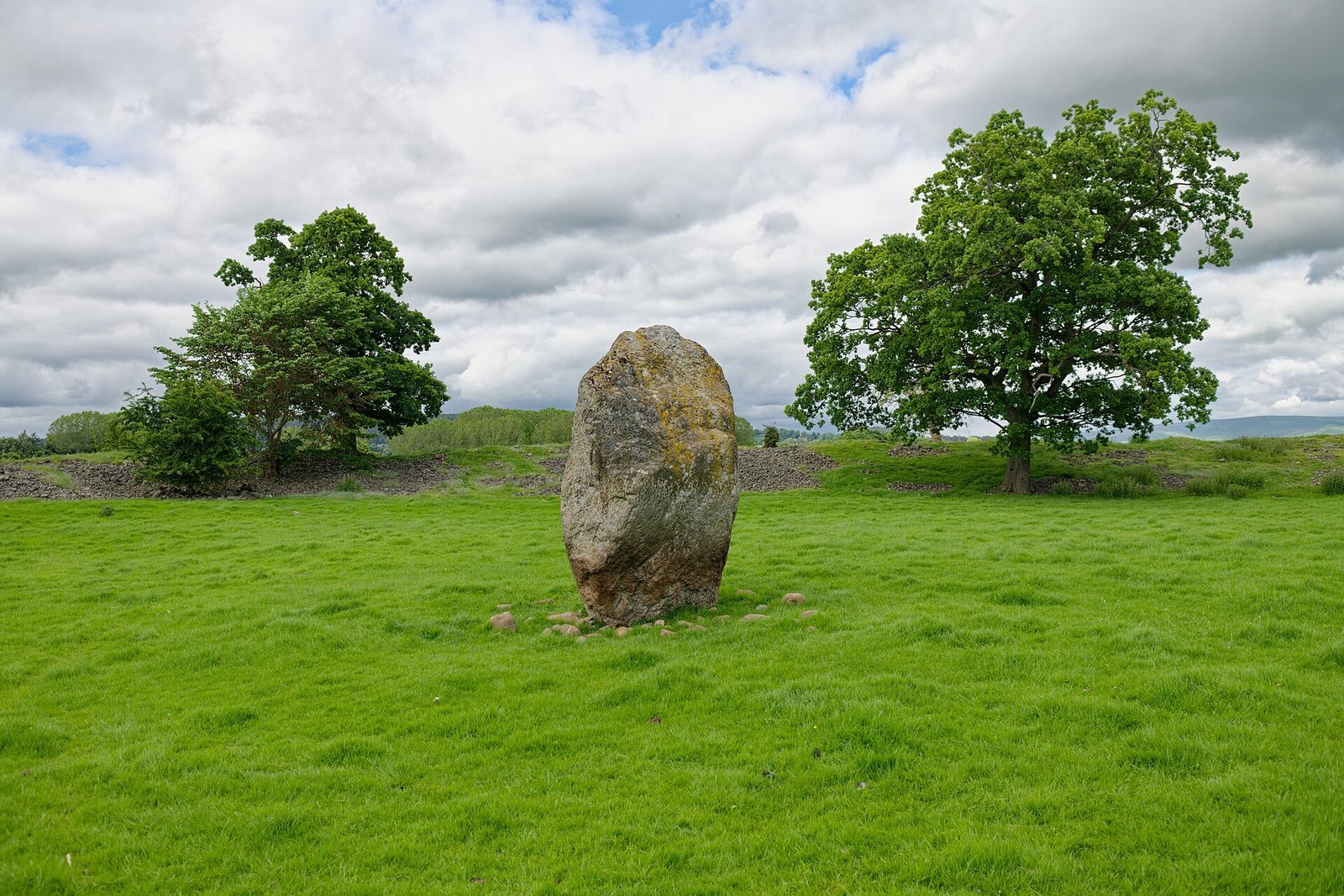
A single monolith, meaning a large standing stone, about 2.8 metres high remains within the enclosure. Thomas Pennant’s 1769 plan showed four standing stones at the center and four at the entrance, and proposed that an outer circle may also have existed. In 1773, Robert Hutchinson recorded local testimony that two other stones had stood beside the surviving one in an angular arrangement. According to that testimony, they were removed because people considered them harmful to the land.
One interpretation is that a stone circle, with four portal stones marking the entrance, came before the enclosing bank. The stonework includes pink and blue-gray local stone and white quartz. This combination has been interpreted as intentional color symbolism, possibly connected with solar and lunar rites and ideas about the living and the dead.
Entrance and alignment
The entrance lies due east of the center. Its direction frames the sunrise at an equinox, one of the two times each year when day and night are approximately equal, and points just north of King Arthur’s Round Table. From inside the enclosure, the view is toward the Blencathra ridge, where the sun sets at the equinox.
Nearby monuments
The Little Round Table lies 75 metres south of King Arthur’s Round Table. A 50-tonne granite obelisk, the Millennium Stone, was erected nearby by Eden Arts Council to mark the year 2000.