Santa Maria del Carmine alle Tre Cannelle: A Baroque Church in Rome
Site at a Glance
- Popularity
- Low
- Country
- Italy
- Primary era
- Early Modern
- Eras represented
- Early Modern, Modern
- Civilizations
- Papal States
- Site type
- Religious
- Remains
- Church
On this page9 sections
History
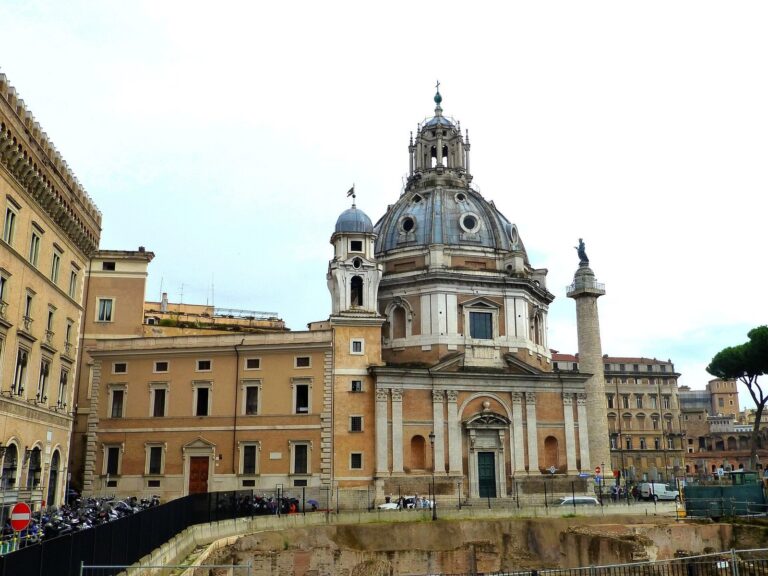
Santa Maria del Carmine alle Tre Cannelle is a small Roman Catholic church in Rome, Italy, dedicated to Our Lady of Mount Carmel. Its Baroque design belongs to an ornate European style associated with dramatic forms, widespread in the seventeenth and eighteenth centuries. The church began as a project for the Carmelite Archconfraternity, a lay devotional association with recognized higher standing. The association had no church of its own: it was founded at San Crisogono in Trastevere and moved to San Martino ai Monti in 1515. Cardinal Odoardo Farnese, its patron, initiated the project at Tre Cannelle. Construction began in October 1605 on land occupied by barns belonging to the Abbey of Grottaferrata, a Byzantine-rite Catholic monastery. The original sanctuary was an oratory, a small place set aside for prayer, and was inaugurated and consecrated in 1623. The church’s name recalls the vanished Fountain of the Three Spouts, which gave its name to the Tre Cannelle area.
Eighteenth-century development and fire
The church’s completion is dated to 1722. During the 1720s, architect Giacomo Ciolli was commissioned to design a new choir, high altar, and nave, completed in 1733. The façade followed in 1750, to a design by Michelangelo Specchi.
A severe fire in 1772 nearly destroyed the building. Pope Clement XIV, who served from 1769 to 1774, initiated an extensive restoration, funded by Cardinal Domenico Orsini d’Aragona. The sanctuary reopened in 1775 and was then accorded the status of a church.
Later changes and present use
French occupation forces plundered the church in 1798, and it closed until reopening in 1801. In 1862, Vincenzo Martinucci, the archconfraternity’s architect, led a renovation. As the association dwindled in the 1970s, the church closed and faced the threat of losing its church status. It reopened to the public in the 1980s. A fire in 2007 destroyed the archconfraternity’s private oratory and smoke-damaged the church interior. Architect Paolo Taffi oversaw a comprehensive restoration, completed in 2014.
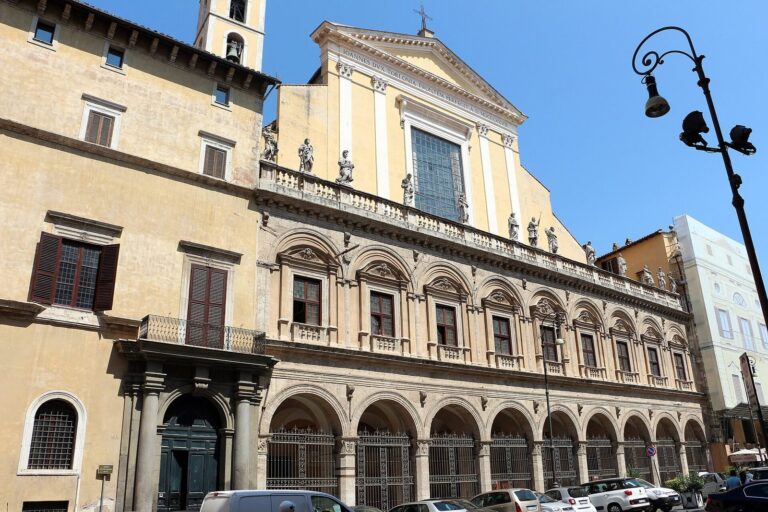
On 7 May 2022, Rome’s vicar, Angelo De Donatis, entrusted the church and its entire building to the Focolare Movement, a Catholic movement promoting unity and dialogue. The handover expressed Vatican gratitude for the movement’s work in Rome. The building is intended as an international meeting place called Focolare Point. The church is part of the parish of Santi XII Apostoli, a basilica dedicated to the Twelve Apostles, in the Diocese of Rome, and remains associated with the Carmelite Archconfraternity.
Remains
The compact Baroque church has a two-storey façade and a single nave beneath a barrel vault, a continuous, semicylindrical ceiling. Its principal interior and exterior features combine architectural decoration with paintings, altars, and musical furnishings.
Façade
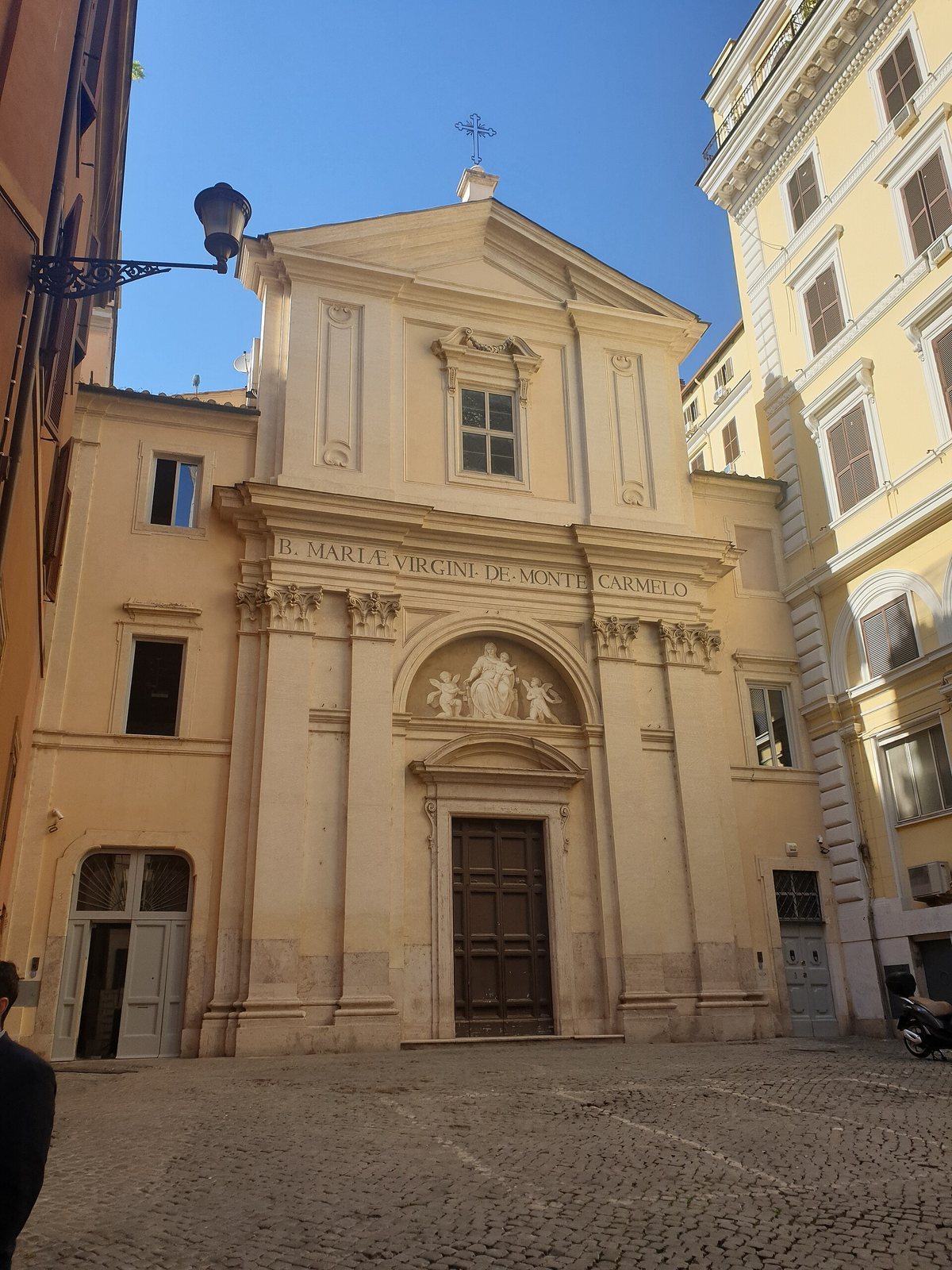
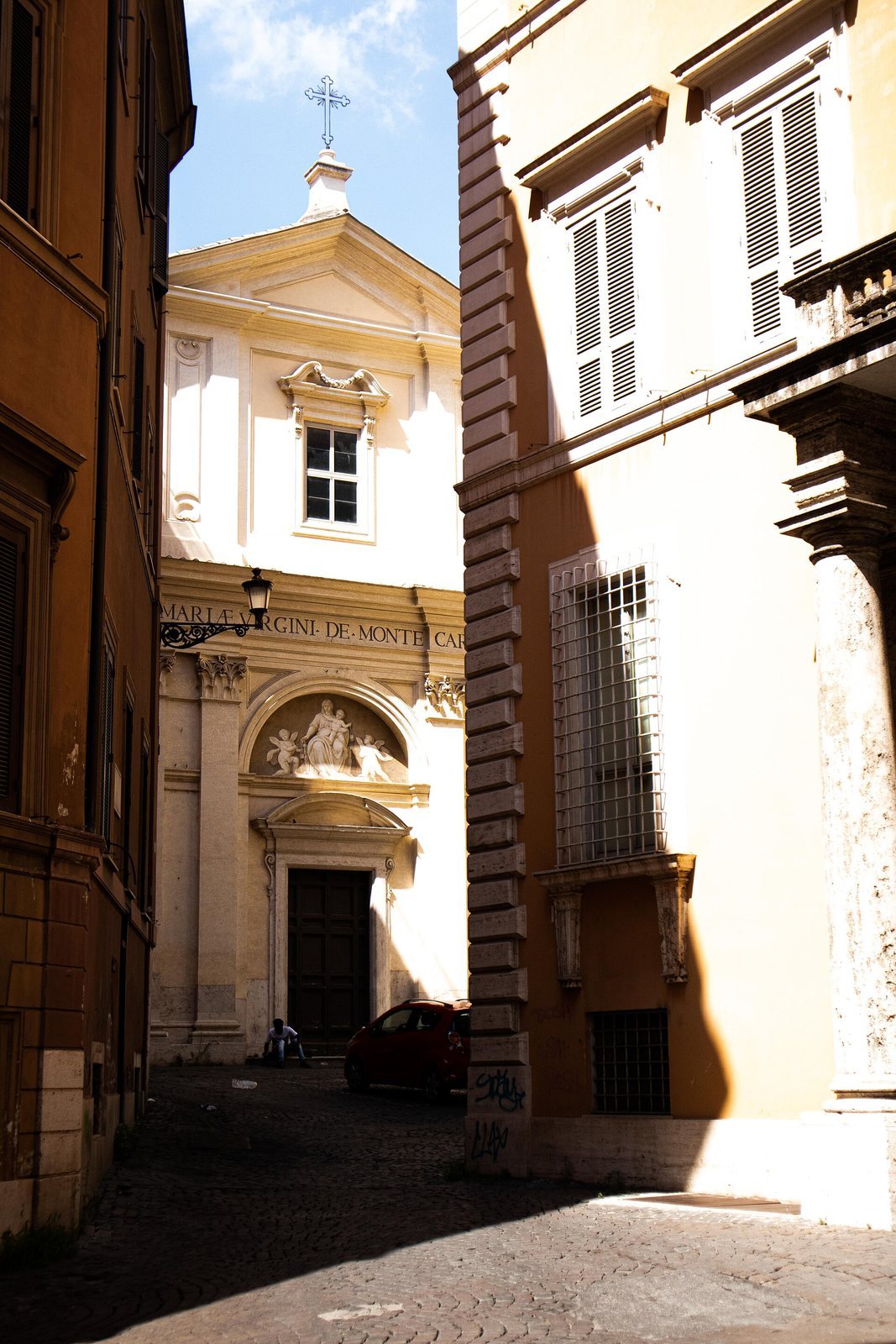
The lower storey has paired pilasters, shallow wall-mounted features resembling columns, topped by Corinthian capitals, ornate column tops. Above the entrance portal, a curved panel holds a wall painting of Our Lady of Mount Carmel made in 1824. It replaced a shallow stucco relief of the Virgin and Child with angels, created in 1750 and lost in the 1772 fire. On the upper storey, a rectangular window sits below a broken pediment, whose upper outline is interrupted, decorated with a festoon, a hanging garland ornament. Paired vertical strips with shell motifs flank the window and pediment, and a triangular pediment crowns the façade. An inscription runs along the decorative horizontal band above the columns.
Interior
Nave and high altar
Monumental Corinthian pilasters line the single nave beneath its barrel vault. Vincenzo Martinucci carried out the interior decoration. Giacomo Ciolli’s high altar displays a statue of Our Lady of Mount Carmel made from paper pulp and described as an eighteenth-century copy. Gaspare Celio’s painting of the same subject, formerly on the altar, is now in the adjacent oratory.
Side altars
The right-hand altar is dedicated to the prophet Elijah and his sacrifice on Mount Carmel. Its banner by Corrado Giaquinto shows the Virgin appearing to Elijah on the front and giving the scapular, a devotional garment associated with Carmelite practice, to St. Simon Stock on the reverse. Simon Stock was a Carmelite religious leader traditionally linked with this devotion. On the left-hand altar is Tito Ridolfi’s 1927 painting of St. Thérèse of the Child Jesus, a French Carmelite nun and Catholic saint. This altar previously held Giovanni Pirri’s 1776 painting of the Virgin giving the scapular to Simon Stock.
Sacristy and choir loft
The sacristy, a room where clergy prepare and liturgical objects are kept, contains an anonymous sixteenth-century painting of the Flagellation of Christ. A pipe organ built by Aldobrando Fedeli in 1748 stands in the choir loft, an elevated gallery often used by musicians, on the entrance-wall side of the church.