Menhirs de la Plumaudière: A Stone Alignment in Normandy
Site at a Glance
- Popularity
- Very Low
- Country
- France
- Primary era
- Stone Age
- Eras represented
- Stone Age
- Civilizations
- Unclassified
- Site type
- Civic
- Remains
- Megalithic Monument
On this page4 sections
History
The Menhirs de la Plumaudière are an alignment of large upright stones at Champ du Houx, near the hamlet of Plumaudière in Montchauvet, Normandy, France. They are among the small number of known stone alignments in Normandy.
A commission examined the stones in 1870. In 1966, archaeologist Robert Caillaud excavated at the base of the principal stone, Pierre du Hu. It was embedded only 0.30 m, and no setting pit, or hole used to anchor an upright stone, was found. These observations raised questions about whether the stones formed an authentic alignment. Since 30 June 1976, the monument has had France’s historic-monument designation, a legal heritage protection for historic properties. Land clearance also disturbed smaller stones that were easier to move.
Local legend says the devil planned to crush the Priory of Plessis-Grimoult, a monastic house governed by a prior, with a load of stones. The monks prayed, and a storm of lightning, hail, and rain stopped him. He abandoned the stones, which, according to the tale, sank into the ground, remained at its surface, or rose upright. The priory was saved, while rocks littered the surrounding fields.
Remains
Alignment and principal stone
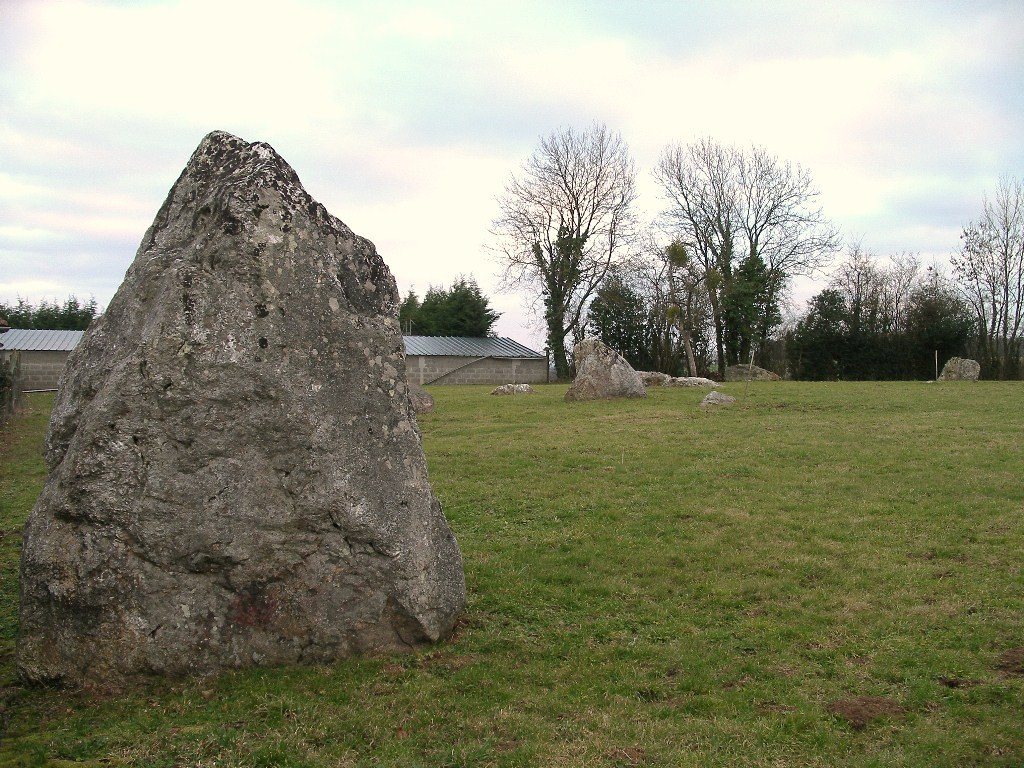
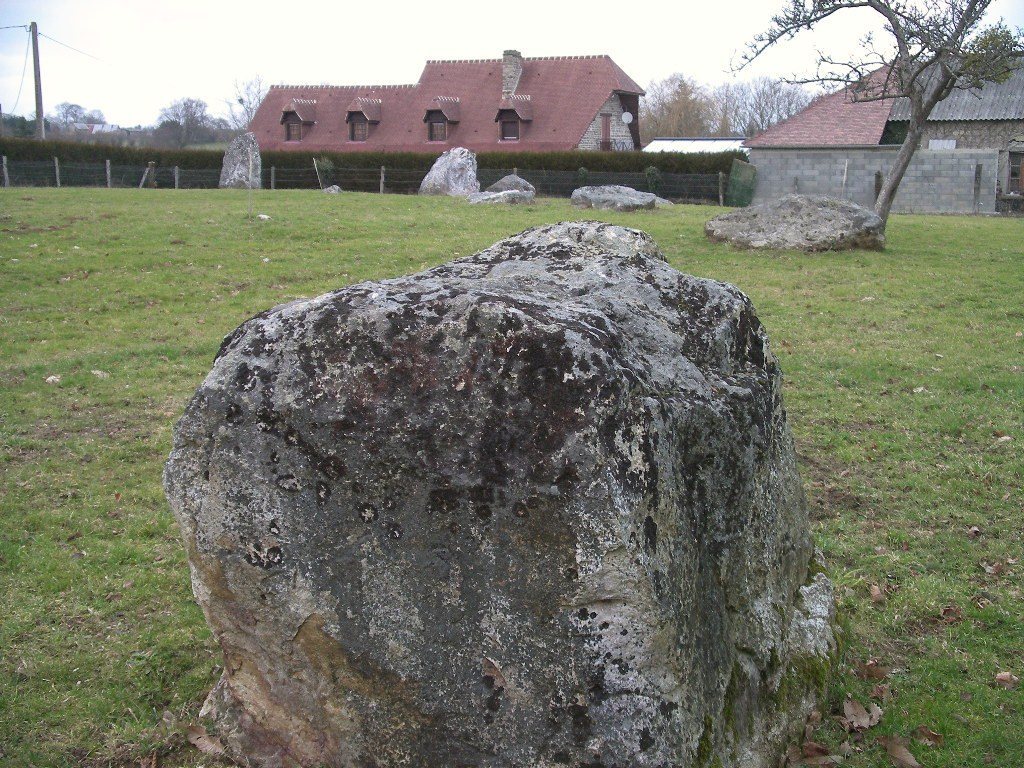
The alignment consists of quartz blocks taken from a substantial underground vein at the site, rather than transported from elsewhere. A 1870 description measured the arrangement at 55–60 m from north to south and 4.5 m across. It counted 20 blocks in two parallel north–south rows about 4 m apart, with 14 blocks in one row and six in the other. Several were toppled and partly buried; some upright stones exceeded 3 m in height and had irregular shapes. The monument record describes nine upright stones, while more than a dozen can be seen at the site, possibly remnants of a larger arrangement. At the northwestern end, Pierre du Hu stands about 3.2 m high and 1.5–2 m wide. Geologists at the University of Caen identified the quartz as local in origin.
Stones and finds in the valley
Numerous smaller stones of the same quartz are scattered through the valley. Finds from the surrounding area include axes made of flint and diorite, flakes, scrapers, and a rare notched scraper.