Ballymeanoch: A Prehistoric Monument Complex in Kilmartin Glen
Site at a Glance
- Popularity
- Low
- Country
- United Kingdom
- Primary era
- Stone Age
- Eras represented
- Stone Age, Bronze Age
- Civilizations
- Unclassified
- Site type
- Religious
- Remains
- Sanctuary
On this page11 sections
History
Prehistoric development
Ballymeanoch is a prehistoric monument complex in Kilmartin Glen, near Lochgilphead in the United Kingdom. Its henge, a ceremonial enclosure formed by an earthwork bank and ditch, and its standing-stone rows were among the earliest elements. The monuments were in use from about 4000 to 1500 BC. Cairns, stone mounds, and cists, which are stone-built burial chambers, were added around 2000 BC during the Early Bronze Age, the opening phase of the Bronze Age when bronze tools and objects came into use.
Investigation and protection
The archaeologist William Greenwell investigated Ballymeanoch in 1864 and excavated the larger burial chamber within the henge. A second, smaller cist was found in 1965 on Monadh an Tairbh, northeast of the main complex. A standing stone pierced by a central hole fell and broke toward the end of the nineteenth century; its fragments were excavated in 1977. A local belief held that passing a limb through the hole could cure illness, perhaps as an explanation for the stone’s unusual shape.
On 30 November 1933, the standing stones received Scheduled Monument status, a form of statutory protection for nationally important archaeological sites, under the name Ballymeanoch Standing Stones. The henge is protected separately as a Scheduled Monument.
Remains
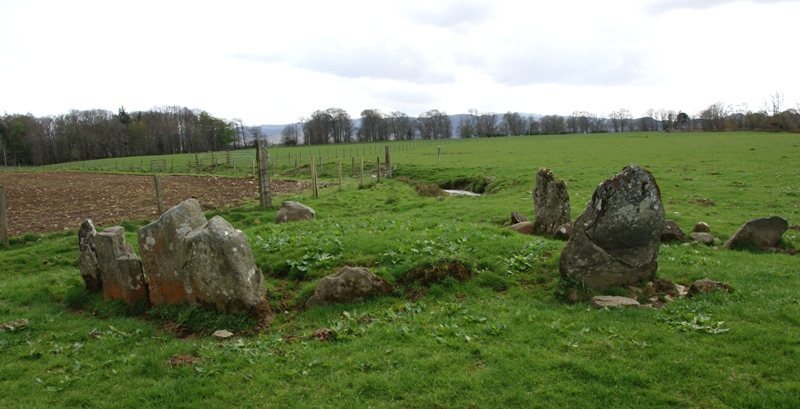
The remains include two alignments of upright stones, an earthwork enclosure ringed by smaller stones, burial chambers, and cairns. The complex brings together standing stones set in pits, low banks and ditches, and stone-built burial features.
Standing-stone rows
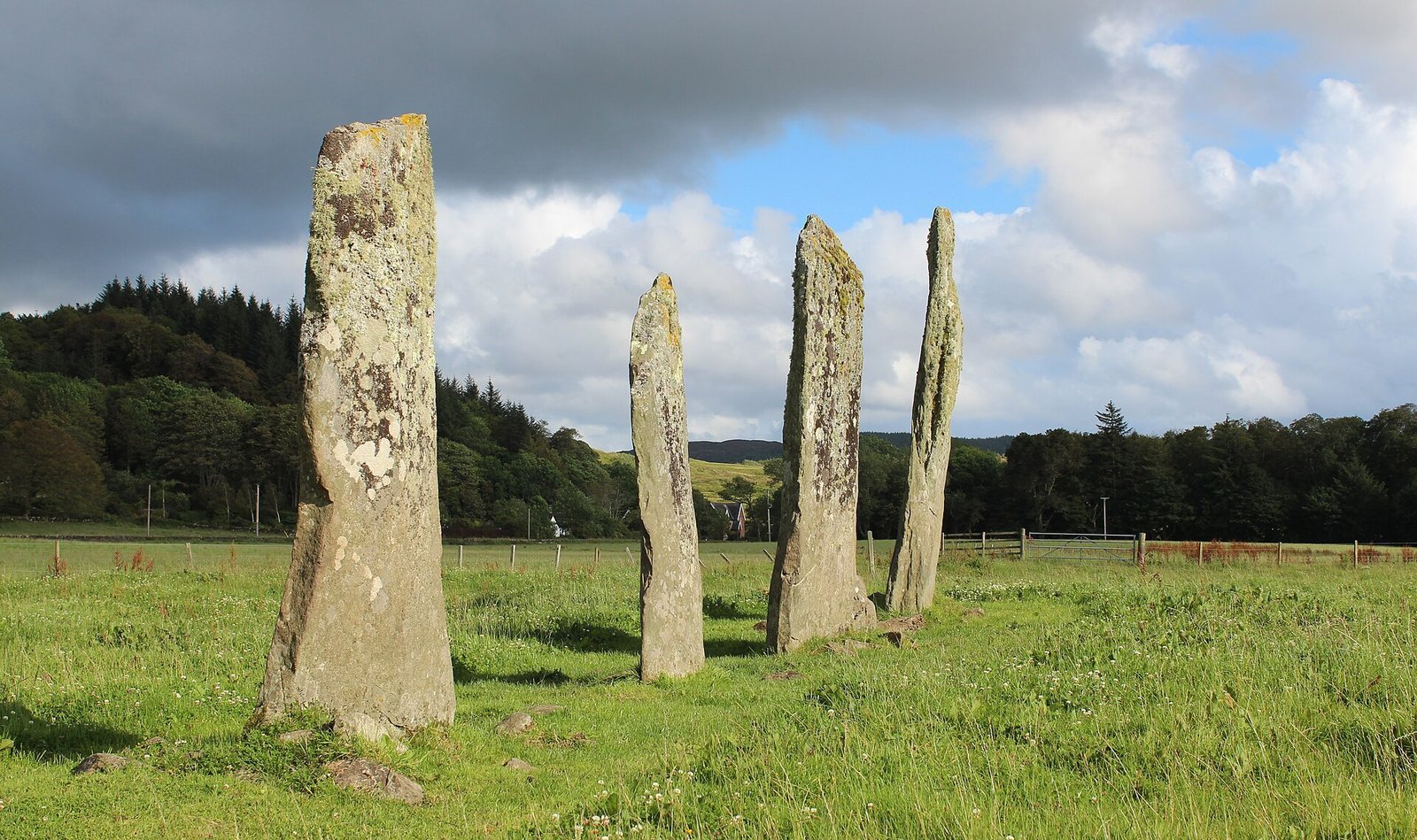
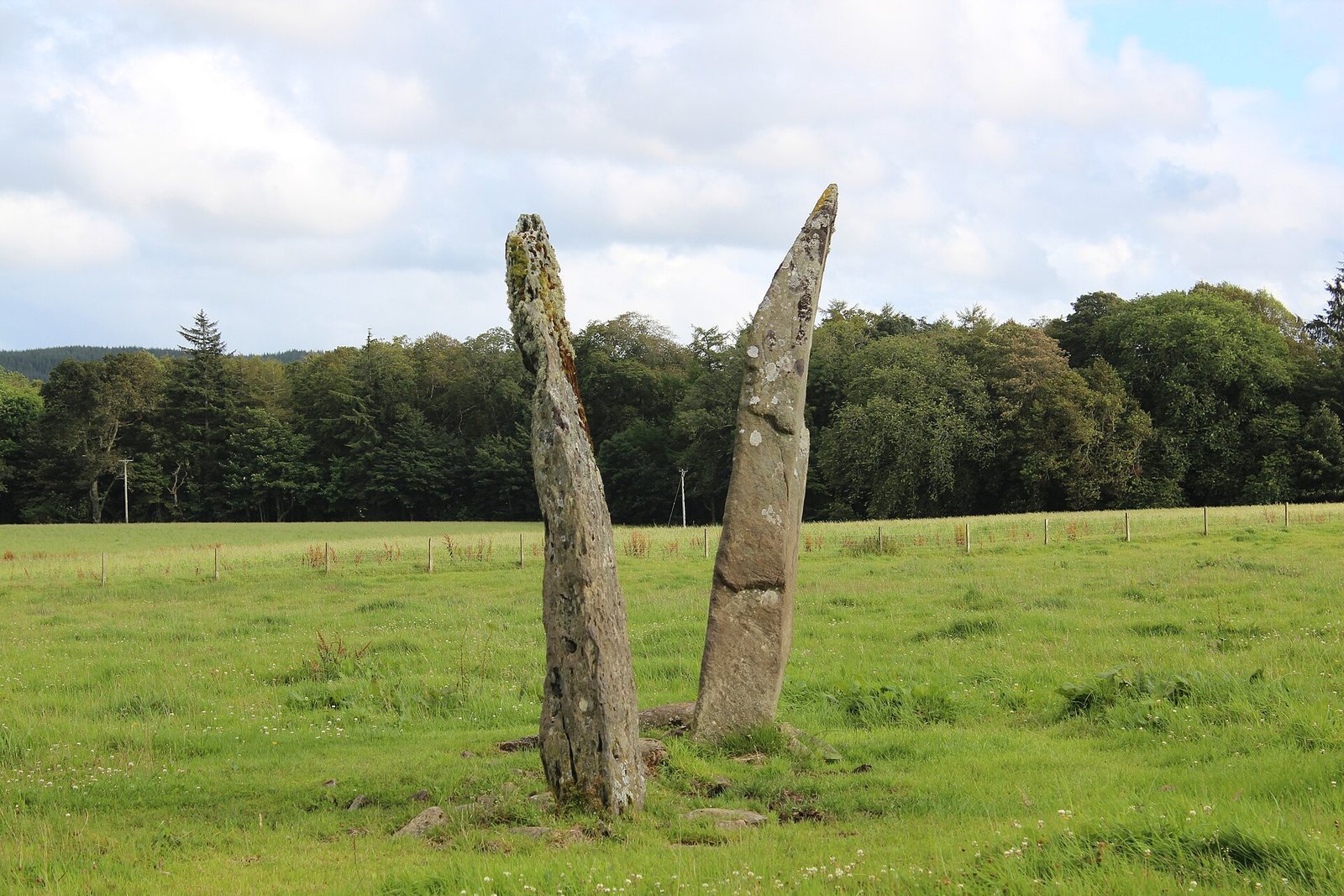
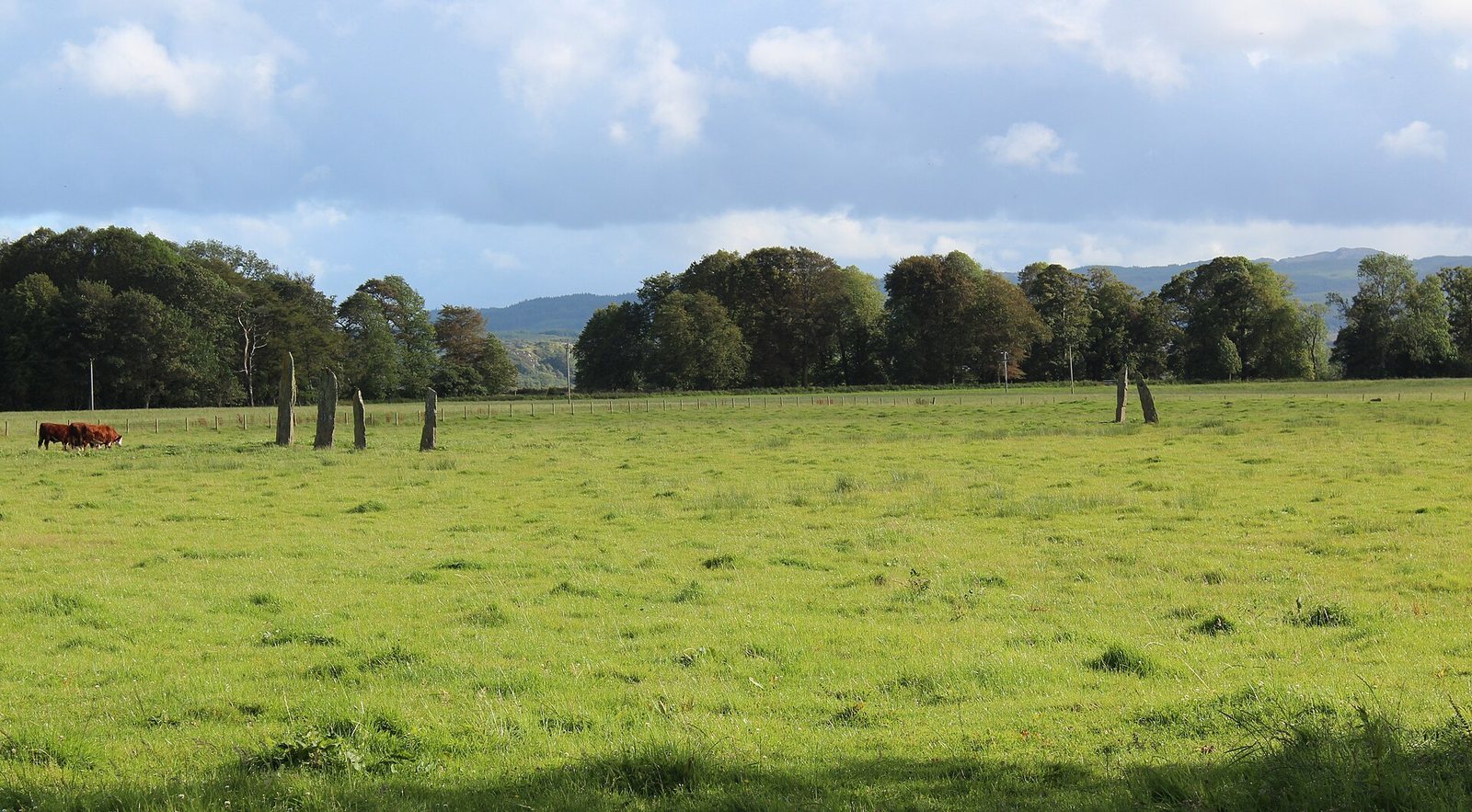
The two rows run roughly northwest to southeast, about 40 metres apart. Six stones still stand: four in one row, descending in height from about 4.1 metres to 2.75 metres, and two in the other, about 3 metres and 2.7 metres high. Each was set into a pit packed with small stones, and cremated bone was found in one pit. The rows are interpreted as marking a route for processions approaching from the southeast. The two middle stones in the longer row carry cup-and-ring carvings, cup-shaped hollows encircled by rings, as well as simpler cup marks. The east face of one has about 70 cup marks and roughly a dozen ringed carvings; the west face of the other has about 40 cup marks and two ringed carvings.
Pierced standing stone
A separate carved stone stood about 20 metres northwest of the two-stone row. Its central opening narrows to about 7 centimetres. The broken fragments excavated in 1977 were placed nearby.
Henge enclosure
The henge lies about 130 metres south-southwest of the stone rows and was probably in use during the same period. It measures about 40 metres across, while its original circular area is described as about 20 metres in diameter. A low outer bank now stands around 40 centimetres high, with an inner ditch about 4 metres wide and no more than 40 centimetres deep. The bank and ditch break to the north and south, where entrances may have been marked by stones. A circle of smaller stones surrounds the enclosure.
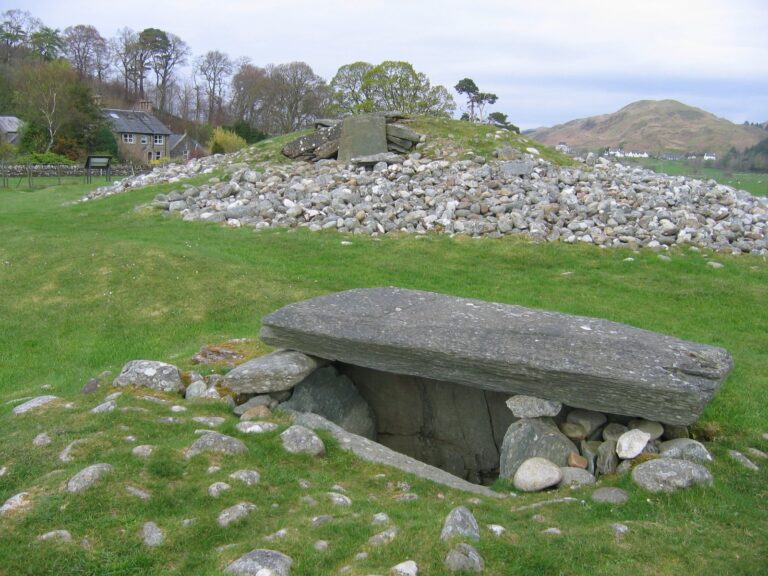
Burial cists
Central burial chamber
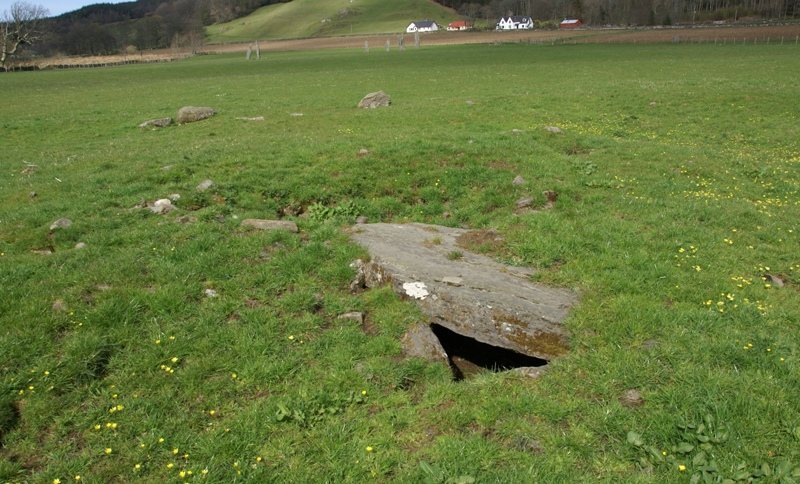
The larger cist stands at the centre of the henge and is about 0.7 metres deep. Its side slabs reach up to 2.75 metres long, and its cover slab measures 2.4 by 1.4 by 0.25 metres. Carefully laid rounded pebbles form the floor. The chamber had been robbed before Greenwell excavated it.
Cist at Monadh an Tairbh
The smaller cist measures about 0.9 by 0.4 by 0.46 metres and was made from four slabs with a cover stone. That cover stone measured 1.6 by 1.1 by 0.25 metres and bore three small cup marks, one surrounded by a ring. The chamber contained remains of three burials and a fragmentary Early Bronze Age beaker, now in the British Museum in London.
Cairns
A small cairn lies east of the processional route, near the stone rows. Upright stones surround it, and it contains at least one grave. Smaller cairns were probably also raised over burials within the henge; a cover stone remains visible among these features.