Église Notre-Dame-de-la-Visitation du Petit-Bornand: A Catholic Parish Church in France
Site at a Glance
- Popularity
- Very Low
- Country
- France
- Primary era
- Early Modern
- Eras represented
- Medieval, Early Modern, Modern
- Civilizations
- Duchy of Savoy, French, Holy Roman Empire, Kingdom of Sardinia
- Site type
- Religious
- Remains
- Church
On this page17 sections
History
Église Notre-Dame-de-la-Visitation du Petit-Bornand is a Catholic church in France, dedicated to the Visitation of the Virgin Mary, the Christian account of Mary visiting Elizabeth. Its foundation is placed in the sixteenth century, though it rests on thirteenth-century foundations. Most of the building dates to about 1553, a year given by an inscription now reset into the façade. The church belongs to the Diocese of Annecy and the Parish of the Epiphany between the Arve and Borne, named for the Christian feast celebrating Jesus’s manifestation to the world.
Sixteenth and early seventeenth centuries
Around 1546, Louis de Rye, Bishop of Geneva, delegated his episcopal duties to Guillaume Furbit, the parish priest and a doctor of the Sorbonne. Furbit held the title of a bishop without governing that bishopric as a resident bishop. He continued in the delegated role after Louis’s brother Philibert succeeded to the see in 1550, and died that year.
François de Sales served as parish priest from 30 June 1597 to 17 June 1598. On 30 September 1597, he baptized Adrienne Fichet, daughter of Jean Fichet, who had been ennobled in 1594. In 1616, Adrienne entered the Visitandines, members of the Catholic Order of the Visitation associated with François de Sales and Jeanne de Chantal. She became the order’s seventh nun, and François de Sales received her vows.
Changes to the church
A fire at the rectory in 1668 destroyed the parish archives. Simon Cauly, then the church’s thirteenth parish priest, was serving at the time. Extensive renovations followed in 1670. By 1730, the church had an arrangement described as the same as its present one.
In 1794, Antoine Louis Albitte, a representative of the French National Convention during the French Revolution, ordered the bell tower demolished. It was rebuilt in 1880. The altarpiece was restored in 1804, the side aisles were opened in 1817–1818, and the Stations of the Cross were installed in 1842. Alterations in 1886 left little of the original building.
Parish life and the twentieth century
Parish customs included nighttime singing visits to homes during Holy Week. Groups of young men, sometimes joined by household heads, sang with violin accompaniment and collected eggs or small sums of money. The proceeds paid for a meal at a tavern, while dancing also took place in some homes at Easter. During long spells of warm-season rain, parishioners pooled funds to buy a calf, which was sold after Sunday Mass in the public square. The money paid for Masses for souls in Purgatory, a state of purification after death in Catholic belief, and was intended to seek better weather.
On Saint Anthony’s day, horses remained in their stables and received special care, while salt and oats for livestock were blessed. The Assumption, celebrated on 15 August in the Catholic belief that Mary was taken bodily into heaven, and the Nativity of Mary, commemorating her birth on 8 September, were marked by festivities and dancing. Skittle games at the latter feast continued for two or three days, with substantial sums at stake.
Women’s clothing and headwear became less plain and economical over a period of roughly 20 to 25 years. Tavern-going contributed to the decline of formerly comfortable households and to emigration to Lyon, Besançon, and Paris. The valley’s population nevertheless grew as young adults married and widowers remarried, and better-off households gave food to poorer residents.
Jean Truffy was parish priest from 1936 to 1958. During the Second World War, he acted as an intermediary among local people, the occupying forces, and the Glières maquis, a French Resistance group. He was deported to Dachau, a Nazi concentration camp, for 15 months and later wrote memoirs.
Remains
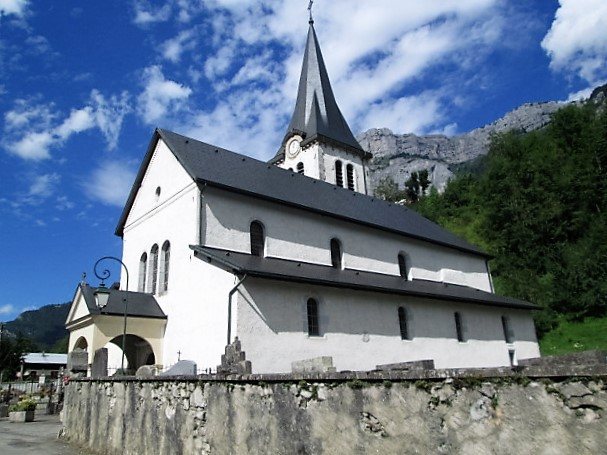
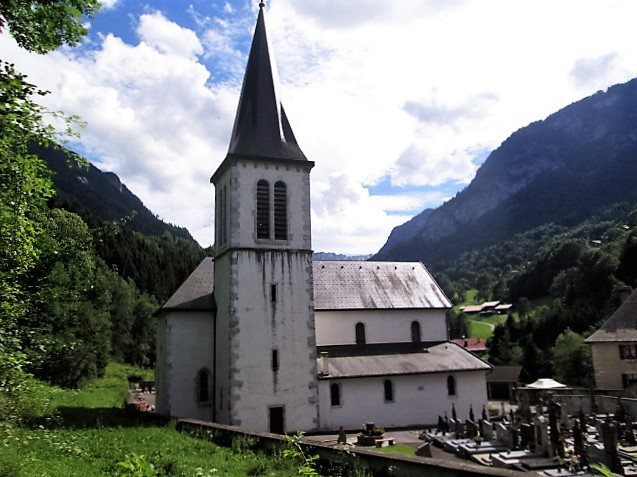
The church stands low in the valley, below the CD 12 road and beside the Borne River. Despite its recessed position, it is regularly oriented and bright inside. Its plan has a central nave flanked by lower side aisles, with the bell tower set to the left of the choir.
Interior architecture
Choir
The Gothic choir predates the fifteenth century. Two tall, narrow pointed-arch windows light it, with two similar openings at the east end and a circular opening, or oculus, above them. The original ceiling may have been a rib vault, supported by intersecting ribs, or a barrel vault, shaped like a tunnel. It was replaced by a bulging groin vault, formed where vaults intersect, with a large central medallion. Its unusual bulge is consistent with the possibility that the earlier ceiling was ribbed.
Nave and side aisles
The central nave has four bays, and the two lower side aisles have three unequal bays each. The nave was initially a single space, braced by angled buttresses. Those supports remain and now help carry the later aisles, which open into the nave through low arches. The arrangement gives the interior a squat, unbalanced appearance. The nave and aisles have elongated groin vaults separated into sections by simple cross arches. Semicircular windows sit in the side walls beneath the roof eaves. The vaulting and some angular moldings show influence from Piedmont, a region of northwestern Italy.
Side chapels
The left chapel has a marble altar and is dedicated to Our Lady of Lourdes. It also contains a wooden confessional and a statue of Our Lady of the Snows, a title for the Virgin Mary especially venerated in Savoy. A chapel dedicated to the same title stands on the Plateau des Glières. The right chapel has a marble altar topped by a painting measuring 2.13 by 1.40 metres. The painting is a copy of Dirck van Baburen’s Deposition from the Cross, also known as the Entombment; the original, dated around 1620, is in Rome’s church of San Pietro in Montorio.
Floor and baptismal font
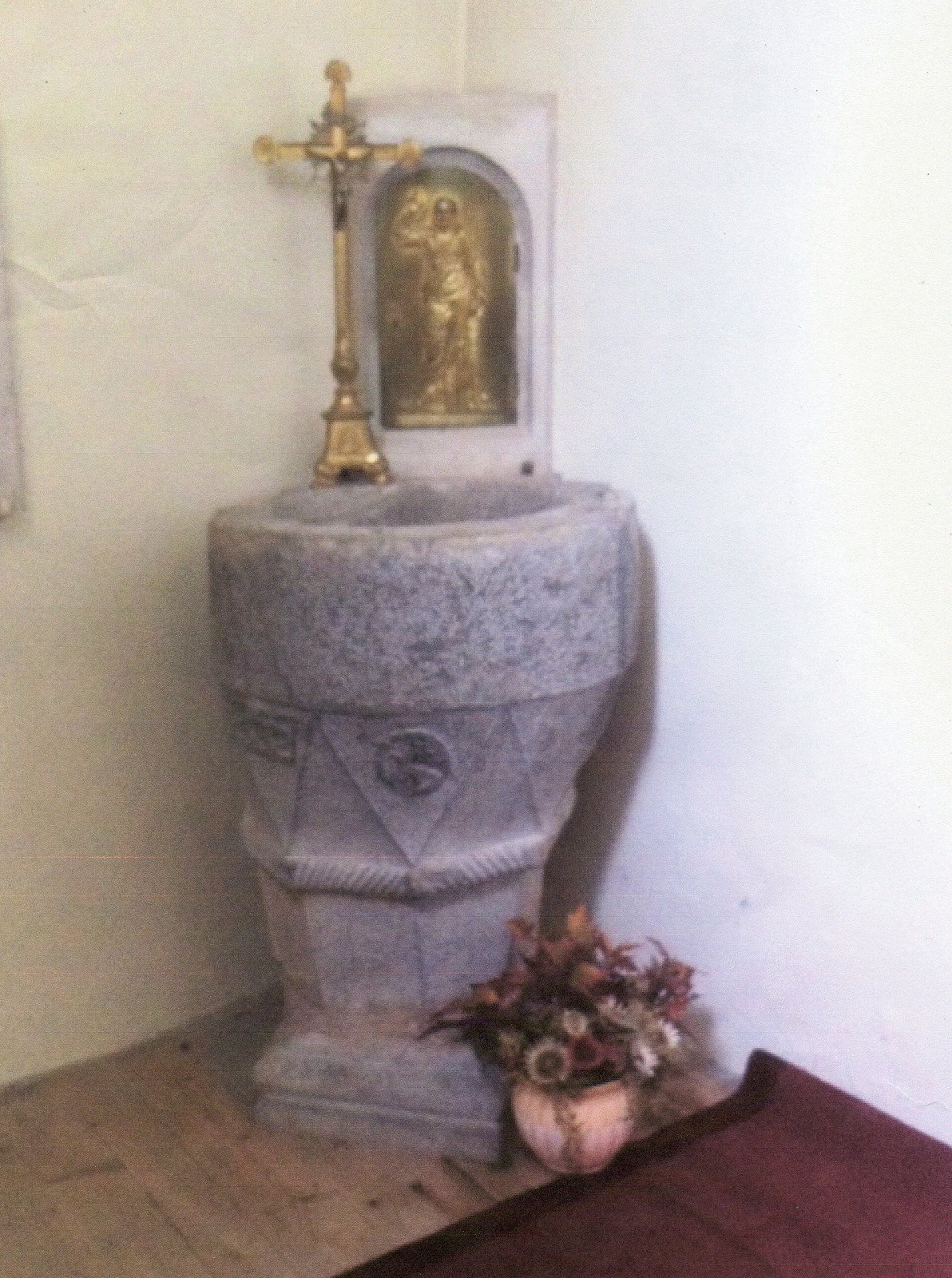
Stone slabs pave the central aisle, while rough wooden flooring remains visible in the side bays. The baptismal font is carved from a single mass of granite and dates to 1553–1554.
Entrance and bell tower
Portal
The 1553 portal was commissioned by Jacques de Savoie-Nemours, then abbot of Entremont and parish priest of Petit-Bornand. Its semicircular arch has a projecting keystone, with horizontal moldings extending across the points from which the arch rises. A rectangular frame surrounds the doorway. Above it, a projecting band rests on two columns attached to the wall, with molded blocks and broad flat caps. The columns continue as matching wall shafts, supported about a third of the way up the door jambs by small rectangular projections with projecting bases and caps. A semicircular niche above the entrance contains a Baroque statuette of the Virgin Mary.
Bell tower and bells
The tower houses two bells. The smaller, cast in 1747, was sponsored by Henriette Favrat-Vignet, a canoness of Geneva Cathedral, and Claude Gaillard; Jacques-Louis Vignet baptized it. The larger bell was cast in Geneva in 1811 by François Dreffet and the Barthélemy Brothers. It weighs 2,025 Geneva pounds and bears the name Marie-Jeanne Claudine Euphrosine. Its sponsors were Marie Euphrosine Bapney and Jean-Claude Bussat, and François Orsy, rector, and Joseph-Marie Rey, mayor, baptized it.
Paintings, windows, and memorial
Apse painting and stained glass
A fresco painted by Georges Hermann in 1925 decorates the apse, the rounded end of the church, and shows Saint François de Sales visiting and blessing parishioners. The stained-glass windows date to 1957. The window that lights the gallery above the entrance appears to have been restored that year as well. Restoration work on the windows has involved Christine Charbonnel of Miroiterie des Savoie in Saint-Pierre-en-Faucigny, a recipient of France’s Best Worker distinction in 2004.
The painting in the right chapel
Claude Gaillard, a native of the hamlet of Termine who served a cardinal, brought the copy of the Deposition from the Cross from Rome around 1745. It had been given to him in recognition of his service. He donated it to a chapel built in the hamlet in 1689; after a series of changes, the painting returned to the village church in 1849. It was formally classified on 28 July 1904.
Jean Truffy’s grave
The grave of Abbé Jean Truffy is located to the right of the entrance.