Forest Glassworks at Lakenborn: A Seventeenth-Century Glassmaking Site
Site at a Glance
- Popularity
- Low
- Country
- Germany
- Primary era
- Early Modern
- Eras represented
- Early Modern, Modern
- Civilizations
- Holy Roman Empire
- Site type
- Economic
- Remains
- Production Complex
On this page15 sections
History
The Forest Glassworks at Lakenborn was a seventeenth-century glassmaking site in Germany. Franz Seidensticker, a master glassmaker from the Kaufunger Forest, founded it around 1655–56, shortly after the Thirty Years’ War, a major European conflict that lasted from 1618 to 1648. The war’s end left the region extensively damaged and its population impoverished. During its operation, Lakenborn was regarded as one of the largest and most important glassworks in the Weserbergland, as well as a representative example of forest glassmaking in the German-speaking lands.
Foundation and regional trade
Before establishing the Lakenborn works, Seidensticker transferred glassworks in the Vogler and Hils, including the works below Hilsborn, to his son. Glassmaking in the Solling had a much longer history: it was established there by at least the thirteenth century, and a 1397 purchase of glass for Münden Castle provides indirect evidence of production. Activity declined during the fourteenth-century abandonment of settlements, then revived in the sixteenth century. The Weserbergland, including the Solling, remained an important European glass-producing region into the twentieth century.
Lakenborn’s products were shipped by way of the nearby Weser to towns in northern Germany and the Netherlands. Forest glassworks were generally placed in remote, wooded areas. Woodland owners collected rent, while glassmakers commonly moved on once nearby timber had been used up, often within about 25 years. Lakenborn operated for more than 25 years, an unusually long period for this kind of works.
Management and closure
After about three years, Seidensticker handed the works to his son-in-law Jürgen Seitz. Seitz ran it for roughly 22 years, until his death around 1680, while Seidensticker went on to take over a glassworks near Kohlstädt in the Lippe region. Around 1681, the last master was a man named Ruländer, possibly Jonas or his son Lorenz, who co-owned the works with Seitz’s widow, Margarethe.
Glassmaking ended around 1681, though it may have continued until 1682 or 1683. Economic problems may have contributed to the closure, but the reason is uncertain. The associated workers’ settlement included a school for their children, brewing for community use, and dairy cattle. It may have housed about 50 people, with a workforce of as many as 25.
Leibniz’s visit
In 1681, the philosopher and mathematician Gottfried Wilhelm Leibniz travelled to the Solling with Hamburg merchant and chemist Martin Elers to make burning mirrors for experiments at the glassworks. Such a mirror concentrates sunlight to produce heat. In a letter dated 2 May, Elers recounted that two days earlier he had found the glassmaking master and the forester drunk at the works.
Excavation and restoration
A local historian conducted a shallow exploratory excavation in 1959. Systematic excavation began in 2003 under Hans-Georg Stephan of the University of Göttingen’s Seminar for Prehistory and Early History, following a survey using electromagnetic signals to locate remains. Further campaigns in 2004, 2006, and 2007 examined the production area and part of the waste mounds. This work advanced understanding of how early forest-glass furnaces and workshops were built and used.
Remains
Workshop hall and setting
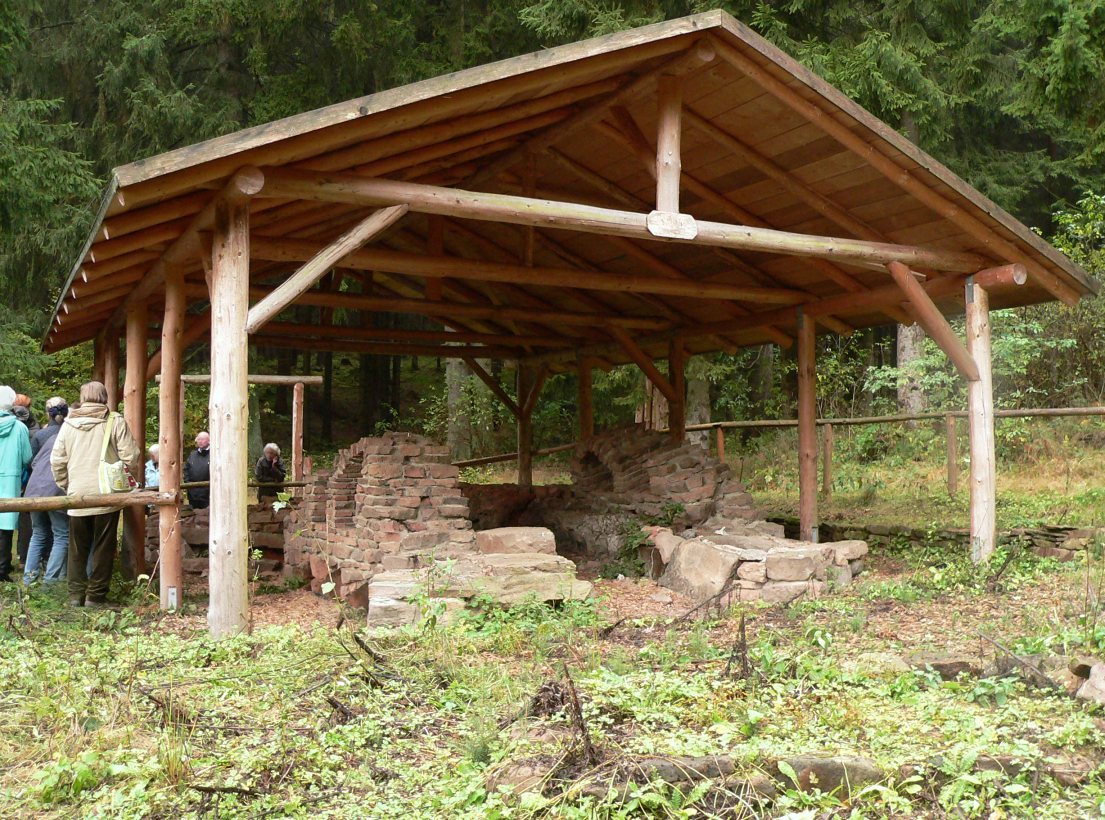
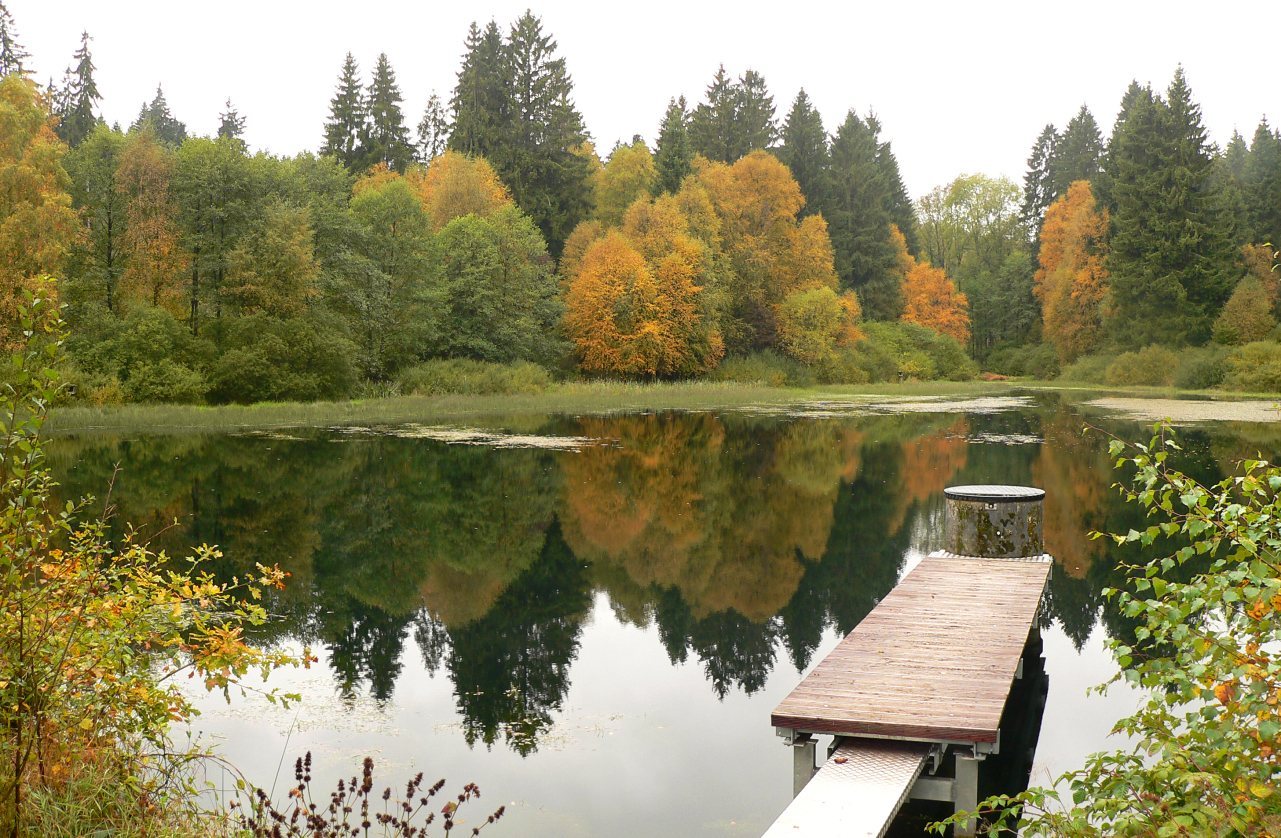
The production area comprised five glassmaking furnaces inside an enclosed workshop hall measuring about 17 by 26 metres. The remains lie beside Lakenteich. The present pond was created by impounding water for timber rafting after the glassworks closed, and was used for rafting for a long period. The name Lakenborn comes from a spring rising on a nearby slope; glassworks were commonly situated near running water, which they needed for production.
Postholes show that the hall was a timber building with two rows of posts. The stronger inner posts supported the roof, while boards fixed to the outer posts formed the walls. Workers fired and stoked the furnaces within the hall, but outside the glassmakers’ immediate working area.
Furnaces
Main pot furnace
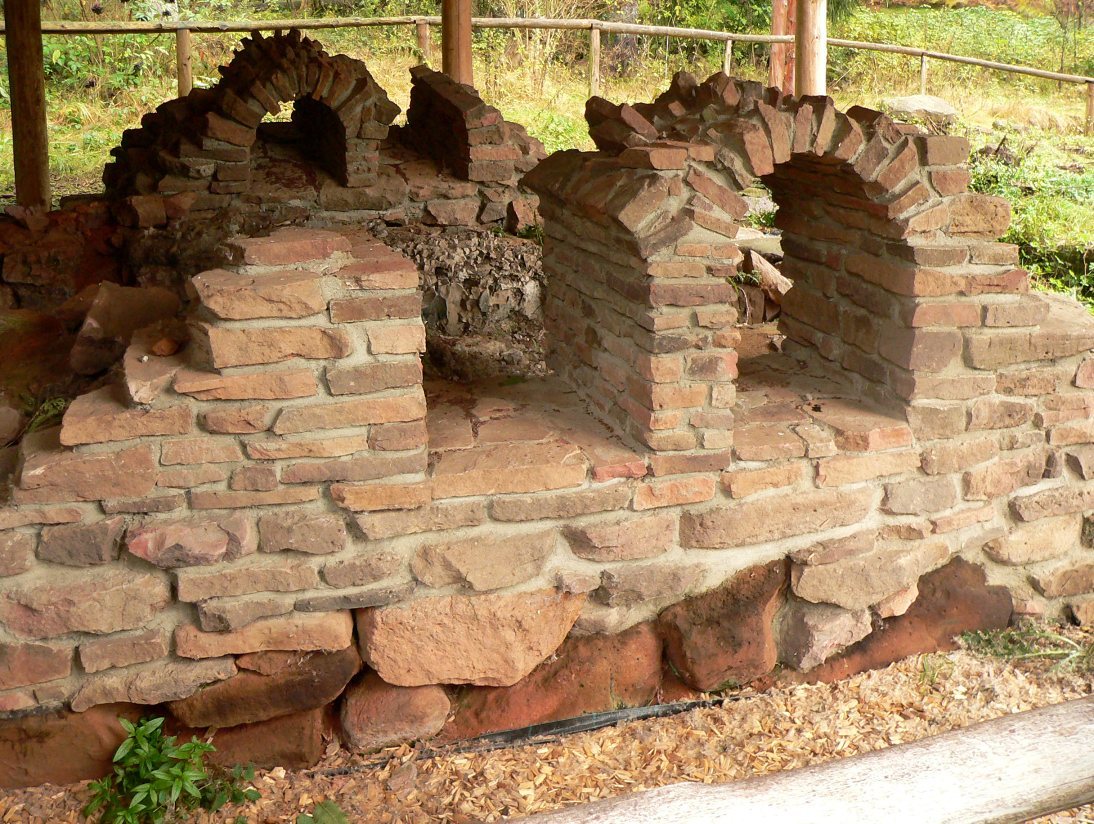
The main furnace was a pot furnace, in which glass melted in vessels, and measured about eight metres long. Its melting chamber was around four metres long, and its surviving foundation consists of red-sandstone slabs. Fragments of a likely clay upper vault include working openings and their closures. Glassmakers drew molten glass through these openings with a pipe. Impressions on surviving supports for the melting pots indicate that some vessels had base diameters of up to 60 centimetres. In 2010, the foundations were restored and the main furnace was partly rebuilt and covered. Its reconstructed openings are larger than current research suggests the originals were.
Supporting furnaces
An oval, solidly built auxiliary furnace, about four metres in diameter, and three other furnaces stood in a semicircle around the main one. Two were annealing furnaces, used to cool glass gradually. One survives comparatively well: it measures about 3.5 metres across, and a layer of clay marks the remains of its dome. The fourth combined annealing and stretching, the latter function flattening blown glass. Separate firing channels allowed its two chambers to reach different temperatures.
Drying or baking oven
A further furnace within the hall was not used to make glass. It is interpreted as an oven for drying or baking.
Waste deposits and glass products
Waste mounds
Waste mounds beside the production area rise as much as three metres above the surrounding ground. Their layers of rubble and ash reflect repeated renewals of the main furnace, which took place about once a year during the works’ operation. Excavated debris includes pieces of furnace supports and melting vessels, as well as clay made glassy by intense heat. Successive deposits of production waste and later clay levelling raised the ground and helped protect the lower parts of the furnaces.
Hollow glass and vessels
The glass was generally greenish, its colour caused by iron oxides in the sand, though coloured glass was also made. Hollow glass was the principal product, including bottles in several sizes, cylindrical drinking glasses, faceted beer glasses, and less common wine glasses decorated with berry-shaped glass bosses. Other finds include buttons, storage vessels, small pharmacy bottles, and a drinking horn decorated with applied threads and roller-stamped patterns. About 2,000 pharmacy-bottle fragments had broken during cooling. A fragment of a painted tankard bearing an imperial eagle points to the presence of a glass painter. The vessels’ forms fall between the Renaissance and Baroque styles.
Window glass and output
Window glass was blown into cylinders and then flattened in the stretching furnace. Panes could measure up to 30 centimetres along an edge. Glass fragments from the works also include laboratory glass, and annual production is estimated at 10–20 tonnes.