Tomb of Menidi: A Mycenaean Burial Tomb at Acharnes, Greece
Site at a Glance
- Popularity
- Very Low
- Country
- Greece
- Primary era
- Bronze Age
- Eras represented
- Bronze Age, Iron Age
- Civilizations
- Mycenaean
- Site type
- Religious
- Remains
- Tomb
On this page11 sections
History
Mycenaean burials and closure
The Tomb of Menidi is a Mycenaean tholos tomb, a circular chamber tomb with a domed roof, at Acharnes in Attica, Greece. It was built in the 14th century BCE during Late Helladic IIIA, a chronological phase of Mycenaean Greece. Grave goods indicate that people were buried there from the 14th into the 13th century BCE.
Six skulls or fragments of skulls indicate that at least six people were buried in the tomb. Their poorly preserved bones were scattered. The German archaeologist Habbo Gerhard Lolling proposed that the most recent body and its grave goods had been moved aside to make room for another burial. He also suggested that water entering the chamber had swept objects away and carried soil inside.
The tomb may have belonged to the family of a prince or ruler of the 14th or 13th century BCE. The nature of any territory he governed remains uncertain, while a settlement about a kilometre away may have been connected with him. In the 12th century BCE, the tomb was closed: its entrance was blocked with a wall, and earth filled the approach passage to the level of the lintel.
Hero worship
A hero cult, the ritual veneration of a hero, probably began at the tomb in the 11th century BCE. Cooking pots found there point to food offerings. The cult ended abruptly in the late 5th century BCE, possibly in connection with the Archidamian War, the first phase of the Peloponnesian War between Athens and Sparta, and the displacement of the inhabitants of Archanai.
Discovery and excavation
Farmers from Menidi found the tomb in autumn 1872 after removing a large stone and entering from above. An antiquities dealer notified the responsible ministry in December. Gustav Körte visited in autumn 1878, and the intervention of imperial envoy Joseph Maria von Radowitz enabled Lolling to obtain excavation permission. Excavations ran from 30 April to 7 June 1879 under Panagiotis Stamatakis, an ephor, or official overseeing antiquities and archaeological work. Richard Bohn prepared plans, and Emile Gilliéron drew the finds.
Remains
Layout and construction
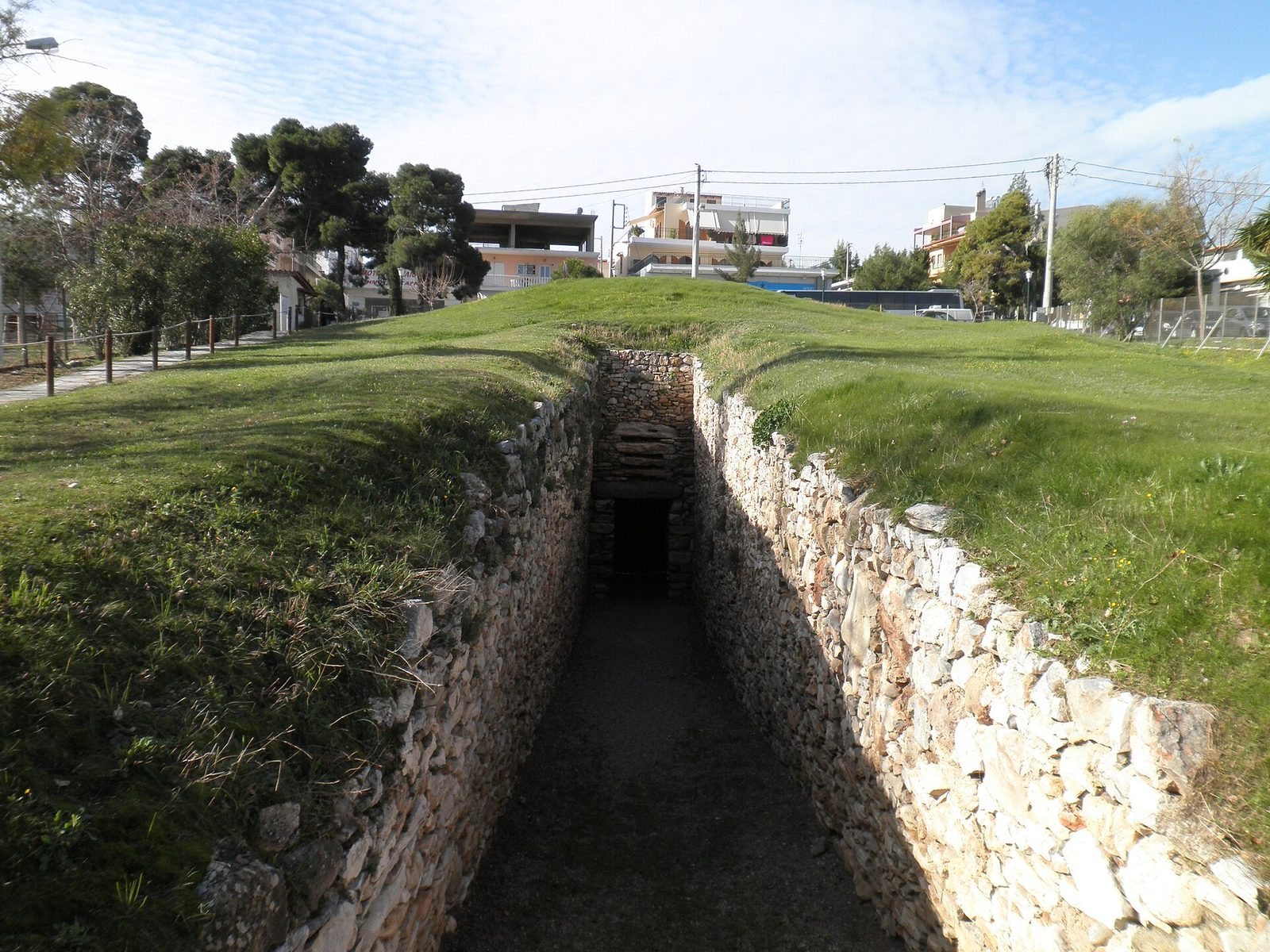
The tomb is set into the slope of an artificial mound, with an eastern approach leading to a circular chamber beneath a dome. Roughly dressed limestone was used for the passage and dome, probably from Mount Pentelikon; the passage’s corner stones received more careful finishing. The site lies in the Lykotrypa neighborhood of Kokkinos Mylos, about 3 km from present-day Acharnes and 10 km from central Athens.
Approach and entrance
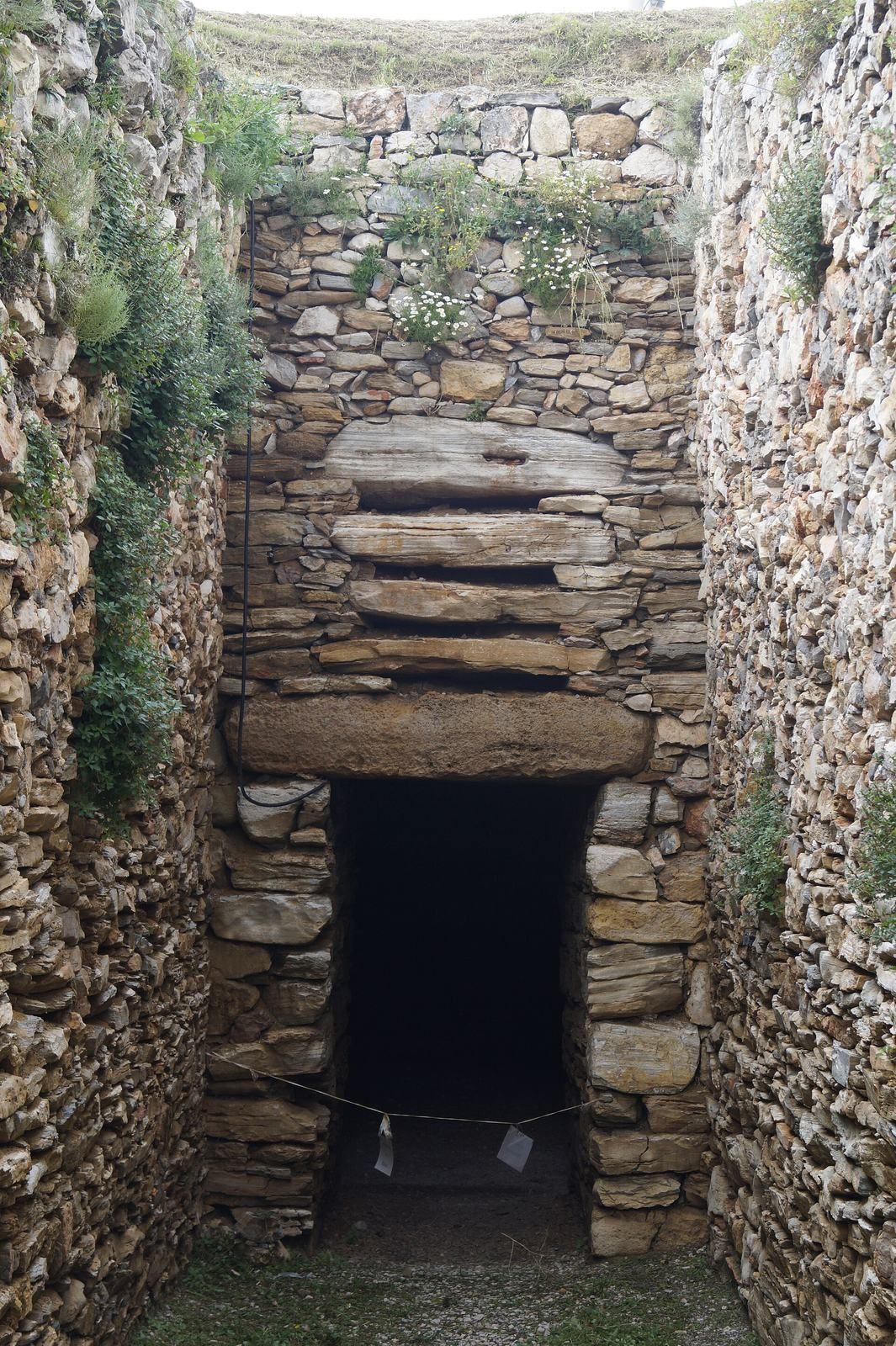
The dromos, the passage leading to the tomb, approaches from almost due east. It is about 27.7 m long and 3 m wide, and was built of irregular stones. A closing wall about 1.2 m thick stood at its beginning. The entrance is approximately 3.3 m high and 1.5 m wide, tapering slightly toward the top; the passage beyond it is 3.35 m long. Three roof stones, each about half a metre thick, cover this passage. The innermost stone follows the curve of the dome, and the stones probably came from the nearby Kifisos lowlands.
Above the interior entrance, a stone relieving triangle, a space that transfers some weight onto the side walls, reduces the load on the roof stones. Above the outer roof stone, four horizontal slabs stabilize the structure. Gaps of 10 to 18 cm separate them, and their thickness increases from about 20 cm at the bottom to 40 cm at the top.
Chamber and mound
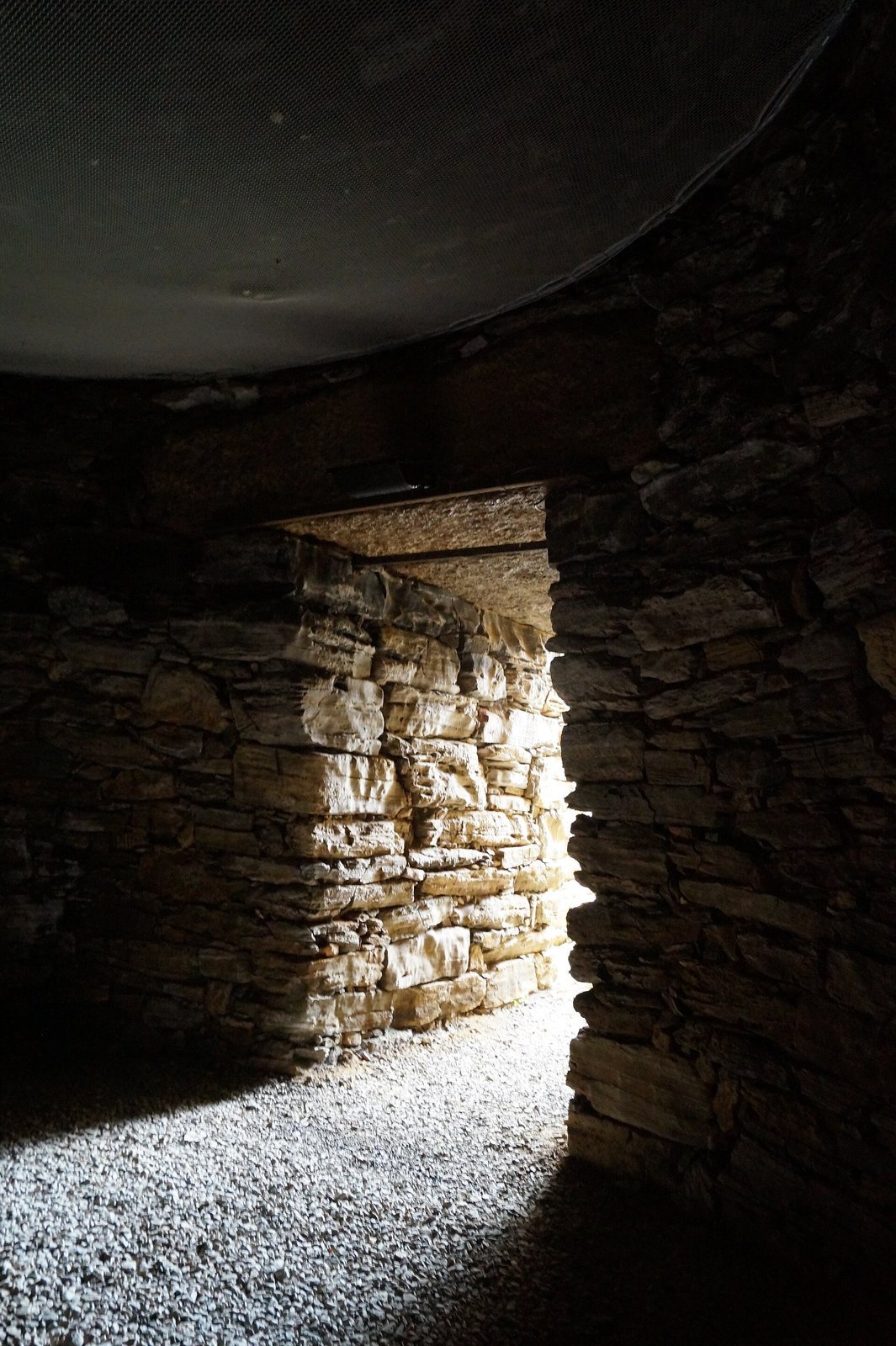
The circular chamber measures 8.35 m across and originally reached about 9 m in height. Its floor was made of tamped clay. A circular wall around the mound helped prevent the earth above the tomb from washing away. During a later phase of use, a platform covered about one-third of the chamber’s southern area. Built in several stone layers, it stood around 70 cm high and had a 5 cm limestone finish. The platform has since been dismantled.
Burial objects and later activity
Objects from the tomb
Finds from inside the tomb include Canaanite amphorae, or large jars, and stone and ceramic vessels, including egg-shaped stone examples. Other objects include bronze weapons, boar tusks probably belonging to a helmet, carved seal stones, arrowheads, faience bead necklaces, thin gold-foil sheets, gold beads, and two miniature gold vessels. Ivory objects include a cylindrical container decorated with goats on its body and lid, part of a relief showing sphinxes, and pieces of a lyre probably strung with seven or eight strings and decorated with four sphinxes.
Finds from activity outside the tomb
Objects associated with activity outside the tomb include cooking pots from the Geometric period, an early phase of Greek art named for pottery’s geometric patterns. Other finds are small Boeotian ceramic shields, votive plaques called pinakes, horse figurines, ointment and drinking vessels, cauldrons, and other pottery. A washing basin, or louterion, made in the black-figure technique, with dark figures painted against natural clay, is attributed to Sophilos, an Athenian potter and vase painter. The finds are held at the National Archaeological Museum in Athens.