Millennium Monument: A Commemorative Ensemble in Budapest
Site at a Glance
- Popularity
- High
- Country
- Hungary
- Primary era
- Modern
- Eras represented
- Modern
- Civilizations
- Austria-Hungary, Habsburg, Hungarian
- Site type
- Civic
- Remains
- Monument
On this page11 sections
History
Origins and construction
The Millennium Monument is a commemorative ensemble in Heroes’ Square, Budapest, Hungary. Designed in an eclectic style, its construction began in 1896 to mark the millennium of the Magyar arrival in the Pannonian Basin, an early medieval settlement associated with the formation of Hungary. The project also presented Hungarian economic, scientific, and artistic achievement as work capable of drawing international attention.
Budapest’s municipal assembly proposed a commemorative monument in 1891. In 1894, Parliament took up the plan and chose a site at the end of Andrássy Avenue, beside City Park. Work on the ground began late in 1896 because an ornamental gate for the Millennium Exhibition was occupying the location. Albert Schickedanz designed the ensemble, while György Zala designed and made most of its original sculptures. The monument was partly finished by 1900 and formally opened on 24 October 1901.
The central statue of Gabriel had already been shown at Budapest’s Hall of Art in 1897. It received the Grand Prix at the 1900 Paris World’s Fair. During construction, wind-load testing cracked two stone discs in the column beneath the statue. Builders replaced the column with one made from harder limestone, completing it in late autumn 1901. Four allegorical sculpture groups were installed in 1906, and Zala completed the last of the original sculptures in 1926. The ensemble’s completion followed with the unveiling of the Heroes’ Memorial Stone on 26 May 1929.
Political change and reinterpretation
On 1 May 1919, during the short-lived Hungarian Soviet Republic, a communist government, the monument was draped in red. Gabriel’s statue was altered to resemble an obelisk, and a seven-metre plaster figure of Karl Marx was placed in front. The original statue of Franz Joseph I, emperor of Austria and king of Hungary, was destroyed; a replacement was made in 1926.
The Memorial Stone, designed by the National Committee for Commemorating Heroes, honoured those who had died in the First World War but was neither a military grave nor a war memorial. It also served Hungarian irredentist aims, efforts to revise the territorial settlement imposed on Hungary after the war. Miklós Horthy, then governor of Hungary, unveiled it in 1929.
The monument suffered damage during the Second World War. Its original Memorial Stone was damaged and later removed. After the war, figures associated with struggles for Hungarian national freedom took the place of Habsburg rulers. The Habsburgs were a ruling dynasty whose members governed Hungary for centuries; the remaining statues and reliefs associated with them were removed by the 1950s. The removed statues were kept at the Kiscell Museum and later taken to Sülysáp.
A replacement Memorial Stone, designed by Béla Gebhardt, was installed in spring 1956 and unveiled with military honours on 3 April. During Mátyás Rákosi’s leadership, officials considered demolishing the monument because they viewed it as monarchist, bourgeois, and nationalist. The communist regime instead promoted a Marxist interpretation, based on the political ideas of Karl Marx.
Restoration and memorial status
Restoration work in 1995–1996 included the group of seven chieftains and Gabriel’s statue. A broader reconstruction of the monument and Memorial Stone followed in 2000–2001. In 2001, Parliament designated both as national memorial sites, and the words “In memory of our heroes” were added to the stone. The monument forms part of the UNESCO World Heritage listing for Heroes’ Square and Andrássy Avenue. Gabriel’s statue was conserved in 2021 and removed from its column in 2024 for comprehensive restoration.
Remains
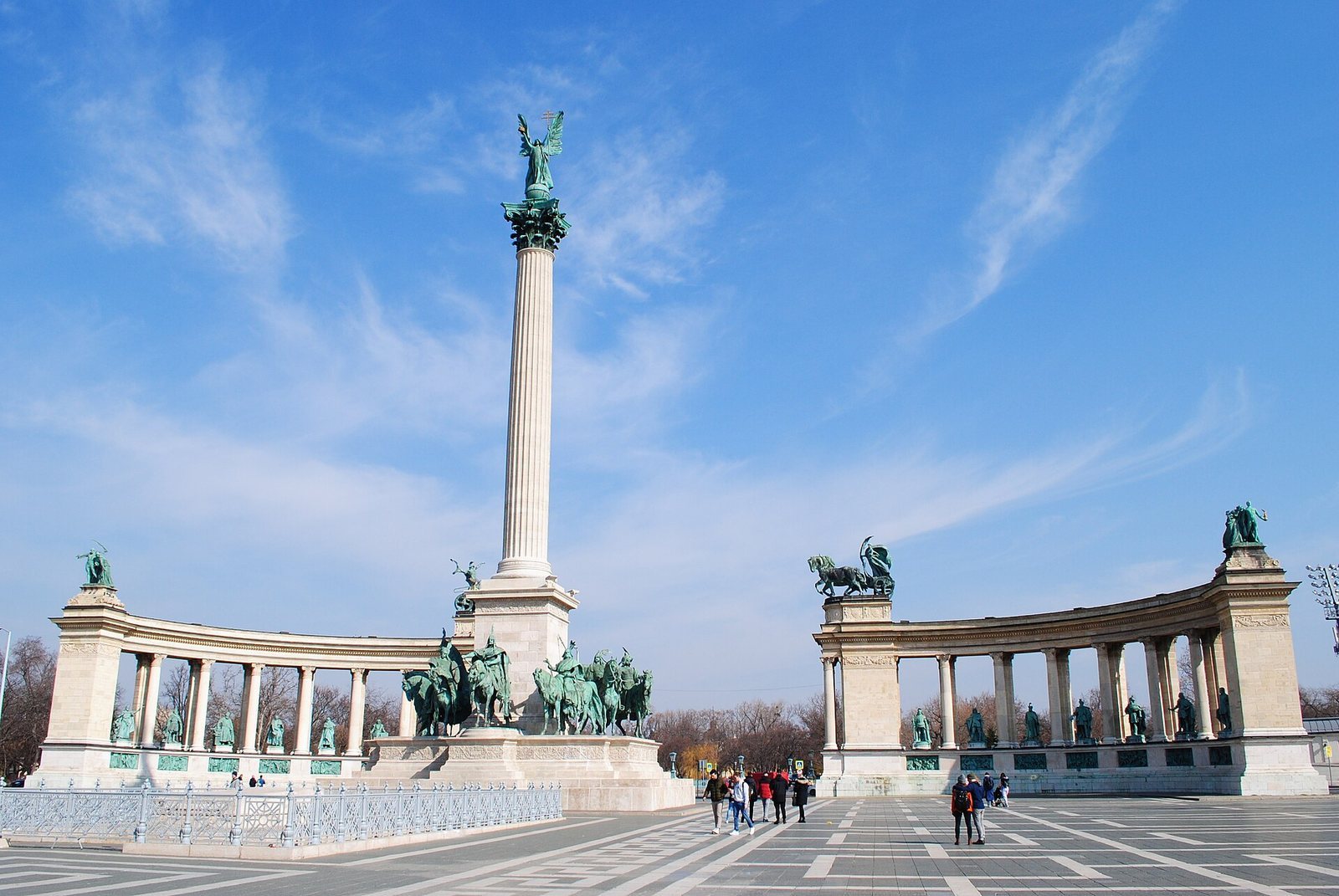
The monument forms a semicircle 85 metres wide and 25 metres deep. Its two curved colonnades stand 20 metres apart and rise 20 metres high; a central column reaches 36 metres. Bronze and marble are among the materials used in the ensemble. The central column and equestrian figures anchor the composition, with the Heroes’ Memorial Stone positioned in front.
Central and commemorative features
Column and chieftains
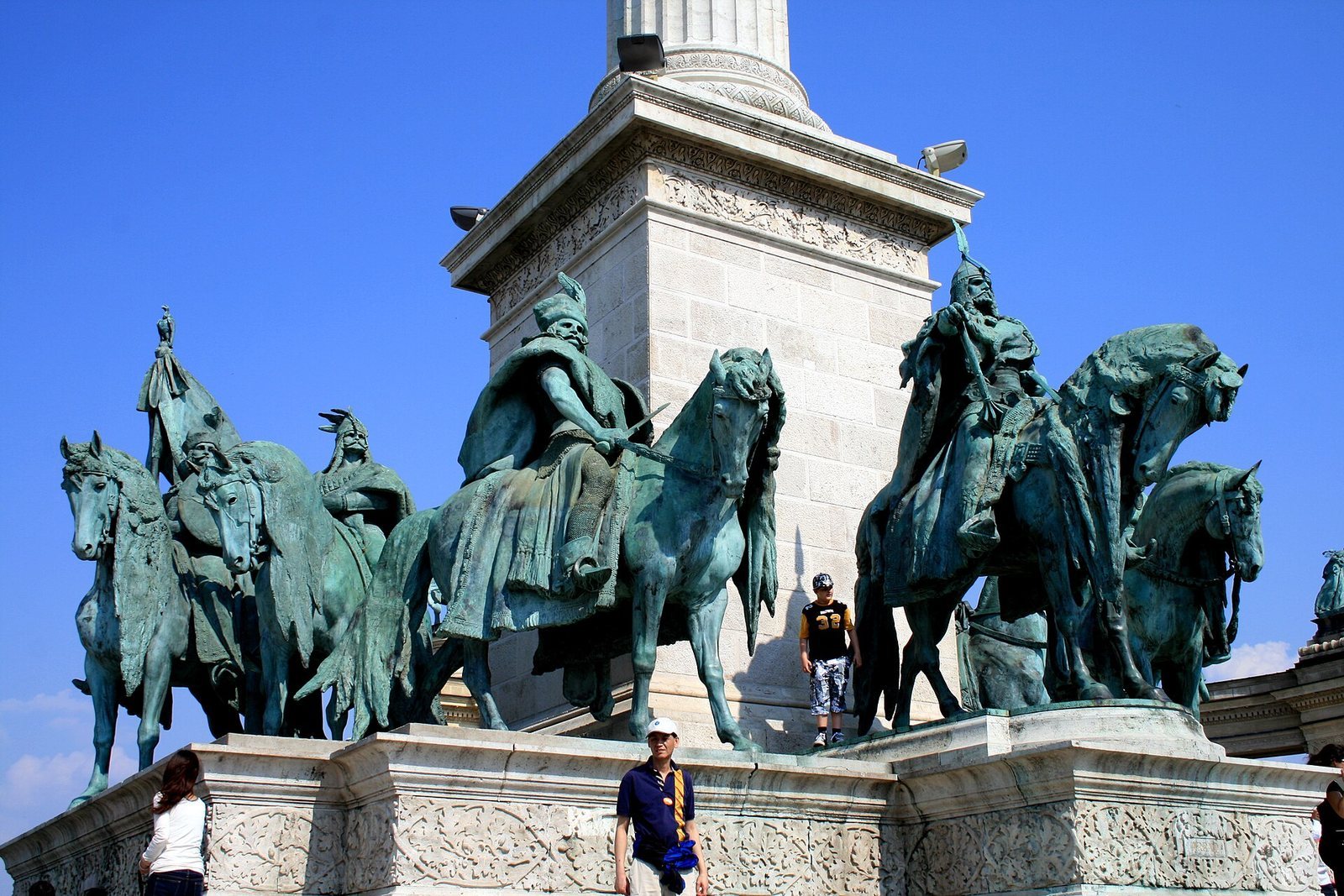
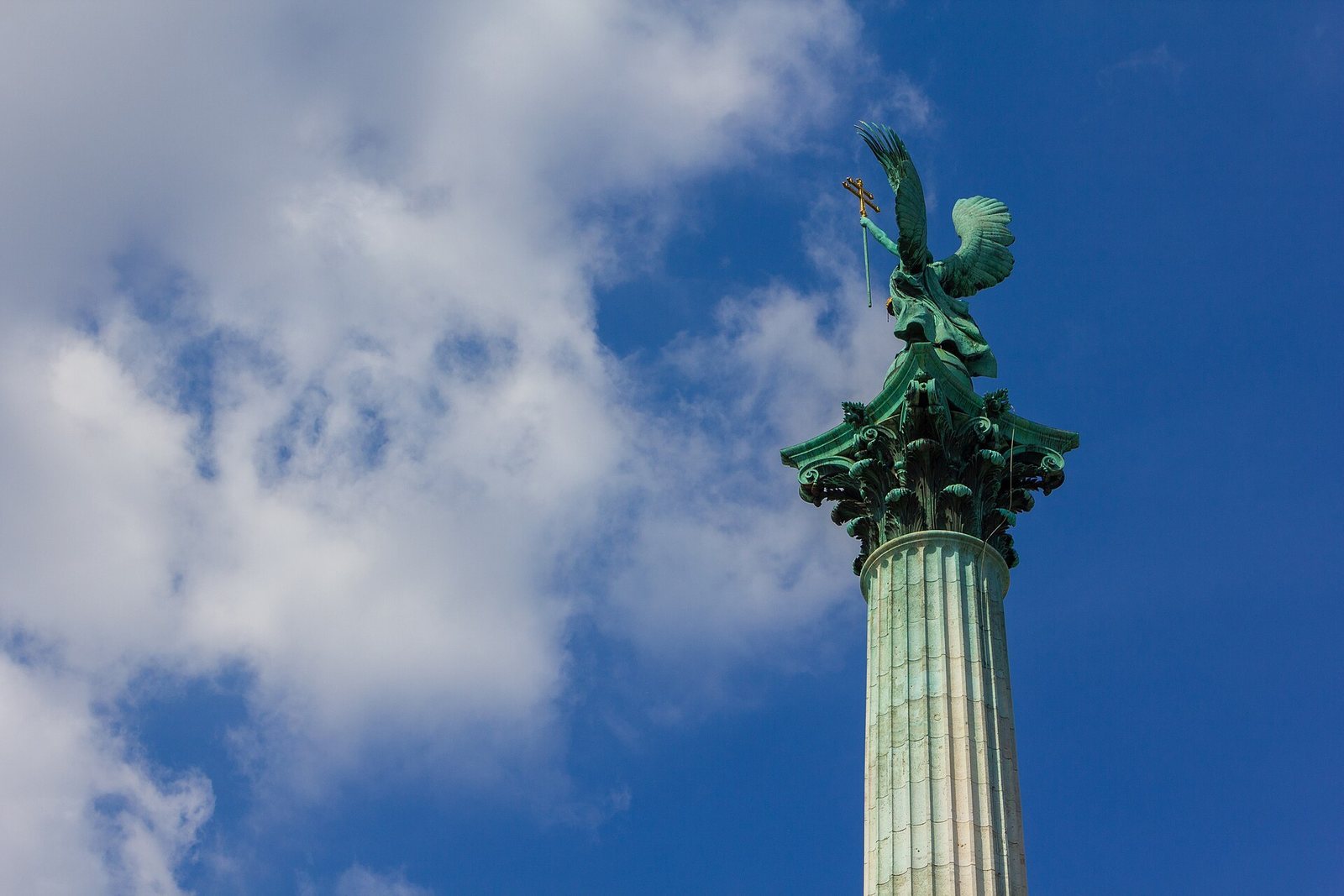
A square, stepped base supports a fluted central column with a bronze capital. At its top stands a nearly five-metre bronze statue of the winged Archangel Gabriel. He holds the Hungarian crown in his right hand and raises an apostolic double cross, a cross associated with Hungarian royal and Christian symbolism, in his left. A legend links the pose to a dream of Saint Stephen, Hungary’s first king. Around the column’s base, bronze equestrian statues depict seven Magyar chieftains, led by Árpád, who is traditionally remembered as a leading figure in the settlement associated with Hungary’s formation. Töhötöm, Ond, and Kond appear on the left, from back to front; Tas, Huba, and Előd stand on the right in the same order.
Memorial Stone and well
The plain replacement Memorial Stone is a monolith measuring 2.4 metres wide, 4.5 metres long, and 0.5 metres high. Its inscription reads, “In memory of our heroes.” A metal plate between the stone and Árpád’s statue covers an artesian well, where groundwater rises under natural pressure. Geologist Vilmos Zsigmondy began drilling in 1868 and reached thermal water on 4 June 1877, at a depth of 970 metres.
Colonnades and sculpture
Statues and historical reliefs
Each curved colonnade contains seven bronze statues standing on high pedestals. Historical reliefs occupy open niches below them, showing events associated with the figures and their periods. Subjects include the pope sending a crown to Saint Stephen at Christmas in 1000; Saint Ladislaus defeating a Cuman, a member of a Turkic people, who had abducted his daughter; and military commander János Hunyadi’s victory over Ottoman forces at Belgrade. Other panels depict Matthias Corvinus among scholars, Coloman the Learned prohibiting the burning of witches, and Andrew II leading a crusade, a medieval military expedition framed as a Christian religious campaign, to liberate Jerusalem.
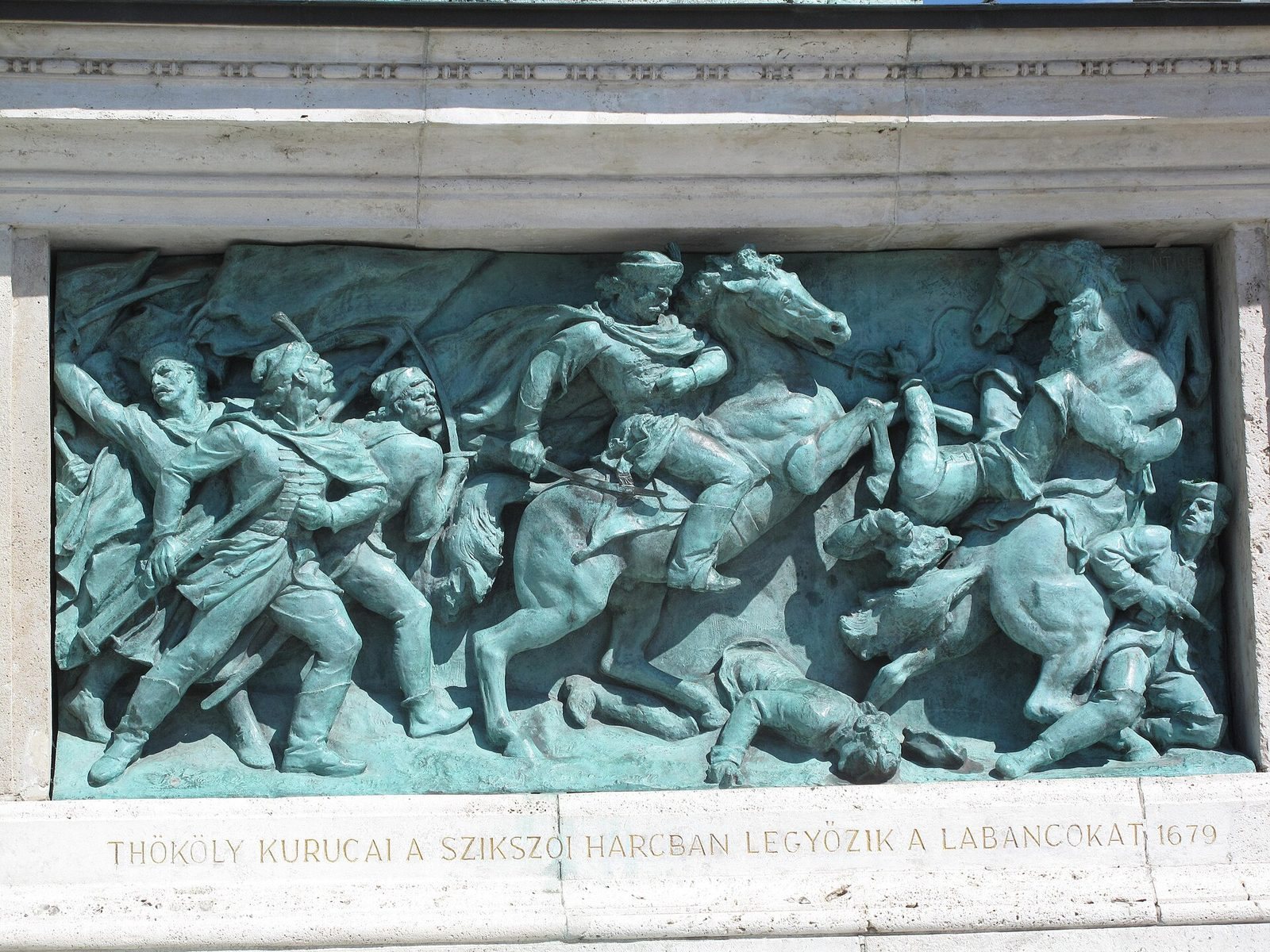
Further reliefs show Stephen Bocskai fighting imperial mercenaries, Gábor Bethlen forming an alliance with the Czechs, and Béla IV rebuilding the country after the Mongol invasion. Imre Thököly’s Kuruc insurgents, who opposed Habsburg rule, are shown defeating the Labanc forces loyal to the Habsburgs at Szikszó. Other scenes depict Tamás Esze and his serf army welcoming Francis II Rákóczi, Louis the Great entering Naples in 1348, and revolutionary statesman Lajos Kossuth calling the inhabitants of the Great Hungarian Plain to arms.
Allegorical groups
Zala’s four sculptural groups occupy the corner supports of the colonnades. On their inner sides, War appears as a male charioteer with a whip, while Peace holds a palm branch. The outer groups represent Labor and Prosperity, with a nude man carrying a scythe and a woman holding fruit, and Knowledge and Glory, with a nude man holding a golden figure of Nike and a woman carrying an olive branch.