Dominican Monastery on Margaret Island: A Medieval Royal Convent in Hungary


Site at a Glance
- Rating
- 4.6
- Popularity
- Low
- Country
- Hungary
- Primary era
- Medieval
- Eras represented
- Medieval
- Civilizations
- Hungarian
- Site type
- Religious
- Remains
- Fortified Monastery
On this page15 sections
History
The Dominican monastery on Margaret Island is a medieval convent in Budapest, Hungary, founded by King Béla IV in the mid-thirteenth century in honor of the Virgin Mary. It became the residence of his daughter Margaret, a Dominican nun, and developed into a royal nunnery and educational center during the rebuilding of Hungary after the Mongol invasion of 1241–1242.
Royal island before the convent
The island, formerly known as Rabbits Island, had belonged to the Hungarian royal family from an early period. Historical tradition places a royal residence on its elevated eastern side around the turn of the twelfth and thirteenth centuries, during the reign of King Imre, who ruled Hungary from 1196 to 1204. A church was later built beside the residence, and King Andrew II entrusted it to the Premonstratensians, a Catholic religious order founded in the twelfth century.
After the Mongol invasion, Béla IV strengthened the royal residence with a horseshoe-shaped corner tower, giving it a more castle-like character. From 1243, the site temporarily housed the king and queen because their residence at Óbuda had been destroyed and burned. Béla also began establishing a monastery beside the residence for his daughter Margaret, who had been vowed to the Church before her birth as a thanksgiving offering for Hungary’s survival. She was born at Clissa on the Adriatic coast in 1242.
Foundation and royal patronage
The first monastery buildings were probably constructed between 1246 and 1255. The Dominican friar Mihály directed the work and enforced the community’s religious rule. In 1252, Margaret and her companions were transferred from the Dominican nuns’ monastery at Veszprém to the new island convent. By the time its foundation charter was issued in 1259, the buildings were complete.
The institution was initially administered by the Augustinians and later by the Dominicans. Ákos, the provost of Buda, an ecclesiastical official with administrative responsibilities, helped establish it. Béla IV endowed the convent with extensive estates, and by 1270 its property included eighty villages. Papal support, considerable toll revenues, and the admission of daughters from wealthy noble families further strengthened the community.
The monastery functioned both as a leading nunnery and as a school for girls. Three other Árpád princesses, members of Hungary’s medieval ruling dynasty, later lived there alongside Margaret. A nearby male religious house was also built. The royal residence remained a place for major political events, including the peace made between Béla IV and his son in 1266. Béla died on the island in 1270.
Margaret and the monastery’s religious importance
The convent gained further importance after Margaret’s death through the movement to have her declared a saint. Reports of miracles circulated during her lifetime, and an investigation begun in 1276 preserved detailed information about her life, her tomb, and the convent. These records became the basis for several versions of the Legend of Saint Margaret. Her brother, King Stephen V, requested her canonization in 1272. Canonization, the formal declaration by the Catholic Church that a deceased person is a saint, was granted in 1943.
The monastery also remained closely connected with the royal family. Queen Elizabeth, the Cuman wife of Stephen V and mother of King Ladislaus IV, moved to the island after her son’s death and died there in 1295. She was buried in the monastery church near Margaret and Stephen V. Béla’s granddaughter Elizabeth later became abbess. From September 1286 to August 1287, the monastery also held the displaced Queen Isabella, daughter of the King of Naples, under supervision.
Medieval rebuilding and abandonment
Hungarian kings continued to support the convent during the fourteenth and fifteenth centuries. The complex was enlarged and rebuilt several times, with the final major medieval rebuilding taking place during the reign of King Matthias, from 1458 to 1490. The enclosure walls were strengthened as the site acquired a more fortified appearance.
The nuns considered leaving after the fall of Belgrade in 1521, but their superior prevented the departure. They left for Kőszeg immediately after Hungary’s defeat at Mohács in 1526, although they later returned temporarily. They departed permanently either in 1529, after news of another major Ottoman campaign, or by 1540. The last island nun died in the Poor Clare convent at Pressburg in the early seventeenth century.
After Buda came under Ottoman control in 1541, the island’s buildings, including the nunnery, were ravaged. The surviving structures were then used for military purposes and gradually deteriorated. When Buda was recaptured in 1686, only ruins remained. The island later became a park and retreat for palatines, senior Hungarian royal officials who could act as the king’s deputies, from the Habsburg dynasty, while the medieval remains received limited attention.
Excavation, restoration, and cultural memory
Archaeological interest increased in the second half of the nineteenth century. A flood in 1838 exposed the graves of Margaret and Stephen V, prompting excavation. Further investigations took place between the two world wars and from 1958 to 1962. Major work began in the 1960s under the archaeologist F. Tóth Rózsa, paused for a period, and resumed in the 1990s under Írásné Melis Katalin together with restoration. A substantial part of the monastery and its associated buildings remains unexcavated.
The restored presentation of the ruins received an ICOMOS award in 2009. The monastery also occupies an important place in Hungarian literature. It is the setting of Géza Gárdonyi’s novel God’s Prisoners, which concerns Margaret’s life, and of the second part of János Kodolányi’s novel Blessed Margaret.
Remains
The archaeological garden presents the remains of several building periods, organized around the church, Margaret’s tomb, and the nuns’ monastery. The complex followed a Cistercian-type church plan, an arrangement associated with a relatively austere medieval longitudinal layout. The surviving structures and associated features form a partly excavated ruin site.
Church and sanctuary
Church building
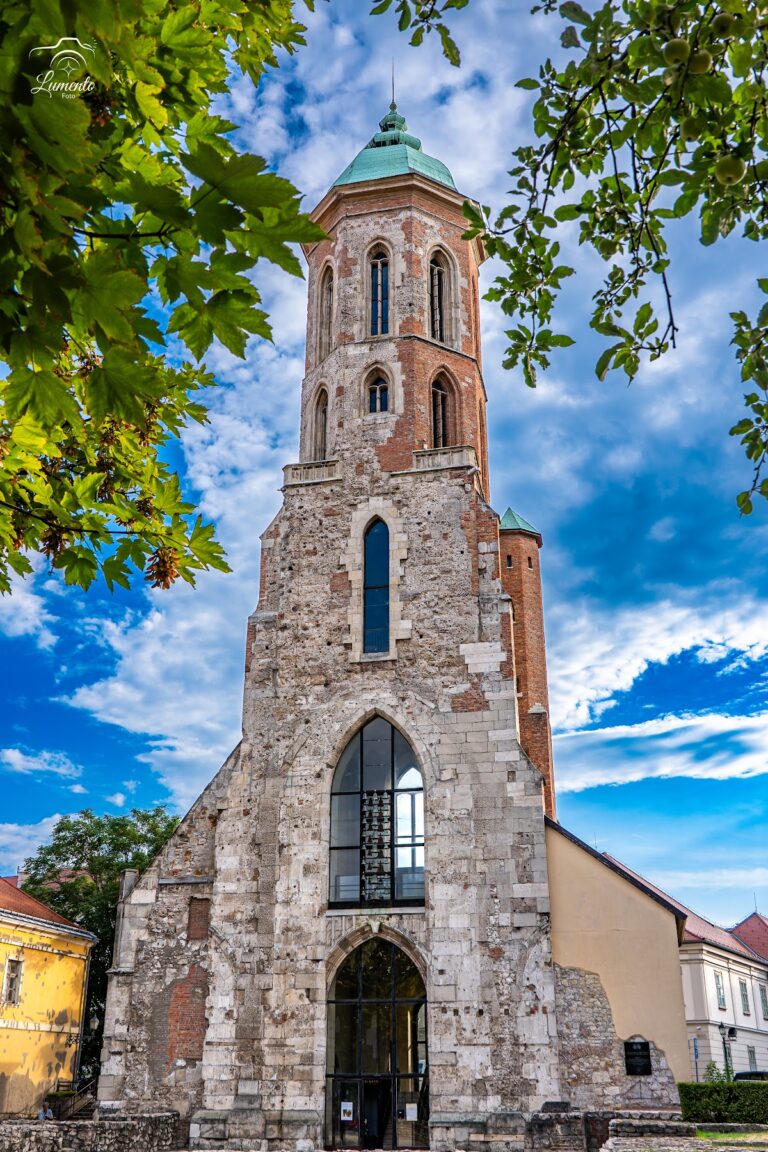
The church was originally Romanesque and measured 51 metres in length and 12 metres in width. In the second half of the fifteenth century, its interior received a Gothic net vault, a vaulted ceiling whose ribs form an interlaced geometric pattern. A later building phase began in 1381 under Paul the Younger, son of the master builder Demeter of Szántó. The sanctuary was enlarged at that time, following the example of the Dominican monastery in Buda, and ended in an apse with five sides of an octagon.
Further rebuilding continued around 1500. Part of the monastery was re-vaulted, and the nuns’ gallery, an elevated space reserved for the sisters within the church, was rebuilt. These changes form part of the architectural sequence visible in the archaeological garden.
Margaret’s tomb
Margaret’s tomb stood in the church sanctuary on the line of the triumphal arch and was enclosed by a wall. The first tomb monument was completed in 1271. It was made from red marble by the Lombard sculptors Peter and Albert. In 1335, a new white-marble monument was produced by a sculptor from the circle of Tino di Camaino and placed behind the sanctuary, where it was protected from pilgrims.
Monastery buildings and enclosed grounds
Nuns’ monastery
The monastery occupied the southern side of the church. Its buildings included a chapter house, where the religious community met for official business, as well as a dormitory, refectory, and kitchen. A hospital and guesthouse formed part of the associated complex. The guesthouse accommodated members of the royal family, while the hospital stood west of the monastery.
Hospital chapel
A chapel was built at the end of the thirteenth century beside the hospital. It was intended for pilgrims and formed part of the group of buildings west of the main monastery. Together with the hospital and guesthouse, it shows that the convent included facilities beyond the nuns’ residential quarters.
Enclosure walls
Castle-like walls enclosed the monastery complex. They were reinforced during the reign of King Matthias, adding to the defensive character that had developed through the medieval rebuilding of the royal residence and convent. The walls survive as part of the archaeological remains presented in the garden.
Monastery garden
The monastery garden preserves the earliest known Hungarian garden-art monument. An aqueduct supplied water for irrigation by 1251. During the Ottoman period, Danube alluvial deposits buried the garden. Excavation later exposed the graves of Margaret and Stephen V after the flood of 1838, while the restored archaeological garden now presents the surviving remains of the monastery and its associated structures.
Nearby sites