Castle Old Blumberg: A Medieval Fortress on the Schaffhausen-Hüfingen Road
Site at a Glance
- Popularity
- Low
- Country
- Germany
- Primary era
- Medieval
- Eras represented
- Medieval
- Civilizations
- Holy Roman Empire
- Site type
- Military
- Remains
- Castle
On this page7 sections
History
Castle Old Blumberg, also known as Alt-Blumberg, was a medieval hilltop fortress west of Blumberg in Germany. It was built in the 12th or 13th century, most likely around the transition between them, to guard the important road between Schaffhausen and Hüfingen. Its defensive role extended beyond local lordship: the castle formed part of a network begun by the dukes of Zähringen and later expanded by the Fürstenbergs and their vassals.
Origins and the Blumberg lords
The hill may have been fortified in prehistoric times, though this possibility remains unconfirmed. A castle and its associated farm are thought to have existed by 1218, before a village had developed. The frequently cited written reference of 1260 may therefore postdate the castle’s beginnings. The hill may already have been called Blumberg, meaning “Flower Mountain,” and the Lords of Blumberg probably took their name from the place.
The farm supplied the castle in both peace and war. Workers and craftspeople gathered around it, and a mill was established later. This settlement became the starting point for Blumberg’s development as a town. Before the town emerged, the community is thought to have included farm laborers, a lordly mill and a few small farmers connected with the castle household. Establishing the castle and farm may have required land from neighboring village districts. Hondingen is one possible source: its church was Blumberg’s mother church and the parish church of Fürstenberg.
The early Blumberg lords were probably ministeriales, service retainers who could rise into the lower knightly nobility, of either the Zähringen or the Counts of Urach. During the Interregnum, a period of disputed kingship and weak central authority in the German lands, they served the Counts of Freiburg and Fürstenberg. They were also particularly close to Rudolf of Habsburg, elected king in 1273. A deed from March 1260 names Hans von Blumberg as a “brother,” a title that may point to membership in a religious order; a record from July identifies Johannes von Blumberg as a knight.
Hüfingen and the family’s changing fortunes
In 1274, King Rudolf confirmed Johannes von Blumberg’s right to hold the Pentecost market at Hüfingen. Over the next two decades, the family became lords of Hüfingen, which had become the center of their lands by the turn of the 14th century. Blumberg remained their ancestral castle. A deed of 1292 reflects the family’s division into branches linked with castles at Blumberg, Blumenfeld, Blumegg, Donaueschingen, Stahlegg and Tannegg, as well as settlements and estates across the southern Baar, western Hegau and Wutach Gorge.
In 1356, Diethelm von Blumberg divided his share of Hüfingen’s castle, town and village between Konrad von Blumberg and Johannes the younger with his brothers Rudolf and Albrecht. The family held Hüfingen as a fief, land granted by a superior in return for obligations, from the Landgrave of the Baar, the region’s territorial lord. The arrangement permitted the property to be pledged and passed to female heirs. Count Heinrich of Fürstenberg renewed that privilege for Burkhardt von Blumberg in 1380.
When Burkhardt died in 1382, his will left the Hüfingen inheritance to his sister Guta, her husband Bentz von Schellenberg and their children. A dispute with the Blumberg cousins was settled in Guta’s favor, and by 1383 Berthold von Schellenberg called himself lord of Hüfingen. After more than a century, the Blumbergs had lost their main center there.
The family re-established its center at Blumberg. In 1384, Rudolf von Blumberg described himself as living there. A document from 1392 refers to a “New Blumberg,” perhaps built to secure western lands and the route from Hüfingen toward the Wutach. The older castle was retained as a source of income and was intended for expansion. References to “old Blumberg” often distinguished family members associated with the two castles, rather than consistently naming the older building.
A mediation document from 1413, concerning a conflict between Fürstenberg and Lupfen, calls Blumberg a stat, a term that may mean a settlement but does not establish that it had formal town status. Rudolf of the old Blumberg line died that year, and the main family line ended by 1451. The lordship passed to Sigmund vom Stein and his family, but they held it only briefly; the Randeggers apparently did not reside there. Documents call it the Castle of Blumberg from 1484, with a different spelling appearing from 1507.
Landau rule, war and destruction
By inheritance, Blumberg passed to Hans von Landau, who developed the castle and town. During the Swiss or Swabian War of 1499, a conflict involving the Swiss Confederacy and forces of the Swabian League and Habsburg lands, the castle and town held out against Swiss troops approaching from Waldshut. Blumberg gained a reputation as the first town to stop their advance. The undefended village was burned to disrupt the attackers’ supplies and was later rebuilt amid its ruins.
Lutz von Landau later sold the castle and small town to Hans Jörg von Bodman. On 4 April 1537, the guardians of Bodman’s underage son, Hanswolf, sold the property, along with its rights and appurtenances, to Count Friedrich of Fürstenberg.
French forces destroyed the occupied castle on 4 May 1644, during the Thirty Years’ War, a major European conflict that lasted from 1618 to 1648. Before withdrawing, the French commander La Valette ordered the fortress blown up. The explosion reportedly injured La Valette, soldiers and several farmers; ten people were thrown into the air and burned. The castle was not rebuilt. A separate New Building served as a stable and granary until the town fire of 1873 destroyed it.
The main tower was blown up in 1706, and castle stones were reused in houses in Blumberg and its village during the 19th century. Further clearance took place in the 1960s, with the final removal dated to 1967.
Remains
Setting and defenses
The castle occupied the western end of a built-up group on a spur about 675 metres above sea level, west of Blumberg and above the Wutach valley. Steep slopes protected the southwest side; marshy ground to the north and east, later obstructed by ponds, restricted access. A road provided an approach that could be guarded. In front of the castle, an outer bailey, the castle’s outer fortified area, was divided from it by a neck ditch, a defensive trench cut across the narrow spur. The bailey area later became the town immediately in front of the castle, while the village lay farther away, in the area corresponding to the present town centre.
Surviving features and historic depictions
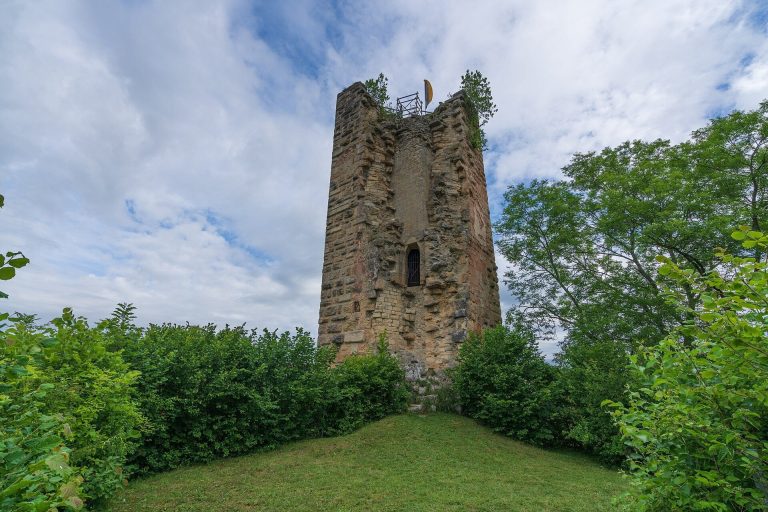
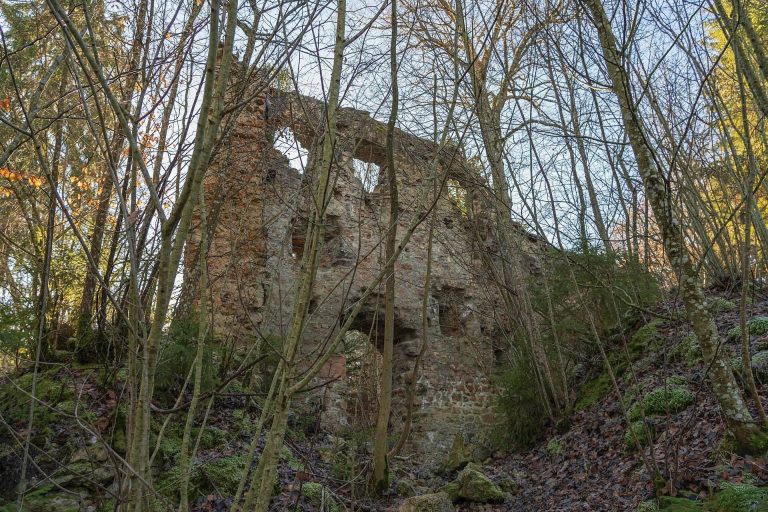
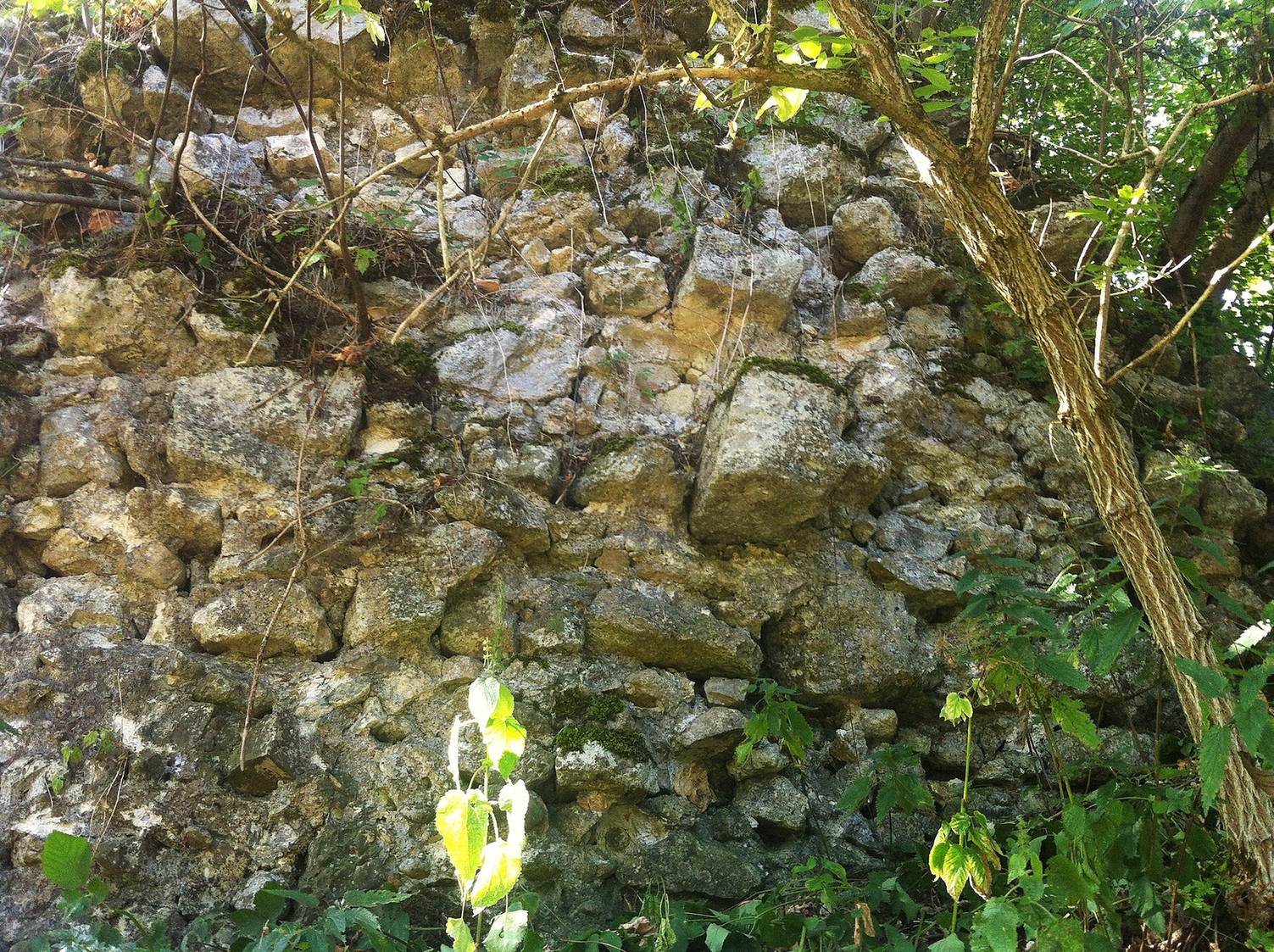
The former castle site has uneven ground and small terraces on its west-facing spur. The neck ditch remains visible as a depression; at its eastern end, large stones survive at a corner of the ditch’s outer retaining wall. Fragments of retaining walls and other traces of the ditch also remain. Older building fabric survives in a structure at the northeastern corner of the town complex. A substantial reinforcement marks its southeastern corner, and a thicker wall is incorporated into a gable at the northern corner. A sketch from 1620 and an oil painting by Martin Meinrad from 1688 depict the former arrangement of castle, town and village. The painting is the only known depiction from before the 19th century; its original is held at Heiligenberg Castle.