Dolmen del Prat Clos: A Final Neolithic Tomb in France
Site at a Glance
- Popularity
- Very Low
- Country
- France
- Primary era
- Stone Age
- Eras represented
- Stone Age
- Civilizations
- Unclassified
- Site type
- Burial
- Remains
- Tomb
On this page9 sections
History
Dolmen del Prat Clos is a prehistoric tomb formed from upright stones on the Pla de Balençò plateau in France. It belongs to the Final Neolithic and is associated with the Bell Beaker culture, named for its distinctive bell-shaped pottery, and the Véraza culture, a regional archaeological culture of southern France.
Neolithic date and cultural associations
Charcoal used as temper in two vessels attributed to the Véraza culture yielded a radiocarbon date of 3096–2913 BC. The vessels were found at the ancient ground surface; the date applies to the sampled charcoal rather than establishing the tomb’s exact construction date.
Local memory and investigation
Local shepherds understood the monument as a burial place and called it taüt, meaning “grave” or “coffin.” A tradition that treasure was hidden there prompted earlier digging. Jean Abélanet learned of the dolmen from a shepherd, excavated its chamber, and restored it in 1968. He brought it to wider attention in 1970 using information gathered earlier.
In 2013, archaeologist Noisette Bec Drelon carried out test excavations in the mound to examine how it had been built.
Remains
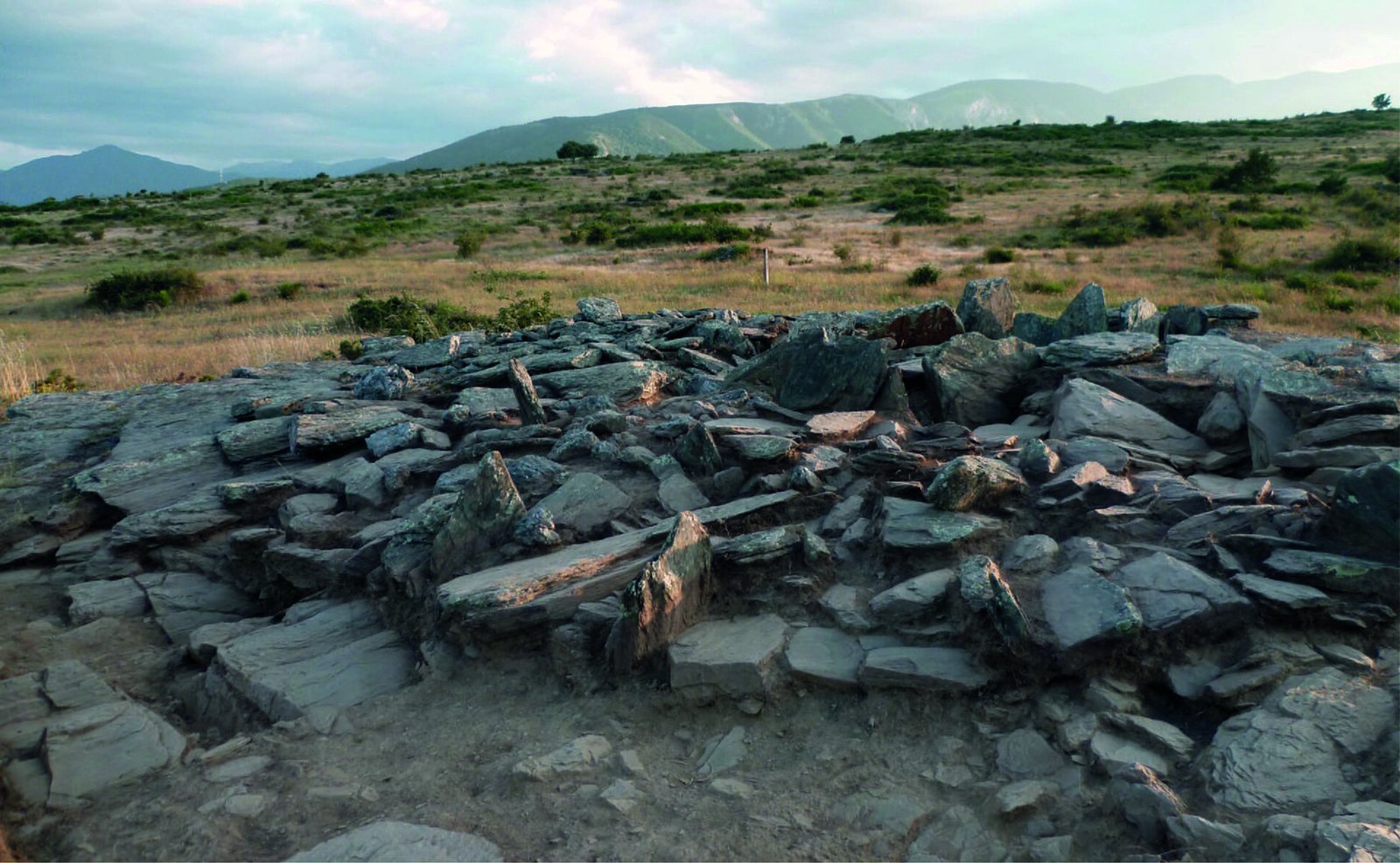
The ruined monument comprises a stone chamber within a roughly circular mound. It stands on a stepped rock outcrop on the small Pla de Balençò plateau, at about 800 metres above sea level.
Chamber and entrance
The chamber resembles a large stone box, measuring about 3 metres long and 1.5 metres wide. Eight locally sourced slate slabs form its sides and ends, with two slabs at each end and three along each side. The stones are deeply fissured, and some lean inward; one appears to be missing at the northwest corner. The chamber opens toward the south-southeast. Its roof arrangement is unknown, though several covering slabs may have been needed for its length. The dolmen has no passage, but upright slabs within the mound may have formed an entrance structure.
Mound and landscape
The mound is about 7 metres across and was built from alternating radial slabs and dry-stone walls, an arrangement also found at several dolmens in the eastern Pyrenees and western Hérault. The stepped rock outcrop beneath it added height and visibility on the plateau and provided stone for construction. The dolmen overlooks a broad panorama, including Pic du Canigou and the Têt valley to the southwest, and lies north of Pla de Vall en So and Llúgols. The surrounding pastoral landscape includes dry-stone shepherds’ huts, prehistoric cists, and rocks bearing cup marks or other engravings. The name Prats-Clos means “fenced meadow” in Catalan.
Archaeological finds
Finds from the chamber
Excavation of the chamber recovered objects from more than one period, including four arrowheads, two leaf-shaped and two with tangs, and part of a polished schist plaque.
Finds from the mound and ground surface
Sifting excavated spoil from the mound produced two more piercing arrowheads, one leaf-shaped and one with a tang, along with handmade pottery sherds attributed to the Bell Beaker culture. Test excavations in the mound yielded Véraza-attributed pottery sherds and small quartz stone tools.