Uraniborg: Tycho Brahe’s Royal Observatory on Ven
Site at a Glance
- Rating
- 4.4
- Popularity
- Very Low
- Country
- Sweden
- Primary era
- Early Modern
- External website
- Open
- Eras represented
- Early Modern
- Civilizations
- Danish
- Site type
- Civic
- Remains
- Observatory
On this page16 sections
History
Foundation and royal patronage
Uraniborg was a Danish royal observatory and alchemical laboratory on the island of Ven, at present-day Sankt Ibb in Sweden, built for the astronomer Tycho Brahe. Its cornerstone was laid on 8 August 1576, and construction continued until 1580 in the Flemish Renaissance style, an architectural tradition developed in the Low Countries. It was the first observatory of the modern era in Europe designed specifically for astronomical research and among the earliest research observatories financed entirely by a government. At the time, it was regarded as Europe’s leading observatory.
Brahe was considering leaving Denmark for Basel when King Frederick II offered him Ven, a yearly pension, and support to keep him in the kingdom. The king paid for the observatory’s construction, while Brahe was responsible for its upkeep and operation. The project was estimated to cost about one percent of the state budget. Frederick also gave Brahe extensive authority over the island and income derived from its inhabitants’ work. Brahe’s severe administration and heavy use of local resources eventually weakened his standing at court.
Research and collaboration
Uraniborg served both as a place for astronomical observation and as an alchemical laboratory. Alchemy was an early practice concerned with investigating and transforming matter, often in connection with medicine and metalworking. Brahe and his assistants also studied weather and astrology, the interpretation of celestial positions as influences on earthly events, with the aim of making astrological judgments more empirical. More than thirty assistants worked at Uraniborg over its lifetime, while teams of around twenty to thirty collaborators carried out observations and calculations. Students, researchers, and royal guests also came to the island.
Brahe used observations of the comet of 1577 to question the accuracy of star positions in both the Ptolemaic and Copernican systems. His further work at Uraniborg led him to present the Tychonic system in 1588. This geoheliocentric model held Earth stationary, with the Moon and Sun circling Earth while the other planets circled the Sun. The mathematician and astronomer Paul Wittich, who spent several months at Uraniborg in 1580, helped Brahe develop the system.
Brahe’s observations reached an accuracy of about one arcminute, one-sixtieth of a degree, roughly ten times finer than the precision previously available. His catalogue of 1,005 stars later provided a basis for Johann Bayer’s Uranometria, published in 1603. Brahe also prepared meteorological findings for Frederick II, although those publications did not bear his name. He shared astronomical and weather observations, including results gathered by his assistants, with Dutch globe makers Arnold van Langren and Willem Janszoon Blaeu, but kept his alchemical work private.
Brahe urged Johannes Kepler to publish tables of Mars using Brahe’s cosmological model. Kepler instead drew on the observations to support a Copernican account and described planetary orbits as elliptical. The collected observations were first published by Kepler in 1627 and later helped him formulate his laws of planetary motion. James VI of Scotland, who later ruled England as James I, visited Uraniborg on 20 March 1590. That year he also gave gold coins to workers associated with the site’s paper and grain mills.
Departure and rediscovery
After Christian IV succeeded Frederick II, Brahe lost royal financial support. He left Ven in 1597 and departed Denmark. Uraniborg and the separate observatory of Stjärneborg were destroyed after his departure; Uraniborg’s destruction is dated to 1601, after Brahe’s death. Islanders reused stone from the buildings in other construction. Copenhagen’s Round Tower, inaugurated in 1642, subsequently took over Uraniborg’s astronomical function.
In 1671, French astronomer Jean Picard visited the ruins and measured their latitude and longitude so astronomers could compare their work with Brahe’s observations. He also dug in search of the main building’s foundations and later returned to investigate atmospheric refraction, the bending of light as it passes through the atmosphere. His account of the expedition appeared in 1680.
Excavations in the 1950s revealed parts of Uraniborg and an underground laboratory at Stjärneborg. Uraniborg’s exterior walls were reconstructed after the excavations, and a broader rebuilding proposal followed in the 1980s. Garden restoration began in 1985, alongside study of plant remains to identify the plants once grown there and their locations. A 1992 plan proposed reconstructing about a quarter of the rampart. Restored elements of Uraniborg and Stjärneborg were incorporated into the Tycho Brahe Museum.
Remains
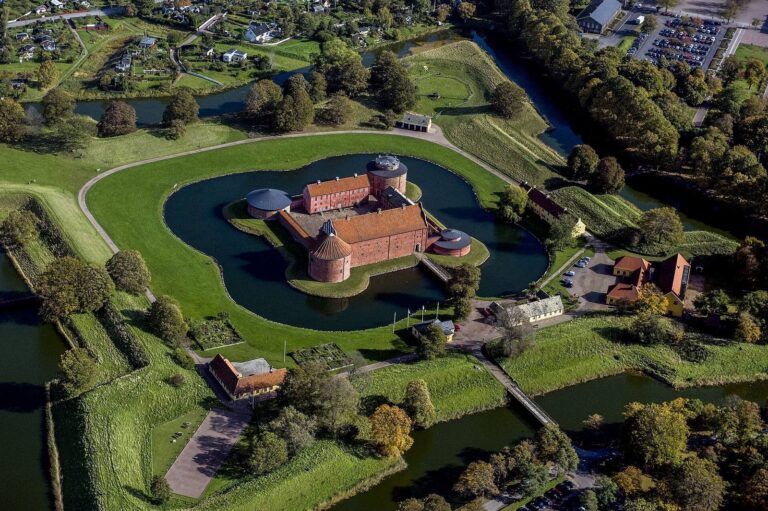
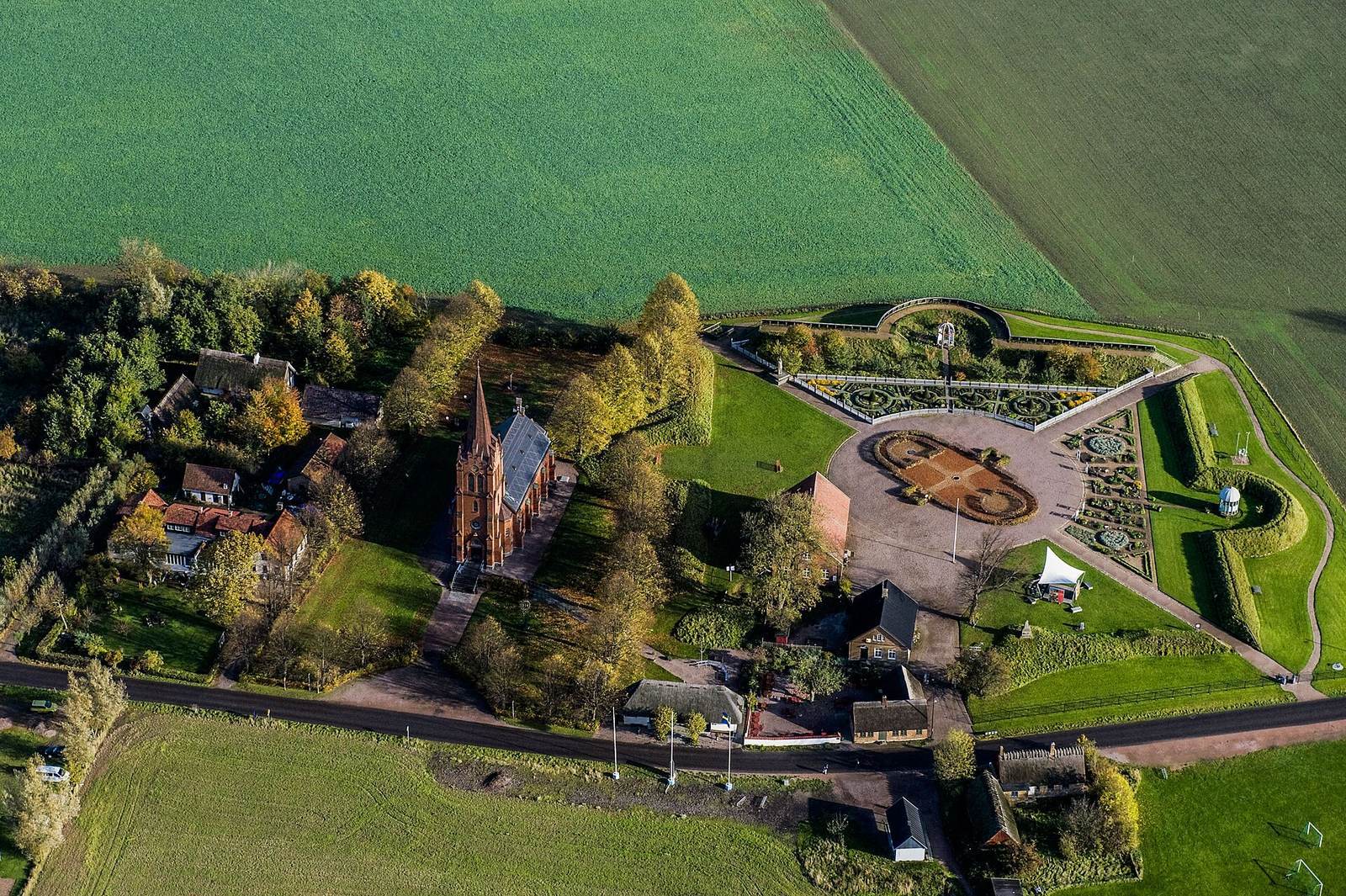
The site occupies Ven’s highest point, about 45 metres above sea level. Uraniborg’s central building stood within an earthen rampart, with a formal garden between the building and the enclosure. The building’s main footprint was roughly square, but towers on its northern and southern sides extended its overall shape. Red brick, sandstone, and limestone formed the principal structure. The rampart is the sole element of the original observatory that remains in its original position; other parts of the grounds have been reconstructed.
Uraniborg and its central grounds
Main building
The palace measured about 15 metres on each side, with two semicircular towers adding to its length. It had three storeys above a substantial basement, and its broad windows, towers, and balconies provided positions for astronomical work. Paintings and sculpture enriched the building. Its design used carefully ordered grids and proportions across the palace, façade, and garden. These proportions may have been intended to act as an astrological safeguard and to support the occupants’ health. An inscription on the cornerstone was written by Brahe’s friend Charles de Danzay.
Rooms and work spaces
Four rooms occupied the ground floor. Brahe and his family used one, while the others housed visiting astronomers. The northern tower contained the kitchen and the southern one a library. Brahe’s study and the library carried the motto Non haberi sed esse, expressing the idea that what a person is matters more than how others perceive them. The second floor had three rooms, including a larger chamber reserved for royal visitors. Eight smaller rooms on the third floor housed students; a central tower above them was reached by a spiral staircase.
The basement combined an alchemical laboratory with storage for food, salt, and fuel. The laboratory was arranged to receive sunlight during the day and had furnaces for work in cold weather. A small prison room was used for disorderly inhabitants or guests.
Observation spaces
The principal astronomical instruments stood in the towers at the level of the second floor, accessible from outside or through doors in the building. Additional instruments were placed on balconies supported by wooden posts, farther from the walls to give them a broader field of view. The tower roofs reached the level of the third floor, rather than forming a further storey, and helped shelter exposed instruments from weather.
Enclosure and garden
An earthen rampart enclosed the central grounds. Between it and Uraniborg, a formal garden laid out in level beds supplied herbs for Brahe’s medicinal experiments. A restored quarter of the garden has beds of plants and herbs selected with reference to Brahe’s writings and seeds recovered in excavations. The grounds also include a fruit orchard at the centre of the pavilion.
Workshops and waterworks
Gatehouses held a printing workshop and another prison. Beyond the central enclosure were houses for servants and workers, as well as workshops for making and repairing instruments. Ponds powered a paper mill, and the site’s wider facilities included equipment for grinding grain and processing leather for bookbinding. The present grounds include the paper mill’s ruins and a replica of the lake that supplied power to the palace laboratory.
Stjärneborg
Stjärneborg, Brahe’s separate observatory, was built around 1584 about 75 metres south of Uraniborg. Instruments mounted in Uraniborg’s towers were vulnerable to movement in the wind, and the sandy soil was considered too unstable for precise measurements. Stjärneborg was smaller and built at ground level, with a plan resembling Uraniborg’s but a more compact enclosure. Its instruments were placed underground and protected by sliding shutters or rotating domes. The design was devoted to observation rather than combining it with the palace’s other uses.
Astronomical instruments
Comet and star-recording instruments
A brass azimuthal quadrant made in 1576 measured an object’s direction relative to the horizon. Brahe used it to observe the comet of 1577, with a stated accuracy of 48.8 arcseconds, or one-sixtieth of an arcminute. In 1580 he made a hollow wooden Great Globe covered with brass plates to record observed stars and planets. By 1595, more than 1,000 stars had been engraved on it: 777 during most of his years at Uraniborg and a further 223 shortly before he left.
Instruments for measuring the heavens
A fixed triangular sextant made in 1582 measured angles and was about 3.2 metres across. Brahe made the larger Great Equatorial Armillary in 1585. Its framework of rings represented celestial circles, and it was designed to measure the positions of stars and planets while allowing for atmospheric refraction. Brahe used it in 1587 to investigate the parallax of Mars, an apparent shift in position seen from different viewpoints, following attempts in 1582, 1583, and 1585. Errors in contemporary refraction tables prevented a decisive result, but the instrument’s measurements contributed to the precision of his observations.
Fixed instruments and optical equipment
A large mural quadrant, a fixed instrument for measuring the height of celestial bodies, was mounted on a north-south wall to track stars as they crossed the meridian. Smaller instruments sensitive to weather were set into recesses in the ground to reduce wind disturbance. Brahe also used refined lenses and optical equipment with instruments such as sextants and armillary spheres. One of his clocks, marked in seconds, was nearly a metre in diameter. He described and illustrated the instruments and their installations in his 1598 book Astronomiae instauratae mechanica.