Rosenberg Castle: Medieval Residential Tower in Giswil, Switzerland
Site at a Glance
- Popularity
- Very Low
- Country
- Switzerland
- Primary era
- Medieval
- Eras represented
- Medieval
- Civilizations
- Holy Roman Empire
- Site type
- Military
- Remains
- Castle
On this page8 sections
History
Rosenberg Castle is a medieval tower ruin in Kleinteil, Giswil, Switzerland. Its thirteenth-century residential tower probably housed an estate bailiff serving Murbach-Lucerne Abbey.
Abbey lands and the tower
Giswil was a fief, land held under obligations to a superior lord, of Murbach-Lucerne Abbey in the ninth century. In the High Middle Ages, the monastery held land, property, and rights in the area. A manor that served as its local center is first mentioned in 1268. Its exact location is unknown, though it was probably in Kleinteil. An ecclesiastical bailiff administered the abbey’s holdings and had a residence somewhere in the village.
A stone building stood on the castle site by the twelfth century. It was probably demolished in the thirteenth century and replaced by a representative residential tower, likely used by the abbey’s bailiff.
Habsburg and local bailiffs
In 1291 the Habsburg dynasty acquired the abbey’s holdings in Giswil and appointed a subordinate as bailiff. The office probably became hereditary. Mathis, the estate administrator of Giswil, is named in 1347 as the last recorded member of that family. The office later passed to the local Rudenz family.
In 1361 the bailiff’s office passed from the Rudenz to the Hunwil family. George von Hunwil, Obwalden’s chief magistrate, received Rosenberg from the Rudenz and began building Hunwil Castle. After George was forced to leave Obwalden for Lucerne in 1382, officials served as bailiffs. Jenni von Wennishusen held the office in 1387, though it is uncertain whether he lived at Rosenberg or Hunwil.
Decline and later history
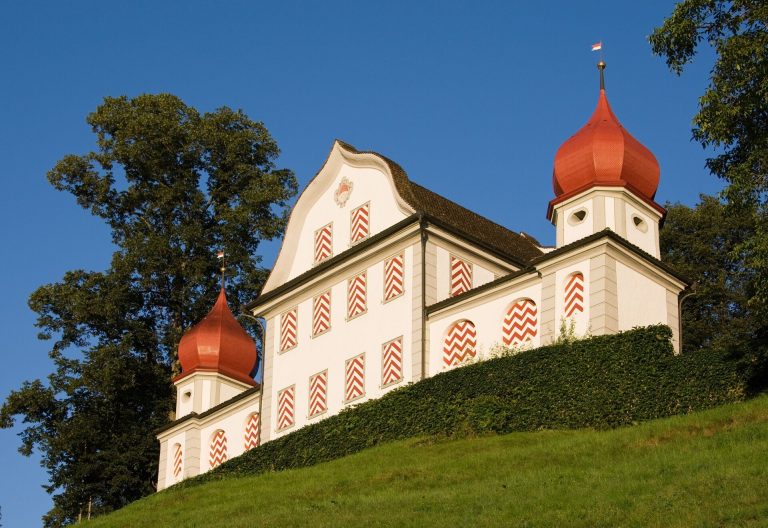
Around 1400, Giswil’s parishioners jointly acquired the bailiff’s office and the former church lands. The tower then lost its importance and was probably left to decay. By 1532 it was described as destroyed. The name Rosenberg came into use only in the seventeenth century, when a chapel dedicated to St Anthony of Padua, a thirteenth-century Franciscan friar and Catholic saint, was built beside the ruins between 1664 and 1667.
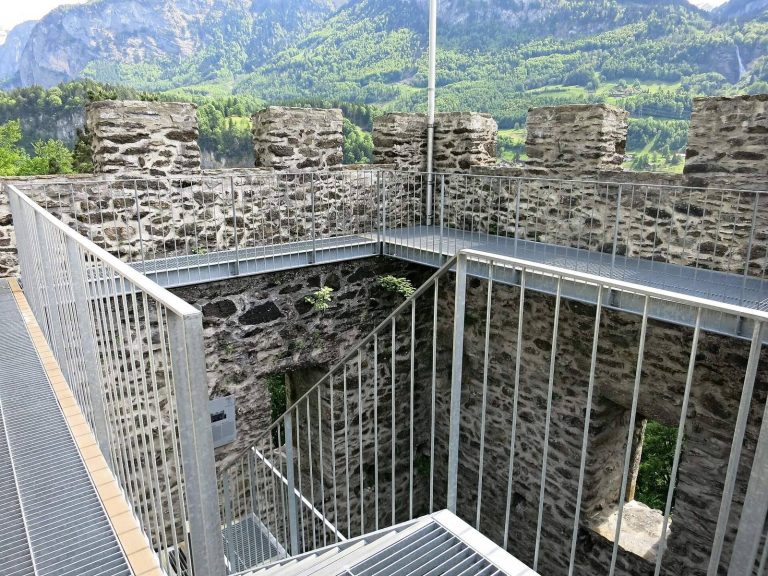
By about 1900, the tower had deteriorated to a grass-covered stump. The Canton of Obwalden acquired the site in 1935 and cleared and repaired the tower the following year, rebuilding parts of its masonry. Rosenberg was once interpreted as part of a defensive line with Giswil’s two other castles, based on their proximity and alignment. They are now generally understood as separate castles built for different purposes. The ruin is protected as a cultural property of regional importance.
Remains
Tower and adjoining chapel
Residential tower
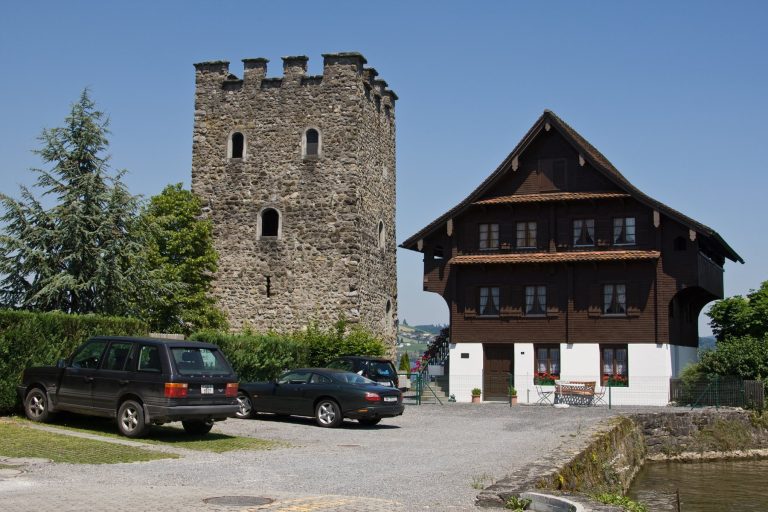
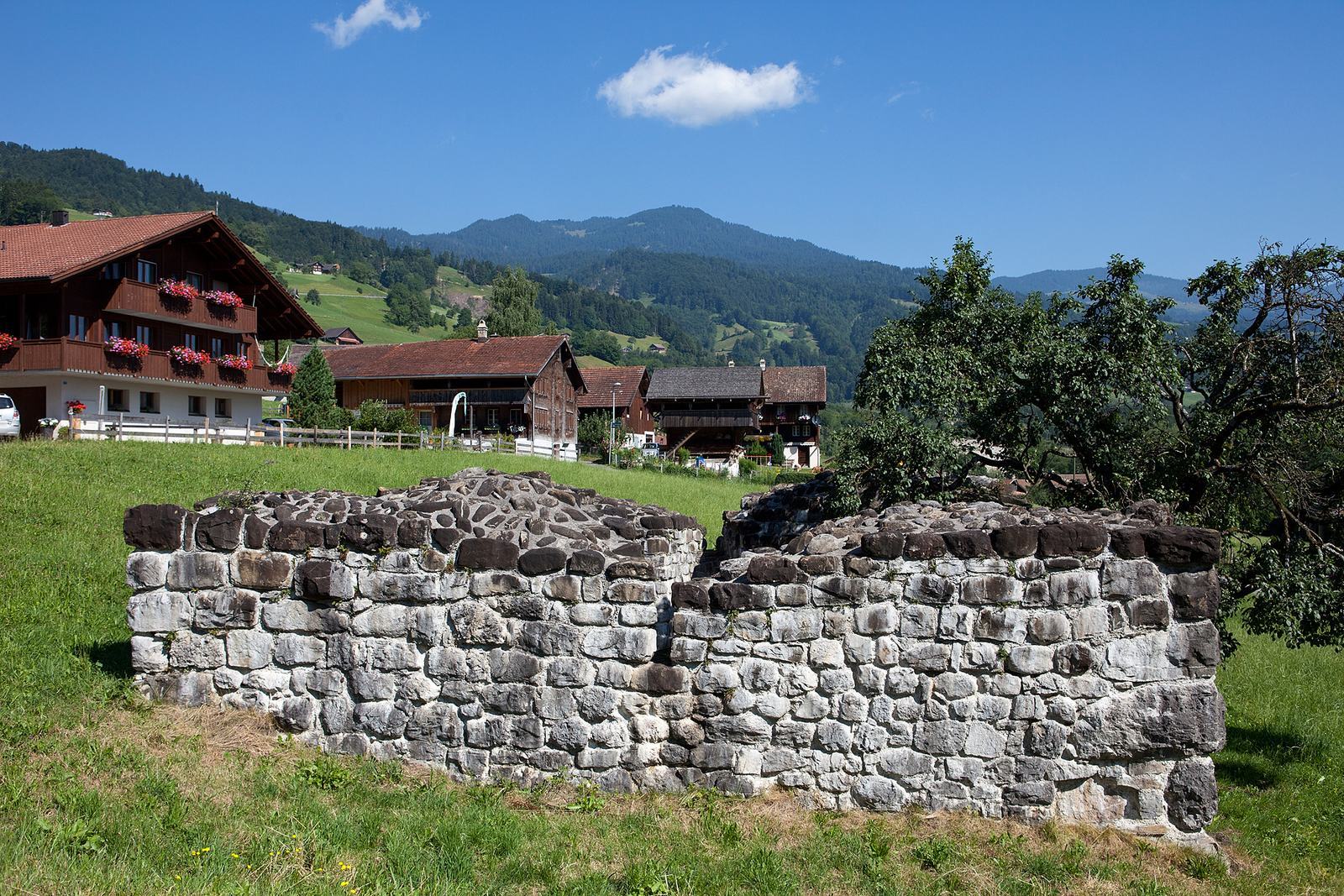
The ruin stands on a slope among the houses of Kleinteil. Its surviving stone tower has a square ground plan measuring about 9.3 metres on each side, with walls roughly two metres thick. The remains rise more than two metres above the surrounding meadow, reaching about three metres in places. Large window openings are visible near the tops of the walls. The tower was probably enclosed by a ring wall and a ditch. A test trench in 1990 exposed remains of the earlier building and recovered a few artifacts.
Chapel of St Anthony of Padua
The chapel stands beside the tower ruins, forming the adjoining structure on the sloping site.