St. Jakob Battle Chapel: A Memorial to the Battle of Sempach
Site at a Glance
- Popularity
- Medium
- Country
- Switzerland
- Primary era
- Medieval
- Eras represented
- Medieval, Early Modern, Modern
- Civilizations
- Holy Roman Empire, Swiss
- Site type
- Religious
- Remains
- Chapel
On this page14 sections
History
Battle and foundation
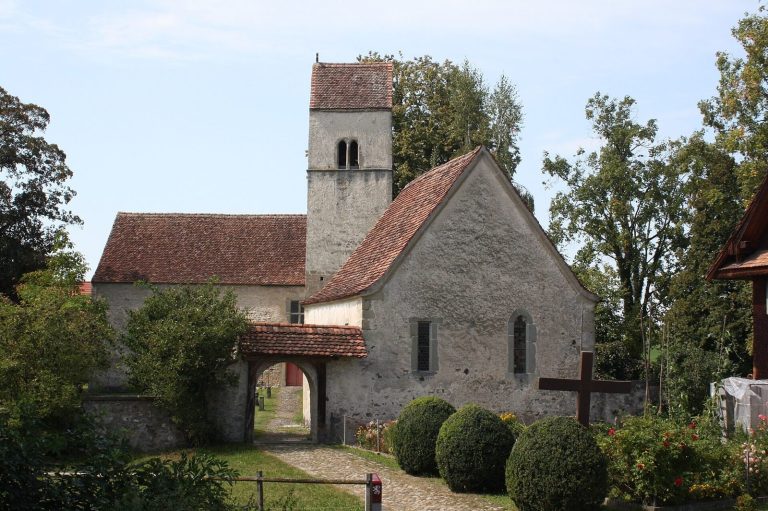
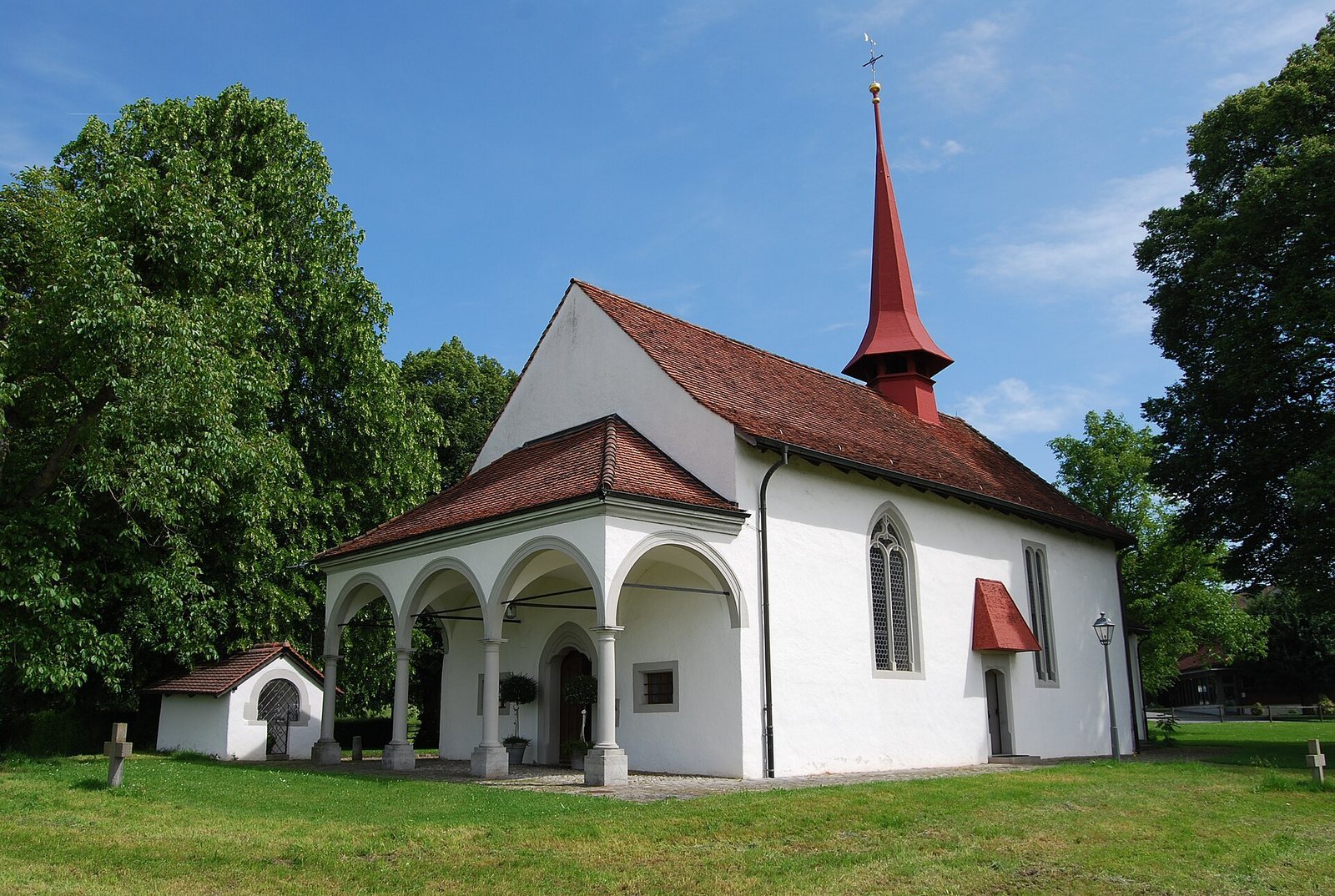
St. Jakob Battle Chapel stands above Sempach in Switzerland. Built in 1472–73, it commemorates the Battle of Sempach, fought on 9 July 1386, and is dedicated to Saint James the Greater, one of the twelve apostles in Christian tradition. At the battle, Swiss Confederates, members of the historic Swiss confederation, from Lucerne and central Switzerland defeated a Habsburg army led by Duke Leopold of Austria. The Habsburgs were a major European ruling dynasty.
A tradition places an earlier memorial where Leopold fell, although this association has not been verified. The chapel itself was built nearly a century after the battle.
Alterations and commemoration
The chapel was renovated in 1551–54 and substantially remodelled in 1638–41. Major works followed in 1747 under Aurelian zur Gilgen, a treasurer responsible for financial administration. Heinrich Viktor von Segesser restored the building in 1885–86 for the battle’s 500th anniversary, and another restoration took place in 1985–86. The chapel is listed as nationally significant in the Canton of Lucerne’s cultural-property inventory.
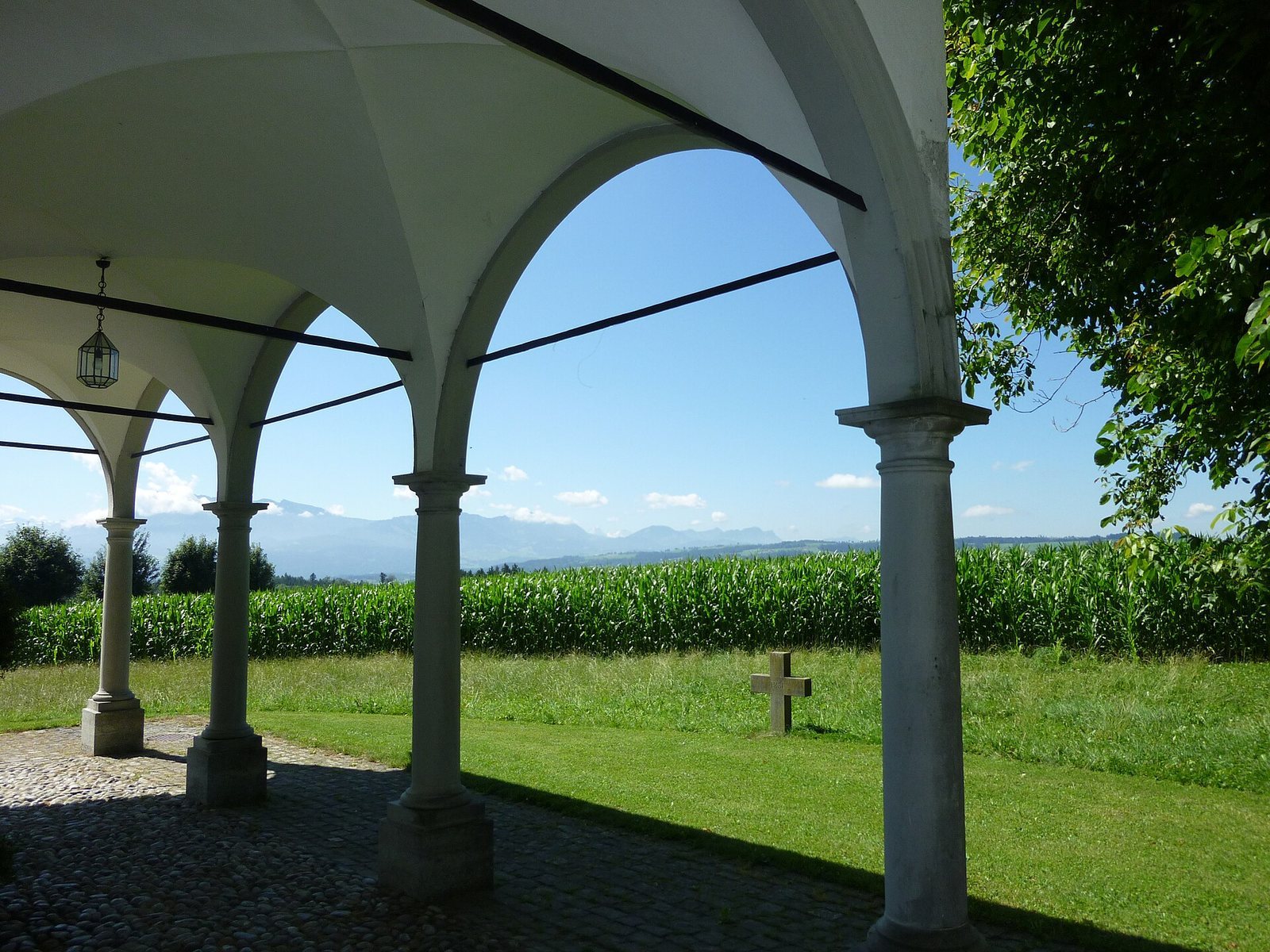
A stone cross marks the place where Petermann von Gundoldingen, a former mayor of Lucerne, is said to have fallen. Together with two other crosses, it served as a station in a procession for the fallen held during the annual battle commemoration on the last Saturday in June.
Remains
Building and structural phases
Chapel structure
The chapel stands on the road to Hildisrieden, above the town of Sempach. Layers of plaster distinguish four building phases. In 1747, the walls were raised by about 50 centimetres and the windows lifted; a porch was added at the west end, a new roof frame installed, and the original flat ceiling replaced by a vaulted one. The vault gave way to a plaster ceiling in 1825. During the 1885–86 restoration, coloured slate was laid on the roof, canopies were added over the side entrances, and the present ceiling was installed. In 1985–86, the pointed spire of the roof turret was replaced with a curved one, and a new canopy was fitted over a side entrance.
Predecessor building
Excavations in 1983–84 uncovered remains of a smaller earlier building in the area of the present choir.
Painted memorials
Names and banners
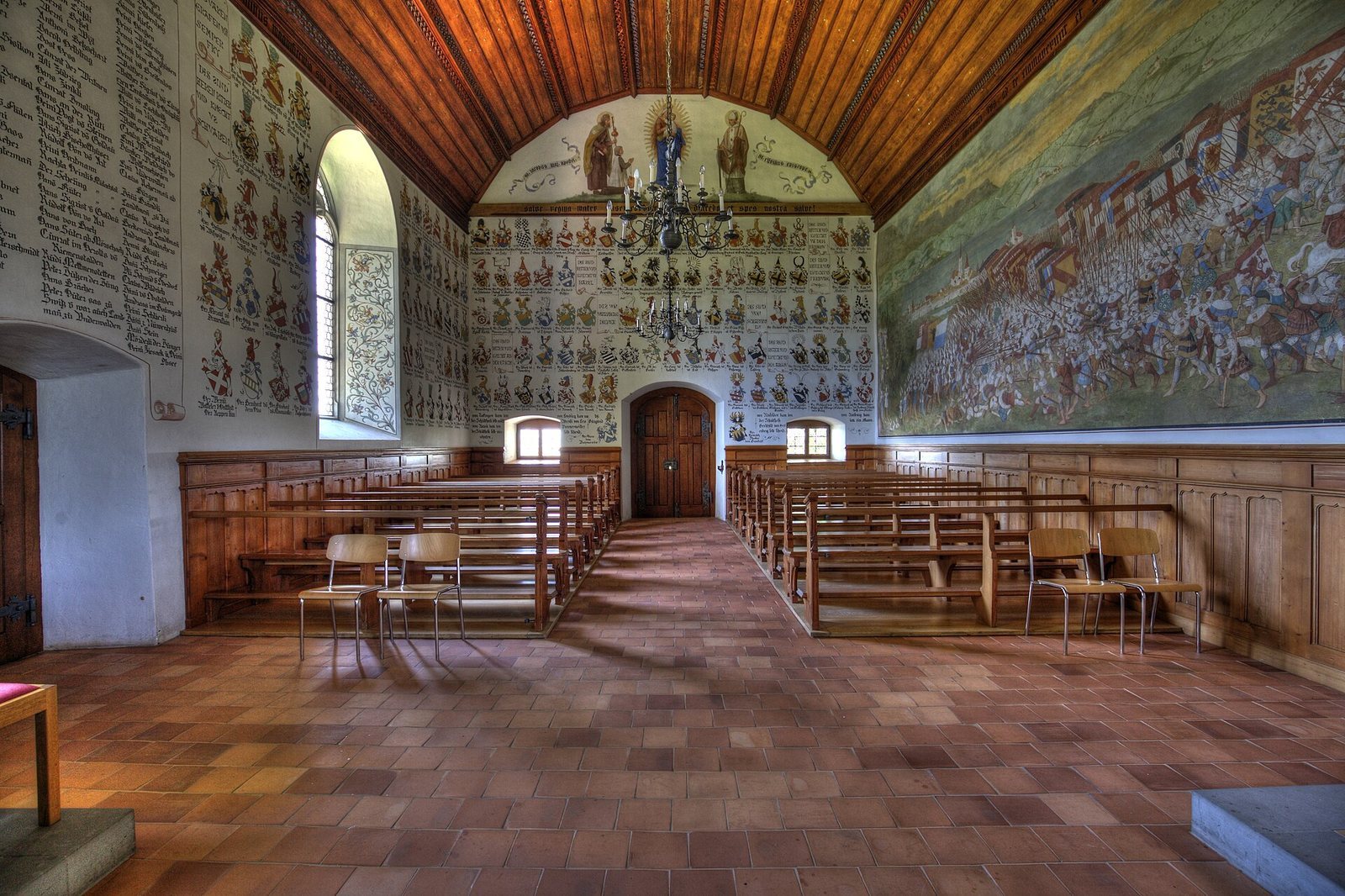
Since 1886, the chapel’s side and rear walls have carried the names of fallen Swiss Confederates, alongside the coats of arms and names of nobles who died on the Habsburg side. Arnold von Winkelried’s name appears as “Erni Winckelried.” The choir wall displays painted Habsburg banners, including those associated with Ochsenstein and Thierstein and the principal Habsburg banner. The names Johann Ochsenstein and Leopold of Austria accompany the display.
Battle painting
A large battle scene covers the northwest wall. The Swiss Confederates occupy the left side and Leopold’s army the right, while Arnold von Winkelried, remembered in Swiss tradition as a hero, is shown forcing down the spears between them. Sempach, Lake Sempach and Nottwilerberg appear in the background, with Pilatus to the left.
The original painter is unknown. Work on a painting in 1551 may refer to this scene, and Hans Rudolf Manuel has been proposed as its artist. It underwent major reworking, or perhaps repainting, in 1638–43, probably by painters from Hans Ulrich Wägmann’s circle. Further restorations followed in 1695 and 1741–43; the scene was extended at the top in 1747 when the chapel walls were raised. From 1826 to 1886 it was concealed by an oil painting by Xaver Hecht, now in Sempach’s festival hall. In 1886 Joseph Balmer restored and supplemented the battle scene and named Wägmann as its painter in the lower left. Restoration work in 1985 revealed two more painted layers beneath the current plaster, one coloured and one grey.
Furnishings and memorial objects
Altars
The chapel has three unsigned altars dating from the seventeenth century. They are separate from its other furnishings.
Ossuary
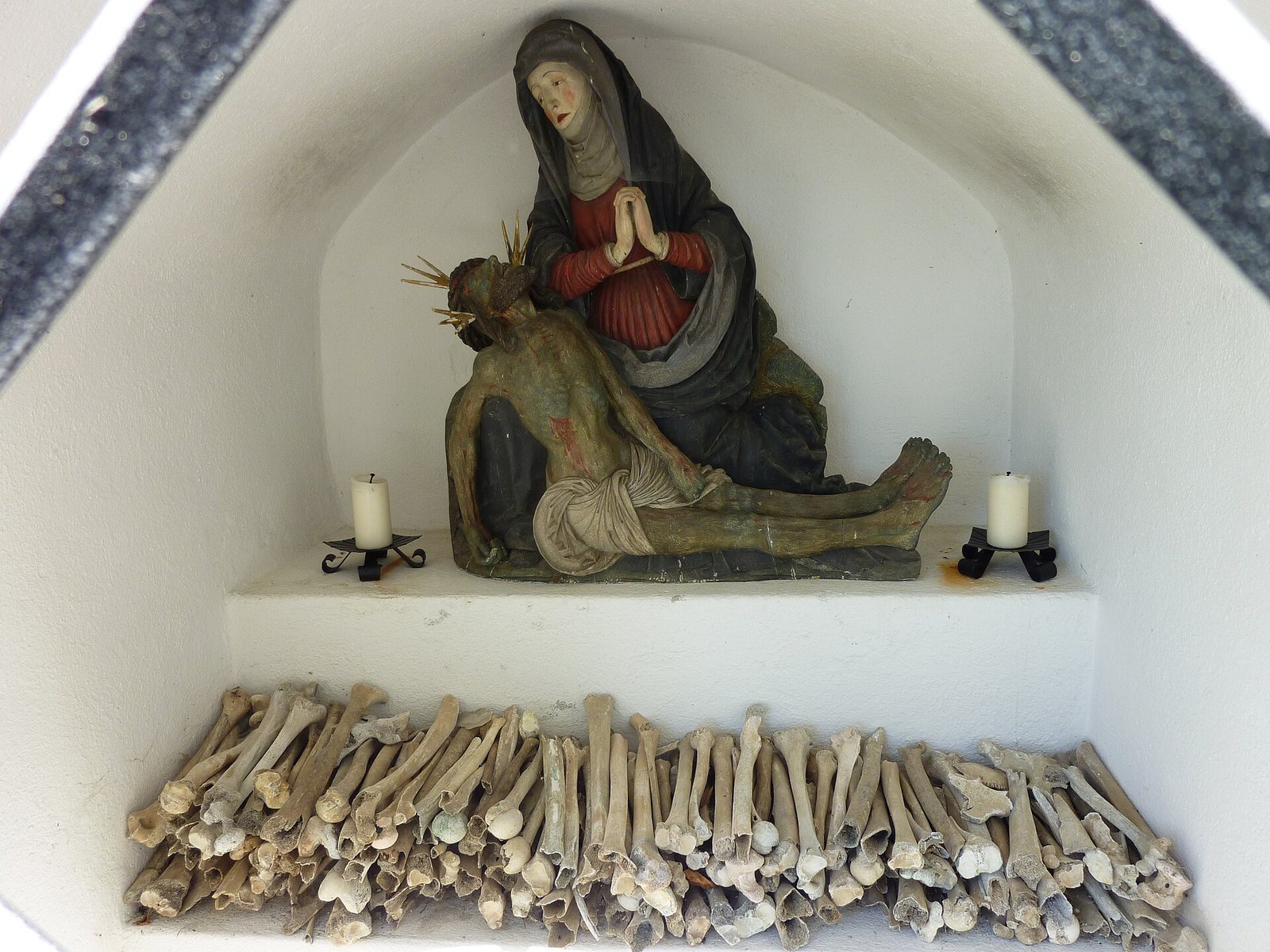
A small ossuary, or place for storing bones, dates from 1594. Its contents were once said to be the remains of people killed in the battle, but examination found the bones to be of more recent date.
Pietà and stone cross
An early sixteenth-century Pietà, a devotional image of Mary mourning Christ, is carved from a single piece of limewood. The stone cross associated with Petermann von Gundoldingen’s fall stands at the place identified by the local tradition.