Tombeau des Géants: A Prehistoric Stone Tomb in France
Site at a Glance
- Popularity
- Low
- Country
- France
- Primary era
- Bronze Age
- Eras represented
- Stone Age, Bronze Age
- Civilizations
- Unclassified
- Site type
- Burial
- Remains
- Tomb
On this page10 sections
History
The Tombeau des Géants is a prehistoric stone tomb in the Paimpont Forest near Paimpont and Campénéac, in Brittany, France. Its broad date, 3000 to 1500 BC, spans the Neolithic and Bronze Age, two prehistoric periods, the latter associated with bronze tools and objects. Its French name means “Tomb of the Giants.”
Prehistoric development
Archaeologist Jacques Briard proposed that four large standing stones, or menhirs, formed a north–south row at the site between 3000 and 2500 BC. He suggested that around 2000 BC three stones were reused to build the tomb: two became its long sides and the third served as a roof slab. The fourth stone may have been moved to a second hole made to hold it upright, toppled, and left parallel to the tomb. It has also been interpreted as part of a row of Early Bronze Age tombs dating to about 1500 BC.
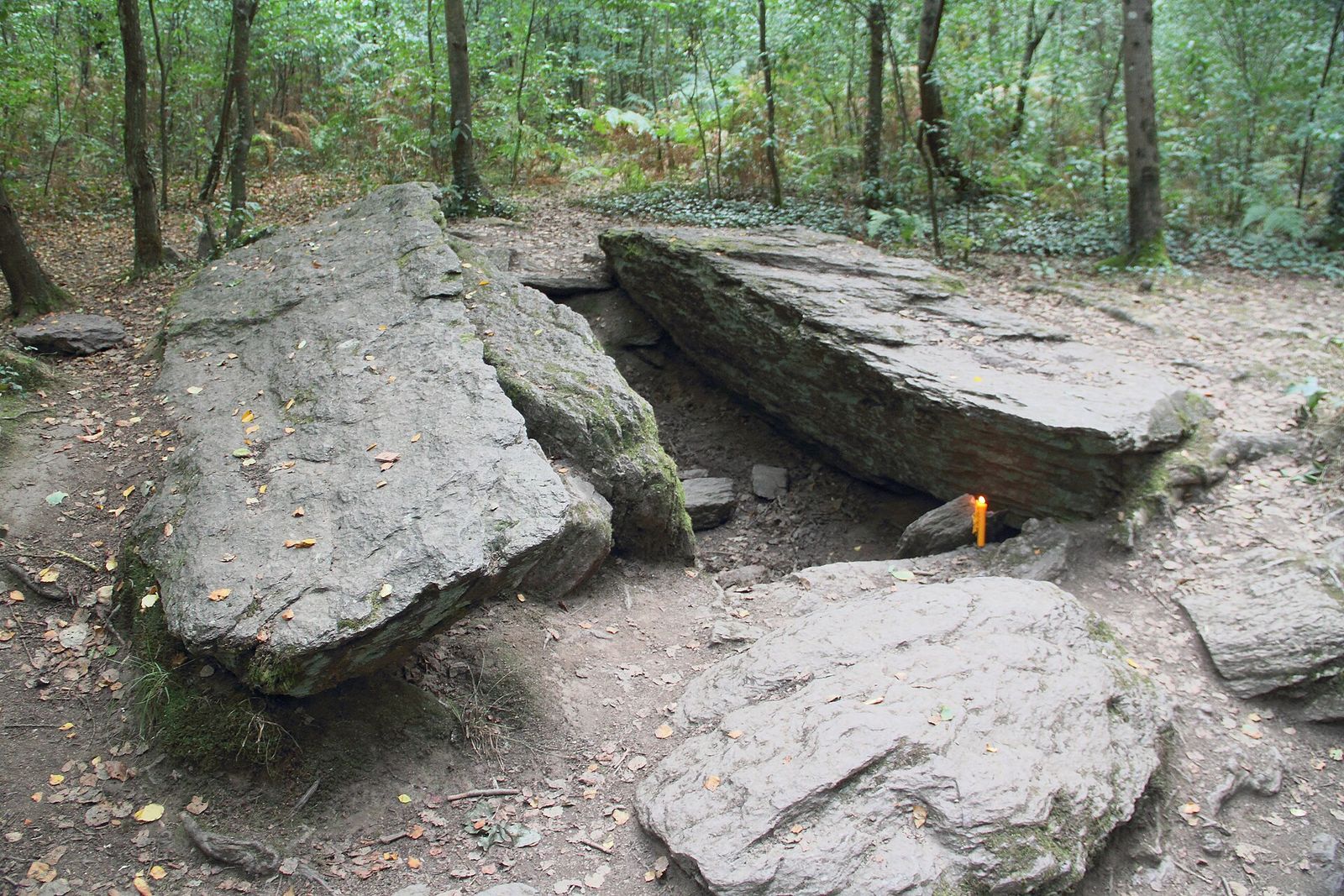
The burial chamber had been emptied at an unknown date. In the nineteenth century, treasure seekers shifted the surviving roof slab from the tomb to a position beside it.
Later accounts and investigation
In his 1896 book La Forêt de Bréchéliant, writer and antiquarian Félix Bellamy described the monument in a condition broadly like its present state. An excavation may have taken place around 1920, but its results are unknown; it may have lowered the chamber floor by about 15 to 20 centimetres. Briard excavated the site in 1982.
Names and traditions
The tomb is also known as Roche à la Vieille, meaning “Old Woman’s Rock,” and was formerly called Witch’s Rock. A tradition Bellamy recorded said that an ancient princess was buried there, accounting for the Old Woman’s Rock name. In folktales, the old woman could instead be a witch or Death. Arthurian legend identifies the tomb as the grave of a giant defeated by the Knights of the Round Table.
Remains
Tomb and burial mound
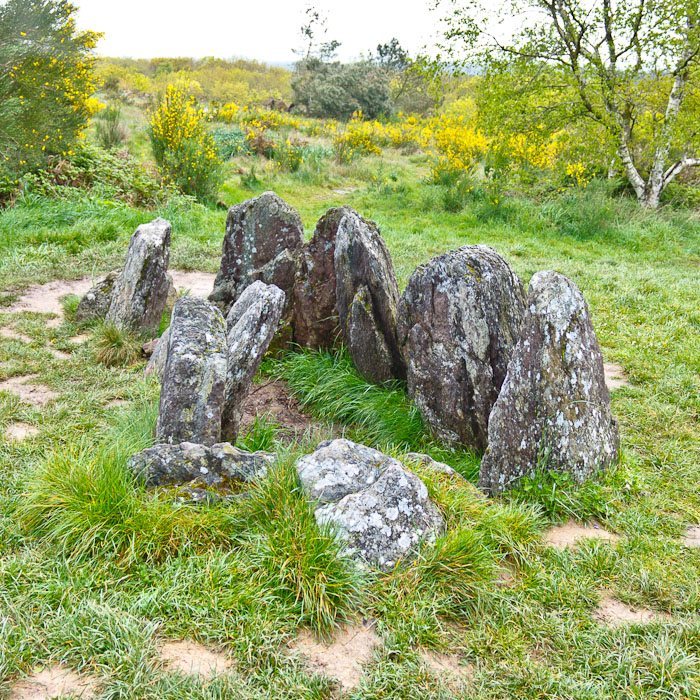
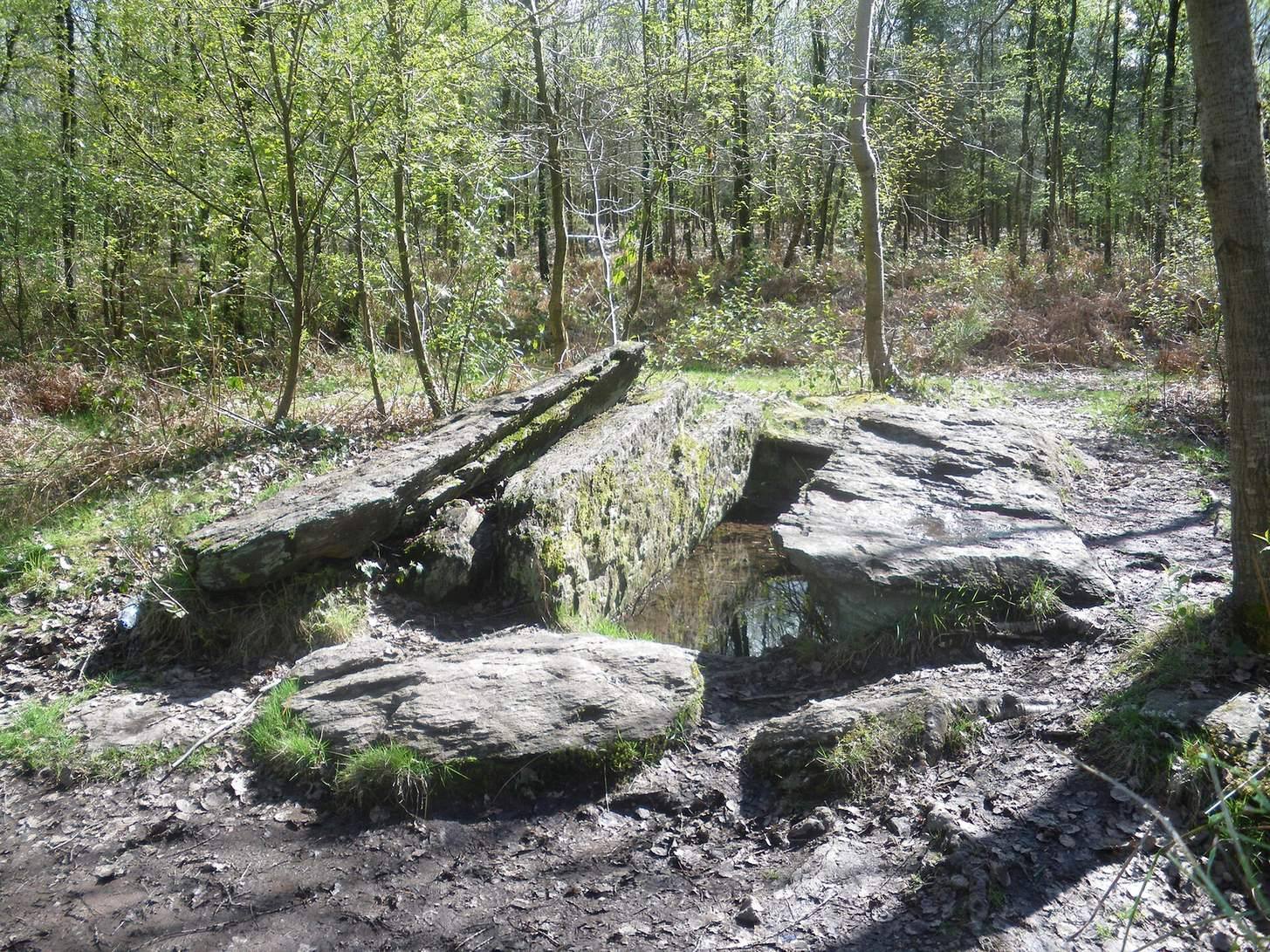
The tomb is aligned northeast to southwest. Its chamber was enclosed by a burial mound, now levelled though its outline remains identifiable. The structure combines large red-schist side stones with short end walls built from stones fitted together without mortar.
Burial mound
The mound consisted of an earth covering over a heap of schist and quartz blocks surrounding the chamber. This stone core reached a maximum diameter of 6 metres and a height of 0.8 metres.
Burial chamber
Two massive local red-schist blocks form the long sides. The western block measures 4.5 by 1.15 by 1.10 metres; its inner face slopes, with the base about 0.5 metres narrower than the top. The eastern block is shaped like a rectangular solid, has a step halfway up, measures 4 by 0.5 metres across the top, and stands 1 metre high. The short ends are poorly coursed and were damaged by earlier digging.
The chamber is 3 metres long and 1.2 to 1.3 metres wide at the base. Its height beneath the roof was probably about 1 metre. The surviving schist roof slab measures 3.65 by 1.20 by 0.25 metres and lies east of the tomb. Because it is shorter than the chamber, additional slabs probably completed the roof. Bellamy noted in 1896 that one such slab lay on the chamber floor.
The displaced menhir
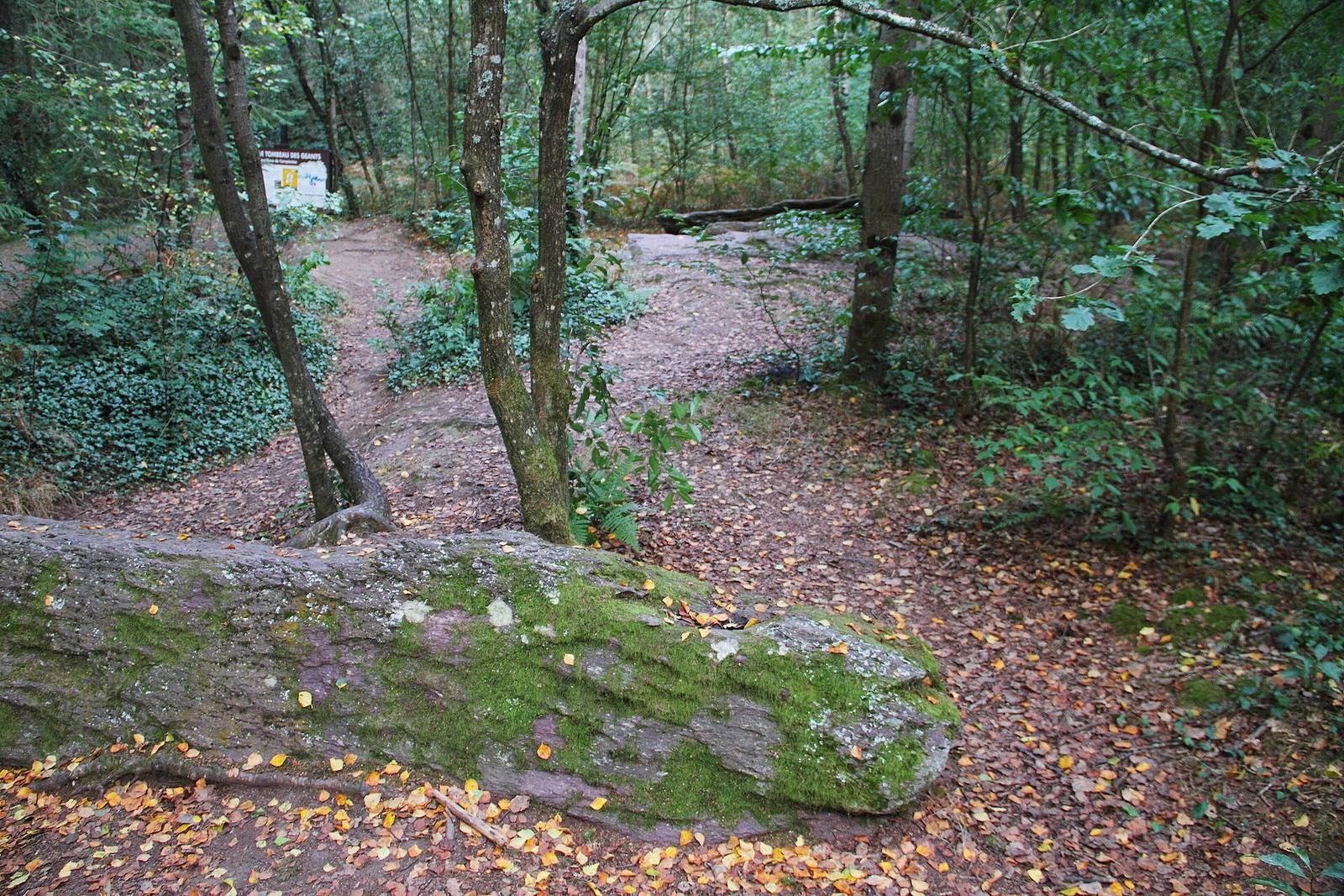
About 8 metres from the tomb, a toppled schist standing stone lies parallel to it. The block is 4.25 metres long, up to 1.30 metres wide, and 0.70 metres thick. Two holes for setting the stone upright were found, one at each end.
Excavated objects
The 1982 excavation recovered a small number of archaeological objects and some modern items. Stone artifacts included a yellow-flint flake of a type associated with prehistoric flint-working around Grand-Pressigny in central France. Rare pottery fragments may date to the Bronze Age; further pottery fragments came from the hole south of the toppled menhir. A schist disc found on the mound surface was the only personal adornment recovered.