Madonna delle Grazie in Soleto: A Baroque Church and Sanctuary
Site at a Glance
- Popularity
- Very Low
- Country
- Italy
- Primary era
- Early Modern
- Eras represented
- Medieval, Early Modern, Modern
- Civilizations
- Italian, Kingdom of Naples, Spanish
- Site type
- Religious
- Remains
- Sanctuary
On this page14 sections
History
Madonna delle Grazie is a Catholic church in Soleto, Italy. Built between 1601 and 1609 in the Baroque style, it is dedicated to the Virgin Mary as Our Lady of Graces and belongs to the Archdiocese of Otranto. Its history is closely connected with a local tradition of devotion and with the Franciscan friars who served there.
The shrine and the church’s foundation
A tradition recorded by the Franciscan chronicler Bonaventura da Lama places an outdoor shrine beyond Soleto, where farmers returning from their fields prayed at sunset. In 1568, according to the story, Giacomo Lisandri lost his wages gambling, then struck the sacred image with an axe and challenged the Virgin to cause his death that evening. After entering Soleto through St Anthony’s Gate, he encountered his creditor, Luigi Rullo of Galatina. A fight between the two ended with Lisandri’s death. The tradition says that blood flowed from the image and darkened the Virgin’s face, and that the church was later built at the shrine.
The church’s construction began in 1601 and was completed in 1609 with contributions from wealthy families. The miracle story has also been interpreted in connection with changes in religious practice in Soleto. Following the Council of Trent, a major Catholic reform council, the Greek rite, an Eastern Christian liturgical tradition, was discontinued in 1598 under the last archpriest, Arcudi.
The Franciscan foundation
In 1602, the Friars Minor, the Franciscan religious order, were brought to Soleto to encourage the Latin rite, associated with Western Christian practice. The change involved hardship for religious minorities. An attached convent was built for the friars, who had been present since 1602 and numbered about fourteen within a few years. The municipality provided land around the convent for a vegetable garden and orchard. The convent is now closed, and the friars live at the Franciscan convent in Galatina.
Sanctuary and continuing devotion
On 5 August 1953, Raffaele Calabria, bishop of Otranto, recognized the church as a sanctuary, a church acknowledged for particular religious importance. The decision reflected the Virgin’s long-established local veneration and devotion that had continued across generations. In May 1983, Orthodox and Catholic participants gathered in prayer with Papas Donato, an Eastern Christian priest, and the Franciscan fraternity. They addressed Mary as Mother of God and Mother of the Church in an act of cooperation between Christian traditions.
The annual feast takes place on 5 August, with a procession on the previous evening. Traditionally, the route headed toward the road to Santa Venerdia and an olive grove. During droughts or severe storms, people also carried the statue in prayer for the Virgin’s intercession. The procession now passes through Soleto’s northern outskirts, turns west toward Via Galatina, pauses at the parish church, and returns to the convent along Viale Raimondello Orsini. Once borne on devotees’ shoulders, the statue is now carried on a cart decorated with flowers. Participants sing a traditional hymn to Mary and recite litanies.
On 5 August 1963, candles near the processional statue set its drapery alight, damaging the sculptural group. Later restoration removed layers of stucco and repainting that had accumulated over time, including work added after the fire. The wooden crucifix underwent restoration in 1989 by Luigi Moscara of Soleto.
Remains
The church has a Baroque exterior and a single principal space for the congregation. Its attached convent and surviving portion of the former garden preserve elements of the wider religious complex.
Exterior and convent grounds
Façade
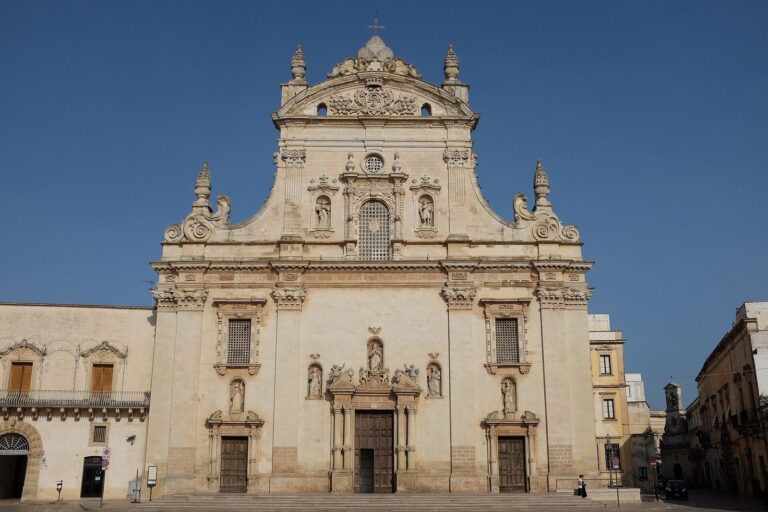
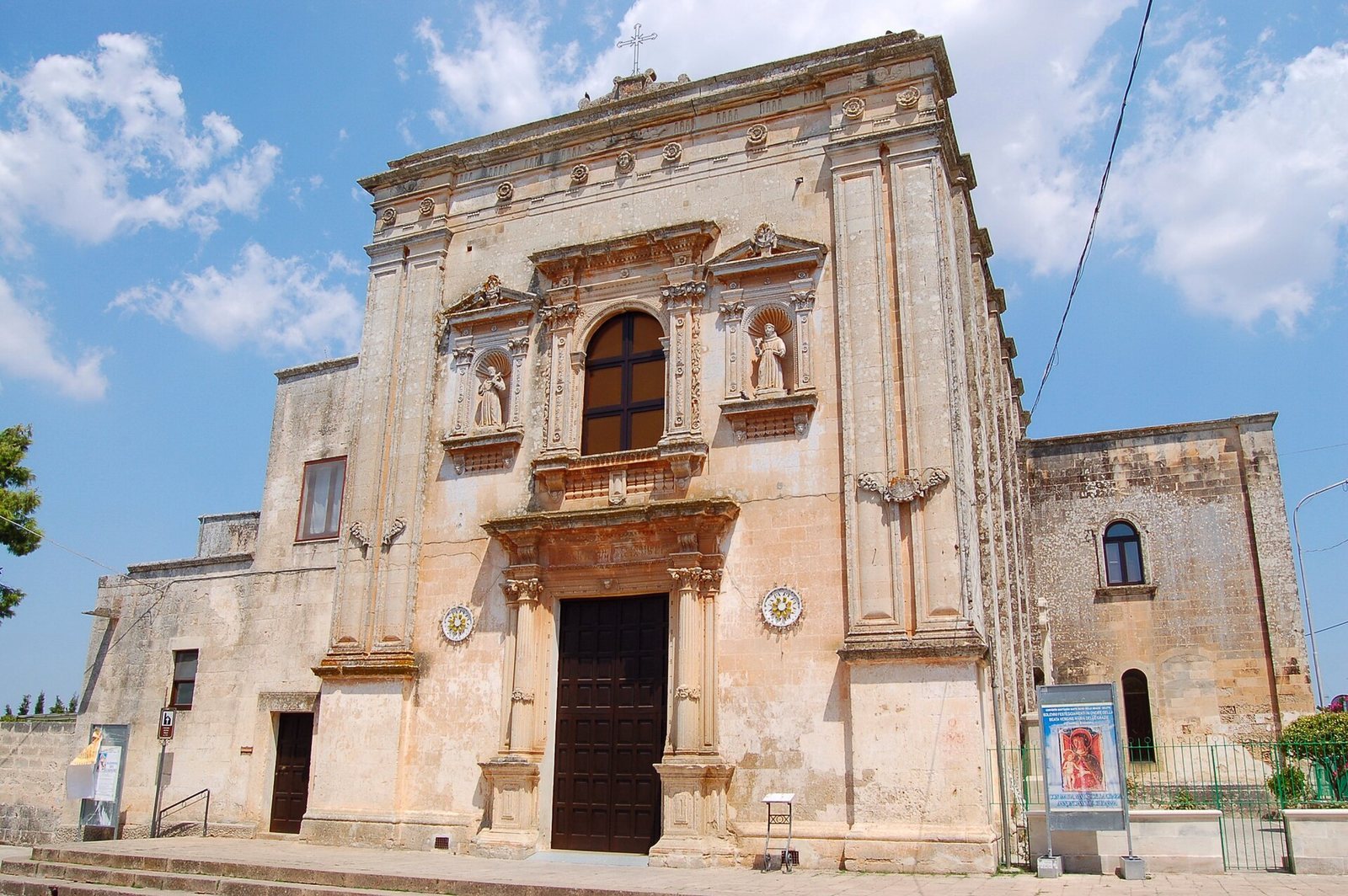
The Baroque façade retains architectural features of a sixteenth-century palazzo. An inscription at its summit says that the church and convent were built through the alms of the devout and gives the date 1609. Niches in the façade hold statues of St Francis and St Anthony.
Bell gable
A bell gable, a wall-shaped structure that carries bells, holds a small bell dated 1639. The bell bears an image of Madonna delle Grazie and names its founder, Vincenzo Bono of Gallipoli.
Convent Garden
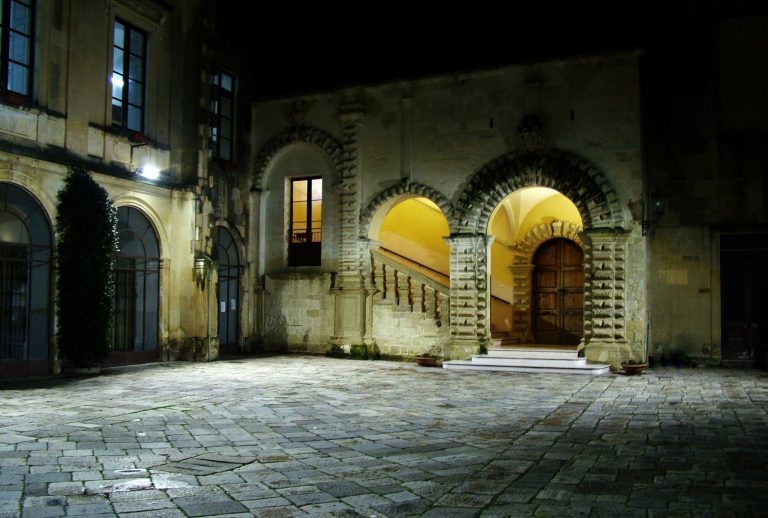
A portion of the convent’s former vegetable garden and orchard survives as the Convent Garden.
Interior and furnishings
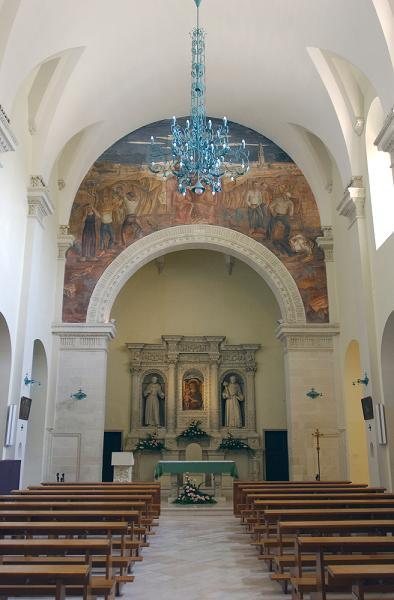
The church’s interior is arranged as a single space for the congregation, with the convent attached to the building.
High altar and frescoes
A fifteenth-century fresco above the high altar shows the Virgin holding the infant Jesus. Her face bears a conspicuous darkened scar. A separate fresco painted by Aloisio Gabrieli in 1953 covers the wall of the triumphal arch, the arch marking the transition between the main church space and the chancel. It depicts the local miracle tradition.
Altars and paintings
Each of the church’s seven altars had a canvas. The best-known is a 1607 Madonna of the Rosary, commissioned by the Attanasi family, whose members appear at the lower edge. The Virgin is shown with St Francis and St Catherine of Alexandria. The painting is attributed to Donatantonio D’Orlando of Nardò, in part because of the characteristic gilding along the edges of the figures’ garments. Other canvases depict St Paschal Baylon, Our Lady of Mount Carmel, the Holy Family, the Annunciation, the Immaculate Conception, and St Anthony of Padua. The Immaculate Conception is attributed to Gian Domenico Catalano of Gallipoli. The Carrozzini family also had an altar and a family tomb in the church.
Carved wooden furnishings
The furnishings include a wooden crucifix from the seventeenth century and a wooden choir carved in 1727 by Francesco Maria da Lequile.
Processional statue
The seventeenth-century processional statue is made of wood painted in several colors and depicts the Virgin with the Child. The figures wear garments in an eighteenth-century style. The statue’s base was destroyed in the 1963 fire.