Bisenė: A Lithuanian Fortress on the Neman River
Site at a Glance
- Popularity
- Very Low
- Country
- Lithuania
- Primary era
- Medieval
- Eras represented
- Medieval
- Civilizations
- Grand Duchy of Lithuania
- Site type
- Military
- Remains
- Fort
On this page10 sections
History
Bisenė was a wooden fortress of the Grand Duchy of Lithuania, a medieval state in eastern Europe, at Kartupėnai Hillfort in Lithuania. Built before 1283, it guarded the Neman River as a defensive outpost. It became the first Lithuanian fortress targeted in the Teutonic Order’s campaign against Lithuania. The Order was a Catholic military-religious organization that fought in the Baltic region.
The attack of 1283
In the winter of 1283, after completing its conquest of Prussia, the Teutonic Order began its campaign against Lithuania by attacking Bisenė. Forces led by Konrad von Thierberg, the Order’s regional leader in Prussia, crossed the frozen Neman and captured the fortress by afternoon. They burned it, took surviving defenders captive, and raided the surrounding area. Many of the attackers were wounded, and four drowned when the river ice broke beneath them.
Rebuilding and renewed attacks
The Lithuanians rebuilt Bisenė. In early 1313, the Order completed nearby Christmemel and used it as a base for further attacks. That summer, Heinrich von Plötzke, the Order’s regional leader in Prussia, led an assault in which some forces traveled by boat on the Neman and used boats to construct a bridge across it. The attack, which also employed war machines, failed. A second assault in autumn burned the fortress’s outer enclosure but did not take its main stronghold.
The garrison served in one-month shifts. The medieval chronicler Peter von Dusburg recorded 85 Lithuanian warriors at Bisenė in 1307. At some point between 1307 and 1315, 22 members of the Order and 60 soldiers ambushed 85 Lithuanians returning after a shift. All but three, who escaped wounded, were killed.
Destruction in 1316
The Order attacked Bisenė twice in 1316. In the first assault, led by the deputy commander of Christmemel, 75 Lithuanians were killed and five escaped. On 4 April, three members of the Order and three squires left Ragnit for Bisenė as a garrison shift ended. They killed six Lithuanians, while six others escaped. When the attackers reached the fortress, they found it unattended and set it on fire. Bisenė was not rebuilt.
After Kolainiai was burned in 1291 and Bisenė in 1316, Junigeda, now Veliuona, became the westernmost Lithuanian fortress on the Neman.
Identification of the fortress
Bisenė’s location was long disputed and often confused with Pieštvė. Research by Lithuanian historian Romas Batūra after 1985 led to general acceptance that the fortress stood at Kartupėnai Hillfort.
Remains
Kartupėnai Hillfort
Promontory and platform
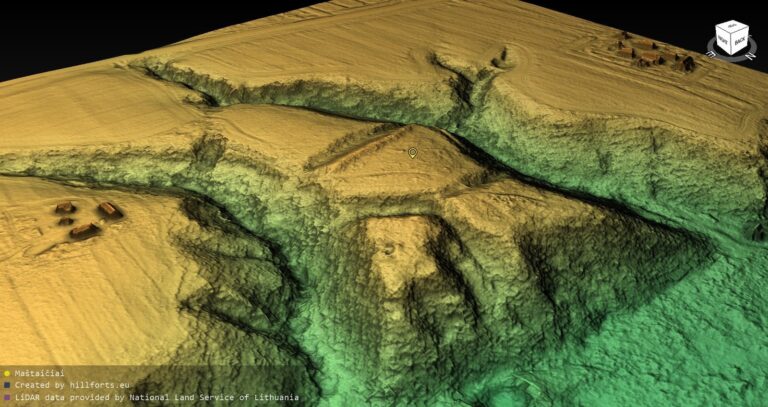
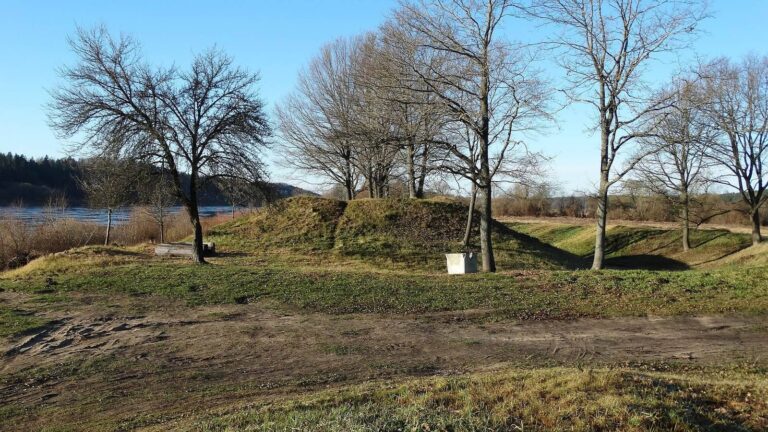
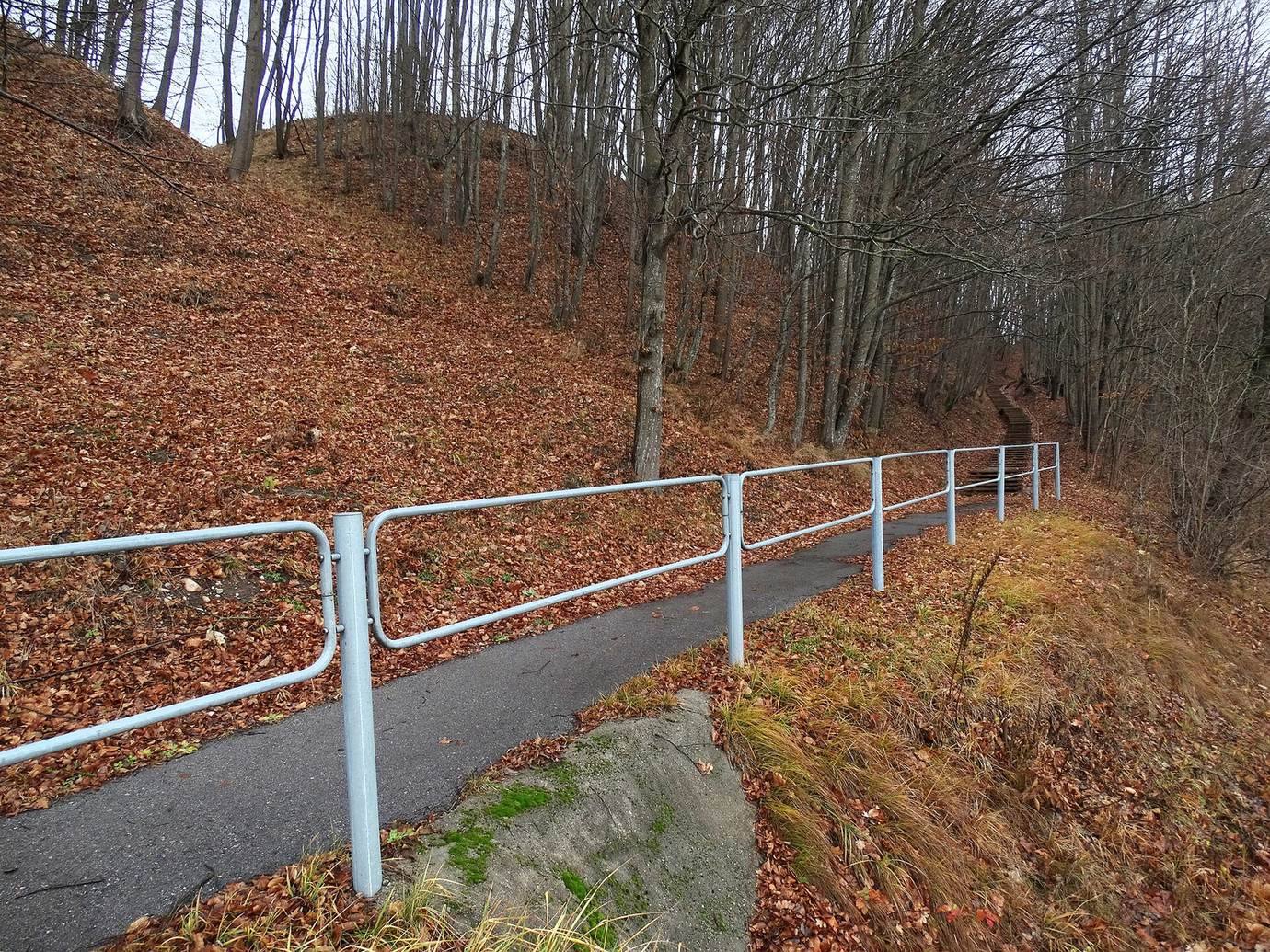
The hillfort occupies the end of a promontory between the Neman and Kartupis rivers. It lies on the Neman’s right bank and the Kartupis’s left bank; the Kartupis borders the site to the west and northwest, the Neman valley lies to the south, and higher ground extends to the northeast. Steep slopes rise about 20 m. The rectangular platform measures 36 by 28 m, while a separate preliminary estimate puts the fortress at about 50 by 30 m on an east–west axis. A remnant of a terrace on the northwest slope lies 4 m below the platform and is about 2 m wide.
Rampart and ditch
On the eastern side, an earthen rampart stands 7 m high and measures 21 m across, adjoining a ditch 2.5 m deep and 25 m wide. The fortress’s defenses included wooden walls and earthworks. Erosion by the Kartupis has reshaped the northern and western parts of the hillfort. The site is also known as Kiaukalnis and Sargutis.
Settlement at the foot of the hillfort
An ancient settlement covering about 1.3 hectares lies east of the hillfort, at the northeastern foot of the promontory.