Dolmen de Bagnol: A Neolithic Funerary Monument in France
Site at a Glance
- Popularity
- Very Low
- Country
- France
- Primary era
- Stone Age
- Eras represented
- Stone Age
- Civilizations
- Unclassified
- Site type
- Burial
- Remains
- Tomb
On this page6 sections
History
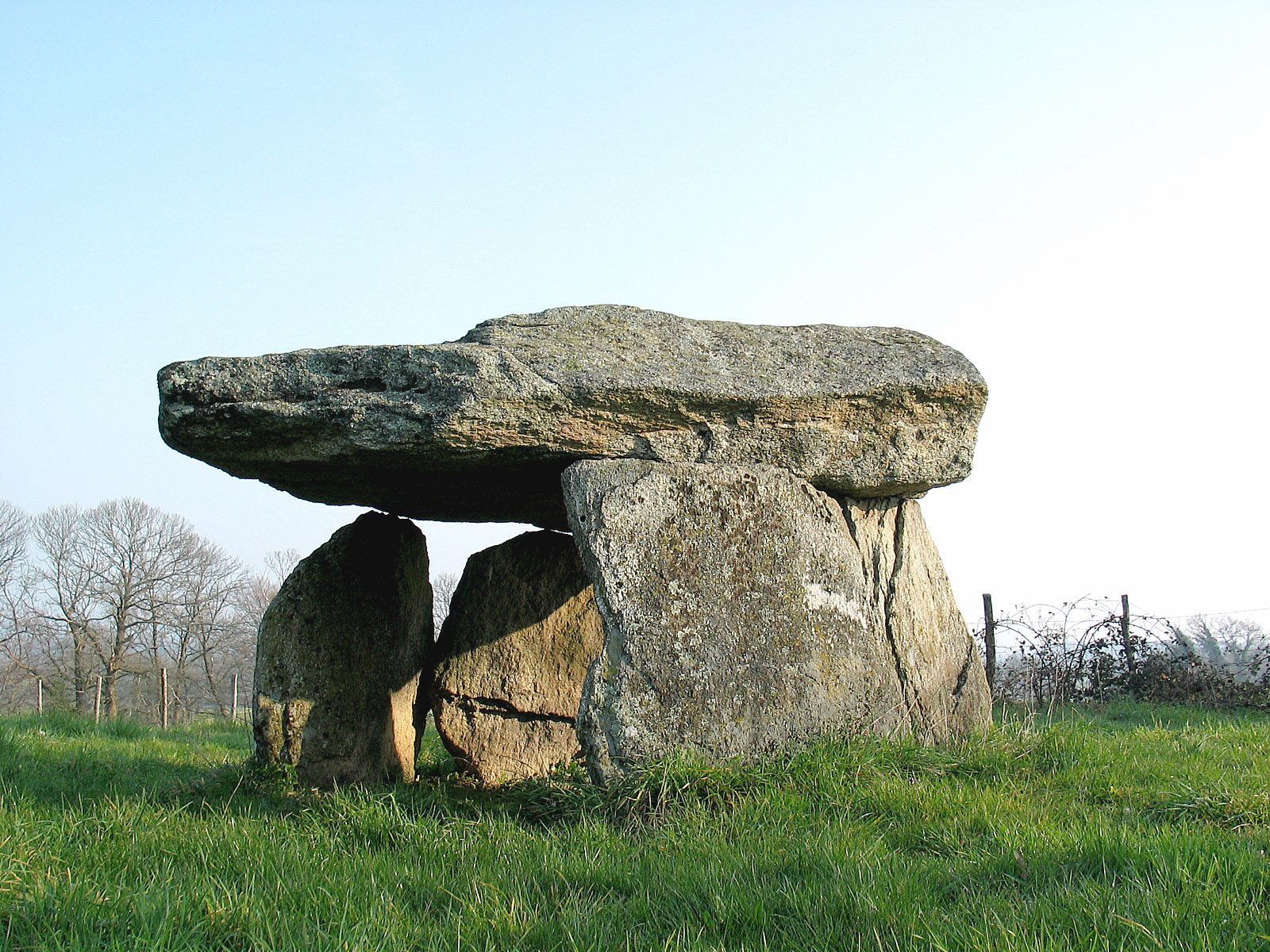
The Dolmen de Bagnol is a prehistoric stone burial chamber at Le Grand Bagnol, near Fromental in France. It was probably built during the Early Neolithic. Charcoal from a pit used to set a pillar was dated to 3788–3389 BCE, and the monument saw further use during the Middle and Late Neolithic and later periods.
Later activity
Evidence from the site points to activity in Gallo-Roman and medieval times. The dolmen also lies close to a prehistoric settlement suggested by flint finds from the surrounding heights.
Recorded history and conservation
The monument first appears in a lithograph published in 1863. A triangular hole in the capstone records an attempt to destroy it with explosives in the early twentieth century. By the early 1990s, its inward-leaning supports threatened collapse. Excavation followed in 1991, and the dolmen was restored the next year.
It has been classified as a French Monument historique, a property protected for its historical importance, since 7 May 1945. Local legend tells of four young women carrying large stones in their aprons. When they tired, they dropped them; after one woman asked God for help, her stone stood upright while the others fell at an angle.
Remains
The dolmen stands at 391 metres above sea level, east of Fromental and north of the D1 road. Its chamber opens east, and its granite slabs form a slightly pear-shaped structure. The White Menhir of Fichades, a large upright stone, lies about 400 metres to the southwest.
Stone chamber
Four coarse-grained granite supports from Montjourde survive, arranged two to each side of the chamber. They stand 1.66 to 1.87 metres high and measure 1.25 to 1.55 metres wide. A triangular capstone rests across them, projecting beyond the supports; it is 4.50 metres long, 2.20 metres wide, and averages 0.80 metres in thickness. Excavation revealed five or possibly six pillar-setting pits, indicating that the chamber had at least one additional support stone.
Finds and environmental evidence
Two polished axes were found in the parcel containing the dolmen during the twentieth century. Excavation recovered about a dozen arrowheads, including Middle Neolithic crosswise-edged forms and Late Neolithic examples with stems and barbs, as well as a dagger point, a dagger blade, and flint flakes. Around 3,000 flint pieces collected on the heights between the dolmen and the White Menhir of Fichades suggest a nearby prehistoric settlement. Such a close association between a megalithic monument and a Neolithic habitation site has rarely been identified in western France.
Other finds include a Gaulish coin, ironworking slag, and coarse pottery from the Gallo-Roman and medieval periods. The pottery is too fragmented to yield further information. Pollen from the archaeological layer includes abundant cereal pollen and pollen from chestnut trees.