Rocca di Monte Battaglia: A Lombard Fortress and Second World War Battlefield in Italy
Site at a Glance
- Rating
- 4.7
- Popularity
- Low
- Country
- Italy
- Primary era
- Medieval
- Eras represented
- Medieval
- Civilizations
- Lombard
- Site type
- Military
- Remains
- Castle
On this page16 sections
History
Rocca di Monte Battaglia is a ruined fortress in Italy, on Monte Battaglia near Casola Valsenio, whose origins lie in a Lombard defensive stronghold. Built during the Lombard period, it guarded the ridge between the Senio and Santerno valleys and the boundary between Lombard territory and the Byzantine Exarchate of Ravenna, the eastern Roman administration of Byzantine possessions in Italy. The hill later remained important to the military organization controlling the two valleys and the plain between Imola and Faenza.
Lombard origins and medieval rule
The name Monte Battaglia has no certain explanation. Medieval documents use the forms Monte de Batalla and Montis Battagliae. Some historians associate the name with a sixth-century battle between Goths and Byzantines. Another interpretation derives “Battaglia” from the Lombard word Pataia, meaning a torn or fluttering piece of cloth.
The fortress first appears in written records in 1154 as the Castrum de Monte de Battalla. A castrum was a fortified settlement or stronghold. At that time, the site belonged to Imola. By 1390 it had come into the possession of Bologna, whose Senate ordered its destruction and assigned the work to Ugolino di Boccadiferro and 500 military engineers.
In 1392 the Alidosi family held Monte Battaglia and rebuilt the fortress. It later passed to Guidantonio Manfredi of Faenza. His son Taddeo, lord of Imola, strengthened the position when his uncle Astorgio attempted to seize it. Astorgio captured the fortress by stratagem in 1462, but was subsequently compelled to return it.
Renaissance control and decline
The fortress later passed to Girolamo Riario and then to Caterina Sforza, ruler of Imola. Cesare Borgia captured it in 1502. Venetian rule followed in 1504, and in 1505 the site returned to the Holy See, the government of the Papal States. Imola then maintained a castellan, the official responsible for commanding and maintaining a fortified site, on behalf of the papacy. Pope Julius II passed the fortress in October 1506 while traveling to Imola.
Military technology changed during the sixteenth century, reducing the effectiveness of the older defenses. Monte Battaglia consequently lost strategic importance and prestige. In 1601, Imola could no longer find anyone willing to serve as castellan. The site briefly housed a Franciscan hermitage, but in 1640 Imola required Casola Valsenio to maintain an armed guard there. Instead, the inhabitants obtained permission to demolish the fortifications, and the complex entered a long period of abandonment. An edict issued in 1757 prohibited the removal of stones, fragments, and other materials from the fortress and tower.
From refuge to wartime stronghold
After Italian unification, the ruins became a refuge for brigands. Many were former smugglers who had operated between the Papal States and the Grand Duchy of Tuscany, a Tuscan state that lasted until Italian unification. At the end of the nineteenth century, a sharecropping family occupied several rooms between the tower and the walls on the southeastern side. Another farming family later took their place and finally left the site in 1942.
Monte Battaglia returned to military history during the Second World War. On 24 September 1944, a 250-man partisan battalion of the 36th Garibaldi Brigade began infiltrating the area. The Garibaldi Brigades were Italian partisan formations associated with the anti-Fascist Resistance. The battalion captured Monte Battaglia on the morning of 27 September while operating in the Apennines of Imola and Faenza as part of the Allied campaign against the Gothic Line, the German defensive system across northern-central Italy.
On the afternoon of 27 September, soldiers of the 350th Regiment of the United States 88th Infantry Division reached the hill and encountered the partisan forces. The division was nicknamed the “Blue Devils.” Its troops were taking part in the effort to break through the Gothic Line along the watershed between the Senio and Santerno valleys.
German forces attacked in heavy rain with the 290th Artillery Regiment and elements of the 44th and 715th Divisions. Three companies of the Blue Devils helped repel the assault. Fighting continued for five more days. Further German attacks, reinforced from the Adriatic front and supported by forces of the Republic of Salò, the German-backed Fascist Italian state that operated in northern Italy from 1943 to 1945, were also repulsed with heavy losses.
The partisan and American defense of Monte Battaglia was regarded as strategically and militarily important to the liberation of Italy from Fascism. The 350th Regiment of the 88th Division later received the name “Monte Battaglia.” On 3 October, American forces handed the position to the 1st Brigade of the Welsh Guards, which resisted the final German attacks until 11 October. More than 2,000 people were killed in the fighting.
The capture of Monte Battaglia opened the route toward the Po Valley, but the Allied advance was halted for strategic and military reasons until the following spring. The final Allied offensive began in April 1945. The Senio Valley was then liberated by the “Friuli” Combat Group, incorporated into the British Army’s 10th Corps. Casola Valsenio later received the Croce di Guerra al Valor Militare, an Italian military valor award for distinguished courage or sacrifice in wartime, for the sacrifices of its population and its part in the partisan struggle.
Recovery and remembrance
Artillery fire during the 1944 battle destroyed the remaining fortress buildings. The tower stump survived immediately afterward, while a pillar of the surrounding wall collapsed soon after the war. A symbolic cemetery was inaugurated in 1950 on the tenth anniversary of the Resistance by Professor Augusto Rinaldi Ceroni.
A 1973 study day organized by the Pro Loco of Casola Valsenio, a local civic association, drew attention to the ruins and stressed that the tower was the keep of a fortress rather than an isolated tower. After the municipality acquired the area in 1982, recovery work and archaeological excavation began. Restoration followed from 1985 to 1987, with further interventions in 2007 and 2008. In 1988, three stone plaques honoring the partisan, American, and British dead were installed, and a plaque commemorating the 1st British Guards Brigade followed in 1990.
A plaque to the German dead was unveiled at the base of the fortress’s eastern spur in 1998. In October of that year, Renzo Grandi discovered the remains of American infantryman Harry Castilloux, killed in an enemy bombardment on 4 October 1944. A plate and a photograph of a girl believed to have been his fiancée were found with the remains. In October 2001, Welsh Guards and soldiers of the German 305th Infantry Division visited Monte Battaglia together in an act of peace and reconciliation. Representatives of the principal forces involved in the battle returned in September 2004 for the sixtieth anniversary. Information panels describing the history of Monte Battaglia from prehistory to the present were installed in 2012.
Remains
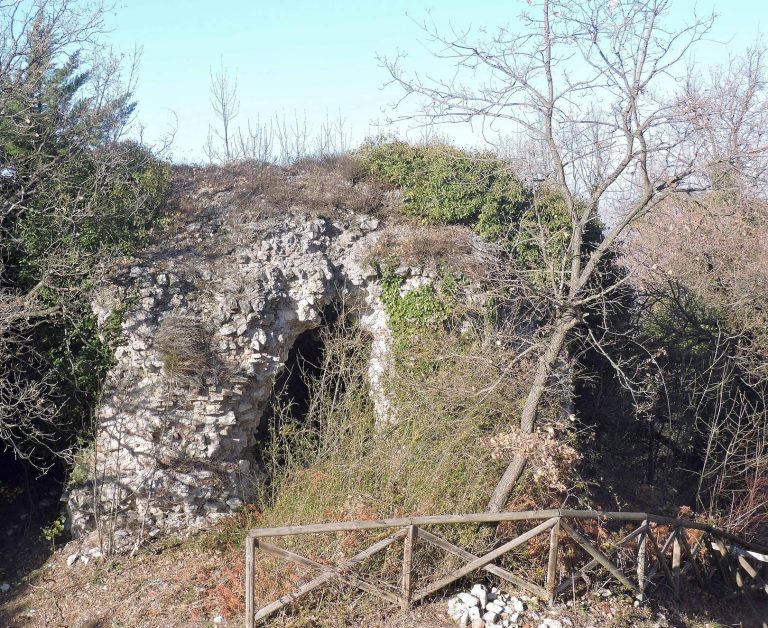
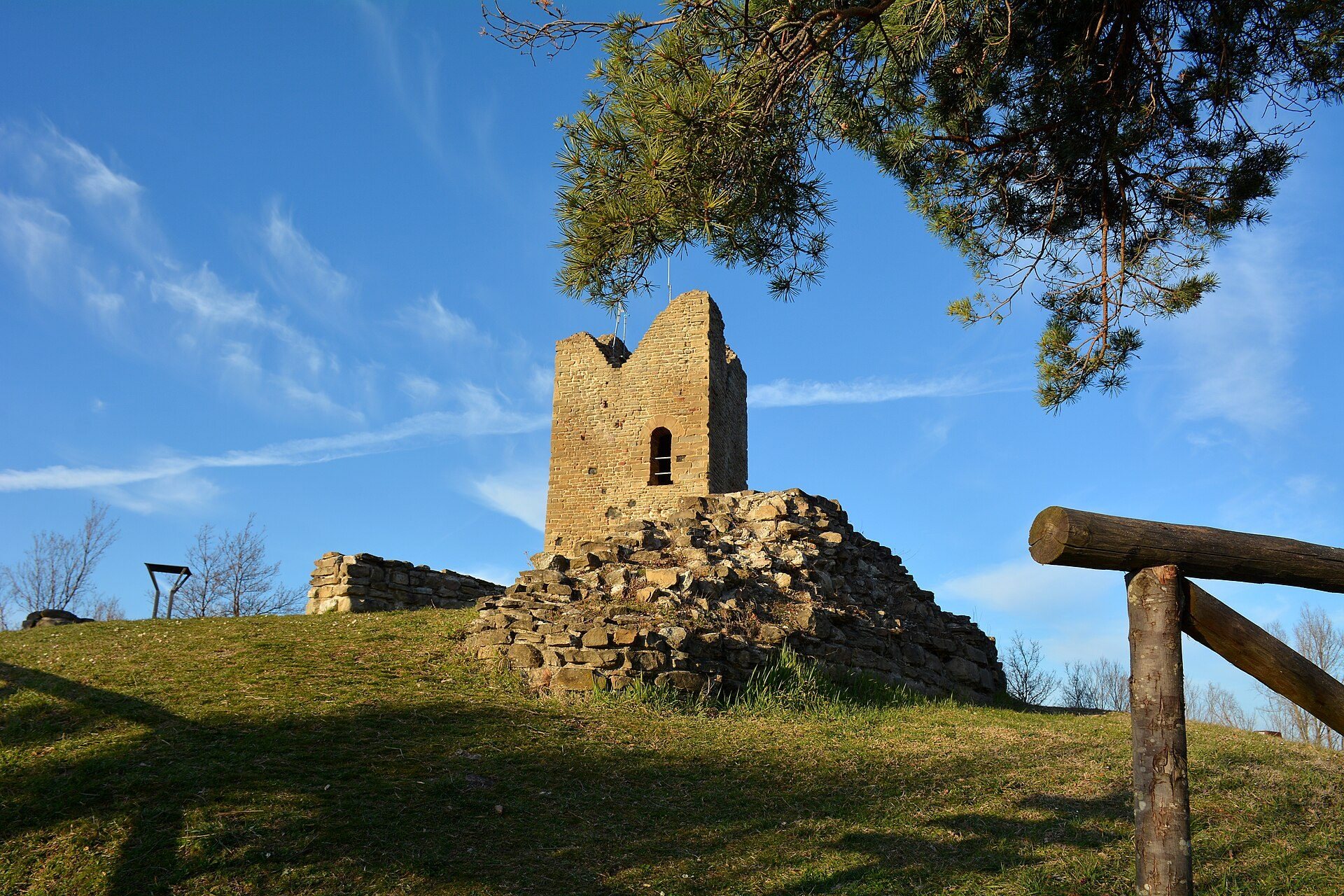
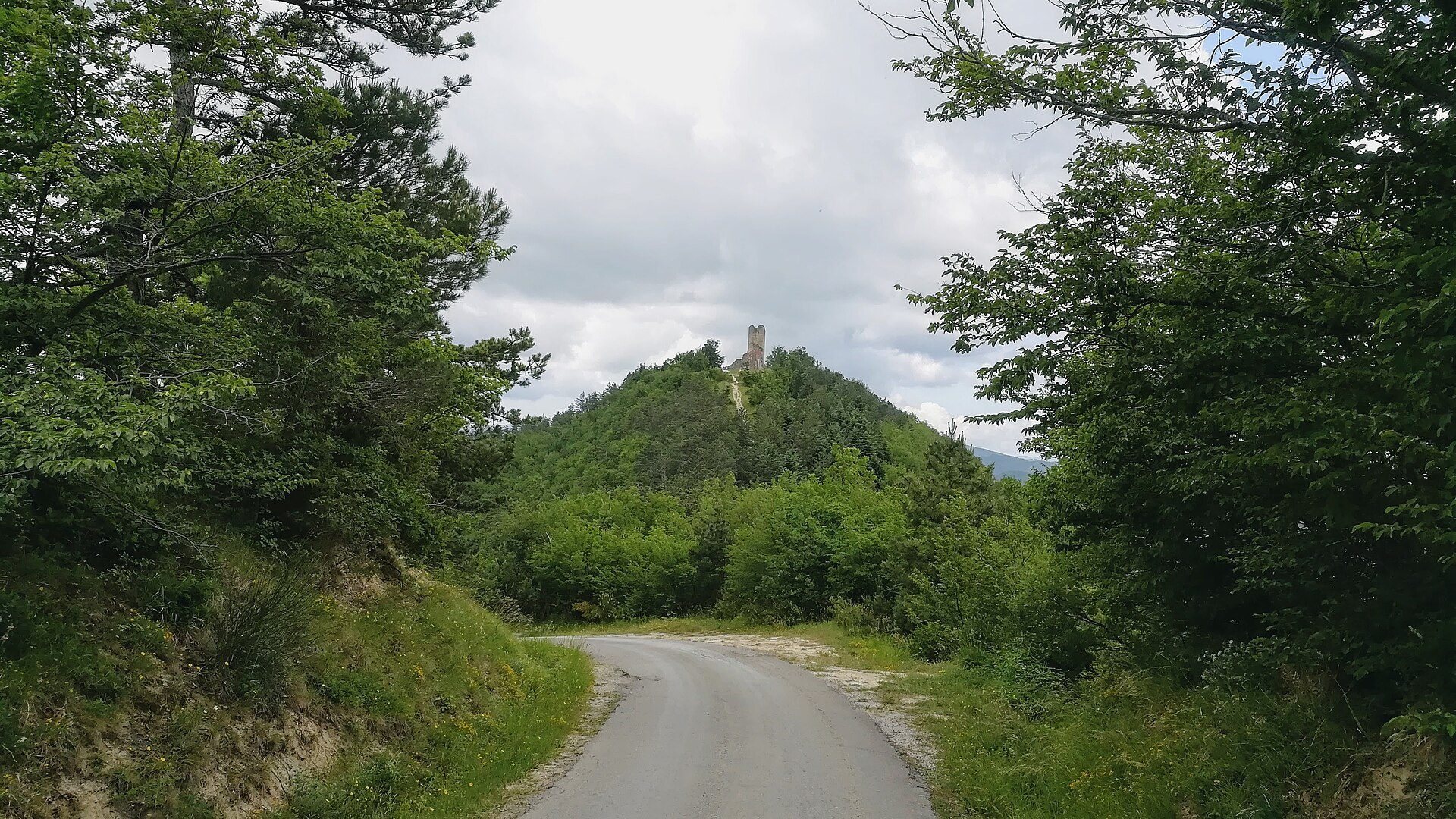
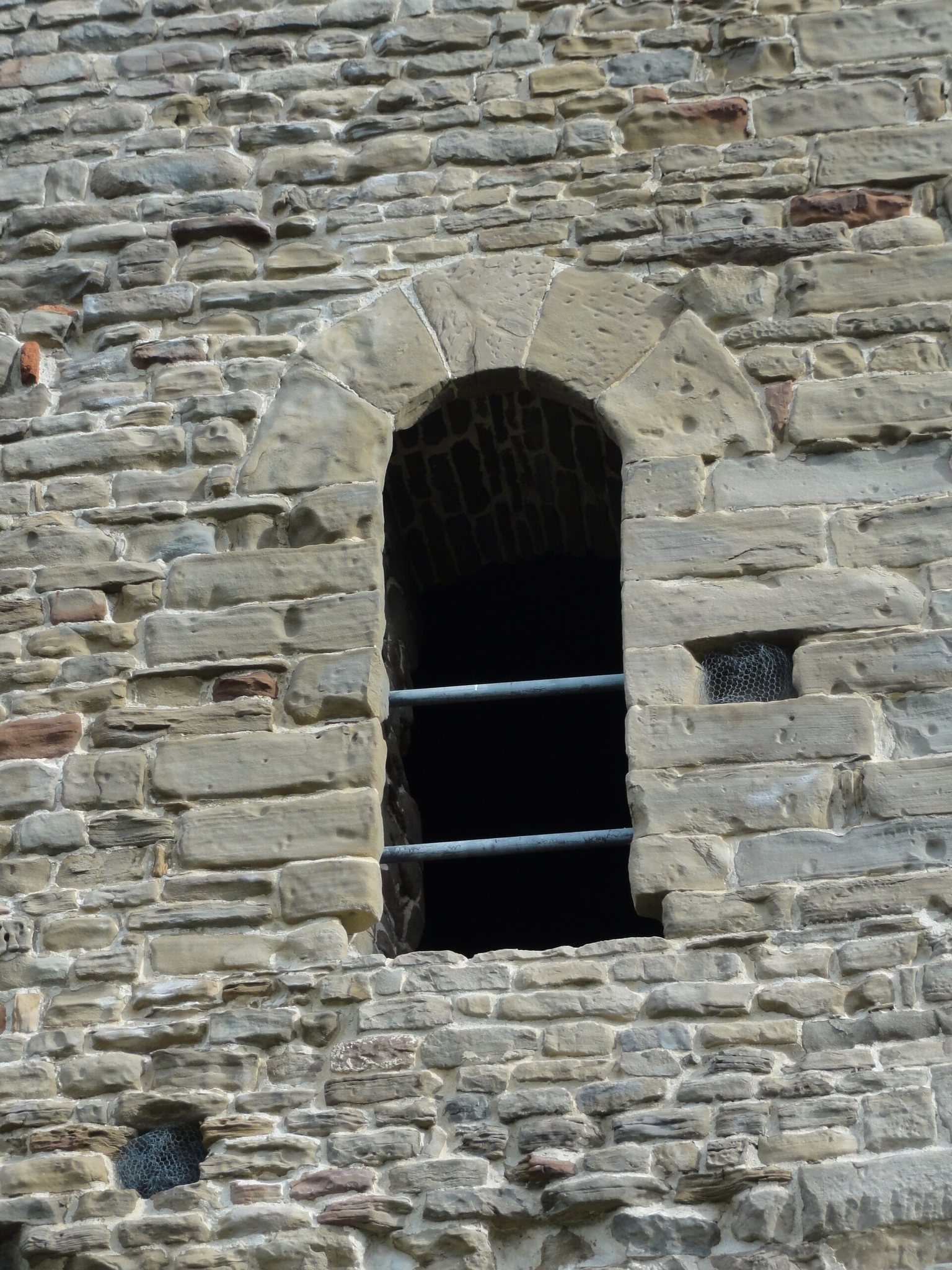
The ruins occupy the summit area of Monte Battaglia, between the Santerno and Senio valleys. The hill reaches 715 metres, while the fortress site lies at approximately 682 metres. The position stands on the ridge separating the two valleys, a location that shaped the fortress’s defensive purpose and its control of routes toward the plain between Imola and Faenza. The surviving complex is built mainly of rubble stone and is organized around the remains of a principal tower, a later bastion, and an enclosing wall.
Fortress structures
The Lombard-period keep
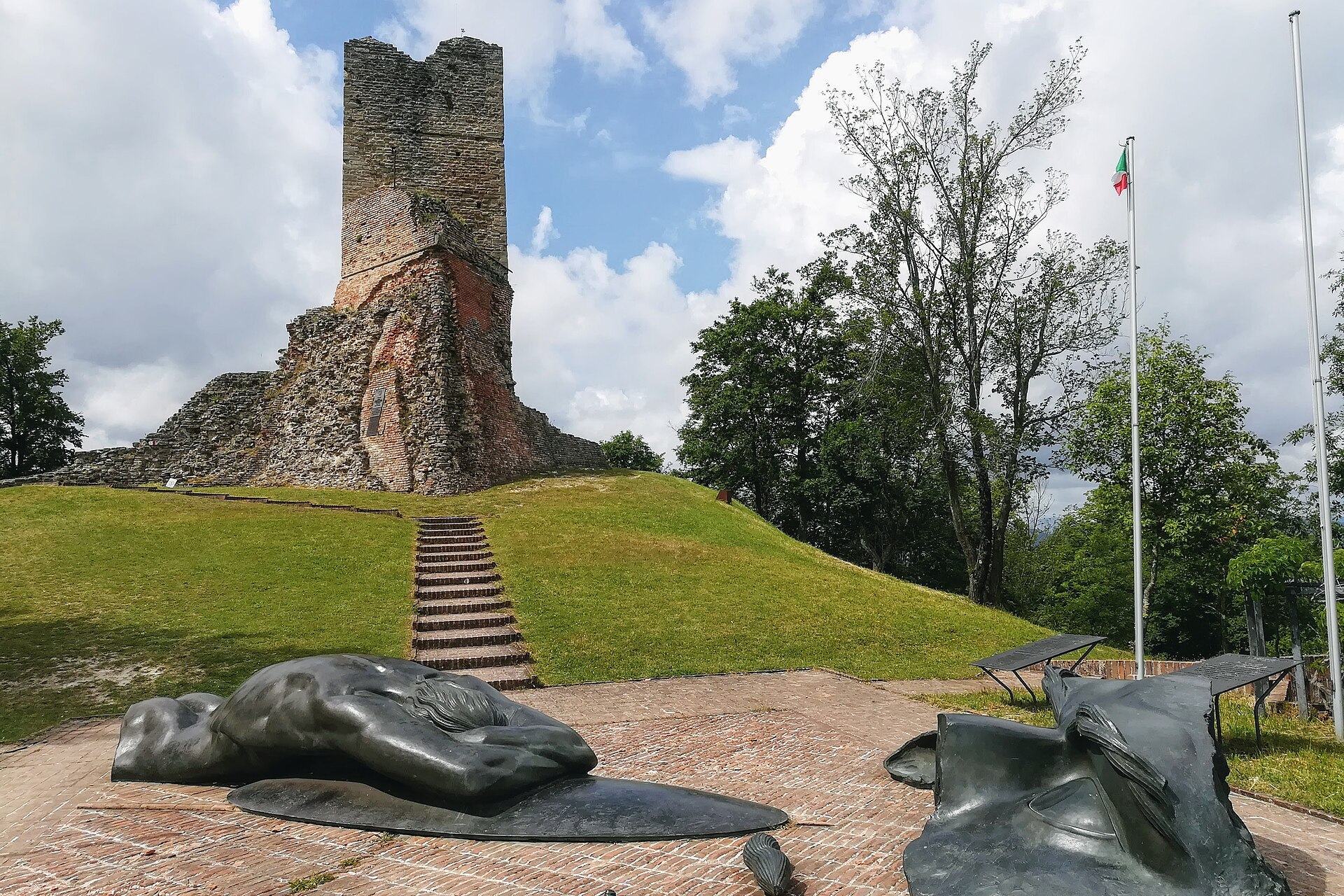
The principal surviving feature is a defensive tower from the Lombard period. Archaeological and historical interpretation identifies it as the keep, or main strong tower, of the larger fortress. The structure is built of rubble stone and survives in a ruined condition, principally as the tower stump left after the artillery bombardments of 1944. Restoration between 1985 and 1987 reconstructed its wooden floors and repaired sections of poorly preserved masonry.
The northern bastion
A bastion, a projecting gun platform, was added against the northern side of the tower in 1494. The master mason Bruchello designed the addition. The bastion remains preserved as part of the surviving fortress fabric and represents the adaptation of the medieval stronghold to later defensive requirements.
The enclosing wall
The fortress was surrounded by an enclosing wall. Intensive artillery during the 1944 battle destroyed most of the complex, and a surviving pillar of the wall collapsed shortly after the war. The 1985 to 1987 restoration consolidated the remaining sections of the enclosure, while additional restoration work took place in 2007 and 2008.
Archaeological evidence
Objects from the fortress
Excavations begun in 1982 uncovered material from the fifteenth and sixteenth centuries. The finds include plates and jugs of incised painted maiolica, a decorated glazed earthenware, along with glazed cooking pots. Weapons-related objects include lance points and crossbow bolts or points. Several counterfeit coins were also recovered.
The counterfeit coins
The concentration of false coins led to the hypothesis that a clandestine mint operated at the fortress between 1510 and 1530, during a period of temporary abandonment. This remains an inference rather than a confirmed identification of the site’s function.
Memorials and commemorative features
Resistance and peace memorial
The Monumento alla Resistenza, alla Liberazione e alla pace tra i popoli was inaugurated in 1988 in memory of the Second World War battle. The bronze work by sculptor Aldo Rontini represents the biblical encounter between David and Goliath, presenting it as a symbol of the struggle for freedom and the peace that followed.
Cemetery and plaques
The symbolic cemetery inaugurated in 1950 forms part of the commemorative landscape. Memorial plaques honor the partisan, American, British, and German dead, while the plaque to the 1st British Guards Brigade recalls the formation that defended the position during the final stage of the 1944 fighting. Information panels installed in 2012 present the history of Monte Battaglia from prehistory to the present.