Santa Maria alla Porta Church: A Baroque Parish Church
Site at a Glance
- Popularity
- Medium
- Country
- Italy
- Primary era
- Early Modern
- Eras represented
- Early Modern
- Civilizations
- Duchy of Milan, Holy Roman Empire, Spanish
- Site type
- Religious
- Remains
- Church
On this page12 sections
History
Santa Maria alla Porta Church is a Baroque Catholic church in Italy, erected in 1652 under Spanish rule to designs by Francesco Maria Richini. It stands on a site occupied by an earlier church before 1105. The discovery of relics during that church’s demolition gave rise to an annual religious celebration.
The earlier church and relics
Landolfo Iuniore, a medieval chronicler of Milan, described the earlier church as minor and said it was not a place where litanies were held. The present church takes its name from its position by the former Porta Vercellina, part of the city walls attributed to Augustus, Rome’s first emperor. The street in front formed part of the decumanus, a principal east–west street in a Roman town plan, running between San Sepolcro Square and the gate.
On 7 May 1105, during the earlier church’s demolition, people found relics associated with Jesus’ burial cloth and shroud, the stone where an angel was said to have announced the Resurrection, a splinter of the Holy Cross, and a fragment of Mary’s clothing. In 1674, the historian Torre also described these relics and the venerated bones of Casto and Polimio, two subdeacons, or junior church ministers.
The discovery prompted the annual Feast of the Savior on 9 May, also called the Feast of the Holy. A procession travelled from the church of Saint Tecla to Santa Maria alla Porta. Participants carried candles and fresh branches and called out agios, meaning “holy” or “pure.”
Seventeenth-century rebuilding
On 8 December 1651, during reconstruction to Richini’s design, workers uncovered a wall painting of the Virgin Mary with the infant Jesus while taking down an exterior wall. Known as the Madonna of the Apron, the image attracted donations that helped fund the rebuilding and its single-nave plan. The church was erected and consecrated in 1652. After Richini’s death in 1658, Francesco Castelli, an architect and engineer from Mendrisiotto in southern Switzerland, completed work that included the Baroque entrance portal and triangular pediment.
Nineteenth- and twentieth-century changes
In 1854, provost Alberto De Capitani d’Arzago, a senior cleric, initiated work on the church, its floors, the burials beneath them, and the surrounding area. The façade was restored in 1856. On the night of 12–13 August 1943, three bombs heavily damaged the church and demolished the Madonna chapel, built in 1704 and later used as a baptistery. Historic buildings on both sides of the church were also destroyed. The chapel’s furnishings and its sixteenth-century Madonna of the Apron wall painting were devastated. A building designed by Luigi Caccia Dominioni, dated 1961, now occupies the plot to the church’s right.
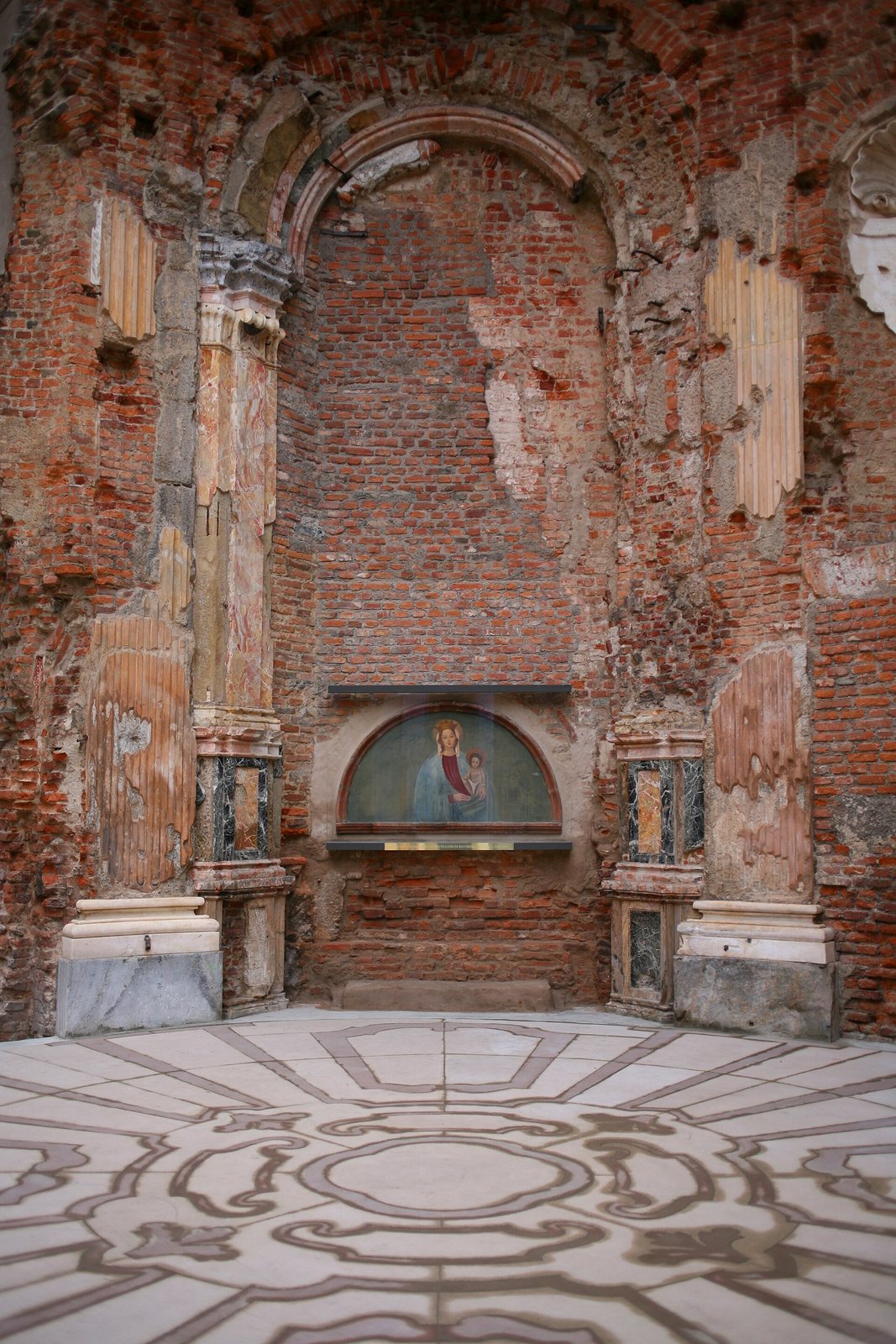
A wall painting known as the Madonna of the Apron, also called the Madonna of Miracles, was later uncovered, restored between 2012 and 2015, and returned to devotional use. Santa Maria alla Porta serves as a parish church of the Archdiocese of Milan and follows the Ambrosian Rite, a Catholic liturgical tradition associated with Milan and its archdiocese.
Remains
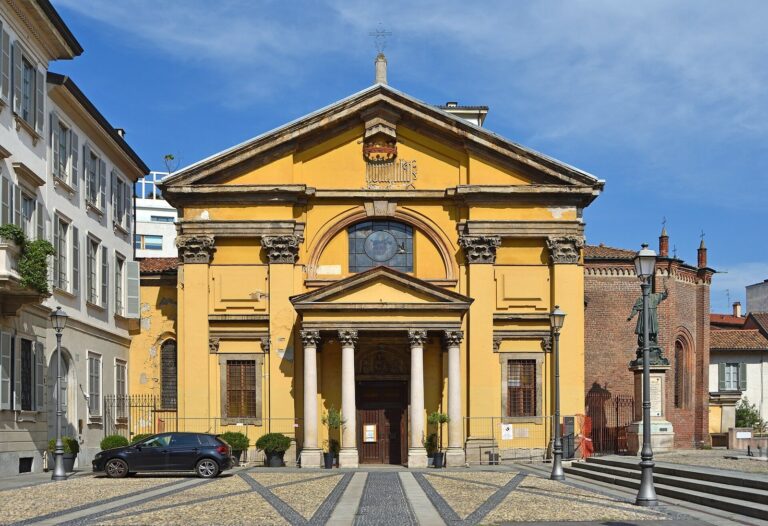
The present church is a compact Baroque building with a single nave, the main hall for worship, four side chapels, and a dome. Its façade, interior decoration, and the remains of the former Madonna chapel preserve distinct aspects of the site’s development.
The earlier church
A record of Cardinal and Archbishop of Milan Federico Borromeo’s 1605 pastoral visit describes the church before Richini’s reconstruction. It had three naves and a cross-shaped plan, faced east, and measured about 20 metres long by 8 metres wide. The record describes wall paintings by the Renaissance artist Bramante and Lombard painter Luini.
The Baroque church
The rebuilt church’s relatively small interior has one nave and four side chapels, decorated with white-marble statues.
Façade
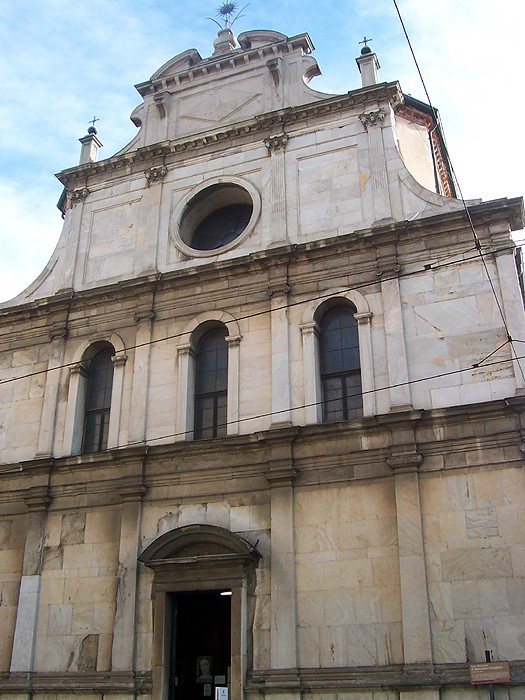
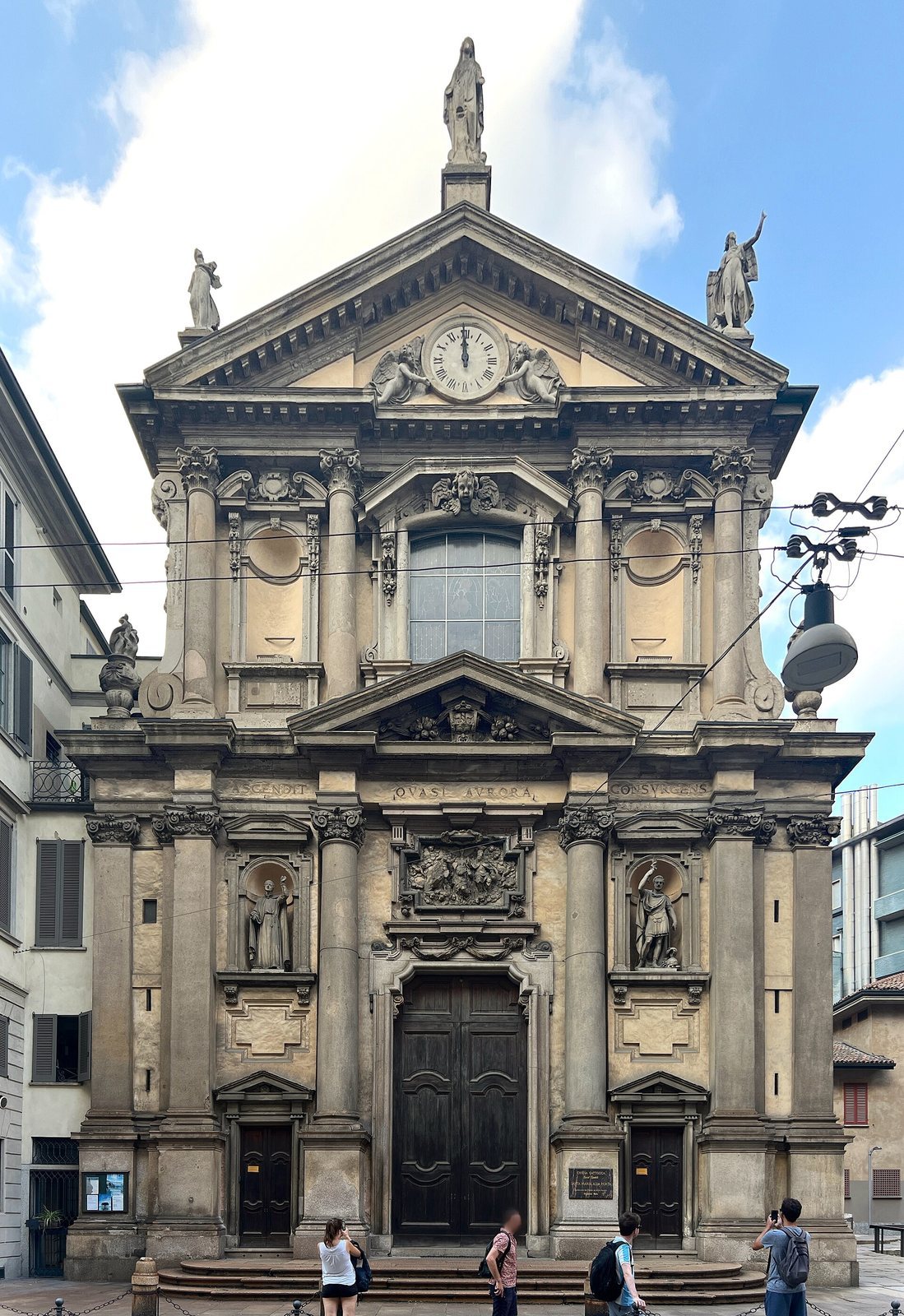
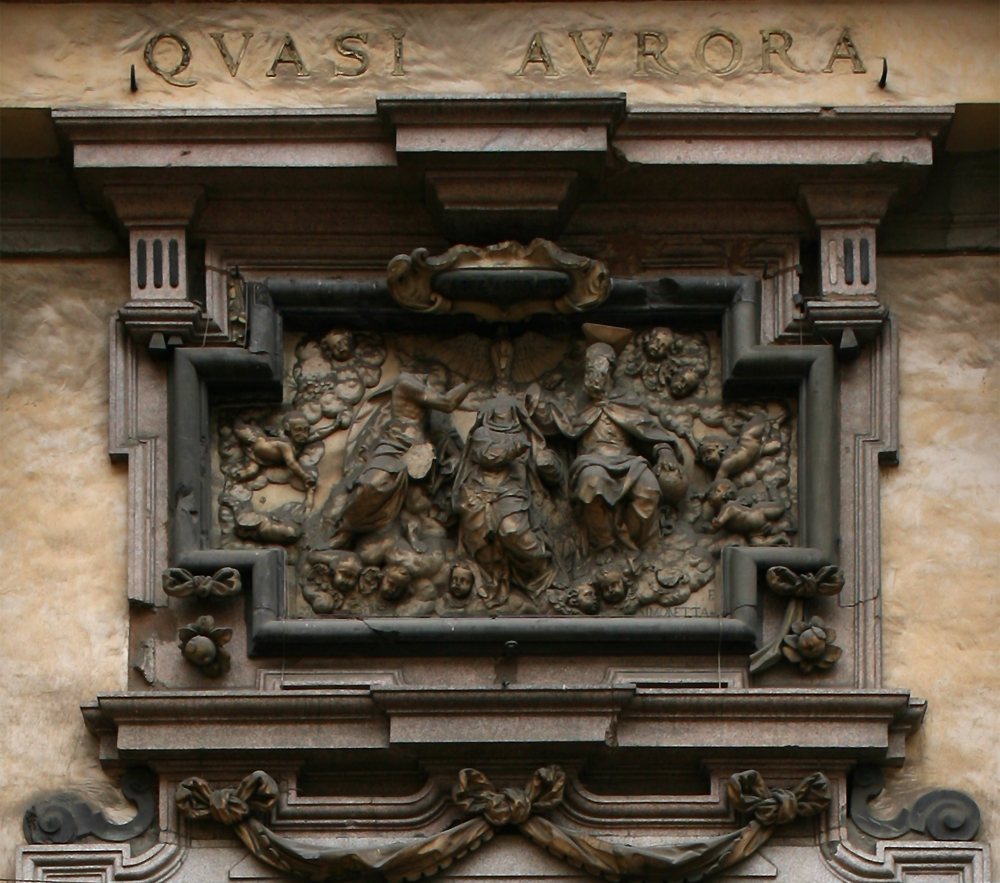
The façade combines Corinthian and Ionic classical orders, forms distinguished by their column capitals. Large granite pedestals support the architectural order beneath a triangular pediment, and a Baroque portal marks the entrance. An inscription below the pediment reads, “She rises like the dawn.” A projecting sculpture by Carlo Simonetta, dated 1670, depicts the Assumption of Mary, the Christian belief that Mary was taken up into heaven. It bears a dedication to Mary in her Assumption. Full-length statues by Giacomo Moraglia stand in niches at either side of the façade. Shrapnel holes and chips mark the façade and its pink-granite columns, while the sculpture is extensively damaged.
Dome and interior decoration
The dome rests on a tall circular base and may have been designed by Girolamo Quadrio. Four angel statues by Giuseppe Vismara and Simonetta, sculpted in 1662, occupy niches in the base. Stefano Sampietro decorated the altar of the Magdalene. A work by Camillo Procaccini is kept in the sacristy, the room where clergy prepare for services.
The Madonna chapel and nearby features
The chapel
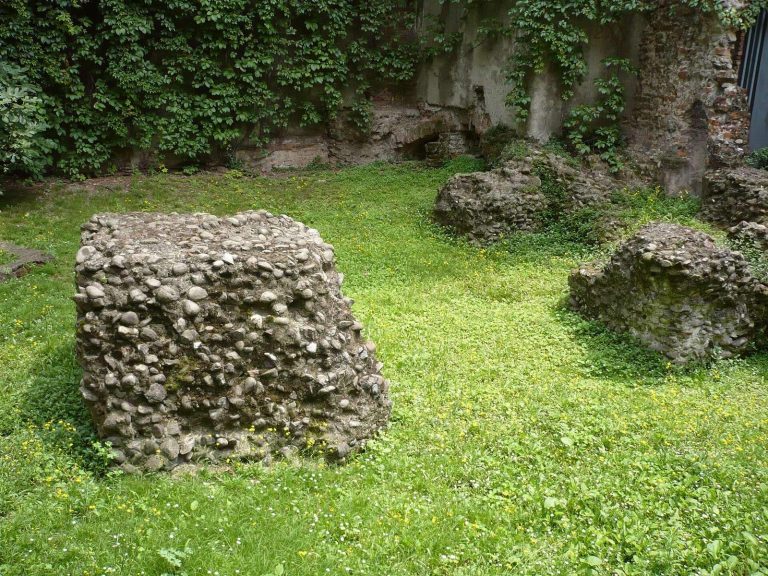
Built to the right of the church in 1704, the Madonna chapel later served as a baptistery, a place used for baptisms. Its scattered ruins survive there; a three-year restoration of the remains was completed in November 2015.
Floor and plaques
A marble floor uncovered during work in Vicolo Santa Maria alla Porta was covered again. A plaque on the church’s right wall lists its parish priests, including Marco Azzoni, active around 1450, and Maffeo Monza, whose known ministry dates from 1536 to 1574. Another plaque beside the entrance identifies the church’s chaplaincy for Polish-speaking worshippers.