Church of the Resurrection of Righteous Lazarus: Suzdal’s 17th-Century Orthodox Church
Site at a Glance
- Popularity
- Medium
- Country
- Russia
- Primary era
- Early Modern
- Eras represented
- Medieval, Early Modern, Modern
- Civilizations
- Russian
- Site type
- Religious
- Remains
- Church
On this page9 sections
History
The Church of the Resurrection of Righteous Lazarus, commonly called Saint Lazarus Church, is an Orthodox church in central Suzdal, Russia, built in 1667. It was the earliest church in Suzdal’s posad, a town settlement often outside a fortified center, and the city’s first five-domed church. Its dedication honors Lazarus of Bethany, whom the New Testament describes as raised from the dead by Jesus.
Medieval records and the 1667 church
The earliest known reference to the church appears in a 1495 charter from Grand Prince Ivan III of Moscow, who ruled from 1462 to 1505, to the Spaso-Evfimiev Monastery, a historic monastery in Suzdal. The church, then outside the town, is listed among those supported by assigned ecclesiastical revenues. The charter also granted the monastery 16 desyatinas, a traditional Russian land-area unit, of meadowland around Vetelsky Pond, under Archimandrite Konstantin, a senior Orthodox monastic leader, and his brethren.
A wooden church stood on the site in the 15th century. By the early 17th century, it was described as a wooden building with a tent-shaped roof; an earlier, simpler log-frame structure is also possible. The 1667 church replaced this predecessor.
The paired churches
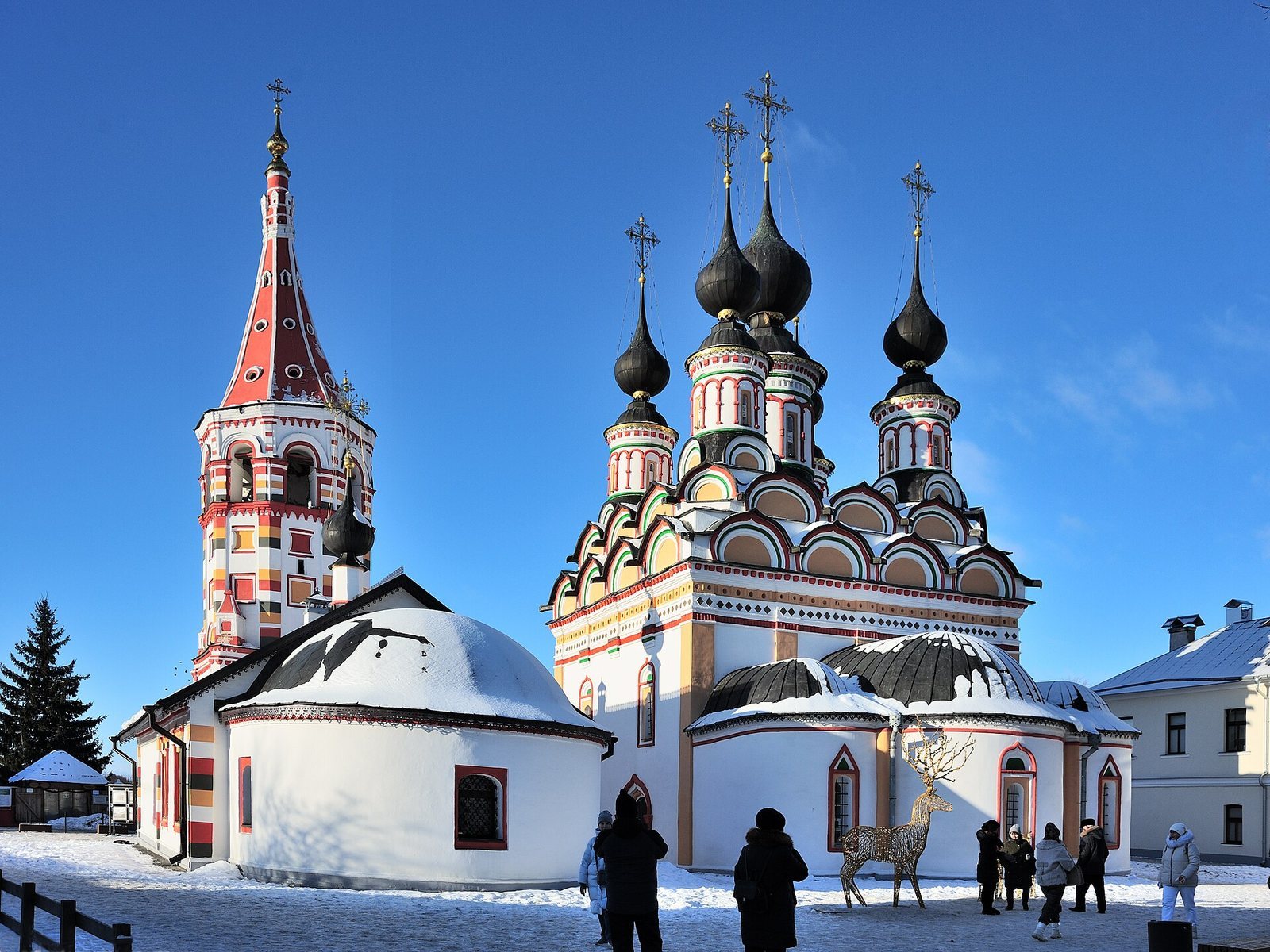
A second church, dedicated to Antipas of Pergamum, was built beside it in 1745. Antipas is venerated in Orthodox tradition as an early Christian bishop and martyr. The new building created a paired church complex.
Church jurisdiction and restoration
In 1969, the church received federal cultural-heritage protection. In 1996, the Lazarus and Antipas churches were transferred for use to the Russian Orthodox Free Church, later renamed the Russian Orthodox Autonomous Church, a separate jurisdiction described as noncanonical. Its restoration work included new interior paintings, which were later criticized.
Legal proceedings over the use of Suzdal’s churches began in 2006. In February 2009, courts ended the Autonomous Church’s use of 13 churches, including the Lazarus–Antipas complex. As its representatives left, they removed the Royal Doors, the central doors in the screen separating the sanctuary from the nave, and pulled heating pipes from the walls.
Both churches were transferred to the Vladimir Diocese of the Russian Orthodox Church in December 2009, and restoration was entrusted to the priest Alexander Lisin. In December 2013, the Lazarus church was unheated, preventing normal liturgical services. It is an active Orthodox church.
Remains
The paired church complex
Church of Lazarus: exterior
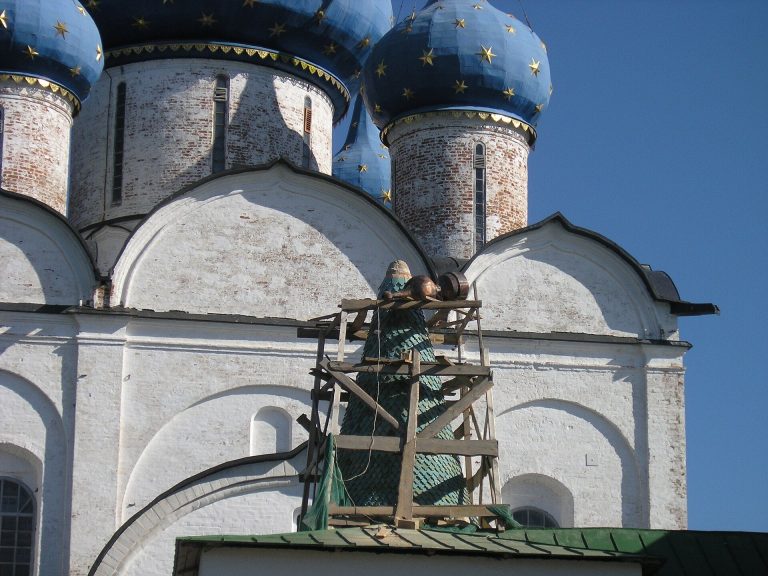
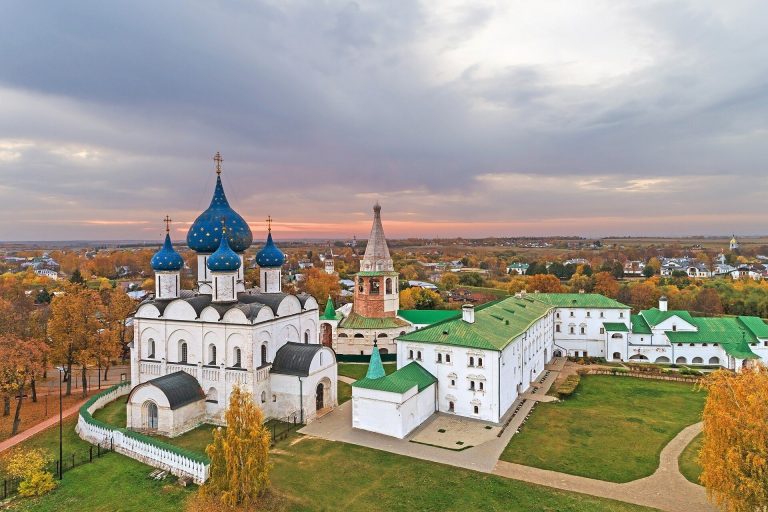
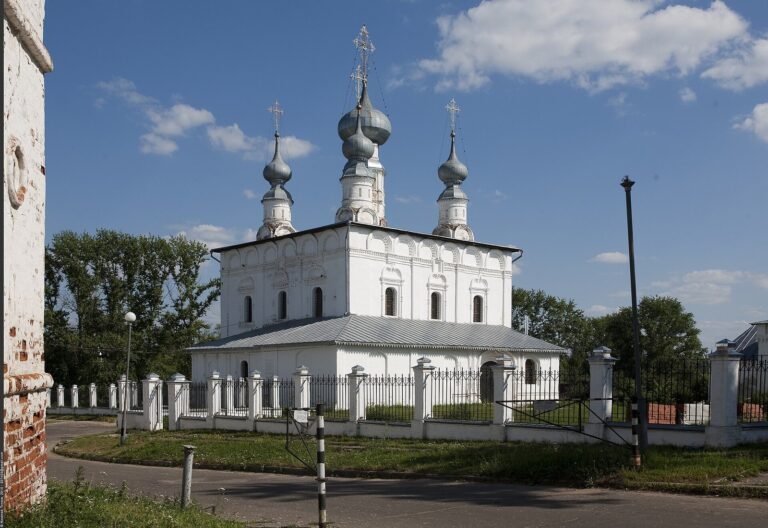
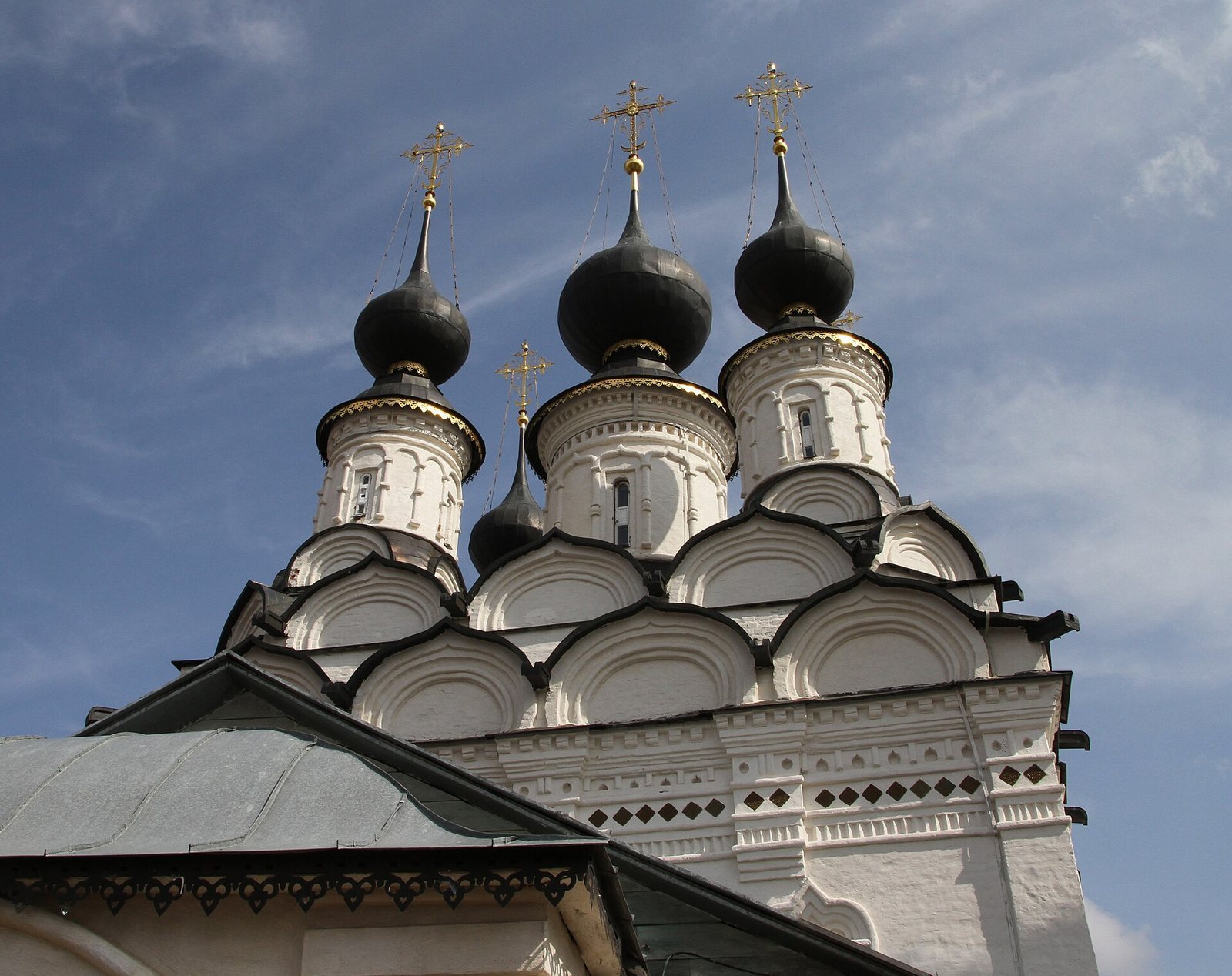
Standing between Market Square and the Monastery of the Deposition of the Robe, the church has a square plan and five bulbous domes. Three apse projections, the semicircular sanctuary ends, extend from its east side. Its facades have portals in three distinct designs, while broad cornices combine tile bands, projecting brickwork, and curved, gable-like kokoshniks. Two rows of these ornaments run along each of the roof’s four slopes. The drums, structures beneath the domes, have narrow windows and rows of semicircular arches at their bases, with decorative column bands. The four corner drums rest on horseshoe-shaped kokoshniks and also have windows. An early design for a tent-shaped bell tower was later replaced by a roof with drums and bulbous domes.
Church of Lazarus: interior
Inside, two pillars support the barrel vaults, continuous arched ceilings. Openings in the central drum and the four corner drums admit light from above. Windows in the corner drums are an unusual feature for a church with this two-pillar arrangement.
Church of Antipas
The neighboring Church of Antipas completes the complex and served as its heated winter church.