San Vincenzo (Casteltermini): The Town’s Principal Church
Site at a Glance
- Popularity
- Very Low
- Country
- Italy
- Primary era
- Early Modern
- Eras represented
- Early Modern, Modern
- Civilizations
- Italian, Kingdom of Sicily, Spanish
- Site type
- Religious
- Remains
- Church
On this page30 sections
History
San Vincenzo (Casteltermini) is the town’s principal Roman Catholic church in Italy, also known as the mother church and the Church of Saint Vincent Ferrer. Construction began in 1629, the year Casteltermini was founded, and the church became the town’s first major public work. Saint Vincent Ferrer, a Dominican preacher of the late fourteenth and early fifteenth centuries, is its dedicatee.
Foundation and enlargement
Gian Vincenzo Maria Termini, the baron who founded Casteltermini, chose Saint Vincent Ferrer as the town’s protector. Termini was related to the Ferreri family. The founding agreements required him to pay the church’s full construction costs, but he instead compelled the municipality and the inhabitants, then regarded as his vassals, to build it while he arranged for his own castle residence.
Initially, construction extended only to the central nave. After the building had been enlarged and improved, architect Pietro Burgio carried out its final inspection in 1883.
Parish life and observances
The church serves the parish of San Vincenzo Ferreri in the Archdiocese of Agrigento, a major Catholic jurisdiction led by an archbishop. Its ecclesiastical structure also includes the Cammarata vicariate, a diocesan subdivision, and the Casteltermini archpriesthood, a jurisdiction associated with an archpriest. Saint Hyacinth Giordano Ansalone, a Dominican missionary and martyr, is also a patron of the church.
Saint Vincent Ferrer is celebrated on 5 April with a feast and liturgical services. The church also celebrates Saint Calogerus the Hermit, a saint venerated in Sicily, on the fourth Sunday of August, with services and processions.
Repairs and transferred images
During the 1930s, water penetration and damp threatened the stability of the dome. Archpriest Giovanni Di Liberto authorized urgent repairs, supported by parishioners and the municipal administration. Workers covered the dome’s exterior with copper sheets and strengthened it with masonry work.
The nearby Church of the Purgatory, named for the Catholic belief in purification after death before entry into heaven, had been closed for worship since 1960. Its statues of Jesus Nazarene and Saint Blaise were transferred to San Vincenzo. The image of Jesus Nazarene is carried in the church’s Holy Week devotions, including a Good Friday procession to Calvary.
Remains
Overall plan
The church has a Latin-cross plan, with a long main axis crossed by shorter arms, and an interior divided into three lengthwise aisles by pillars. Ten arches span the aisles, while smaller arches connect the spaces near the entrance end. A large dome rises above four supporting pillars.
Façade and dome
Façade
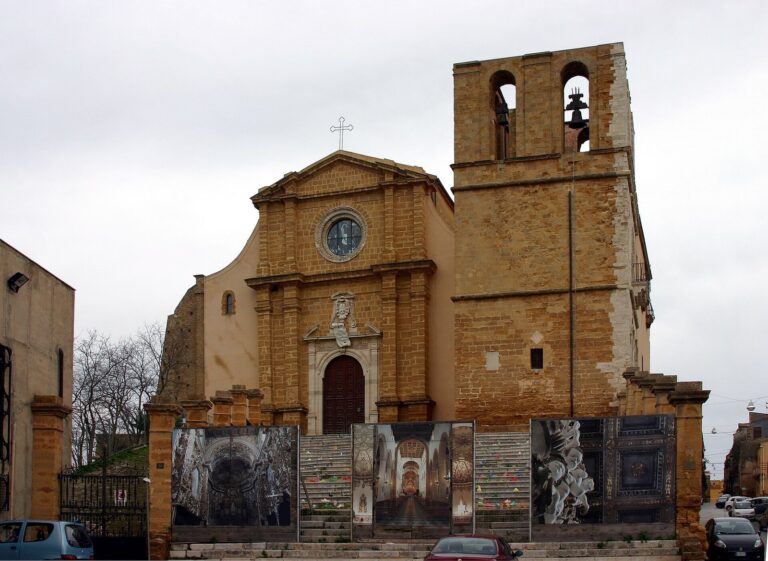
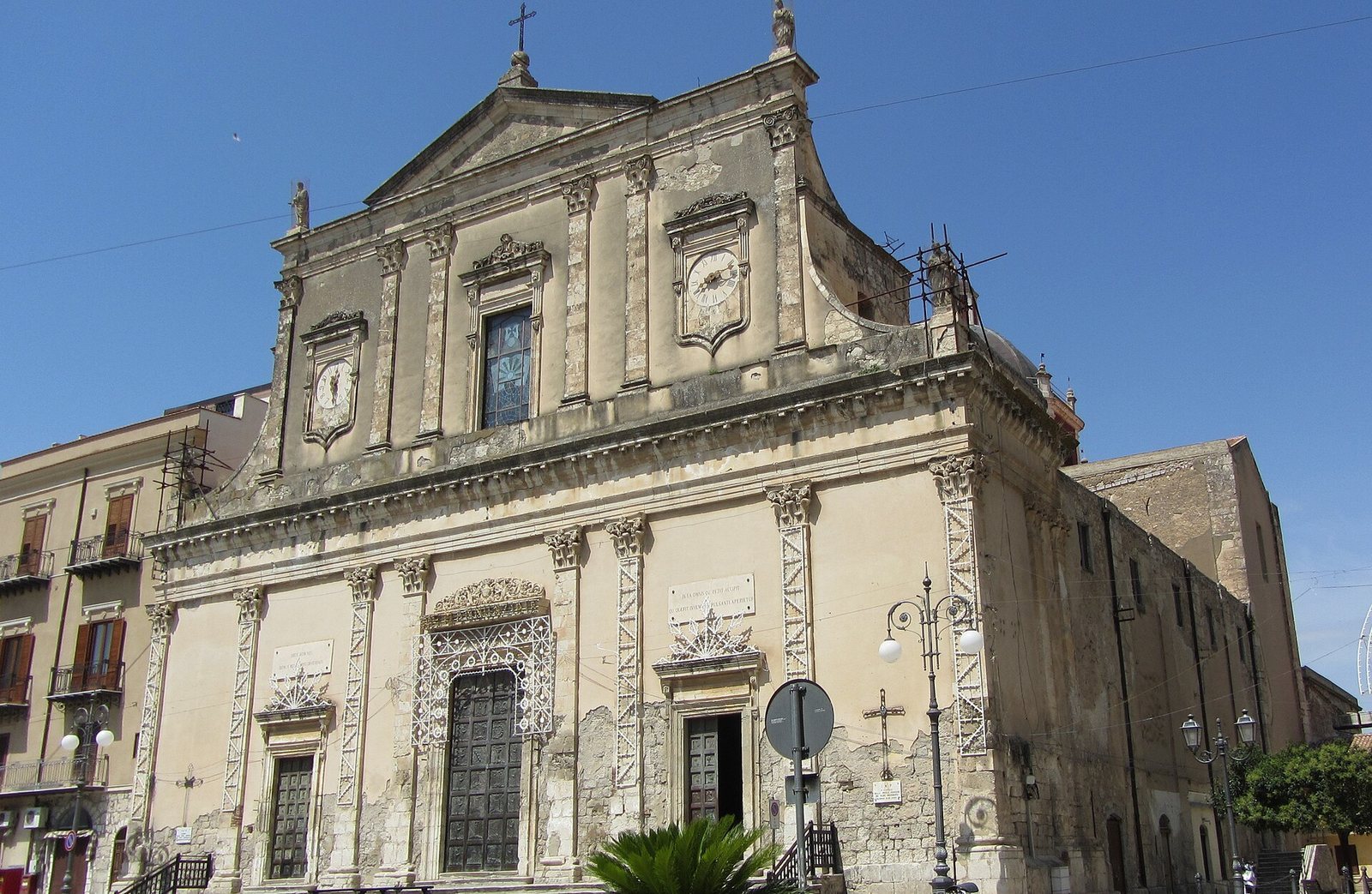
A flight of steps links the street to the façade’s three doorways, and the right-hand entrance has a separate staircase. The lower façade, up to its first projecting horizontal molding, follows the Corinthian order, a classical design known for ornate capitals. Pairs of flat, wall-attached columns frame the entrances. Above, the Composite order combines Corinthian leaf forms with Ionic scroll forms, repeating the lower level’s central arrangement. A large central window and two shield-shaped surrounds containing different clock faces occupy this upper section; scroll-shaped forms join the two levels.
Statues of Saint Joseph and Saint Vincent Ferrer stand on the corner supports. Figures of Saints Peter and Paul flank the triangular gable at the second horizontal molding. Above them, a pyramid-shaped top carries a sphere and iron cross. Stoneworkers from nearby Sciacca carved the attached columns, their capitals, the gables and the façade’s decorative bands and moldings. Inscribed plaques sit above the two smaller side entrances.
Dome
The dome follows the Tuscan order, a comparatively plain classical design. Curved supporting surfaces, called pendentives, carry it above the pillars; these surfaces bear the four Evangelists with their customary emblems. Matthew appears with an angel, John with an eagle, Mark with a lion, and Luke with an ox.
Right aisle chapels
First section: Saint Rosalia
The first section of the right aisle contains the chapel of Saint Rosalia. Its statue of the saint was made by Michele Caltagirone, known as Quarantino, a sculptor from Casteltermini.
Second section: the Rosary
The chapel of the Rosary occupies the second section. Quarantino carved its group of the Virgin of the Rosary with Saint Dominic de Guzmán, founder of the Dominican Order, and Saint Catherine of Siena.
Third section: the Crucifix
An eighteenth-century crucifix by an unknown sculptor stands in the chapel of the Crucifix. A statue of Our Lady of Sorrows is to its right, and a wooden figure of Saint John the Evangelist by Quarantino is to its left.
Fourth section: the Holy Family
The chapel of the Holy Family contains a wooden sculptural group made by Quarantino.
Fifth section: the side entrance
The fifth section contains the right-side entrance. In its wooden vestibule is Quarantino’s statue of Jesus Nazarene, made from papier-mâché and wood.
Left aisle
First section
A fiberglass statue of Saint Pio of Pietrelcina stands on a wooden altar beside the main entrance.
Second section: Saint Anthony the Abbot
The chapel of Saint Anthony the Abbot contains a wooden statue dated 1780. It was made by Rosario Bagnasco, a sculptor from a family originally from Turin who settled in Agrigento while young and worked there for many years.
Fifth section: the organ
An arch between columns in the fifth section accommodates the organ.
Other devotional sculptures
The Annunciation
A sculptural group of the Annunciation by Calogero Cardella, a sculptor from Agrigento, reflects the devotion of Casteltermini’s sulfur miners. They sponsored the work after choosing Mary under this title as their protector.
Images of saints and Mary
Other works include a wooden statue of Saint Anthony of Padua by Quarantino, a statue of Saint Rita, and a wooden statue of Saint Blaise carved by Cardella. Quarantino also made a wooden statue of Our Lady of the Chain, flanked by figures of Saints Rosalia and Lucy. A heavy wooden statue of Saint Calogerus the Hermit, by an unknown sculptor from Palermo, was brought to Casteltermini in 1840.
Cross-arm chapels
Chapel of the Immaculate Conception
The chapel in the right arm is dedicated to the Immaculate Conception, the Catholic belief that Mary was conceived without original sin. Its eighteenth-century wooden statue, by an unknown Neapolitan sculptor, stands in an elaborate wooden shrine. A statue of the Assumption, the belief that Mary was taken bodily into heaven, is displayed below it in a glass urn. A large painting by the Capuchin painter Fedele Tirrito shows the Virgin in ecstasy against a luminous background as angels lift her toward heaven.
Tomb of Antonio Castelli
Beside the Immaculate Conception chapel is a tomb monument of multi-colored marble, made by an unknown sculptor. Paolo Castelli commissioned it in 1702 for Antonio Castelli, a local prelate, baron of Raaltavilla, and abbot of Sant’Anna di Protopapa.
Chapel of the Holy Trinity
The chapel in the left arm holds Fedele Tirrito’s oil painting of the Trinity, also known as the Exaltation of the Cross. The work dates to around 1760, when the painter was in Casteltermini.
Sanctuary and choir
Chapel of Saint Vincent Ferrer
The chapel on the right side of the apse, the church’s sanctuary end, is dedicated to Saint Vincent Ferrer. Its altar holds a statue of the saint carved from very hard wood by an unknown nineteenth-century sculptor. Two low-relief carvings on the side walls show miracles associated with him, the miracle of the mason and the resurrection of a Jewish woman.
Chapel of the Blessed Sacrament
The chapel on the left side of the apse is dedicated to the Blessed Sacrament, the Eucharist. An unknown sculptor made its wooden altar statue of the Sacred Heart of Jesus, a devotion expressing his love. Beneath the altar table is Quarantino’s sculptural group of the Last Supper, based on Leonardo da Vinci’s painting.
Apse and choir
The apse contains Fedele Tirrito’s 1752 painting of the Annunciation. He made it while serving as guardian of the Capuchin convent in Casteltermini. A Capuchin is a member of a branch of the Franciscan order, and a convent’s guardian is the friar responsible for its community.
Two large paintings by the Sicilian artist Giuseppe Velasco hang on the choir’s side walls. They depict Jesus and the Adulteress and Jesus Driving the Merchants from the Temple. Forcalle, a wealthy administrator to Diego Pignatelli Aragona Cortes, Duke of Terranova and then baron of Casteltermini, gave the paintings to the church. The choir also contains a wooden statue of Saint Francis of Paola by Rosario Bagnasco.