Skelia Menhirs: Prehistoric Standing Stones in Ukraine
Site at a Glance
- Popularity
- Medium
- Country
- Ukraine
- Primary era
- Bronze Age
- Eras represented
- Bronze Age
- Civilizations
- Unclassified
- Site type
- Religious
On this page9 sections
History
The Skelia Menhirs are four prehistoric standing stones in Rodnikove, Crimea, Ukraine, dating from the third millennium to the beginning of the second millennium BCE. Archaeologist A. A. Shchepinsky interpreted them as ritual monuments and, in 1978, described them as the largest and most distinctive examples of their type in southeastern Europe. He also considered the stones he studied to have remained undisturbed in later centuries and in their original positions.
Early study and interpretation
Archaeologist N. I. Repnikov brought the site to scholarly attention in 1907, recording three stones. The name Skelia comes from the village’s historical name. In Crimean Tatar, the menhirs are called Tekli-Tash, meaning “placed stone.”
Rediscovery and restoration
A third stone was uncovered during water-pipeline construction in the 1960s. The fourth, which had fallen in antiquity, came to light during earthworks in 1989. The site was placed under protection by a 1975 decision of the Sevastopol City Council executive committee. Guided by Repnikov’s sketches and descriptions, the third and fourth stones were returned to their positions on 26 November 2010. Regional cultural-heritage status was confirmed in 2017.
Remains
Layout and setting
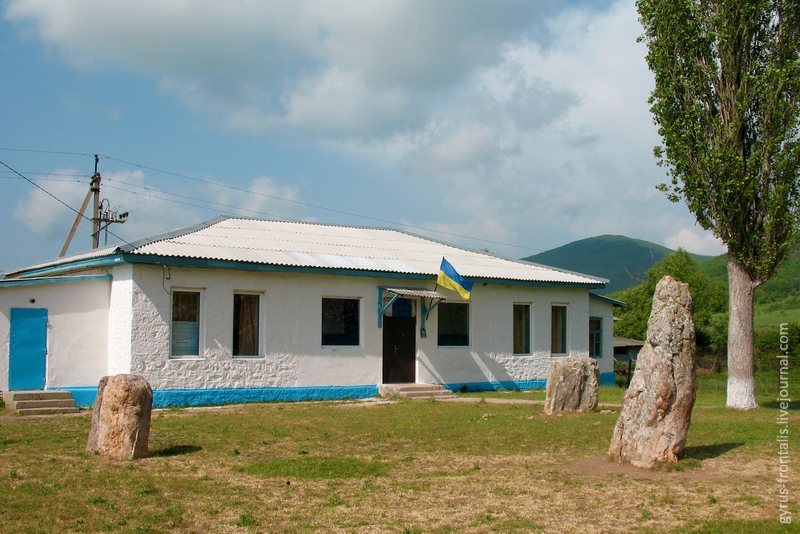
The four upright stones are made of marble-like limestone and form an approximate triangle. A large central menhir stands with one stone to the south and two to the north, one northeast and the other northwest. The group lies about 120 metres south of the shore of the Chernorechenskoye Reservoir, with all four stones close to the village club. A photograph from 1908 shows them among a tobacco plantation.
Individual stones
Central menhir
Known as “Peace,” the central stone has a regular, tapering form resembling a pyramid-shaped pillar. It stands about 2.7 metres high, has an average cross-section of 1 by 0.7 metres, and weighs about six tonnes.
Southern menhir
The southern stone is squat and massive, measuring about 1.5 metres high, 1.2 metres wide, and 0.55 metres thick. It stands within the enclosure of a mass grave for Red Army soldiers and partisans who died in the Second World War.
Northern stones
One northern stone is a fragment about 0.85 metres high, with a cross-section of 0.77 by 0.55 metres. The other northern stone stands upright.