San Sebastiano: The Parish Church of Renazzo, Italy
Site at a Glance
- Popularity
- Low
- Country
- Italy
- Primary era
- Early Modern
- Eras represented
- Early Modern, Modern
- Civilizations
- Italian, Papal States
- Site type
- Religious
- Remains
- Church
On this page9 sections
History
San Sebastiano is the Roman Catholic parish church of Renazzo, a locality within Cento, Italy. It belongs to the Vicariate of Cento, a local grouping of parishes, within the Archdiocese of Bologna, a large church jurisdiction led by an archbishop. Built in the fourteenth century, the church was first dedicated to Saint James and depended on the church of Pieve di Cento. Its dedication later changed to Saint Sebastian, an early Christian martyr, following a vow made during a plague in the hope that it would end.
In 1489, Giuliano della Rovere, then bishop of Bologna and later Pope Julius II, ordered that the church be made a parish.
Reconstruction in the eighteenth century
The building underwent restoration around 1729, but a complete rebuilding was soon chosen. Work on the new church began in 1745 to designs by Carlo Francesco Dotti, an Italian architect, and was completed in 1754. It was erected beside the earlier church, which was taken down in stages so that worship could continue until the replacement was ready. Some material from the demolished building was reused in the new foundations. Taxes initiated by Renazzo’s residents met much of the project’s cost.
Later changes and restoration
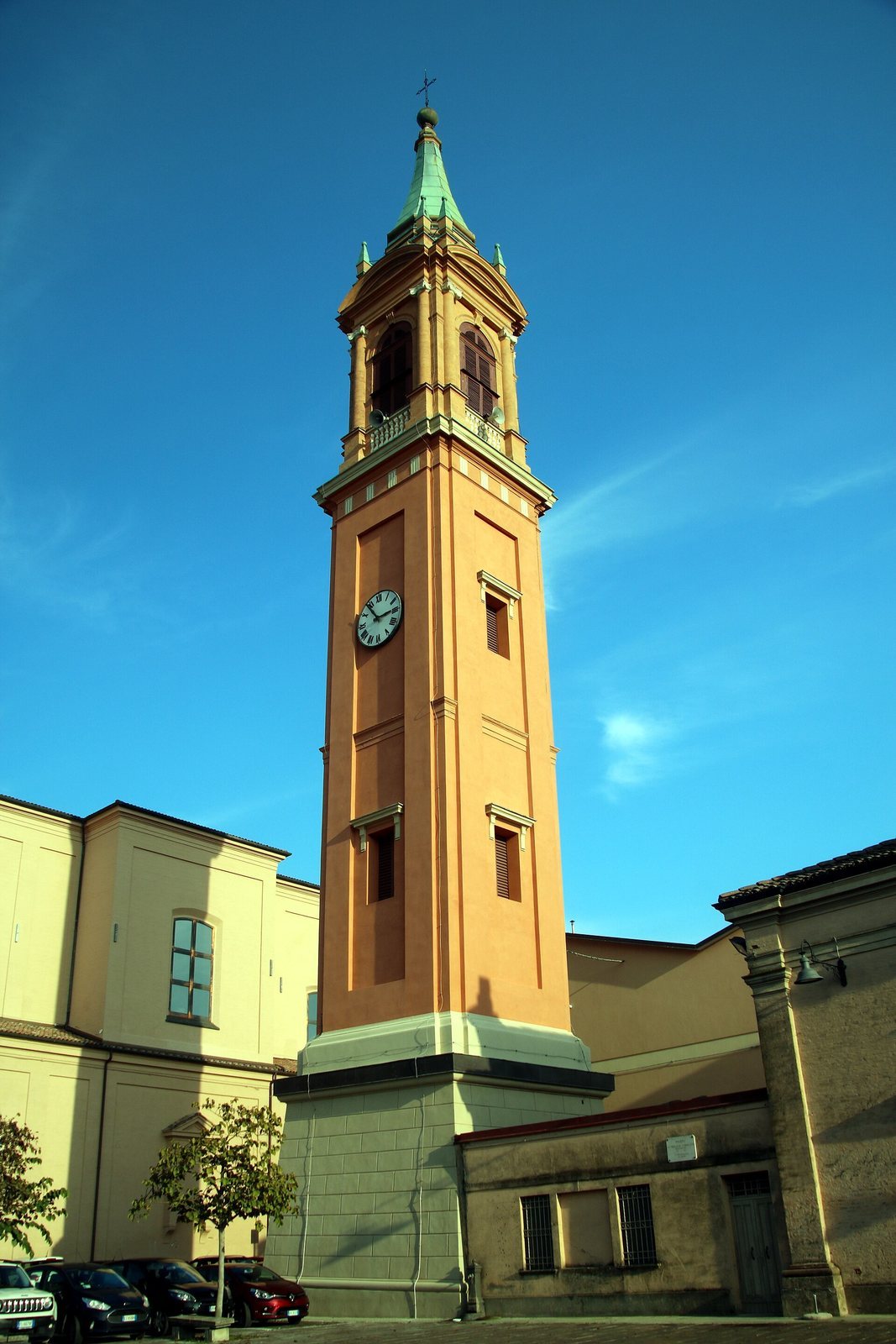
Angelo Venturoli, an Italian architect, designed the bell tower, which was erected in 1793. The church was formally consecrated on 26 September 1819.
Restoration after the middle of the nineteenth century renewed the interior paintwork and flooring. Between 1931 and 1937, workers completed the façade and laid new flooring inside. The roof covering was repaired and the façade repainted in the 1980s. The 2012 Emilia earthquake caused serious damage. Safety and restoration work concluded in 2018, and worship resumed on 2 September that year.
Descriptions preserved in the parish archive record the earlier church’s furnishings and frescoes. Some of those frescoes were attributed to Guercino, the name used by the Italian painter Giovanni Francesco Barbieri, but they have been lost.
Remains
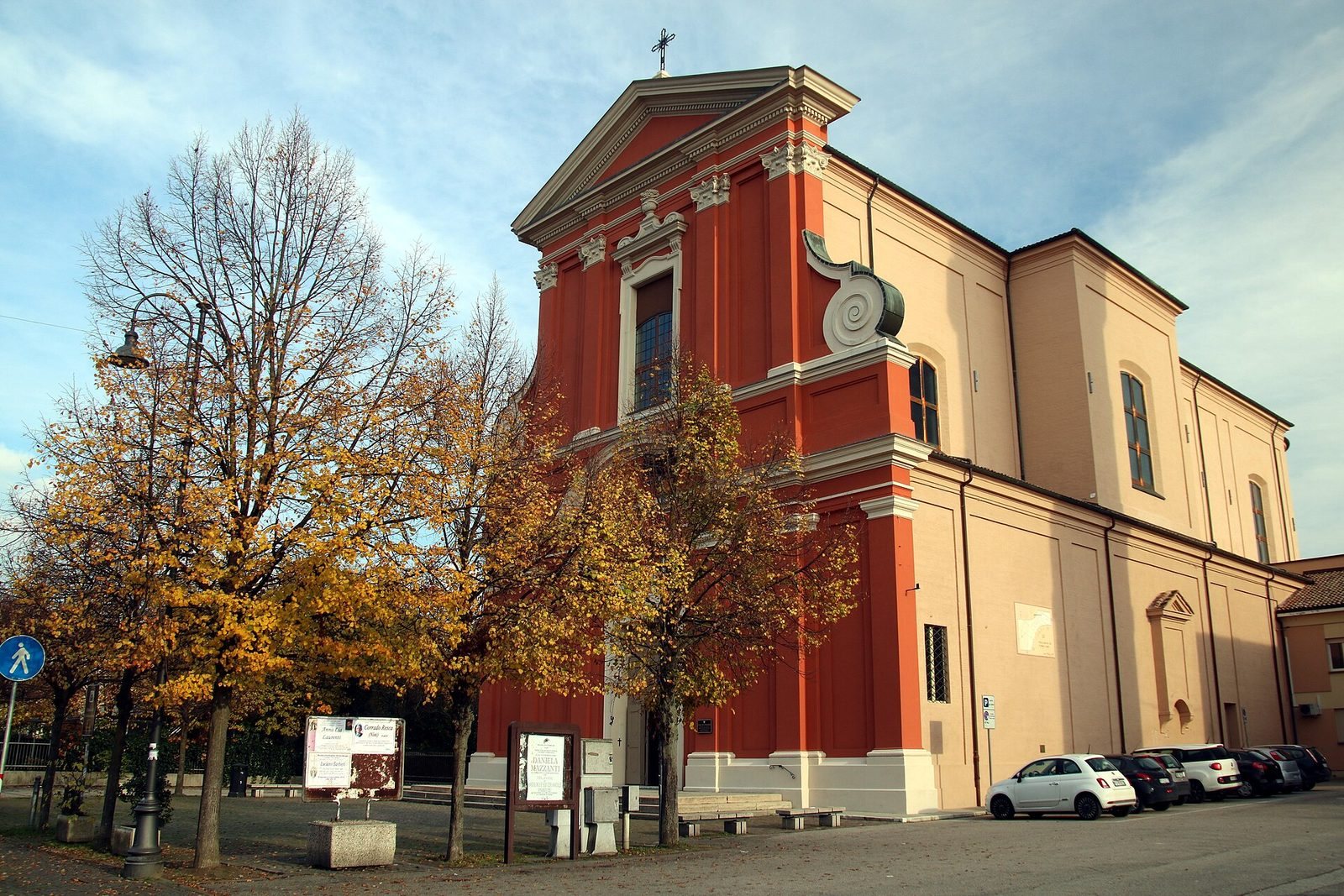
The church forms part of a complex that also includes a rectory, sacristy, and parish spaces. The building faces east, and its forecourt is paved with porphyry.
Church and interior
Facade and plan
The main façade has two tiers, with pilasters, or shallow attached columns, across its plastered, brick-red surface. Pilasters frame the entrance, which has a horizontal lintel spanning its opening and a curved arch. A large rectangular window occupies the center of the upper tier.
Interior and paintings
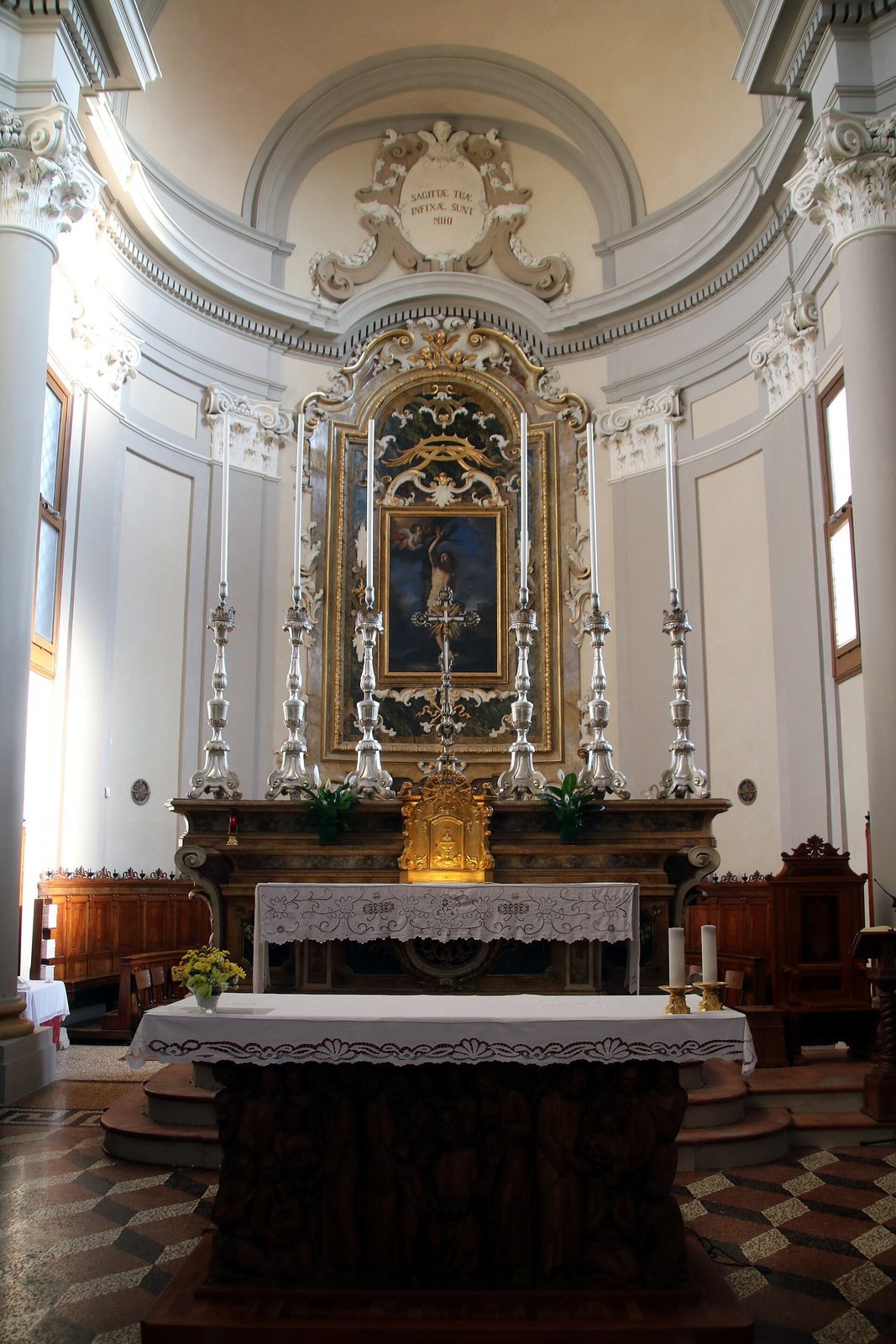
The interior has a single main hall and three side chapels on each side. Its paintings include The Miracle of Saint Charles Borromeo Restoring the Sight of a Boy Born Blind, depicting a sixteenth-century cardinal and archbishop of Milan; The Madonna and Child Enthroned with Saints Francis, Anthony the Abbot and Bovo; and Guercino’s The Madonna and Child in Glory with Saint Pancras and a Holy Nun. Saint Sebastian and Saint Pancras were early Christian martyrs. Saint Francis of Assisi founded the Franciscan movement, and Saint Anthony the Abbot was an early Christian ascetic associated with the beginnings of Christian monasticism.
The church also holds a copy of Saint Sebastian by Benedetto Gennari the Younger, Guercino’s nephew and favored pupil. The copy is in an eighteenth-century frame; Guercino’s original painting is at the Palazzo Pitti in Florence. Several artworks were removed during the post-earthquake restoration and later returned.
Bell tower
The bell tower stands detached from the church on its southern side.
Earlier church
The church that preceded the present building had stone and brick walls, a roof supported by timber beams, and a small bell tower attached to the structure.