Madonna del Bagno: A Catholic Sanctuary in Casalina, Italy
Site at a Glance
- Popularity
- Medium
- Country
- Italy
- Primary era
- Early Modern
- Eras represented
- Early Modern, Modern
- Civilizations
- Italian, Papal States
- Site type
- Religious
- Remains
- Sanctuary
On this page11 sections
History
Madonna del Bagno is a Catholic sanctuary in Casalina, in the municipality of Deruta, Italy. Dedicated to Mary and affiliated with the Archdiocese of Perugia-Città della Pieve, it developed in the 17th century around a small Marian image.
Origins and construction
Around 1643, Pietro Bruni, a Franciscan friar and member of a Catholic religious order, found a ceramic cup fragment and placed it among the branches of a young oak to keep it from being trampled. About ten years later, the Casalina merchant Cristoforo di Filippo found the image on the ground and set it among the oak’s branches.
In March 1657, Cristoforo prayed to the image for his seriously ill wife and found her recovered. On 16 July that year, the couple made a pilgrimage to the oak and hung an offering in fulfilment of a vow. Following her recovery, a chapel enclosing the oak and image was built between 1657 and 1658. At the request of the abbot, head of St Peter’s monastic community, it was designed by Don Cornelio da Perugia, the monastery’s prior (a monastic superior), and Ruffino da Assisi, a master mason responsible for masonry work. The present church enlarged the chapel and was completed around 1687. Liturgies continue to be celebrated there.
Devotion and later events
Offerings from the early period associate the cult with the Madonna of the Oak. Ecclesiastical approval later established the title Madonna del Bagno. The sanctuary’s particular Marian title is Mother of Holy Hope, a devotional name presenting Mary as a source of hope. Worshippers followed a prescribed passage into and out of the church in front of the oak, reciting prayers. Each passage was associated with an indulgence, understood in Catholic practice as remission of temporal punishment associated with sin. Ecclesiastical authorities at one point prohibited entry to the chapel.
The oak was enclosed to protect it from worshippers who stripped its leaves, bark and young branches. The enclosure caused irreparable damage, and the tree died. The chapel of the Crucifix was used as a cellar until 1980. On 4 and 6 September that year, thieves stole 201 offering tiles and damaged 40 others, leaving them on the floor. The sanctuary’s isolation and lack of a custodian enabled the theft. Between 1980 and 1987, Italy’s financial police and the Carabinieri, the national police force, recovered about half the stolen offerings in several operations. Security measures later stopped further theft attempts.
Remains
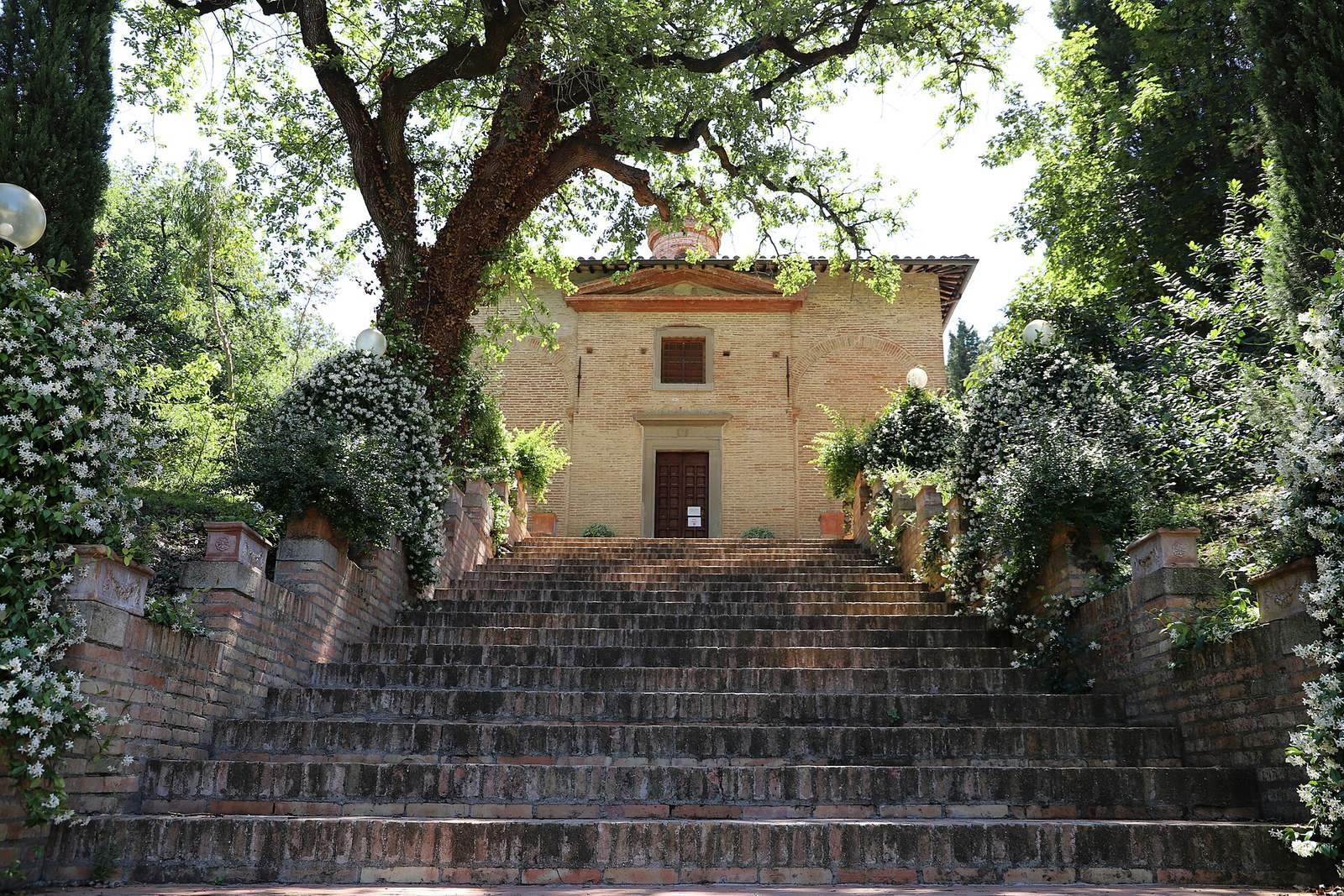
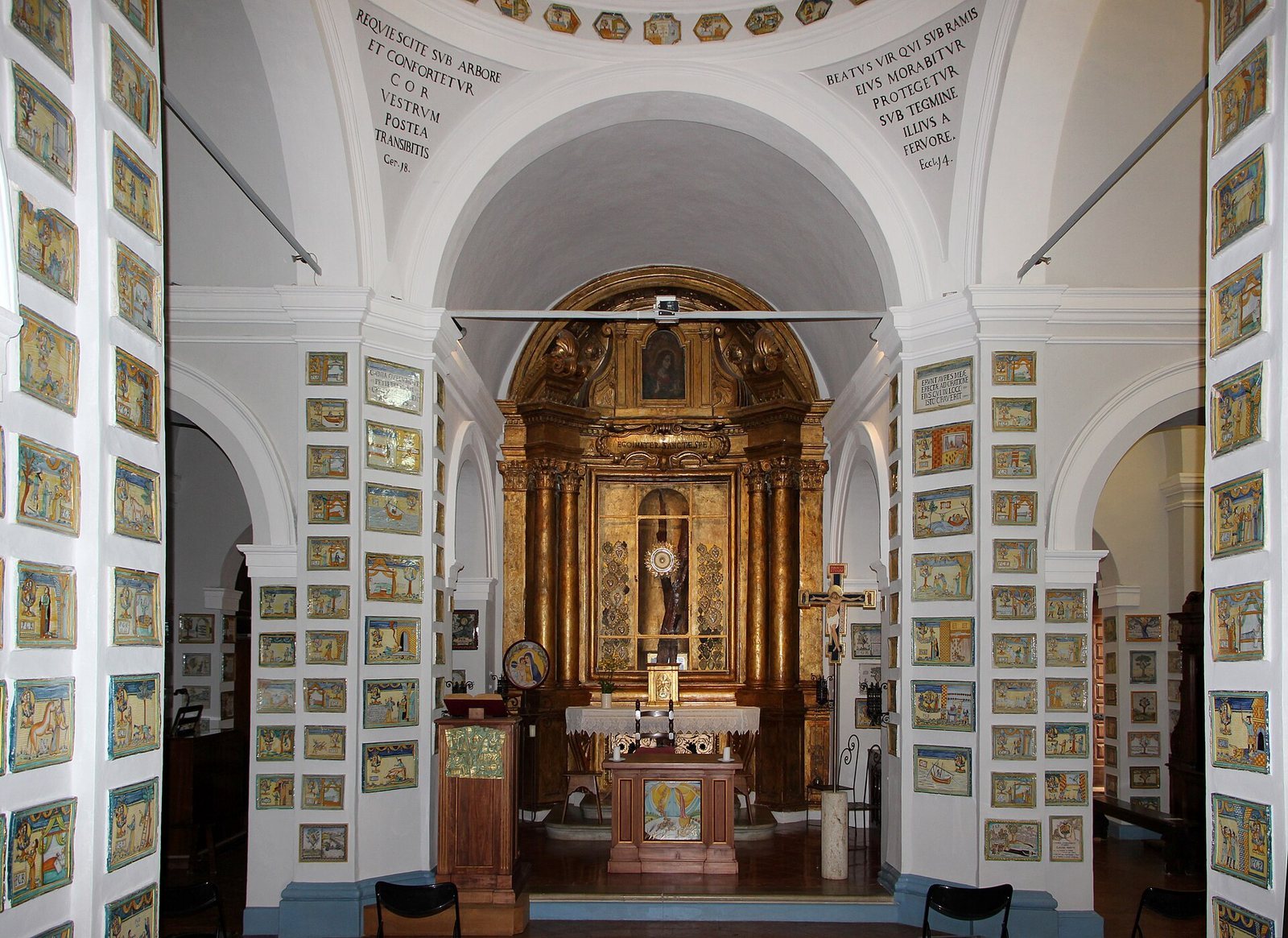
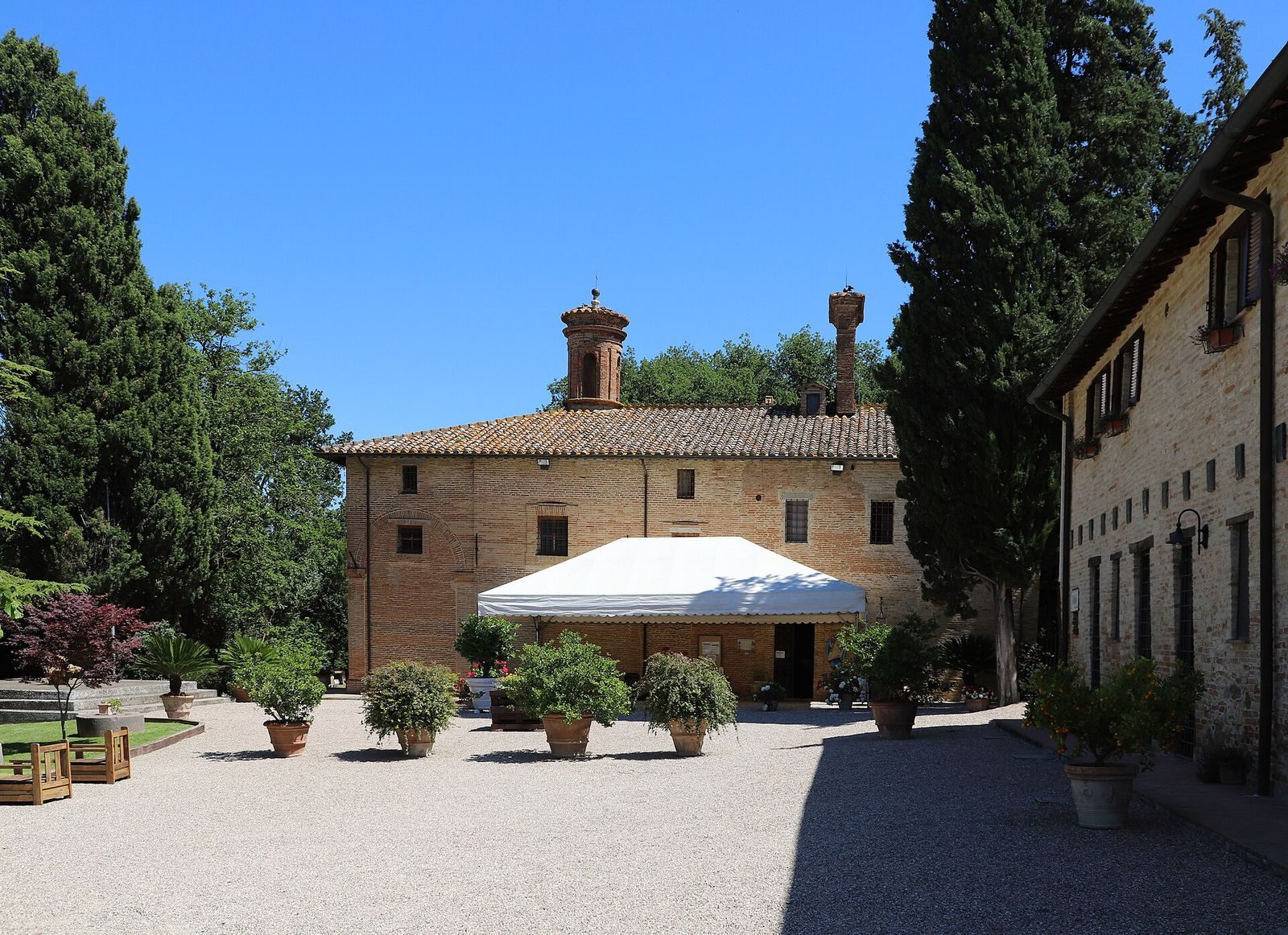
The sanctuary stands amid rural land, and its exterior blends into its surroundings. The church measures 23.2 m long and 13 m wide. Its rectangular interior has three aisles beneath vaulted ceilings. Behind the main altar, a corridor allows worshippers to pass in front of the oak. A dome 4 m in diameter and 14 m high is concealed between the vault and roof, making it invisible from outside. The terracotta floor repeats the dome’s dimensions in plan.
Altars
Main altar
The main altar combines wood and stucco and is entirely gilded. The oak associated with the image is preserved within it and can be seen from the corridor. The tree is skeletal and without bark, with nail marks from offerings and damage caused by woodworm. A wrought-iron grille made in 1928 forms the altar frontal and leaves the oak’s base visible. Paolo Gismondi, a 17th-century painter from Perugia, painted the canvas of God the Father in the altar’s crowning section. A further canvas by Gismondi depicts the Glory of St Benedict, who is associated with the monastic rule named for him; it bears the inscription “May the grace of Benedict be with us.”
Side altars
The two side altars are made of stucco, gilded and decorated with floral and geometric patterns. Gismondi’s paintings for them, signed and dated 1660, show St Nicholas of Bari distributing bread to the poor and St Anthony of Padua, a Franciscan friar and preacher.
Chapel of the Crucifix
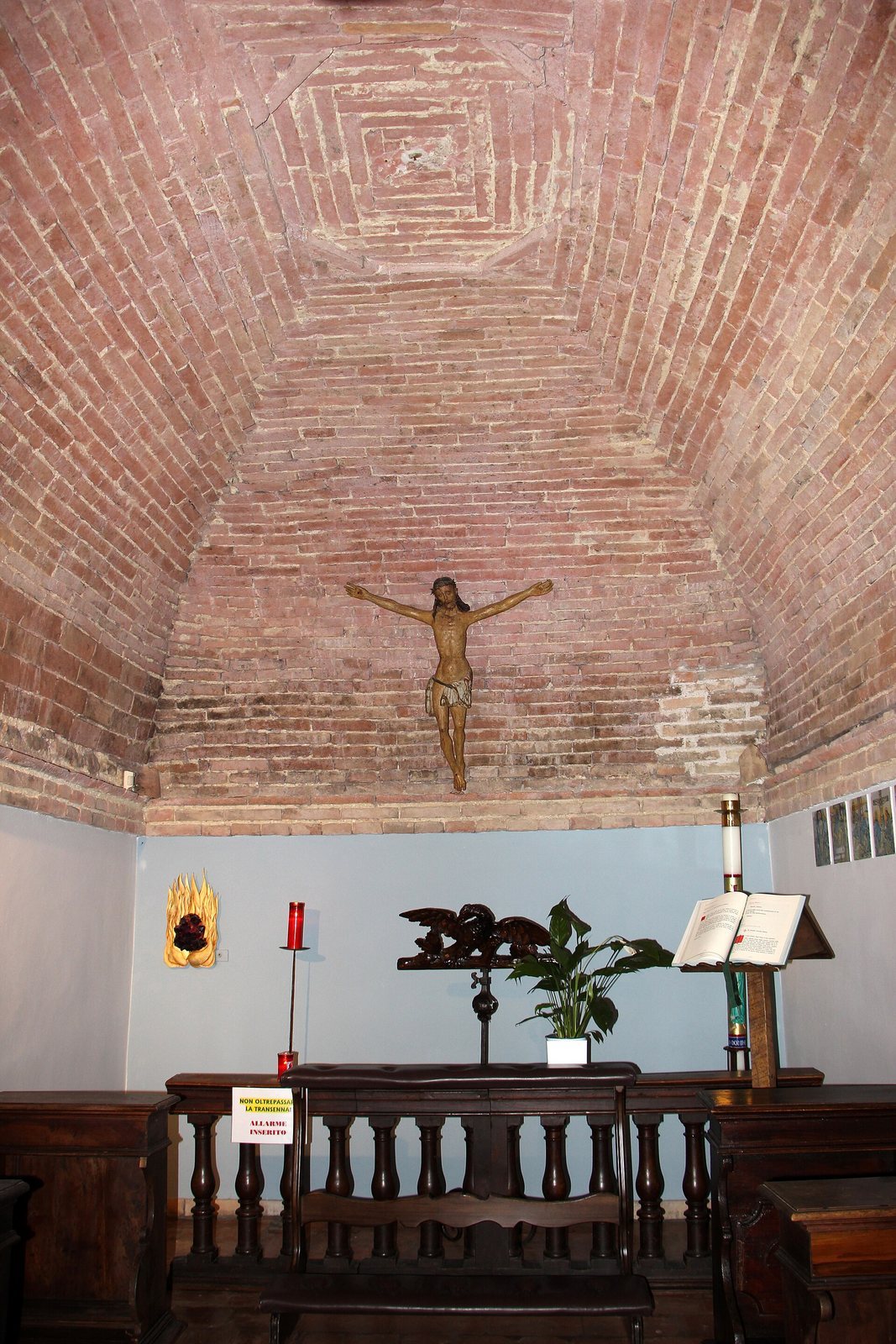
The chapel contains a 15th-century crucifix showing Christ dying on the cross. Casalina families contributed donations for its acquisition. Hand-painted ceramic tiles on the right wall depict the fourteen Stations of the Cross and the Resurrection. A tile on the back wall names donors or their family members, both living and dead. At the lower right of the altar wall is a small Madonna and Child in white Volterra alabaster, given by a devotee.
Ceramic offerings
Healing memorial
A tile in the corridor behind the altar commemorates the healing associated with the sanctuary’s beginnings. Thieves broke it during an attempted theft in 1980 and left it behind; it was later restored.
Tiles in the walls
About 700 ceramic tiles given in fulfilment of vows or in gratitude are set into the sanctuary’s walls. They span roughly 350 years and provide evidence of local social and cultural history. Examples date to 1670 and 1940. Most carry the abbreviation P.G.R., meaning “for grace received”; a smaller number bear V.F.G.A., meaning “vow made, grace received.”