Church of San Bernardino da Siena: Carpi’s Baroque Patronal Church
Site at a Glance
- Popularity
- Low
- Country
- Italy
- Primary era
- Early Modern
- Eras represented
- Early Modern
- Civilizations
- Holy Roman Empire
- Site type
- Religious
- Remains
- Church
On this page9 sections
History
Foundation and artistic patronage
The Church of San Bernardino da Siena is a Baroque Roman Catholic church in Carpi, Italy, dedicated to the city’s patron saint and serving as its patronal church. Construction began in 1604 under the Confraternity of Saint Bernardino, a voluntary religious association. Bernardino of Siena (1380–1444) was a Franciscan preacher and Catholic saint. The church’s Baroque style belongs to a European tradition known for dramatic forms and elaborate decoration.
The confraternity commissioned the Italian painter Ludovico Carracci to portray Saint Bernardino saving Carpi from an enemy army. The painting was first displayed in this church before being transferred to the Church of San Bartolomeo. Duke Alfonso IV d’Este of Modena then took the original for his court and gallery and arranged for a copy to be made for Carpi.
The painting’s later history
The original remained in Modena for about a century and a half. During Napoleon Bonaparte’s campaigns in Italy, the French army took it to France as part of the plunder. It later became part of the property available to Notre-Dame Cathedral in Paris and was at risk during the fire of 15 April 2019.
Later changes and restoration
Over time, many of the church’s furnishings and artworks were moved to the Galleria Estense, an art collection in Modena, or to other locations; copies were left in their places. The 2012 Emilia earthquakes damaged the church, which was subsequently restored under an architect’s direction.
Remains
Exterior and setting
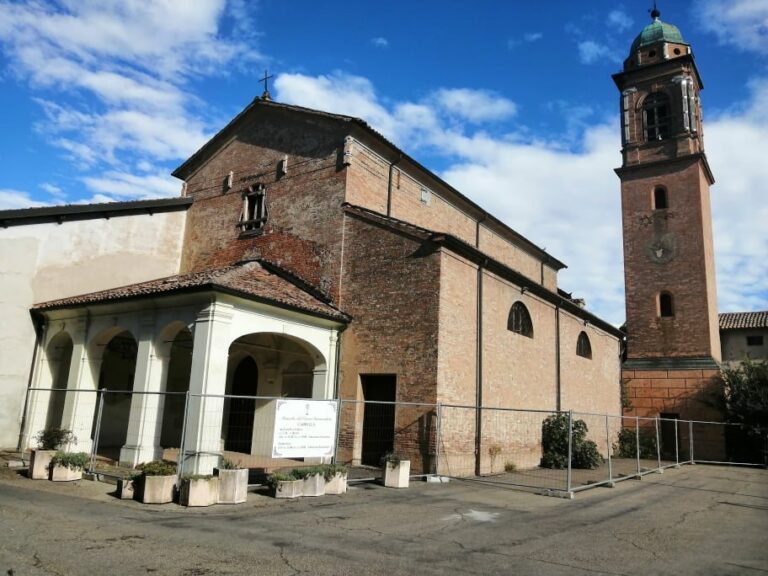
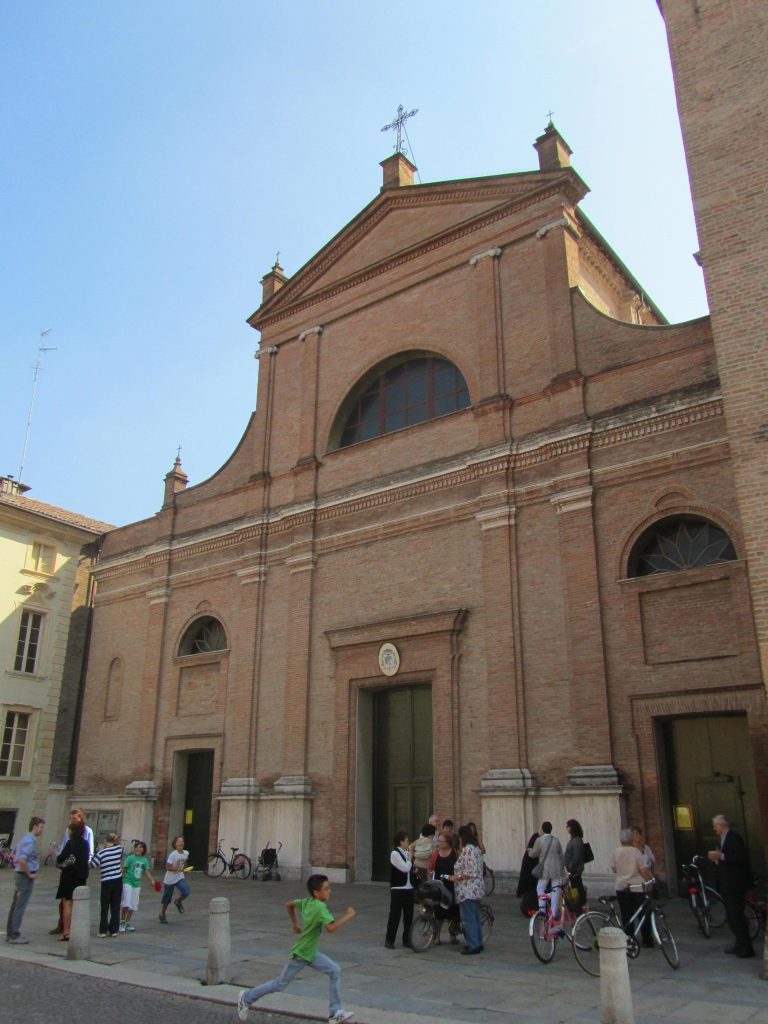
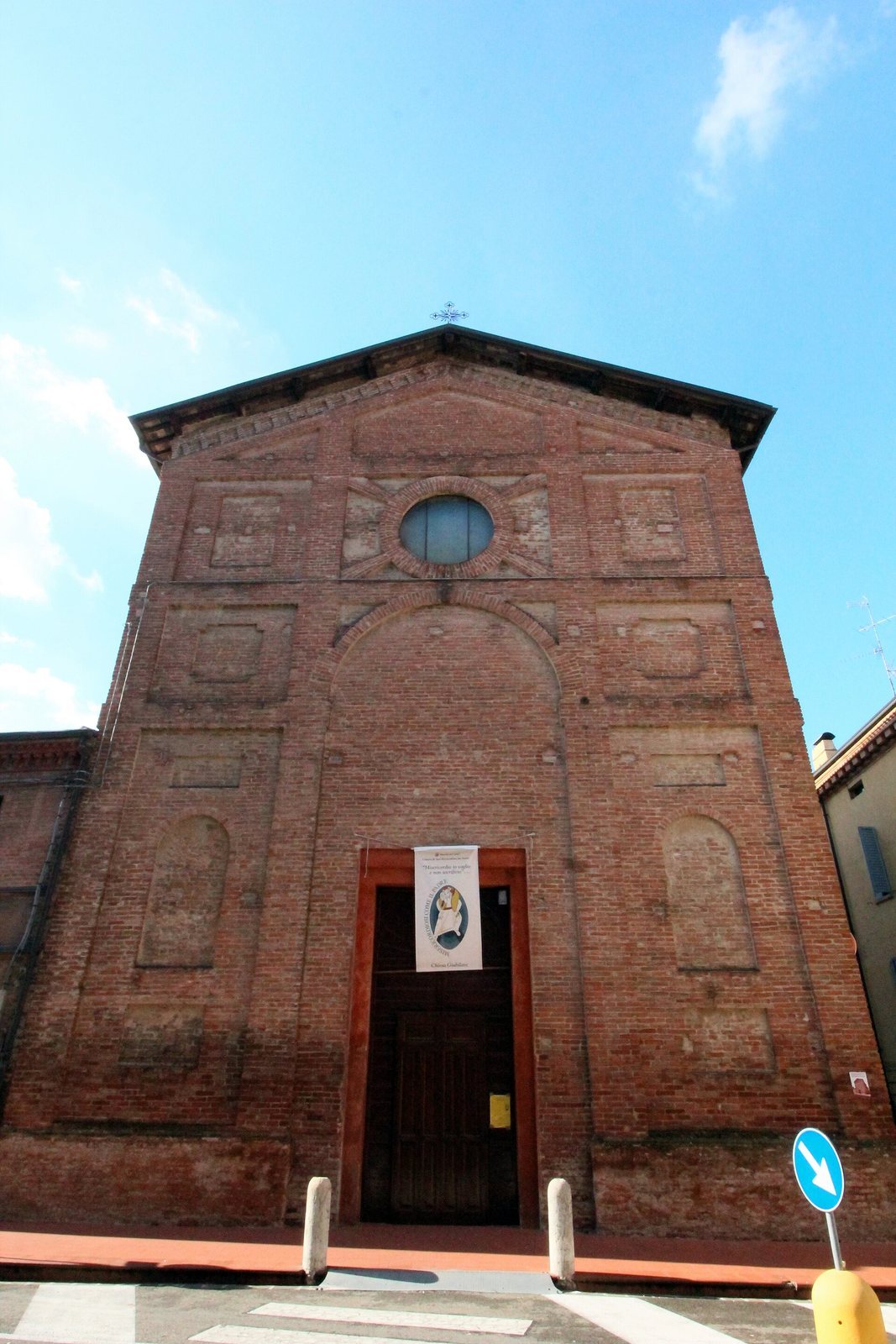
Near Carpi’s historic centre, the west-oriented church has a single nave and an exposed-brick main façade. Its roof has two slopes, while the façade is divided into three vertical sections. A central entrance, topped by a horizontal lintel, has a round window above it that lights the interior. The north side faces Via San Bernardino and has projecting masonry supports high on the wall. A bell tower rises on the south side beside the altar area; its bell chamber has large openings, each with a single window. The church stands next to a Capuchin monastery, belonging to a branch of the Franciscan religious order.
Interior
Nave and altar
The nave, the main space for the congregation, contains valuable wooden furnishings. Decorative coverings on the altars are made of scagliola, a plaster technique that imitates marble or inlaid stone, and stucco. The eighteenth-century high altar holds a reliquary bust containing relics of Saint Bernardino. Milanese goldsmith Giovanni Bellezza donated the bust during a cholera epidemic in 1857.
Chapel paintings
The first chapel on the right contains a depiction of the Martyrdom of Saint Lawrence, an early Christian martyr, attributed to Italian painter Jacopo Palma il Giovane. A painting of Saint Charles Borromeo, a Catholic saint and archbishop of Milan, is in the second chapel and is by Camillo Procaccini. A canvas by Italian painter Stefano Lemmi is among the smaller altarpieces that remain in the church.