Sant’Orsola, Palermo: A Church for the Brotherhood of the Prayer for the Dead
Site at a Glance
- Popularity
- Medium
- Country
- Italy
- Primary era
- Early Modern
- Eras represented
- Early Modern
- Civilizations
- Kingdom of Sicily, Spanish
- Site type
- Religious
- Remains
- Church
On this page19 sections
History
Sant’Orsola is a Roman Catholic church in Palermo, Italy, built in the seventeenth century for the Brotherhood of Saint Ursula of the Prayer for the Dead and opened in 1662. Dedicated to Saint Ursula, a Christian martyr, it belongs to the Archdiocese of Palermo and follows the Roman Rite, the principal liturgical rite of the Catholic Church’s Latin Church. The building combines a Baroque interior with a Renaissance-style façade.
The brotherhood and its church
The Brotherhood of Saint Ursula of the Prayer for the Dead was founded on 5 November 1563 in a chapel at the neighboring church of Santi Quaranta Martiri Pisani al Casalotto. A lay confraternity, meaning an association of non-clergy formed for devotion and communal duties, it was known as “the Blacks” because its members wore black during processions. They were responsible for burying the dead in their district and arranging masses for the deceased. The brotherhood was twinned with a Roman confraternity devoted to prayer for the dead.
An oratory, a place set aside for prayer, was built beside Santi Quaranta Martiri Pisani al Casalotto in 1590. The church that stands today was built for the brotherhood and opened to the public in 1662. Giacomo Amato, a Sicilian architect associated with Palermo’s Baroque architecture, designed the nave and may have designed the whole building.
Burial, devotion, and later care
The church received its first interior decorative cycle in 1672 and was embellished again in the following century. Under regulations introduced in 1782, burials were moved to the Cemetery of Santo Spirito. The cemetery had been established by decree of Domenico Caracciolo, Viceroy of Sicily, and was placed in the brotherhood’s care.
The 2 November Commemoration of the Dead was celebrated in competition with San Matteo al Cassaro, with the rival observances distinguished by vestments, lighting, and music. Sant’Orsola was also associated with the Brotherhood of the Most Holy Name of Jesus. Its Serpotta stuccoes were restored in the twenty-first century.
Remains
Street façade
Exterior
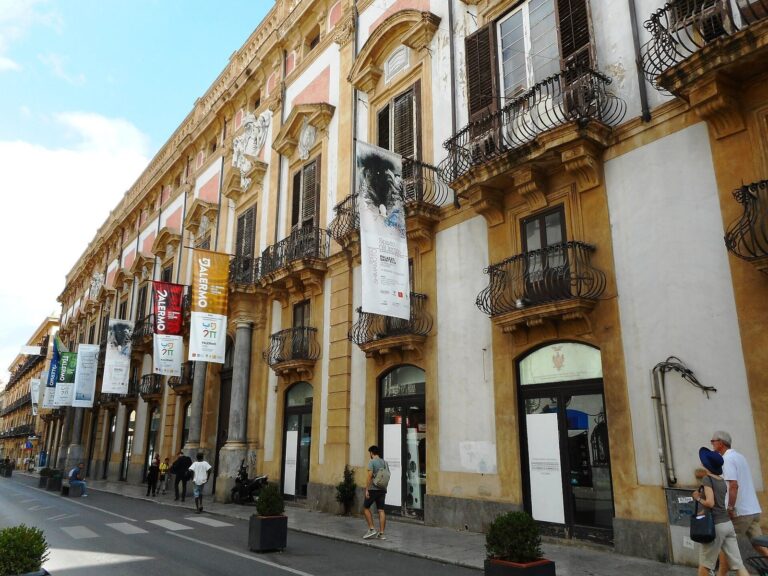
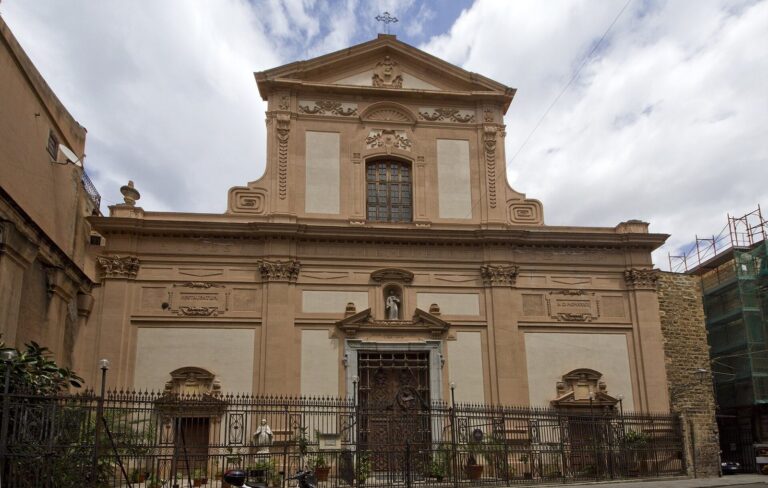
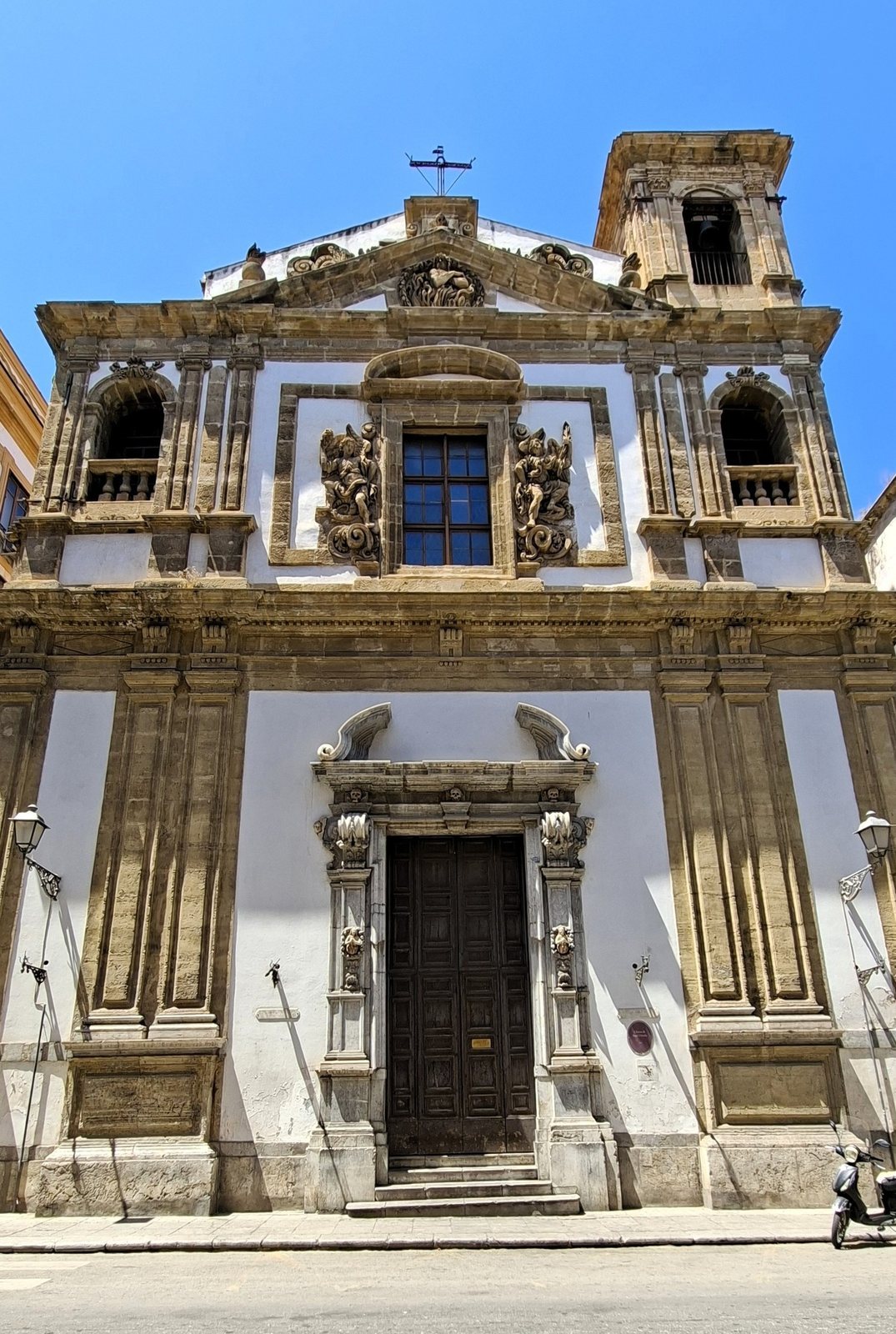
Sant’Orsola stands on Via Maqueda in Palermo’s historic Albergaria quarter, between Quattro Canti and Piazza Sant’Antonino, beside Palazzo Comitini. Its façade forms part of the street frontage. White plaster and paired pilasters, shallow columns attached to the wall, divide the elevation into two levels. The pilasters are doubled around the entrance, and a heavy horizontal band separates the levels. Sculpted figures flank the high entrance; three skulls decorate its lintel, while carved male figures called atlantes support the broad cornice. The side pilasters repeat a figure of a soul in Purgatory, the state of purification after death before entry into heaven in Catholic teaching. An interrupted, low-curved pediment rises above the entrance.
A large central window, framed by angels and topped with another curved pediment, occupies the upper level. Open-sided galleries with round arches and stone balustrades flank it. Only the gallery on the right was completed with a third level, which serves as the bell tower. A human figure amid flames appears on the triangular gable. Scroll-shaped ornaments and skulls, including one at the façade’s peak, evoke human mortality, sin, and the soul’s redemption through expiation. On the wall facing into the church, a stucco pediment frames the portal.
Church interior
Nave
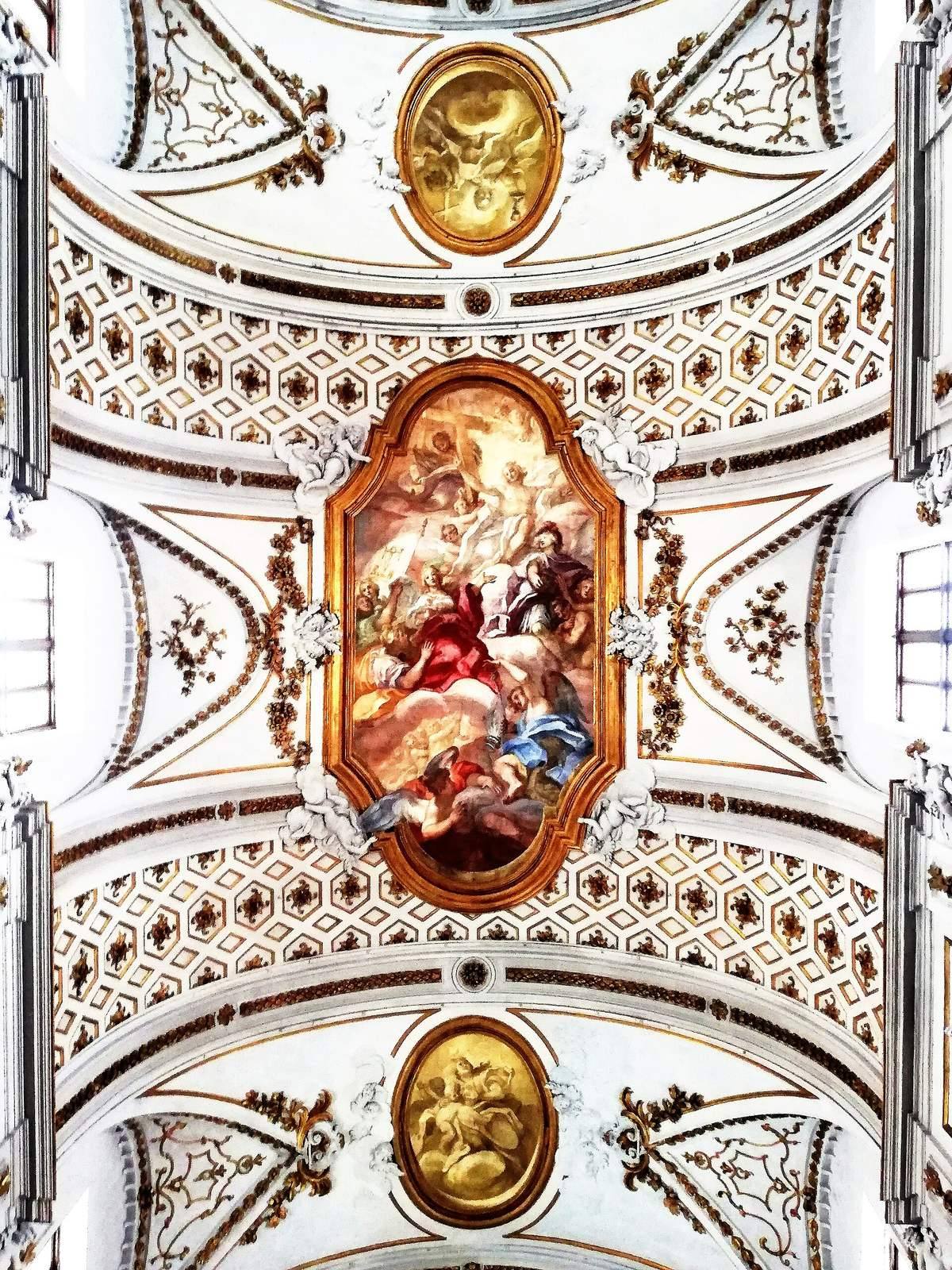
The church has a single nave, or main hall, with three communicating side chapels on each side. Giacomo Serpotta and his collaborators Bartolomeo Sanseverino and Gaspare Firriolo created the nave’s stucco decoration. On the ceiling, a fresco, a painting made on plaster, shows the Glory of Saint Ursula; images of Faith and Charity are dated 1756. Six oval pictures in stucco frames on the nave pillars depict Palermo’s patron saints Lucy, Christina, Agatha, Ninfa, Olivia, and Rosalia. They come from the workshop of Pietro Novelli.
Chapel of Saint Anne
The right-hand chapel is dedicated to Saint Anne, traditionally identified as the mother of the Virgin Mary. Its altar painting shows Anne with the infant Mary. The seventeenth-century canvas is attributed to Pietro Novelli and has been proposed as his penultimate work.
Chapel of Saint Ursula
The altar painting depicts the martyrdom of Saint Ursula. Pietro Novelli painted it in 1642. The chapel also contains an eighteenth-century wooden reliquary, a container for religious relics, and a wooden sculpture of the dead Christ from the same century.
Chapel of the Souls in Purgatory
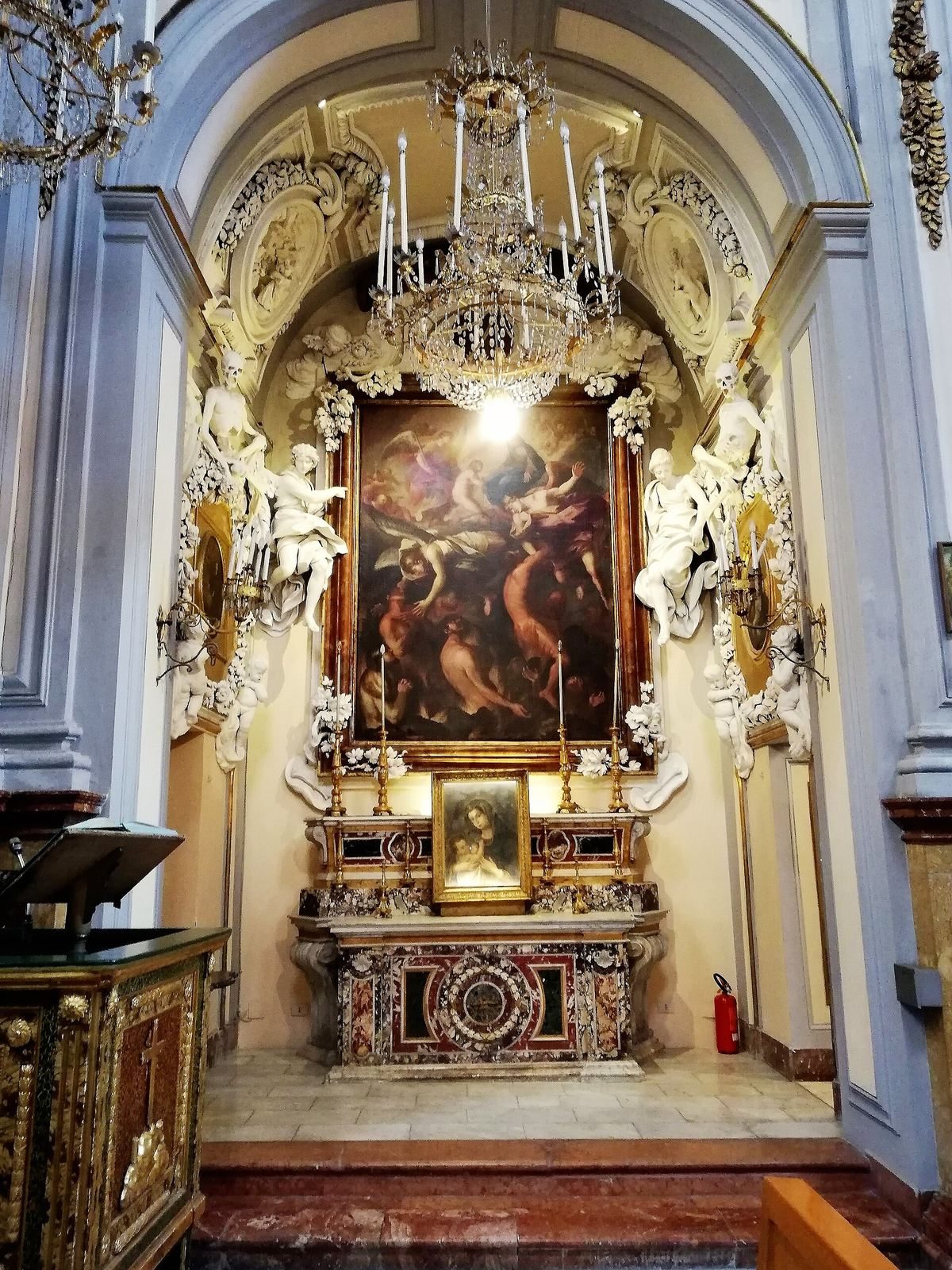
The altar painting of the Salvation of the Souls in Purgatory is flanked by two stucco angels by Serpotta. Two skeletons, emblems of the brotherhood, sit above wall medallions showing Saint Rosalia on the left and the Immaculate Virgin Mary on the right. The inner curve of the chapel arch contains two high-relief scenes Serpotta made in 1696: Elijah fed by an angel and Elijah at the altar of fire. Other stuccoes use skeletons to represent death and figures of souls rising toward heaven. Elijah was an Israelite prophet in the Hebrew Bible.
Chapel of the Holy Family
The left-hand chapel dedicated to the Holy Family contains an altar painting of the Holy Family and the Holy Spirit.
Chapel of the Crucifix
An eighteenth-century wooden Crucifix occupies the left-hand chapel dedicated to it. Objects and symbols of Christ’s Passion surround it: the sun and moon, a sword associated with the severed ear, a water jug, a rooster, a chalice, a hand, a sickle, a bag of coins, a bow and arrows, the spear that pierced Christ’s side, the arrow carrying the vinegar-soaked sponge, pincers, a hammer, nails, a ladder, a column, and scourges. A painting of Our Lady of Sorrows stands on the altar table.
Chapel of Saint Jerome
The left-hand Chapel of Saint Jerome was originally the Chapel of Saint Ursula. Its altar painting shows Saint Jerome, an early Christian scholar, in his study and is attributed to Gaspare Vazzano. It may have come from the oratory beside the church of Sant’Antonio Abate. Wooden statues of Saints Cosmas and Damian, Christian physician-martyrs, were restored in 2017.
High altar and apse
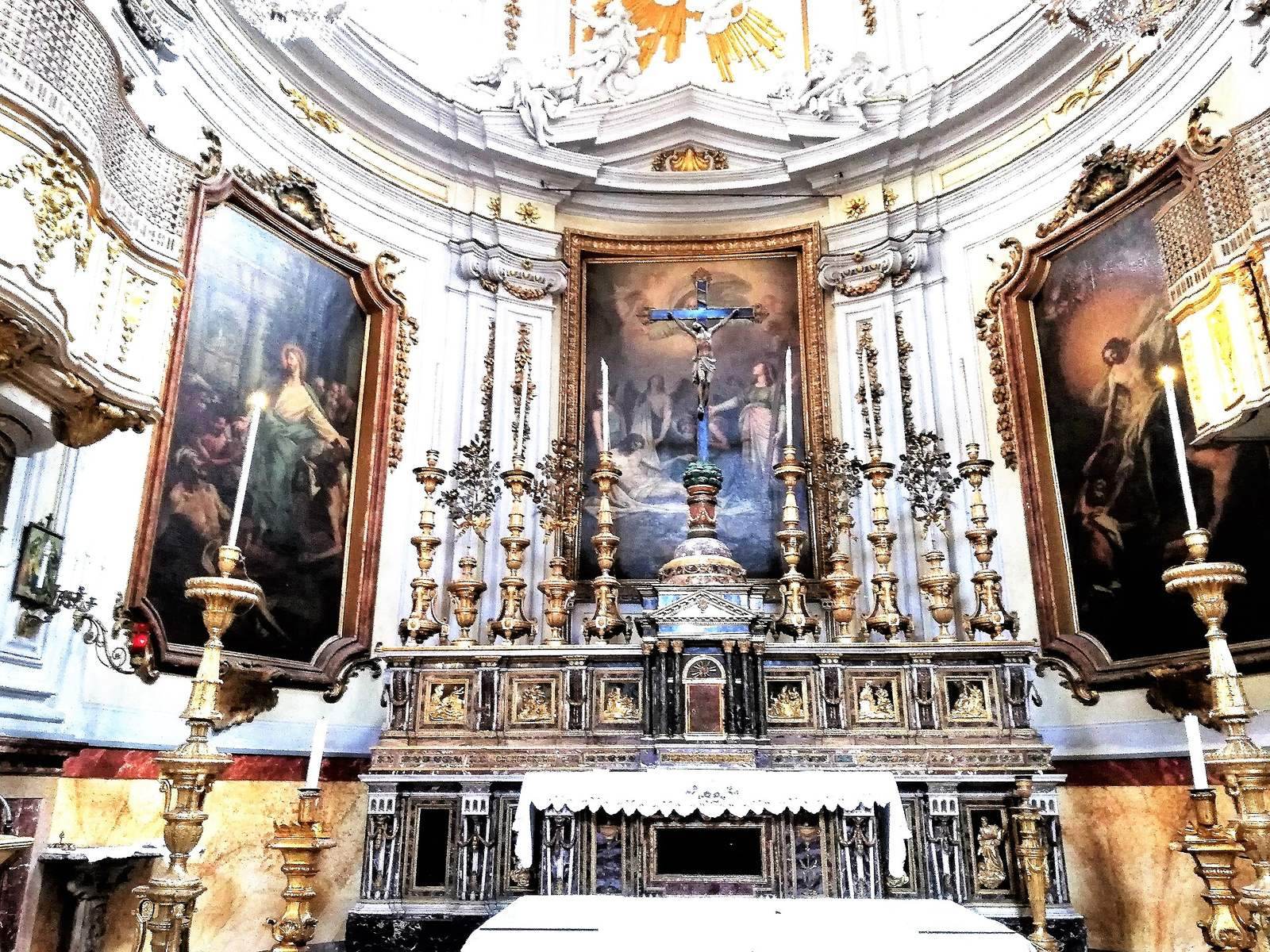
The high altar is faced with multicolored marble, including rare red stone from Custonaci. Behind it is Giuseppe Patania’s Deposition with the Three Marys. Its furnishings include an eighteenth-century wooden Crucifix and a small, temple-shaped tabernacle, the cabinet in which the Eucharist is kept, faced with lapis lazuli and other hard stones. Low-relief sacred scenes carved in wood and multicolored marble decorate the altar front.
Two large canvases by Antonio Manno flank the apse, the rounded end of the church: the Pool of Bethesda, showing the healing of the paralytic, and the Descent of Christ into Limbo. In Christian belief, Limbo is the realm of the dead into which Christ descends after his death. Gaspare Serenari painted the Assumption of the Virgin Mary on the apse vault, and two large organ galleries stand at its sides. Above the altar pediment, a gilded stucco sunburst occupies the center of the vaulted area. Its triangular symbol of the Trinity bears the name Yahweh, a conventional English rendering of the biblical name of God, and is surrounded by stucco putti, angels, and clouds.
Sacristy
The sacristy contains Manno’s Descent of Christ into Limbo, dated 1778, and two paintings by Novelli: Madonna with the Savior of the World and Jesus Christ with the Cross. The latter was inspired by Raphael’s Spasimo of Sicily.
Oratory and crypt
Oratory
A wooden altar stands in a chapel decorated with stucco putti, festoons, garlands, bones, and skulls. A painted commemorative slab in the curved panel above it sits over the Triumph of Saint Ursula, a painting by Giacomo Lo Verde that has also been attributed to Pietro Novelli and was brought from the brotherhood’s earlier premises. Paintings and frescoes of the martyr’s life, medallions representing the brotherhood’s activities, and its emblem cover the walls and ceilings. On the wall facing into the oratory, a carved table stands beneath a painting of the Deposition attributed to Novelli, with a Crucifix below it.
Crypt
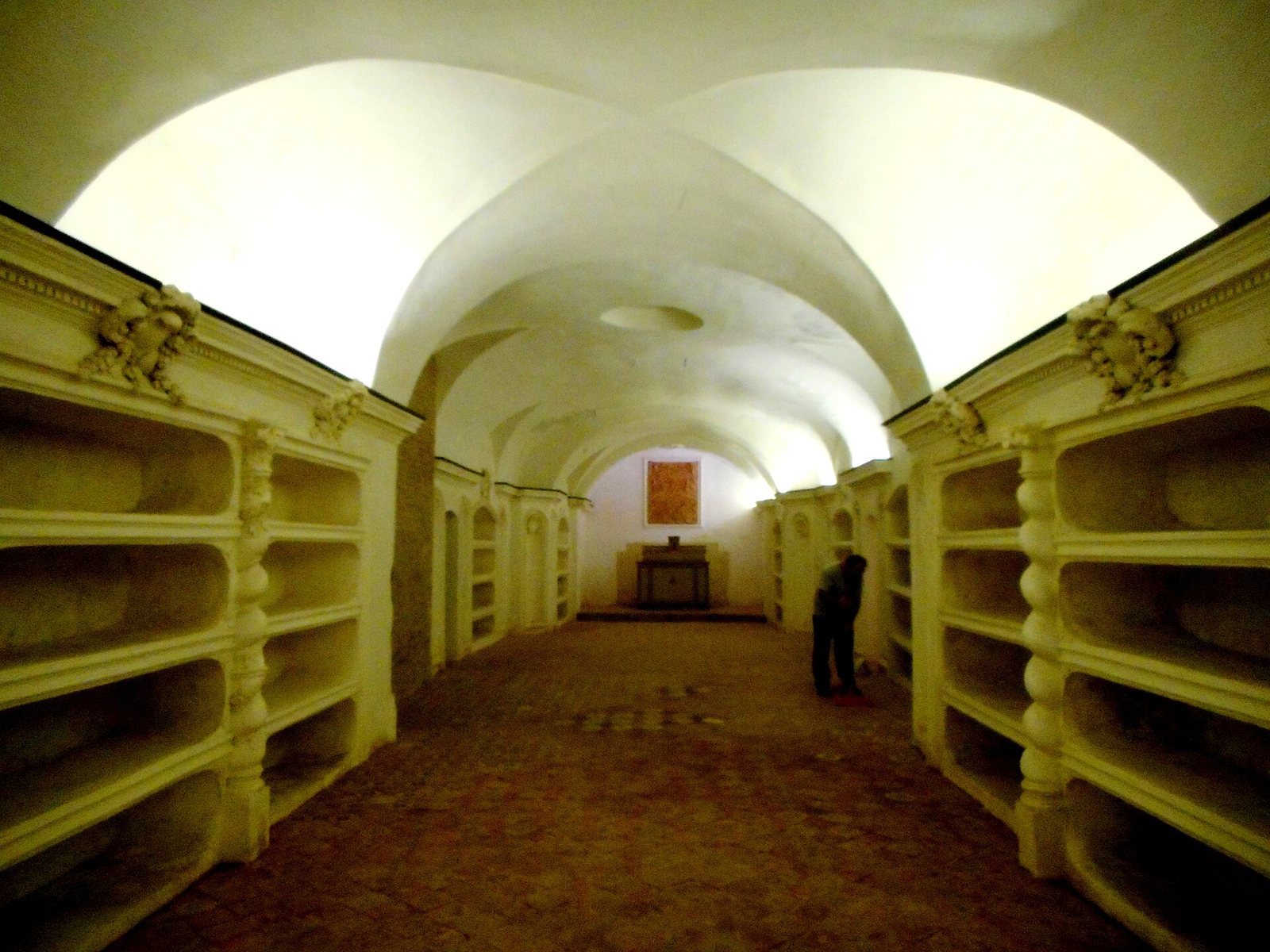
The crypt contains burial niches and recesses decorated in Serpotta’s style. Its restored underground rooms include cisterns, trapdoors, and installations for draining corpses as part of the preservation of bodies.