Deir Aziz: An Ancient Jewish Settlement and Synagogue in the Golan
Site at a Glance
- Popularity
- Low
- Country
- Israel
- Primary era
- Medieval
- Eras represented
- Medieval, Early Modern
- Civilizations
- Abbasid, Byzantine, Mamluk, Ottoman
- Site type
- Religious
- Remains
- Synagogue
On this page18 sections
History
Deir Aziz is an ancient Jewish settlement in Israel’s southern Golan, with evidence of occupation by the eleventh century BCE and a synagogue founded in the early sixth century CE.
Early occupation
Remains indicate that people lived at the site by the eleventh century BCE. An eleventh-century BCE tomb lies beneath the synagogue’s foundations, linking the place to a much earlier period than the surviving public buildings.
Evidence also points to settlement during the Hellenistic period, which followed Alexander the Great’s conquests and brought Greek political and cultural influence to the eastern Mediterranean. Activity may have continued into the Maccabean era, the revolt and rule of the Hasmonean dynasty. In 81 BCE, Hasmonean king Alexander Jannaeus conquered the Golan, though the evidence does not establish how that event affected Deir Aziz.
Byzantine settlement and synagogue
During the Byzantine period, the settlement covered about 30 dunams, or 30,000 square metres. Its buildings and activities included a synagogue, an olive press, and a cemetery, as well as what was probably a pottery workshop. Following a period of destruction, possibly caused by an earthquake, the settlement was rebuilt in the late Byzantine period.
The synagogue dates to the early sixth century. It may have been destroyed in the earthquake of 749. Later building phases at Deir Aziz belong to the Byzantine period and to the Abbasid caliphate and Mamluk sultanate. Dwellings close to the synagogue are associated with the Ottoman Empire.
Later settlement and the modern village
Bedouin communities lived in the area during the nineteenth and twentieth centuries, followed by Syrian farmers. The engineer and surveyor Schumacher described a small winter hamlet of ten huts near the valley of Deir Aziz. The modern Syrian village was administered within the Batiha subdistrict of Quneitra district until the Six-Day War in June 1967. Israel captured the area during the war; residents left, and Israeli forces later destroyed the village. The area was subsequently administered as part of the Golan subdistrict in Israel’s Northern District.
Archaeological investigation and interpretation
Lawrence Oliphant’s visit in 1885 produced the first report on the synagogue. Archaeological investigations carried out by the Syrian government before 1967 also uncovered ancient remains. Excavations led by archaeologist Zvi Maoz in 1979 established the synagogue’s early-sixth-century date.
The synagogue’s resemblance to buildings in the southern Hebron Hills, together with a Greek-inscribed fragment bearing the letters AZIZO, led excavator Ben David to propose that people had migrated from that region. Other interpretations suggest that Aziz was a donor’s name or that the inscribed fragment came from a pagan building.
Remains
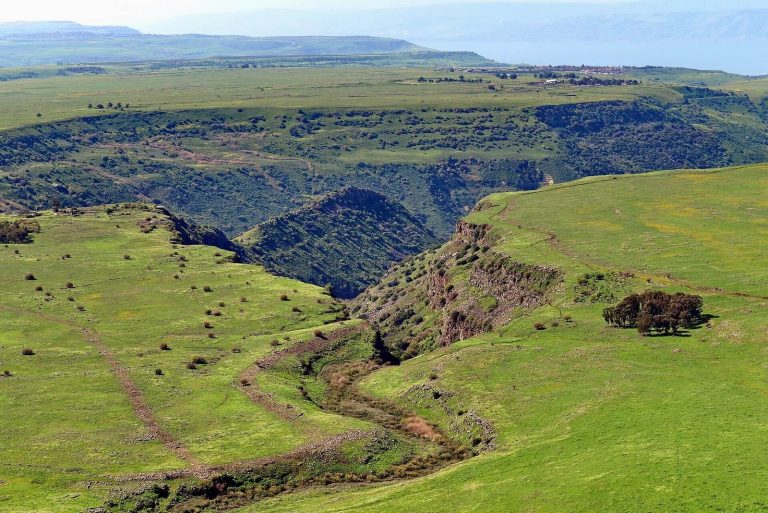
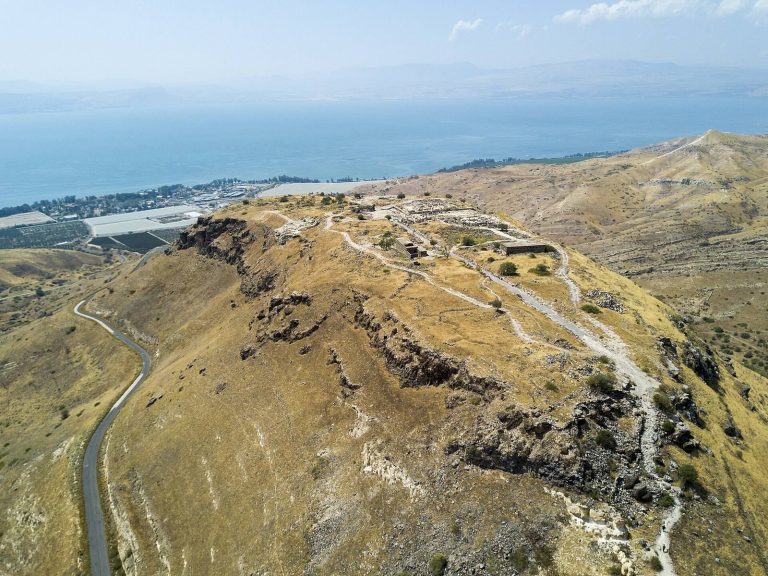
The ancient settlement occupies the northern edge of the Deir Aziz valley, overlooking it from a height of about 200 metres. The synagogue stands midway up the slope on the western bank of the Kanaf stream. Residential and agricultural buildings are situated on the hilltop above it.
Synagogue
Plan and structure
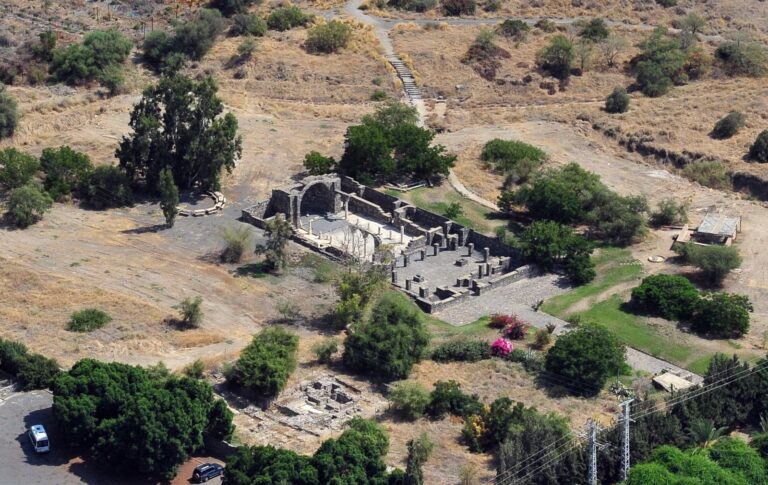
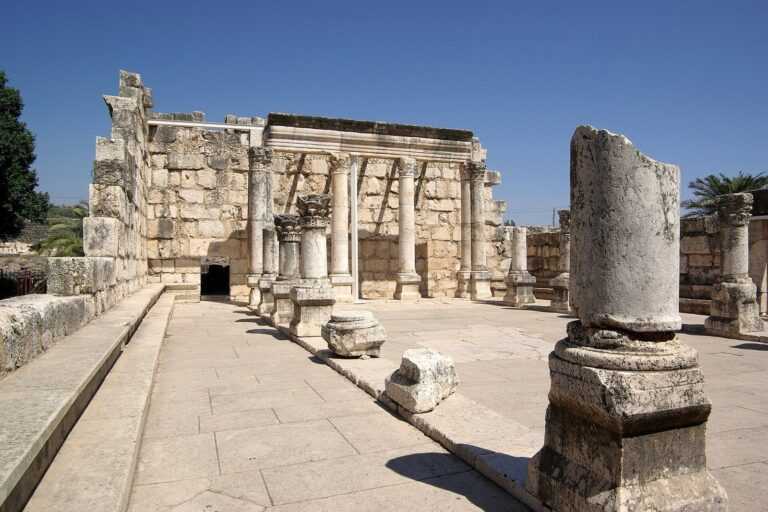
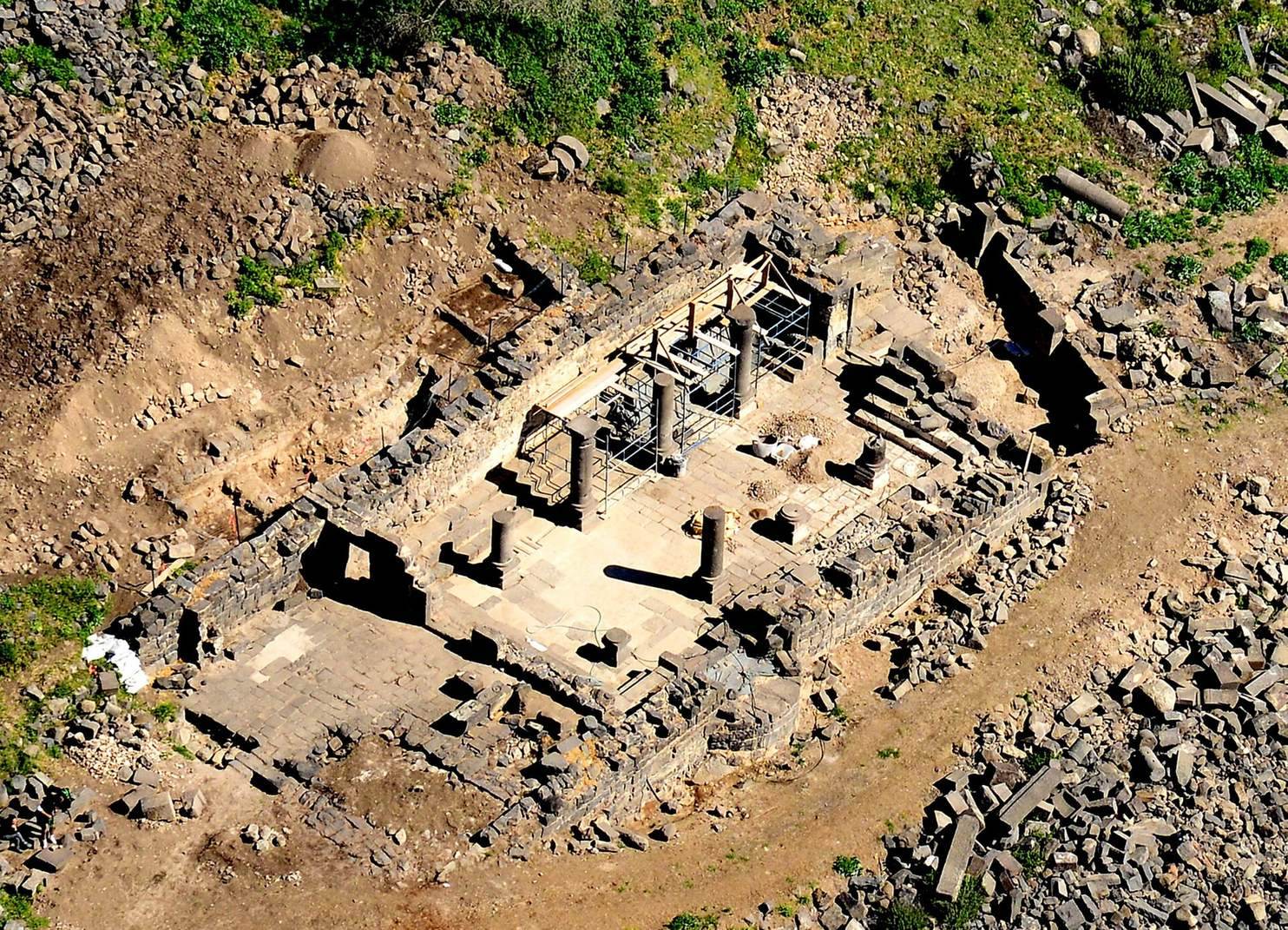
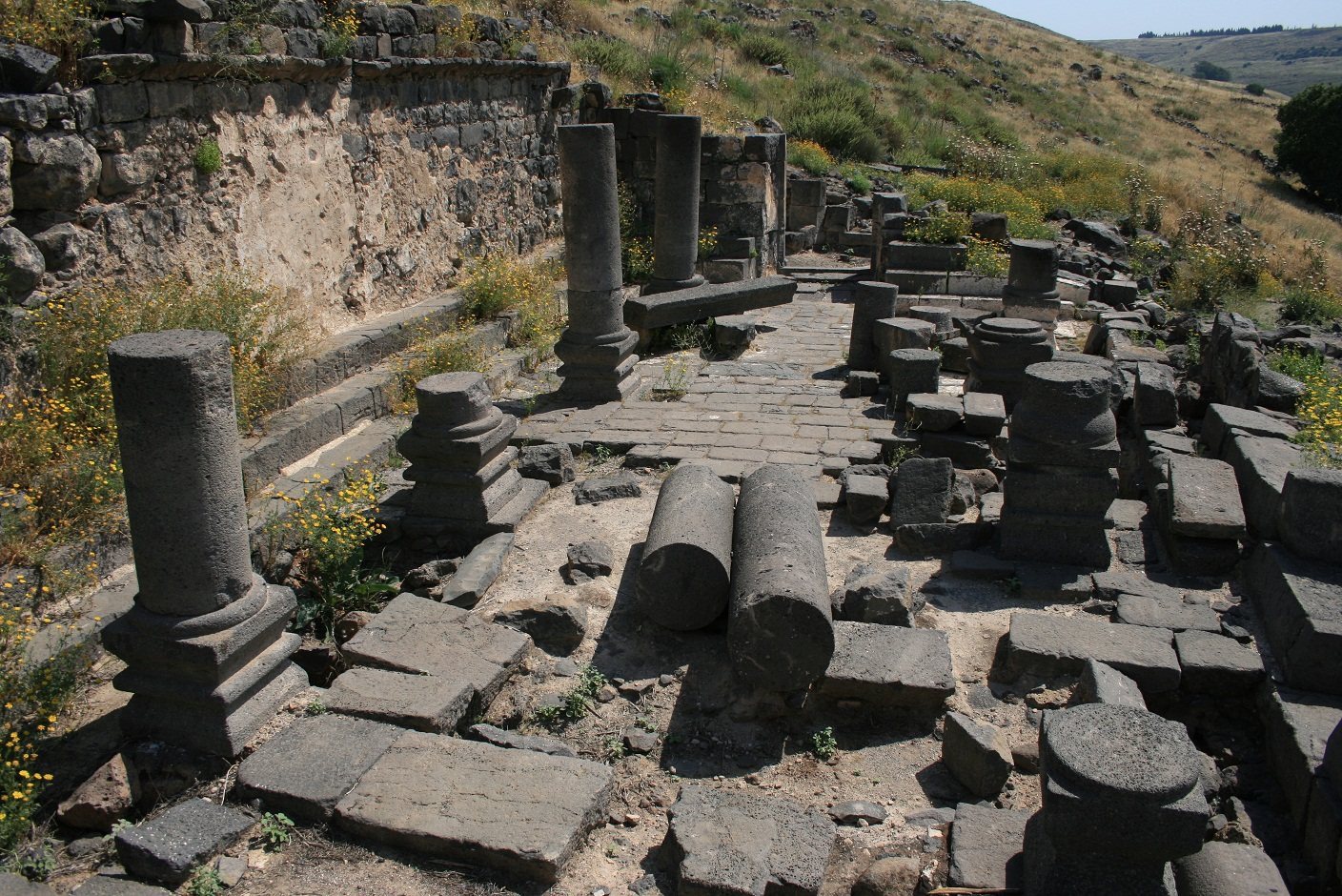
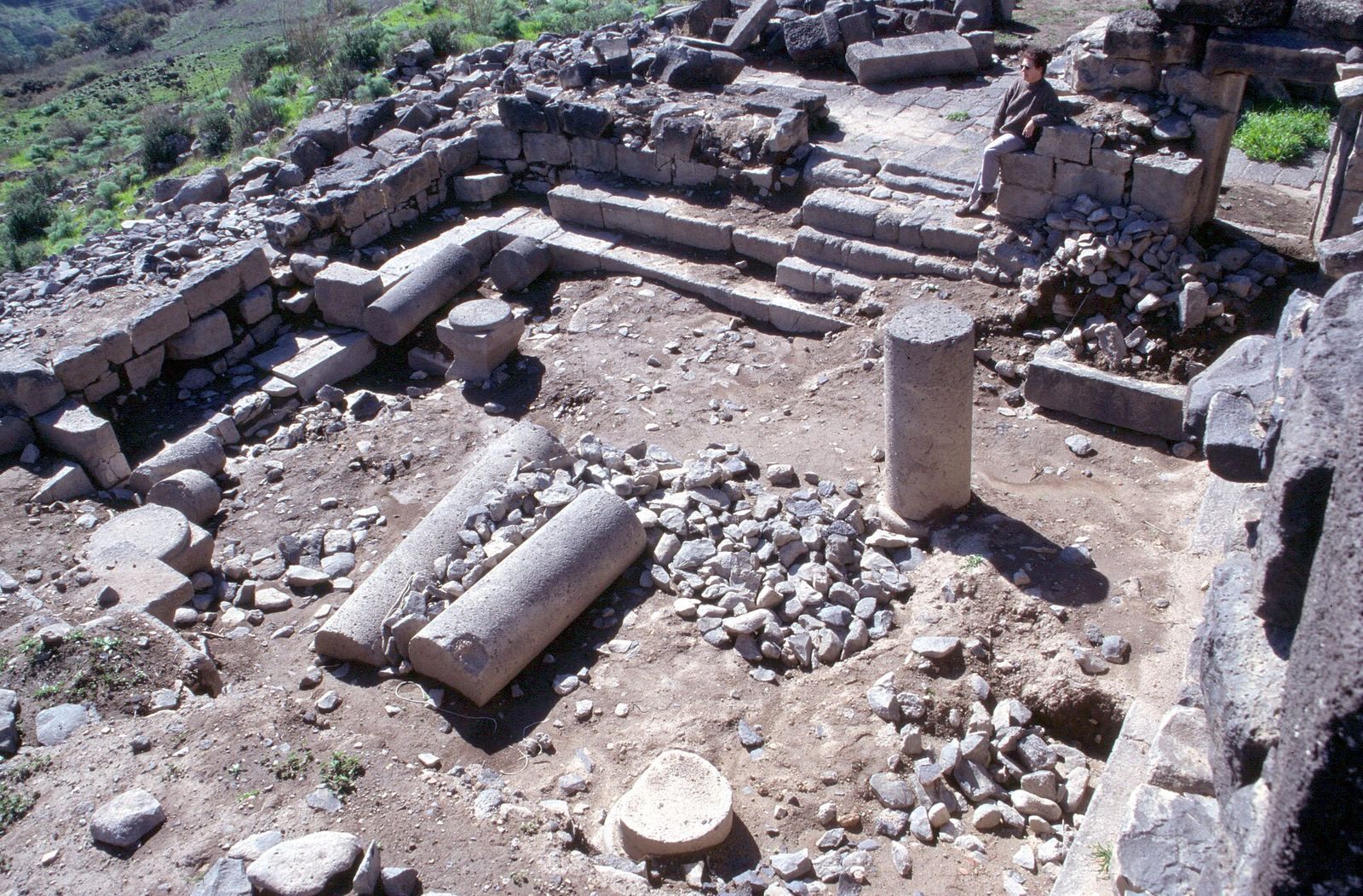
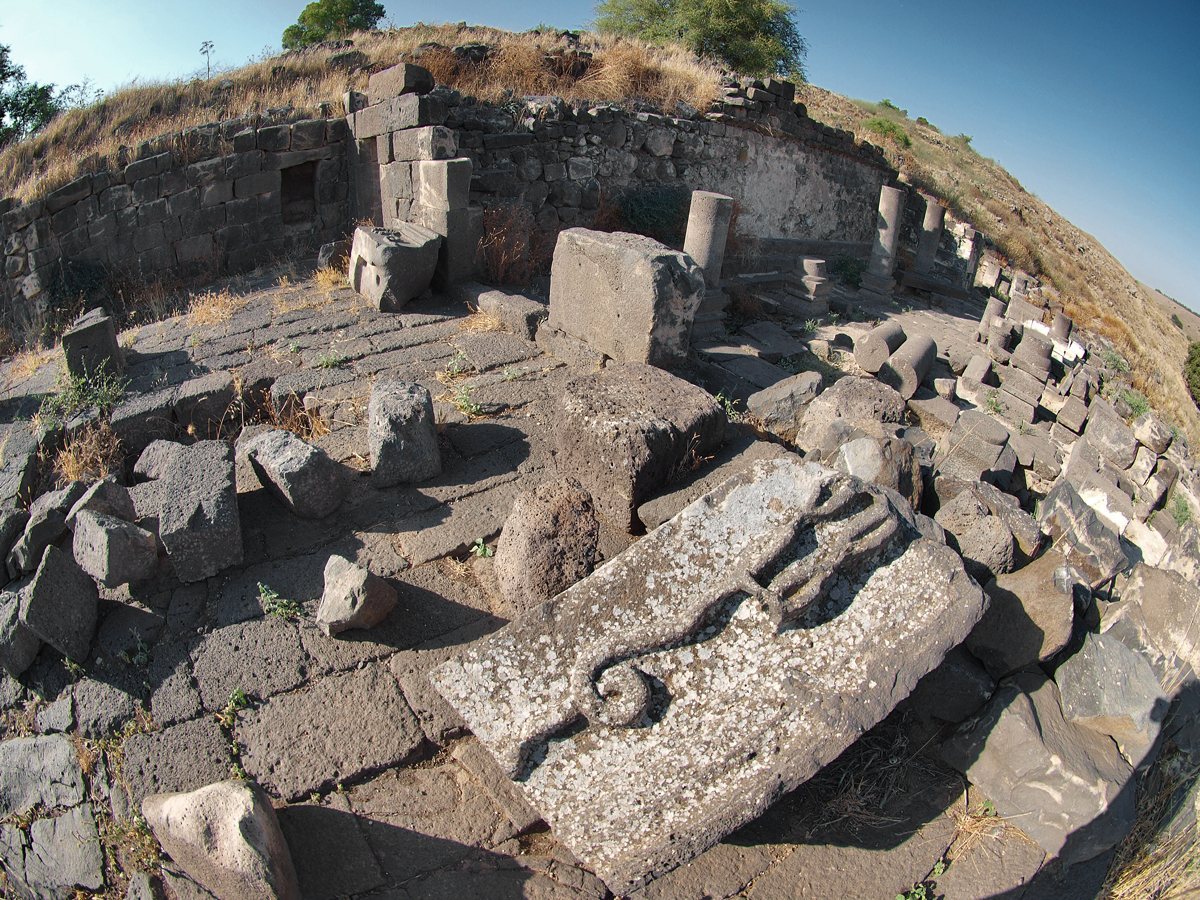
The synagogue is a rectangular hall measuring 11 by 18 metres. A small paved courtyard leads to its eastern entrance. Two rows of four black-basalt columns divide the interior; the columns stand on pedestals and have joined sections. The northern wall also serves as a retaining wall, holding back the hillside.
Interior arrangements
Two doorways open through the western side of the hall. One leads to a former storeroom that may have held Torah scrolls. Three-tiered stone benches run along the interior walls, except on the south side. A projecting niche for the synagogue ark, the cabinet or recess where Torah scrolls were kept, is set in the southern long wall. In other Golan synagogues the ark was placed against the western short wall, an arrangement that allowed worshippers to face Jerusalem during prayer.
Eastern façade
Oliphant described the eastern façade as standing about three metres high in 1885. It apparently collapsed in the 1920 earthquake and was no longer present when archaeological work resumed after the Six-Day War.
Burial and coins beneath the hall
An eleventh-century BCE tomb lies beneath the synagogue’s foundations. Excavations below the hall floor yielded 532 coins minted between 425 and 518 CE.
Other settlement buildings and finds
Public buildings
A large public building stands at the top of the hill; its function has not been established. The public building excavated on the southern slope served as the synagogue.
Houses and settlement-edge remains
Ruins of stone houses survive within the ancient settlement. Excavations in the western part of the former modern village, built over an older ruin site, uncovered stone buildings with stone roofs. Scattered ancient building remains and a large building made of cut, shaped stone blocks were found at the village’s southwestern edge.
Architectural fragments and pottery
Finds from the site include large columns with capitals, or carved tops, bearing Greek and Latin inscriptions, fragments of cornice mouldings, and pottery dating to the Roman and Byzantine periods.
Spring and waterworks
Water collection
A spring below the synagogue supplied water for the settlement. Its ancient collection works included stone arches or vaulted structures, a channel, and a trough. The 1920 earthquake destroyed these structures. A modern pumping station and concrete basin now occupy their location.
Pottery deposits
Pottery fragments came from deposits below the trough and beneath the synagogue floor. The layer was identified as Chalcolithic, or Copper Age. The finds included bowls, jars, and pieces of ceramic floor tiles, as well as material dated to the mid-sixth century CE.