Zarax: An Ancient Greek Town on the Laconian Coast
Site at a Glance
- Popularity
- Medium
- Country
- Greece
- Primary era
- Classical
- Eras represented
- Classical
- Civilizations
- Ancient Greek, Roman
- Site type
- City
On this page12 sections
History
Early settlement and rival powers
Traces of prehistoric habitation have been found at Zarax, an ancient Greek town on the eastern coast of Laconia, Greece. The town existed at least from the Classical period of Greek history through Roman times. It is not generally regarded as a Classical city-state, though in the late fifth century BCE it may have been a Laconian community distinct from Sparta’s citizen body but within its sphere of control.
Foundation traditions offer different accounts of the town’s namesake. One identifies Zarax, or Zarex, as the son of Petraios, king of Karystos. Another tells of a man called Zarex who learned music from Apollo, the Greek god associated with music. Zarax lay in territory contested by Sparta and Argos. After the Battle of Thyrea in 546 BCE, a conflict between the two city-states, it is thought to have come under Spartan control.
Macedonian rule and conflict
Zarax’s political position changed after Philip II of Macedon defeated a Greek coalition at Chaeronea in 338 BCE. During Macedonian dominance over Greek affairs, the town passed into Argive hands.
In 272 BCE, the Spartan royal Cleonymus devastated Zarax while attempting to take power from his brother Areus, with help from King Pyrrhus of Epirus. The town’s earlier transfer to Argive control appears to have contributed to Cleonymus’s attack. The destruction was severe, and Zarax never fully recovered. In 219 BCE, the Spartan king Lycurgus attacked cities in southern Argolis but failed to capture either Zarax or Glyppia.
Roman period and abandonment
Augustus, Rome’s first emperor, made Zarax one of the communities in the League of the Free Laconians, a league of towns in Laconia. Zarax flourished during the Roman period: its Temple of Apollo was rebuilt and its acropolis, the fortified high part of the town, was reconstructed. The temple honored Apollo as a lyre-player, and Pausanias later described a statue of the god holding a lyre.
When Pausanias, a Greek travel writer, visited in the second century CE, he characterized Zarax as modest and among the league’s most ruinous towns. He also described the harbor as apparently abandoned. An earthquake in 365 CE was followed by the town’s abandonment.
The ancient name survives in altered forms in the modern village of Ierakas, also known as Gerakas. The municipal unit of Zarakas, which includes Ierakas, likewise takes its name from the ancient town.
Remains
Peninsula and fortifications
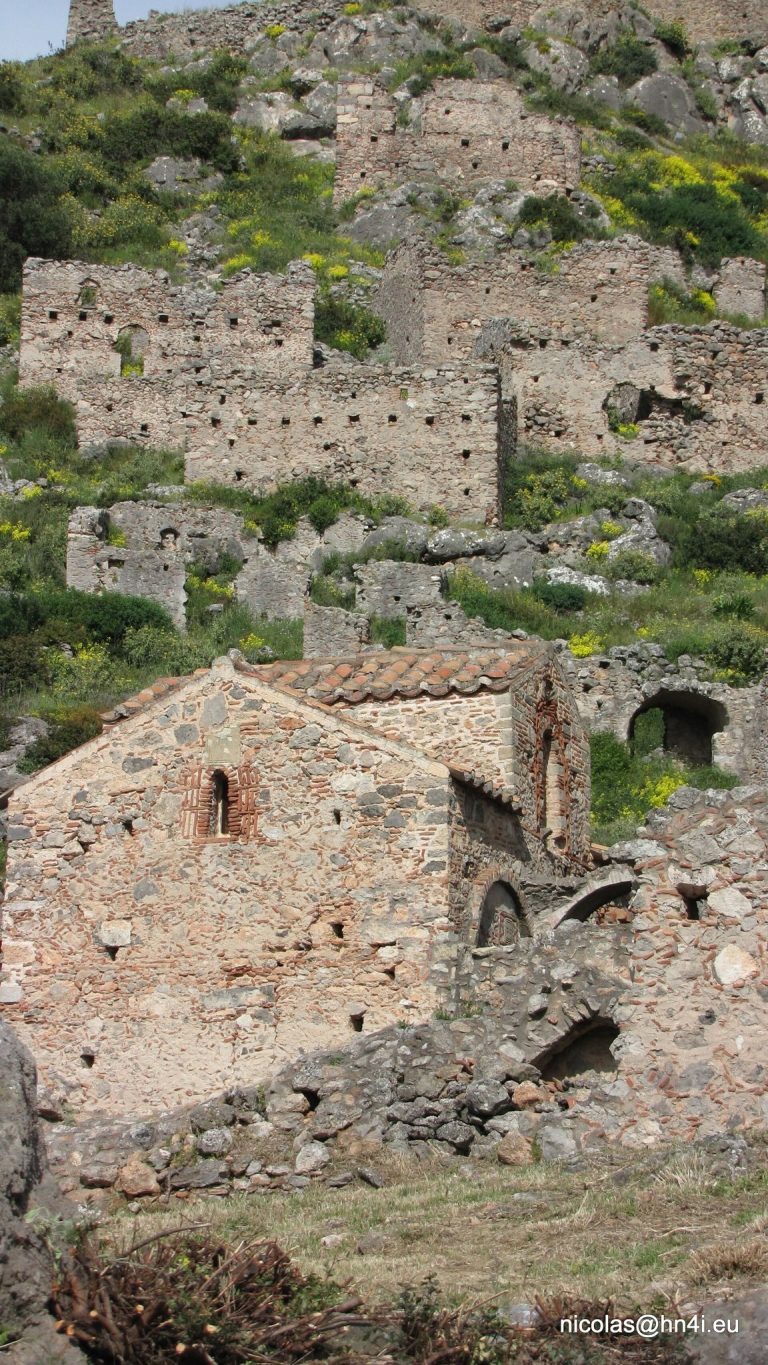
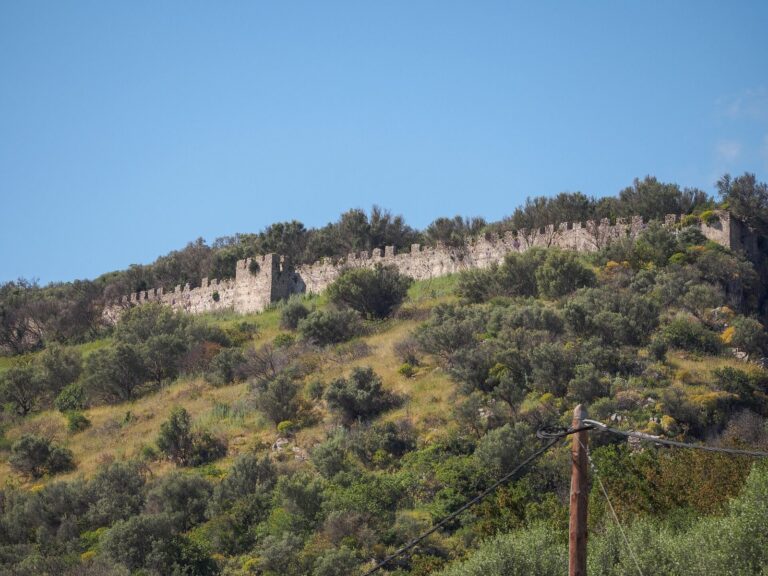
Zarax occupied a small peninsula north of the entrance to Gerakas harbor, a natural harbor. The peninsula projects from Mount Zarax, and the town lay on the bay’s northeastern side, east of modern Limani Ieraka. A hill at the peninsula’s tip served as the acropolis, on the eastern side of the town. Walls enclosed both the acropolis and the ancient settlement.
Walls and natural defenses
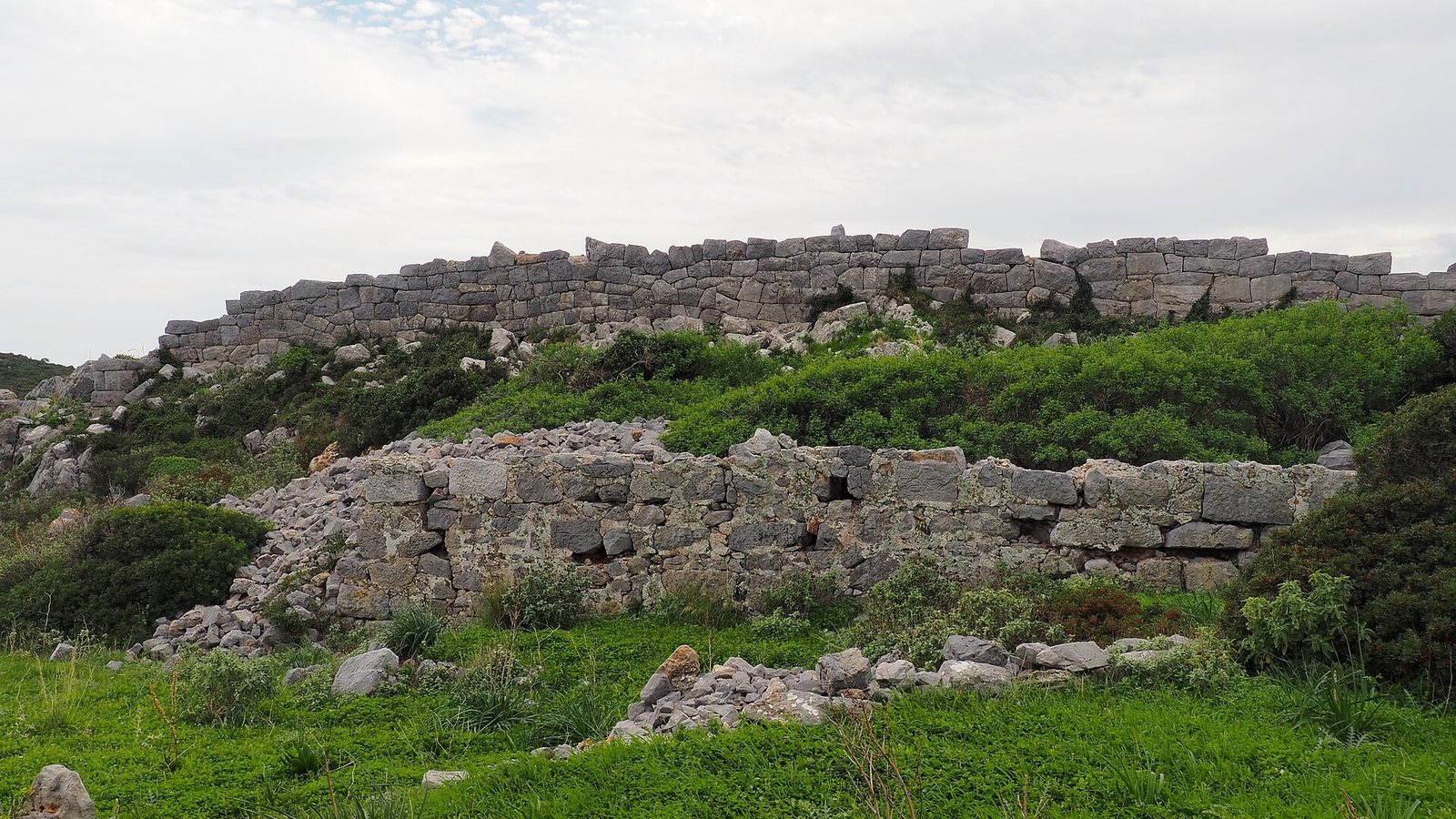
The fortifications date to the late Classical or Hellenistic period, the era following Alexander the Great’s conquests. They were built with irregular polygonal and squared stones. The northern and western stretches survive particularly well and still reach considerable height. A steep natural slope protected another side of the town.
Towers and gate
Eight square or rectangular towers strengthened the defenses. At the northwest corner of the acropolis, a well-preserved gate was protected by a round tower. Its passage, about one metre wide, ran north before turning east. Two temporary wooden gates could be used to block it at separate points during an attack.
Buildings and finds
Roman vaulted building
Within the walls stands a Roman-period building with a vaulted interior, a ceiling formed by curved masonry. Its walls survive to considerable height.
Christian basilica
Remains of a three-aisled Christian church lie within the acropolis. A three-aisled basilica has a central aisle flanked by two side aisles. The building has not been excavated.
Late Hellenistic tomb
A tomb near the acropolis, dating to the late Hellenistic period, was discovered by chance in 1908. Its finds included vases and sculptures, among them a 47-centimetre-tall terracotta, or fired-clay, statue of Aphrodite. The goddess is bare above the waist, holding her clothing in her right hand and looking into a mirror held in her left. These tomb finds are in the National Archaeological Museum in Athens; other objects from Zarax are in the Archaeological Museum of Neapolis Voion.
The surviving remains are unprotected and deteriorating rapidly.