Platiana Acropolis: A Fortified Ancient Greek City
Site at a Glance
- Popularity
- Very Low
- Country
- Greece
- Primary era
- Classical
- Eras represented
- Iron Age, Classical
- Civilizations
- Ancient Greek
- Site type
- City
On this page8 sections
History
The Platiana Acropolis is the fortified hilltop center of an ancient Greek city just south of modern Platiána in Greece. Occupation here began in prehistory, while the city’s remains span the Archaic, Classical, Hellenistic, and Roman periods. The settlement flourished especially in the Late Classical and Hellenistic eras. The Hellenistic period followed Alexander the Great’s death in 323 BCE and preceded Roman dominance in the eastern Mediterranean. In antiquity, the city lay in northeastern Elis, in the Peloponnese, near Triphylia and Arcadia.
Debated ancient identity
The city’s ancient name is uncertain. Hypana and Typaneai have both been proposed, and the Barrington Atlas of the Greek and Roman World places Hypana at the site. Both proposed cities belonged to Triphylia, a region of the Peloponnese, and are associated with an attack by King Philip V of Macedon in the account of the Greek historian Polybius. The attack took place during the Social War of 220–217 BCE, fought between Macedon and the Achaean League on one side, and the Aetolian League and its allies on the other.
Earlier identifications included Epeion and Aipy. During the Morea expedition, a scholarly exploration of the Peloponnese, French geographer Émile Le Puillon de Boblaye proposed that the site was Aipy of Homeric tradition. Homer is the poet traditionally associated with the Iliad and the Odyssey. At the time, Aipy was often, but incorrectly, identified with Epeion.
Abandonment and later use
The city was probably abandoned before the second century CE. In later periods, two churches were built on the acropolis. Lower-city remains could still be seen in the early twentieth century, and systematic archaeological investigations took place in 2002–2003.
Remains
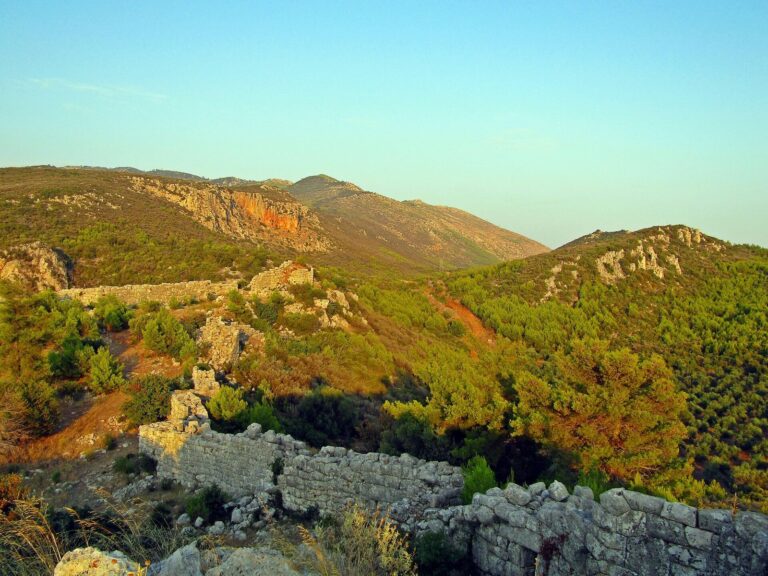
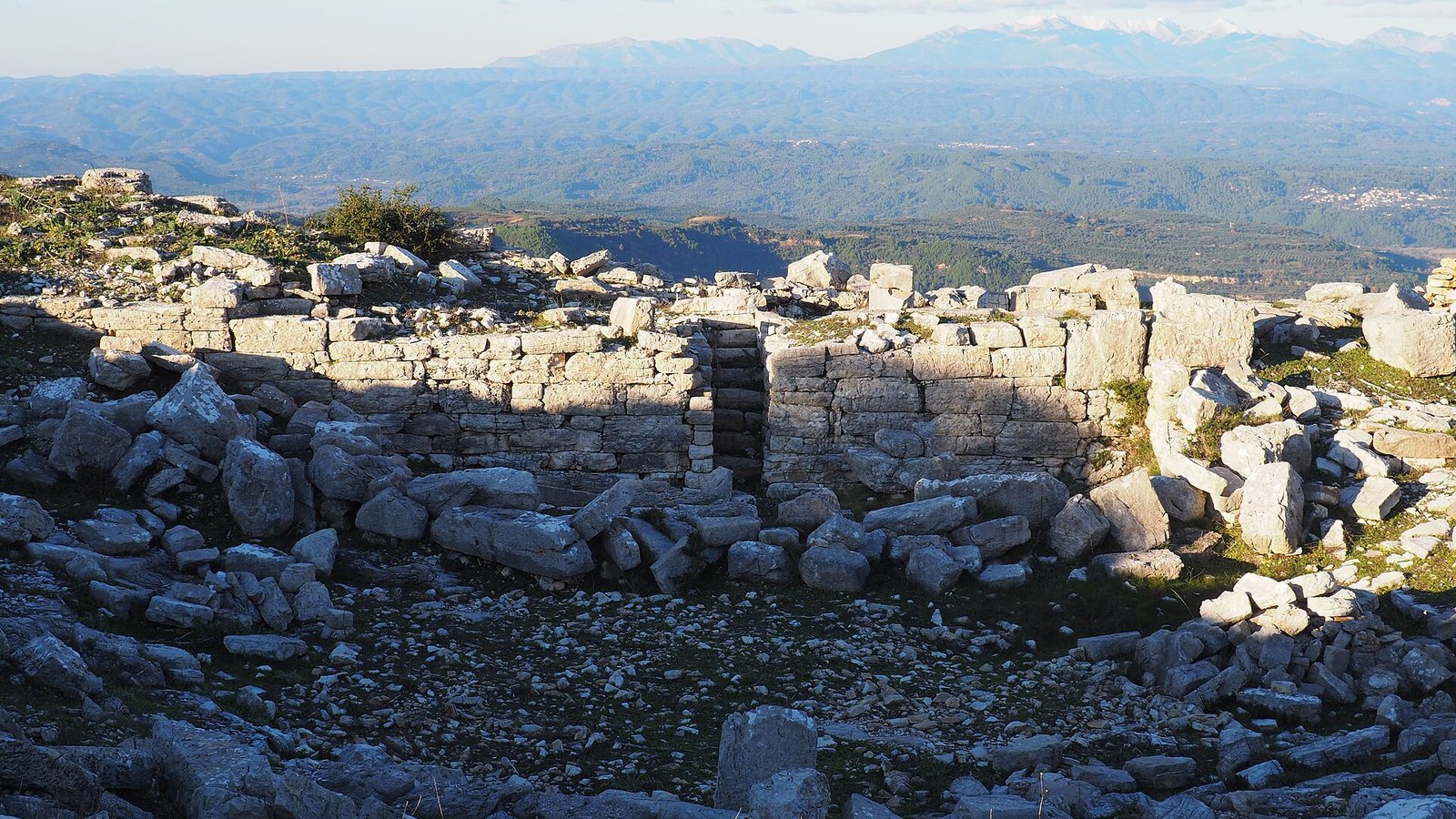
The site occupies a steep hill at the eastern end of Mount Lapíthas, about 600 metres above sea level. It lies beside the road between Andrítsaina and Pýrgos, south of the Alfeiós River. The ridge is unusually long and narrow for an acropolis, measuring about 680 metres long and 60–80 metres wide. The settlement’s plan follows this elongated hill, with three walled sectors and eight terraces.
Fortifications and urban sectors
The circuit wall dates to the late fourth century BCE, within the Late Classical and Hellenistic periods. It was built from polygon-shaped stones and included several towers and gates. The main gate stood at the southeastern corner of the eastern wall. The fortifications survive to about five metres high in places. The city comprised the hilltop acropolis, a lower city on the southern slope, and a third walled area on the northern slope. The hill’s difficult approach and position gave control over the Triphylian mountains and the road from Pisatis to Megalopolis and other parts of Arcadia.
Terraces and civic buildings
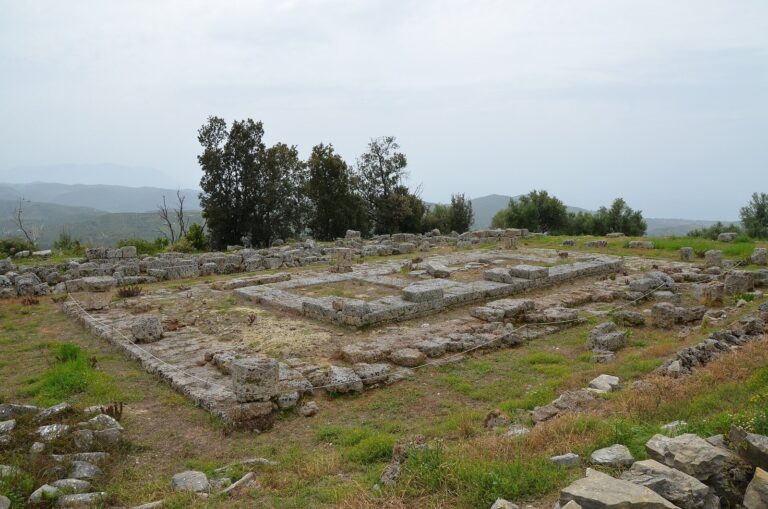
Eight terraces lie within the circuit wall. The four lowest and easternmost terraces of the upper city, numbered I–IV, probably held private houses and public buildings. On terraces III and IV are the remains of a large rectangular building with five rooms, including two rooms and an inner courtyard, as well as a separate one-room structure. Terrace V probably held the agora, the central public space for civic life and often commerce; a large square cistern survives there. Terrace VIII lies at the western end of the hill.
Theatre and summit acropolis
A small Greek theatre occupied terrace VI. Its seating area, 34.5 metres in diameter, dates to the fourth century BCE, while the stage building dates to about 245 BCE. Both are partly preserved. It is one of two known ancient theatres in Elis, the other being at Elis. Terrace VII at the summit was set aside for the fortified acropolis, which had its own wall. A cistern and a well were also found there.
Later churches
The later churches on the acropolis are Profítis Ilías (Prophet Elijah) and Ágios Ilías, also identified as Agía Eléni (Saint Elijah or Saint Helen).