Archaeological Site of Olympia: Sanctuary and Birthplace of the Olympic Games


Site at a Glance
- Rating
- 4.7
- Popularity
- High
- Country
- Greece
- Primary era
- Classical
- External website
- Open
- Eras represented
- Iron Age, Classical
- Civilizations
- Ancient Greek, Kingdom of Macedon, Roman
- Site type
- Religious
- Remains
- Sanctuary
On this page26 sections
History
The Archaeological Site of Olympia in Greece is an ancient Greek sanctuary near Archaia Olympia, developed around the cult of Zeus from the tenth century BC and shaped by the religious, political and sporting traditions of the Greek world. It lies in a valley formed by the Alpheios and Kladeos rivers in the north-western Peloponnese, where human settlement began by the end of the Neolithic period and continued through the Bronze Age.
Early settlement and the cult of Zeus
Archaeological evidence places settlements and cemeteries in the valley between approximately 4000 and 1100 BC. These remains include Middle Helladic and Mycenaean phases. Olympia was first associated with the cults of Pelops and Hippodameia and, in tradition, with Kronos, Gaia, Themis and Eileithyia. Religious activity by the tenth century BC is indicated by food remains and burnt offerings. A sanctuary may have existed in the ninth or eighth century BC, although the character and date of its earliest formal development remain uncertain.
By about the tenth century BC, Olympia had become an important centre of worship dedicated primarily to Zeus. The first enclosed sacred area, or temenos, developed during this early growth. The larger sacred precinct was known as the Altis, meaning the sacred grove, and it gradually incorporated temples, altars, monuments and buildings connected with religious ceremonies, administration and athletic contests.
The sanctuary initially lay within the territory of Pisa. Elis seized Pisa and Olympia around 900 BC, but Pisa regained control around 676 BC before Elis recovered the sanctuary around 580 BC. Olympia generally remained under Eleian administration thereafter, although its control was disputed during later conflicts.
The Olympic festival
The ancient Olympic Games were religious festivals held in honour of Zeus. Tradition attributed their origin variously to Pelops and Heracles. In 776 BC, Elis reorganized earlier local contests as a Pan-Hellenic festival, meaning one shared by the Greek world as a whole. Tradition also associated the restoration of the games with King Iphitos of Elis, Cleosthenes of Pisa and Lycurgus, who established the Sacred Truce, or Ekecheiria. This agreement protected the movement of athletes and visitors and helped shield Olympia during the festival, but it did not bring all warfare in Greece to an end.
The games took place every four years, and the interval between festivals, known as an Olympiad, became a system for dating events in the Greek world. The festival began with a single stadion race. It later included long-distance running, the pentathlon, wrestling, boxing, the pankration, chariot and horse races, boys’ contests and the hoplite race. The programme eventually lasted five days. Victors received an olive wreath and a red headband, together with public honours in their communities.
As competitors and visitors arrived from Greek communities throughout the Mediterranean, Olympia developed into a religious, political and sporting centre. Its ceremonies expressed ideals of physical and mental harmony, noble competition and peaceful rivalry. The games and the Sacred Truce later gave Olympia an enduring association with peace and international competition.
Archaic and Classical expansion
The sanctuary expanded rapidly during the Archaic period. Major construction included the Temple of Hera, the Prytaneion, the Bouleuterion, the first stadium and a row of treasuries commissioned by Greek city-states. These developments reflected the growing importance of the games and sanctuary beyond Elis and its immediate territory.
The Temple of Zeus was built around 470–457 BC, during the Classical period, when Olympia reached a high point of cultural and architectural development. Further religious, administrative and athletic buildings were added around the Altis. During the war of 364–362 BC, Olympia came under Arcadian control. Elis violated the truce by fighting the Pisatans within the sacred area, and Pisa held the 104th Olympic festival in 364 BC instead of Elis. Control later returned to Elis.
Hellenistic and Roman transformations
During the Hellenistic period, new accommodation and training facilities enlarged the sanctuary. The Leonidaion provided lodging for distinguished visitors, while the Palaestra, Gymnasium and additional baths supported athletic preparation. The Philippeion, a circular building begun by Philip II of Macedon after the Battle of Chaeronea and completed by his son Alexander the Great, commemorated the Macedonian ruling family.
Roman rule brought repeated changes to Olympia. Roman citizens were admitted to the games, existing buildings received extensive repairs, and new baths, an aqueduct, an exedra, or semicircular fountain structure, and luxurious residences were constructed. In 85 BC, the Roman general and dictator Sulla plundered Olympia. He transferred the competitors of the 175th Olympiad, held in 80 BC, to Rome for a reproduction of the festival and considered moving the games permanently to Rome. The plan ended with his death in 78 BC.
The games regained prestige under Augustus, the first Roman emperor. In AD 67, the festival was postponed to accommodate Emperor Nero’s participation. Olympia remained an active sanctuary during the later Roman period, when the Greek geographer Pausanias visited around AD 160–170. His detailed description of the buildings, monuments and rituals, together with archaeological research, has helped reconstruct the ancient arrangement of the site.
Decline, burial and rediscovery
Measures issued by Emperor Theodosius I against pagan festivals prohibited the Olympic Games in AD 393. That year is conventionally treated as the date of the last festival, although lists of victors indicate that contests may have continued until at least AD 401. In AD 426, Emperor Theodosius II ordered the destruction of Olympia’s temples, and the Temple of Zeus was burned.
A Christian community later occupied the sanctuary and converted the workshop of Pheidias into a church. Earthquakes in the sixth century, including major events in 522 and 551 or 552, caused further destruction. Flooding and deposits brought by the Alpheios and Kladeos eventually covered the sanctuary, while changes in the rivers’ courses removed or buried parts of the ancient landscape. Settlement at Olympia was interrupted or abandoned by the early seventh century.
The sanctuary was eventually buried beneath approximately 5–8 metres of alluvial, sandy and muddy deposits, and its precise location was forgotten. Modern research has also proposed that repeated tsunami-related marine flooding, together with river deposits and landslides, contributed to the burial.
A Venetian map marked the location in 1516 under the name Andilalo. Matthias Palbitzki probably became the first western European to reach Olympia in 1647. Bernard de Montfaucon proposed excavation in 1723, but the plan was not carried out. Michel Fourmont searched in Greece between 1728 and 1731 without excavating Olympia, and Johann Joachim Winckelmann planned to investigate the site but died before doing so.
Richard Chandler identified the ruins in 1766 during an expedition organized by the British Society of Dilettanti. The first excavation took place in 1829, when the French Expedition Scientifique de Moree partially excavated the Temple of Zeus and removed fragments of its pediments to the Louvre.
Modern archaeology and preservation
Systematic excavation began in 1875 under the German Archaeological Institute at Athens, initially directed by Ernst Curtius and Friedrich Adler. Early campaigns uncovered the Nike of Paionios, the Hermes with the infant Dionysus, the Philippeion, the Prytaneion, the Pelopion and the Leonidaion. A later campaign concentrated on cataloguing the finds.
Archaeological work continued during the twentieth and twenty-first centuries. Investigations in 1908–1929, 1936–1941, 1952–1966, 1972–1984 and 1984–1996 examined the southern sanctuary, stadium, baths, Gymnasium, workshop of Pheidias, Leonidaion, Prytaneion and Pelopion. They also clarified the earlier history of the sanctuary. Bronze and ceramic objects and terracotta roof tiles were recovered from numerous debris pits.
In 2021, archaeologists found a bronze bull figurine near the Temple of Zeus after heavy rain exposed one of its horns. The figurine dates to approximately 2,500 years ago, and fine pottery of the Geometric period was also found nearby.
Conservation and restoration have protected parts of the sanctuary while following scientific and technical conservation principles. The surrounding landscape was damaged by fires in 2007, but the ancient monuments were not significantly affected and the natural environment was subsequently restored. Dikes along the Alpheios strengthened flood protection, while vehicle restrictions introduced in 2008 reduced vibration, noise and pollution near the monuments.
The Archaeological Site of Olympia was inscribed on the UNESCO World Heritage List in 1989 under criteria (i), (ii), (iii), (iv) and (vi). The protected property covers approximately 105.6 hectares, with a buffer zone of approximately 1,458 hectares. The Ephorate of Antiquities of Eleia, the regional Greek archaeological service, supervises excavation, building work, conservation and protection against illegal digging.
Olympia also remains connected with the modern Olympic movement. The international Olympic Games were revived in 1896 through the movement associated with Pierre de Coubertin. Since 1936, the Olympic flame has been lit at Olympia by concentrating sunlight with a parabolic mirror before being carried by relay to the host city. In 2004, the men’s and women’s shot-put competitions of the Athens Olympics were held in the ancient stadium with limited intervention in the archaeological setting.
Remains
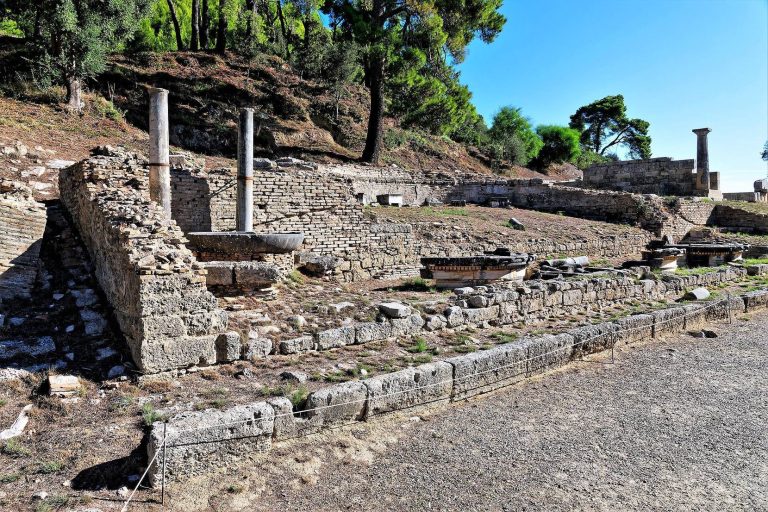
The surviving sanctuary occupies a landscape bounded by the Alpheios River to the south, the Kladeos River to the west and Mount Kronos to the north. At its centre was the Altis, an irregular quadrangular sacred enclosure more than 183 metres on each side in one phase and approximately 200 by 175 metres at its greatest extent. A stone boundary wall enclosed it, with three western gates and two southern gates. The Echo Stoa formed its eastern edge and separated the sacred precinct from the stadium area. Olive, plane, poplar, oak and pine trees continue the wooded character associated with the Altis.
Temples and sacred monuments
Temple of Zeus
The Temple of Zeus stood near the centre of the Altis. Built around 470–457 BC, it was a Doric temple with six columns across the front and thirteen along each side. Its upper platform, or stylobate, measured approximately 27.7 by 64.1 metres. The temple housed Pheidias’s colossal statue of Zeus, a roughly 13-metre image made from gold and ivory over a wooden framework. The statue was regarded as one of the Seven Wonders of the Ancient World and has been lost.
Temple of Hera and the Pelopion
The Temple of Hera stood in the north-western part of the Altis. Built around 600 BC, it was the first major temple at Olympia and one of the earliest Greek monumental temples. It was initially dedicated jointly to Zeus and Hera, then became Hera’s temple after the Temple of Zeus was completed. The Doric building had six columns across the front and sixteen along the sides, with a stylobate approximately 18.8 by 50 metres. The altar of Hera stood to its east.
South of the Temple of Hera was the Pelopion, a sanctuary and hero tomb associated with Pelops. It occupied the site of the oldest prehistoric settlement and was rebuilt in the sixth century BC. A five-sided boundary wall enclosed it, with a formal entrance at the south-west corner. Excavated material includes a continuous ceramic sequence from the eleventh century BC, including Sub-Mycenaean and Protogeometric pottery, as well as votive figurines and vessels.
Altars and the Metroon
The great altar of Zeus stood north of his temple, near the earlier sanctuaries of Hera and Pelops. Centuries of burnt sacrifices and votive offerings formed an ash mound that reportedly reached nearly seven metres in height. The Metroon, east of the Temple of Hera, was a Doric temple dedicated to Cybele, the Mother of the Gods. Built at the beginning of the fourth century BC, it was later used for the imperial cult. Its stylobate measured approximately 10.6 by 20.7 metres, and its plan contained six by eleven columns. A sanctuary of Hestia and an altar of Artemis occupied the south-eastern part of the Altis during the Classical period.
Philippeion and Prytaneion
The Philippeion was a circular tholos, or round building, in the north-western corner of the Altis, south of the Prytaneion. Begun by Philip II after the Battle of Chaeronea and completed by Alexander the Great, it had an Ionic exterior approximately 15.2 metres in diameter with eighteen columns. Five statues inside represented Alexander, his parents and his grandparents.
The Prytaneion occupied the north-western corner of the enclosure. Built in the sixth century BC and altered later, it served as the meeting place of officials responsible for sacrificial rites and hosted victory feasts during the games. It included an altar dedicated to the sacred hearth fire.
Administration and athletic facilities
Bouleuterion and Theokoleon
The Bouleuterion stood south of the Altis and served as the administrative centre for officials organizing the games. Athletes and judges, known as the hellanodikai, swore their oaths there before the contests. In its largest form, the building measured approximately 33 by 42 metres. Two sections with curved western ends were separated by a rectangular room containing a statue of Zeus Horkios, Zeus who protected oaths.
West of the Temple of Zeus stood the Theokoleon, the meeting place and residence of the priests known as the theokoloi. Its position beside the workshop of Pheidias placed priestly administration close to an important area of artistic production.
Stadium
The stadium began as a simple running track near the altar of Zeus within the Altis. It was remodelled around 500 BC with sloping spectator banks and moved eastward twice as the sanctuary expanded. During the Classical period it was transferred outside the sacred enclosure, where it remains approximately 215 metres long and 30 metres wide. Its running track measures 192.27 metres, the distance of the stadion race. The starting line lies at the western end, the finish at the eastern end and a judges’ platform along the southern side. The spectator area could accommodate approximately 45,000 people.
The stadium hosted every Olympic event except the equestrian competitions. These contests included the stadion race, long-distance running, pentathlon, wrestling, boxing and pankration. Athletes and judges entered through the Crypt, a long, narrow vaulted passage connecting the stadium with the sanctuary.
Palaestra and Gymnasium
The Palaestra stood west of the Altis. Built in the third century BC, it was a training facility for wrestling, boxing and the long jump. Its peristyle, a courtyard surrounded by a colonnade, measured approximately 66.4 by 66.8 metres. Rooms around the central court served activities such as changing and oiling the athletes, and the architecture combined Doric and Ionic elements.
North of the Palaestra was the Gymnasium, built in the early second century BC for javelin and discus throwing and for running. Its colonnaded court measured approximately 120 by 220 metres. A stoa, or roofed colonnade, the length of the stadium occupied its eastern side and provided a covered running space. The complex combined Doric and Ionic elements.
Treasuries and colonnades
Treasuries
A row of treasuries occupied the northern side of the sanctuary on the southern slope of Mount Kronos. Greek city-states built them mainly during the sixth and fifth centuries BC for votive offerings to the gods, and they may initially have served other religious purposes as well. At least fifteen were constructed between approximately 600 and 450 BC. The Treasury of the Sikyonians is the best preserved and has been restored, while the Treasury of the Gelians was the largest. Other treasuries were associated with Syracuse, Epidamnus, Byzantium, Sybaris, Cyrene, Selinus, Metapontum and Megara, as well as with an unidentified city.
Echo Stoa and South Stoa
The Echo Stoa, also called the Painted Stoa, formed the eastern boundary of the Altis. Built in the fourth century BC, it was approximately 98 metres long and was named for the echo produced within or around it. The South Stoa stood south of the Bouleuterion and formed part of the southern approach to the sanctuary. It measured approximately 80.6 metres in length.
Baths, lodging and Roman buildings
Bath complexes
The Western, or Greek, Baths stood near the Kladeos at the western edge of the site. Built in the fourth century BC, the complex measured approximately 5.8 by 21.6 metres and included a swimming pool. It was enlarged during the third and second centuries BC. During the Roman period, it was replaced by several bath complexes, including the Kladeos Baths beside the river, the Northern or Kronion Baths north of the Prytaneion, the Southern Baths west of the Bouleuterion and the Eastern Baths near Nero’s residence.
Leonidaion and Nero’s residence
The Leonidaion was a large guest house south-west of the Altis. Built around 330 BC, it was named after its donor and designer, Leonidas of Naxos, and originally accommodated distinguished visitors. It later served Roman officials. Its plan measured approximately 74.8 by 81.1 metres.
Nero’s residence stood south-east of the Altis and east of the Hestia sanctuary complex. It was built around AD 65–67 for the emperor during his participation in the Olympic Games. The Nymphaion, or Exedra, was a semicircular fountain dedicated to the nymphs on the northern side of the sanctuary. Built in the second century AD with funding from Herodes Atticus, it was approximately 33 metres wide.
Workshop and artistic remains
Workshop of Pheidias
The workshop of Pheidias stood west of the Altis. Built in the fifth century BC while the sculptor created the cult statue of Zeus, it preserves evidence of sculptural production, including tools. The building was later converted into a Christian church, linking the site’s Classical artistic history with its late antique religious occupation.
Sculpture, offerings and inscriptions
Thousands of altars, statues and votive offerings were dedicated at Olympia to gods, demigods, heroes, Olympic victors, rulers and military commanders. Victory statues were often grouped by event and place of origin. Some were made by sculptors such as Polykleitos and Myron. The Zanes, statues of Zeus placed near the stadium, were funded by fines imposed on athletes caught cheating; their surviving remains generally consist of bases.
Important sculptures found at Olympia include the Nike of Paionios and the Hermes with the infant Dionysus, attributed to Praxiteles. Large votive bronzes, sculptures from the pediments and metopes of the Temple of Zeus, and other finds reveal the range of artistic production associated with the sanctuary. These objects are displayed principally in the Archaeological Museum of Olympia, while associated museums present the history of excavation and ancient Olympic sport.
A bronze bull figurine found near the Temple of Zeus in 2021 dates to approximately 2,500 years ago. Fine fragments of Geometric-period pottery were found with it. Together with the sanctuary’s monuments, votive remains and surviving tree and plant species, these objects form part of an archaeological landscape that retains much of the ancient spatial character of Olympia.