Treasuries at Olympia: Civic Offering Buildings for Zeus
Site at a Glance
- Popularity
- Medium
- Country
- Greece
- Primary era
- Iron Age
- Eras represented
- Iron Age, Classical
- Civilizations
- Ancient Greek
- Site type
- Religious
On this page16 sections
History
The Treasuries at Olympia were a group of Greek civic offering buildings in the Altis, the sacred precinct at Olympia, Greece, built in successive phases from the early sixth to the mid-fifth century BCE. Most were financed by Greek cities or colonies participating in the Olympic Games, and all but two are described as works of colonies. The contributing communities belonged to the Dorian Greek cultural group. Their treasuries held valuable offerings to Zeus, the chief god of Greek religion, and equipment for sacrifices. Giving to the sanctuary was an act of devotion and could also bring public recognition to a city among its own people.
Dedications and historical events
The Sicyon treasury was dedicated by Myron, a tyrant of Sicyon, meaning a ruler who held power outside the usual constitutional framework. Myron made the dedication after winning a chariot race at the thirty-third Olympiad, one of the four-year periods used to number the ancient Games. The Sicyon building is identified as the earliest of the group. Syracuse’s treasury commemorated a victory over Carthage in 480 BCE. The Selinus treasury was built before the Carthaginians destroyed that city in 409 BCE, while the citizens of Gela made their own dedication.
The Metapontum treasury was later destroyed, though Pausanias did not know the reason. The treasuries could also hold substantial sums of money, and Olympia is interpreted as having become an important financial center. During the Peloponnesian War, the conflict between Athens and its allies and the Spartan-led Peloponnesian League, Elean leaders gave financial assistance to the League.
Pausanias and the later record
Pausanias, a Greek travel writer of the second century CE, named ten of the twelve treasuries that existed. Two may have been demolished to make a path from the sanctuary toward Mount Cronius. His descriptions preserve details of the buildings and their dedications, including objects that were no longer in place by the time he visited.
Remains
Terrace and overall plan
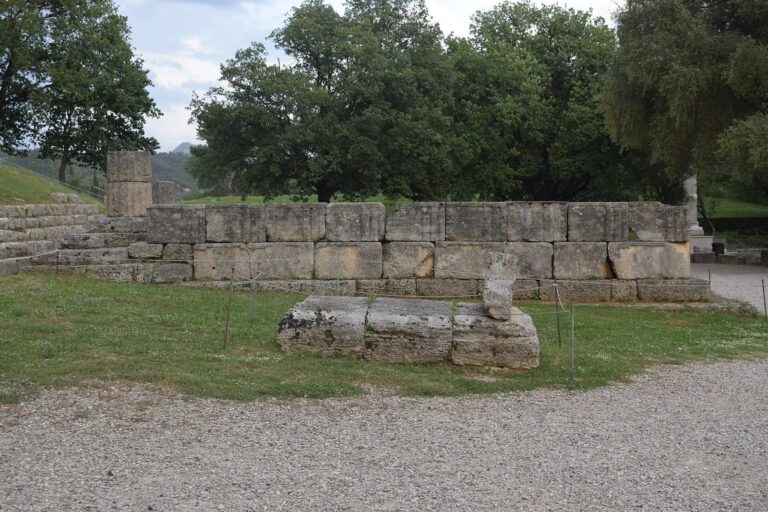
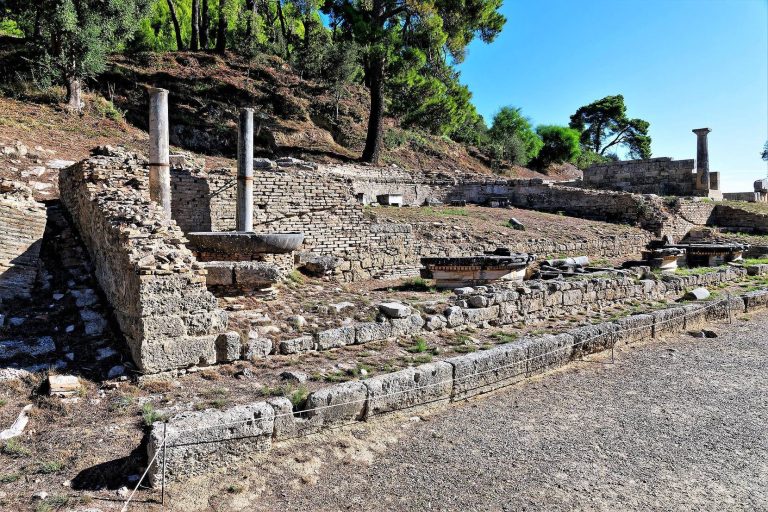
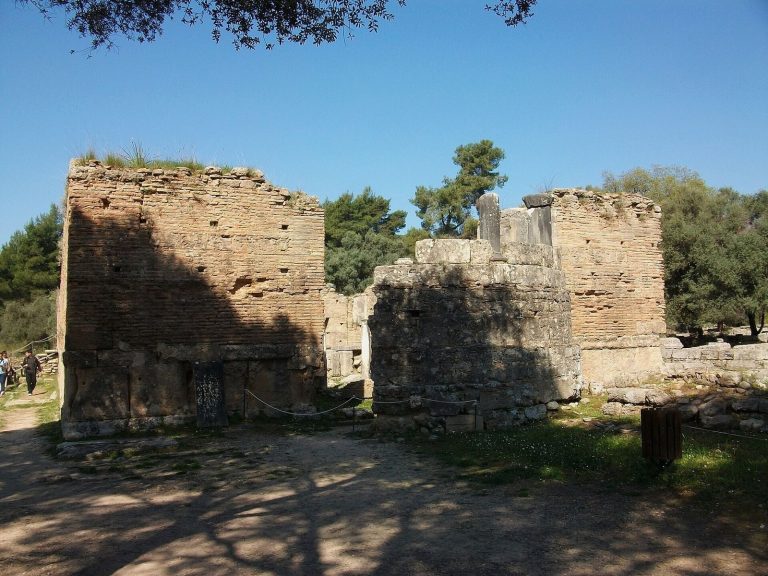
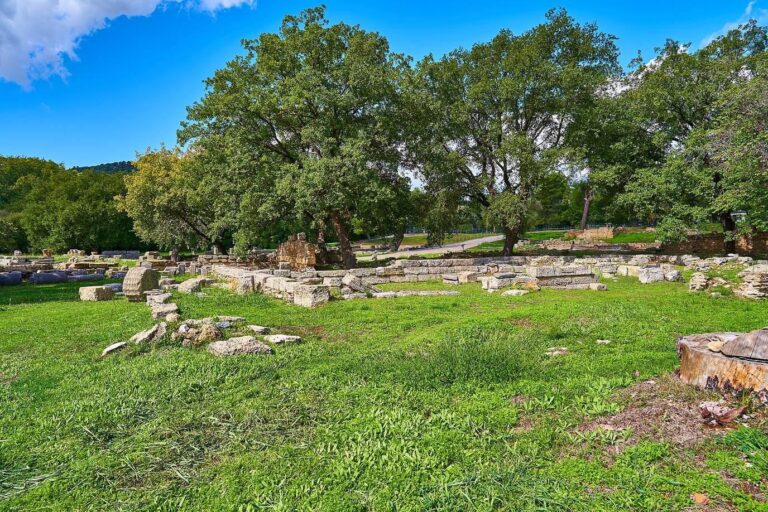
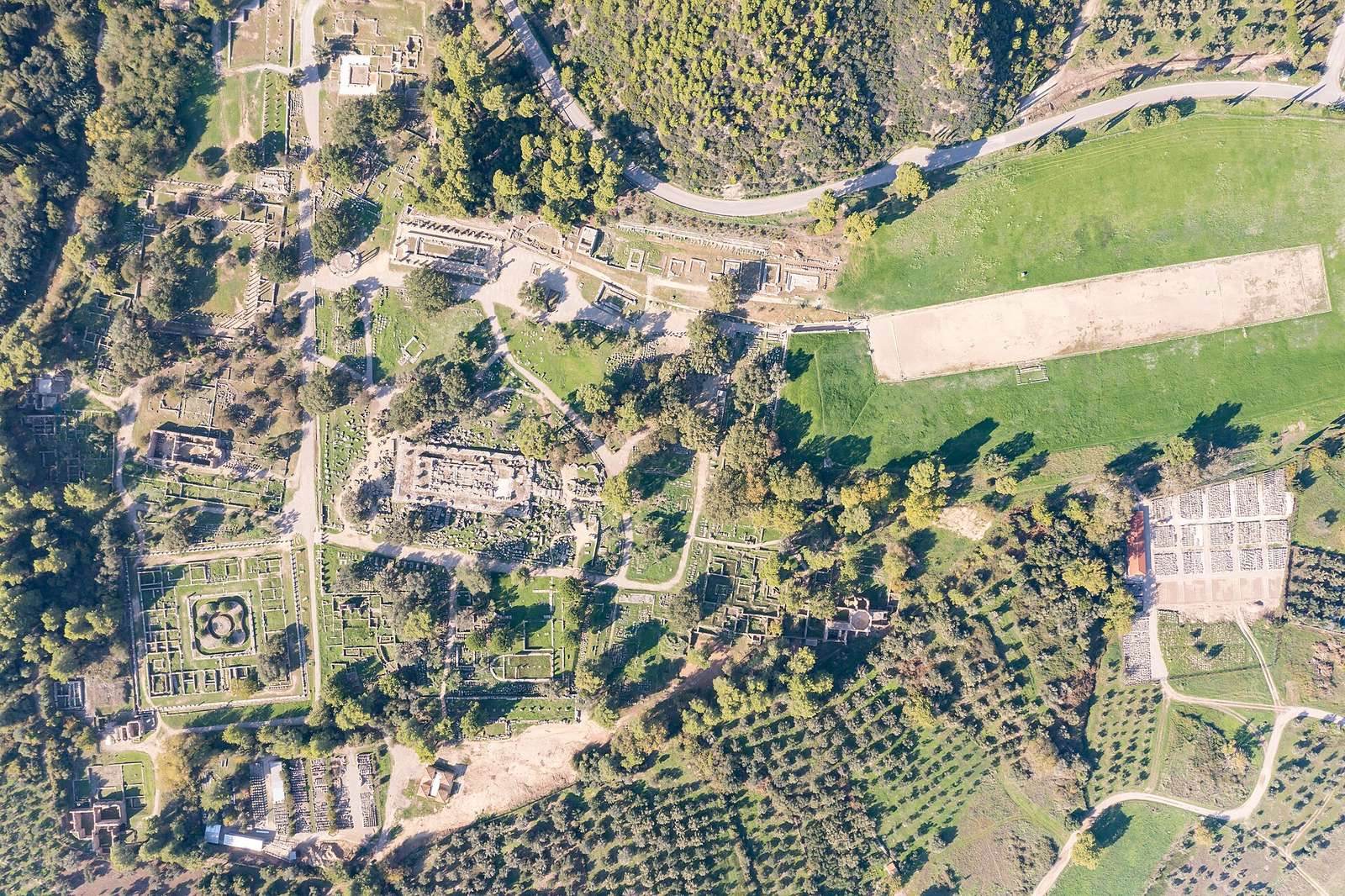
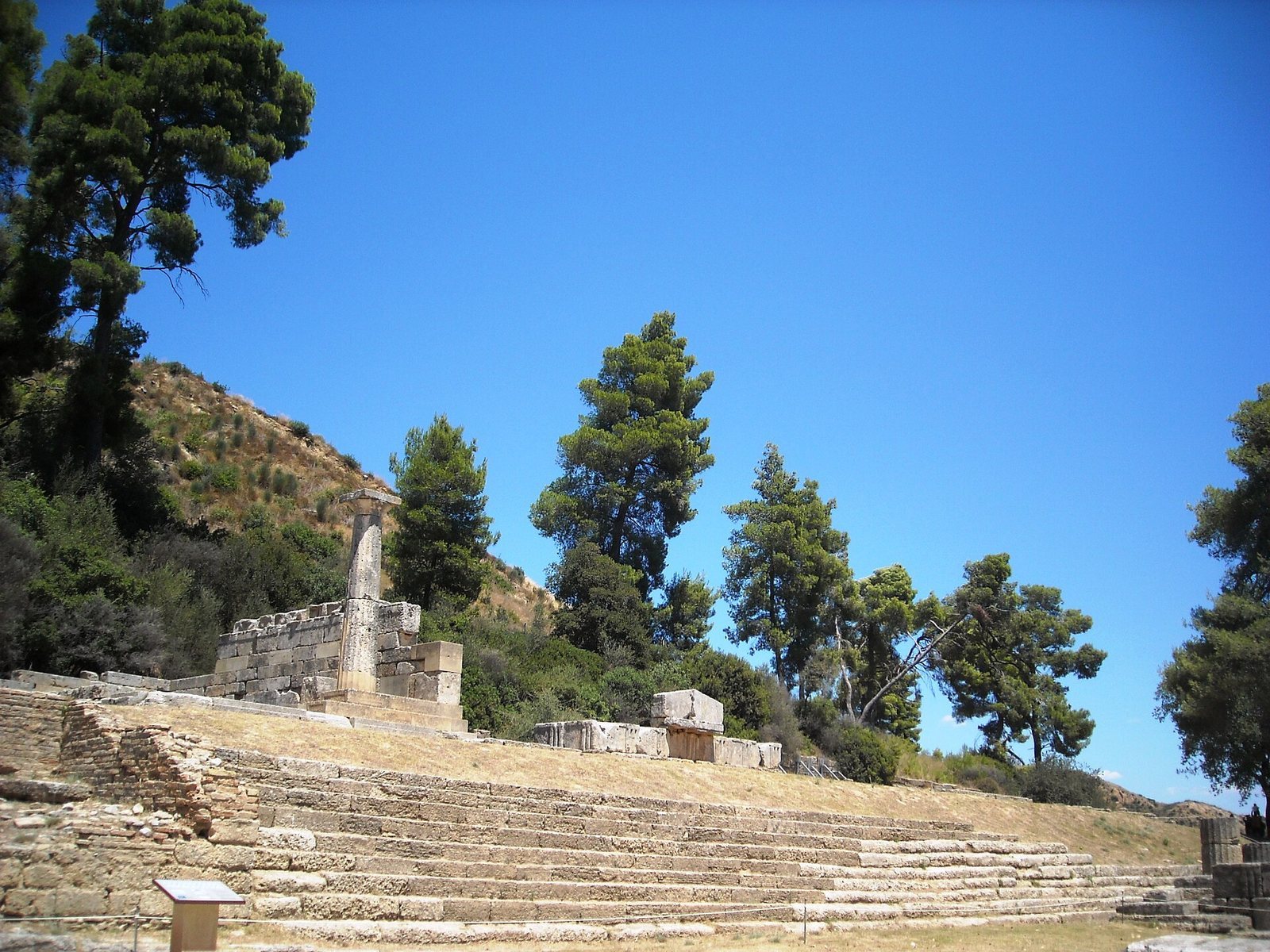
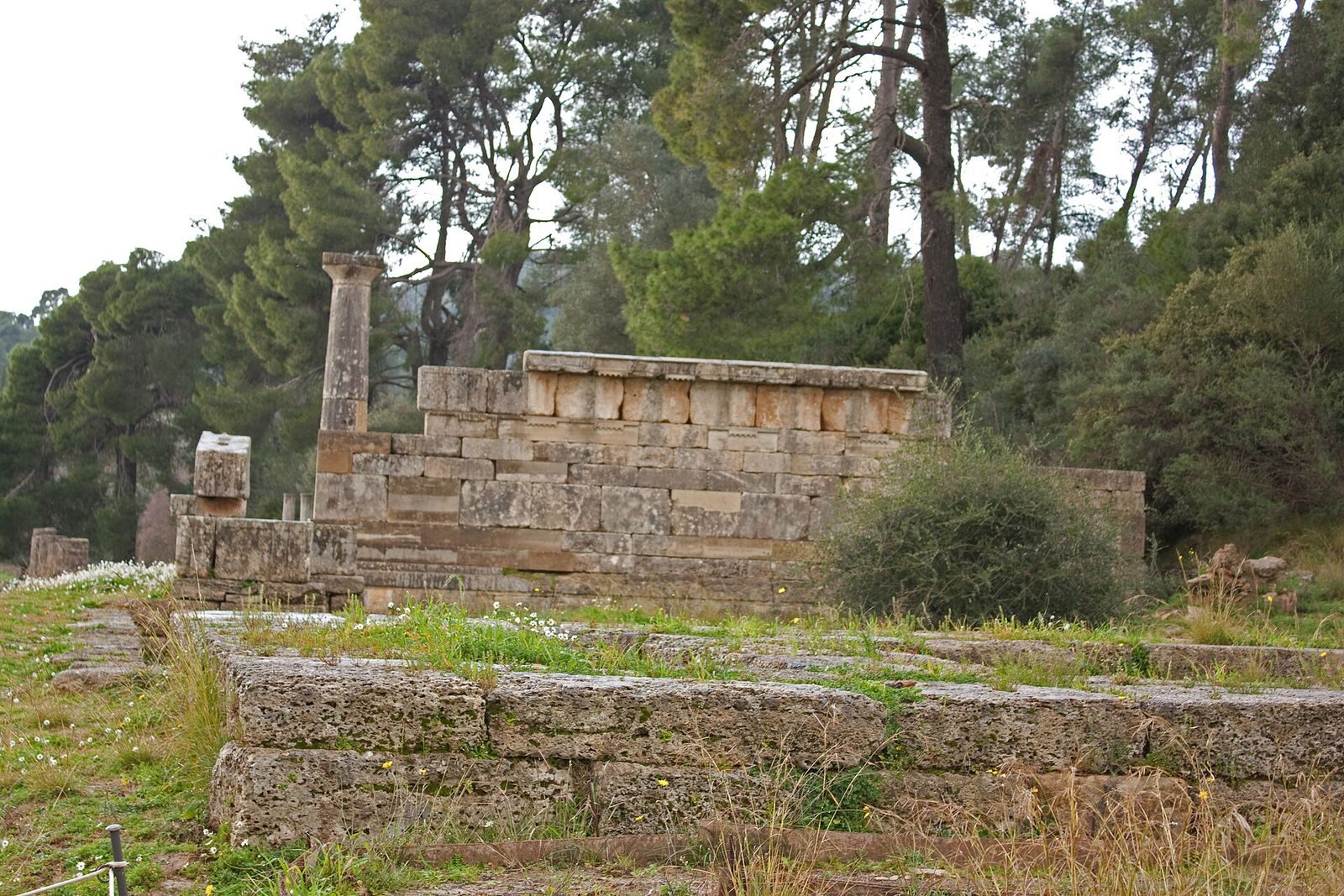
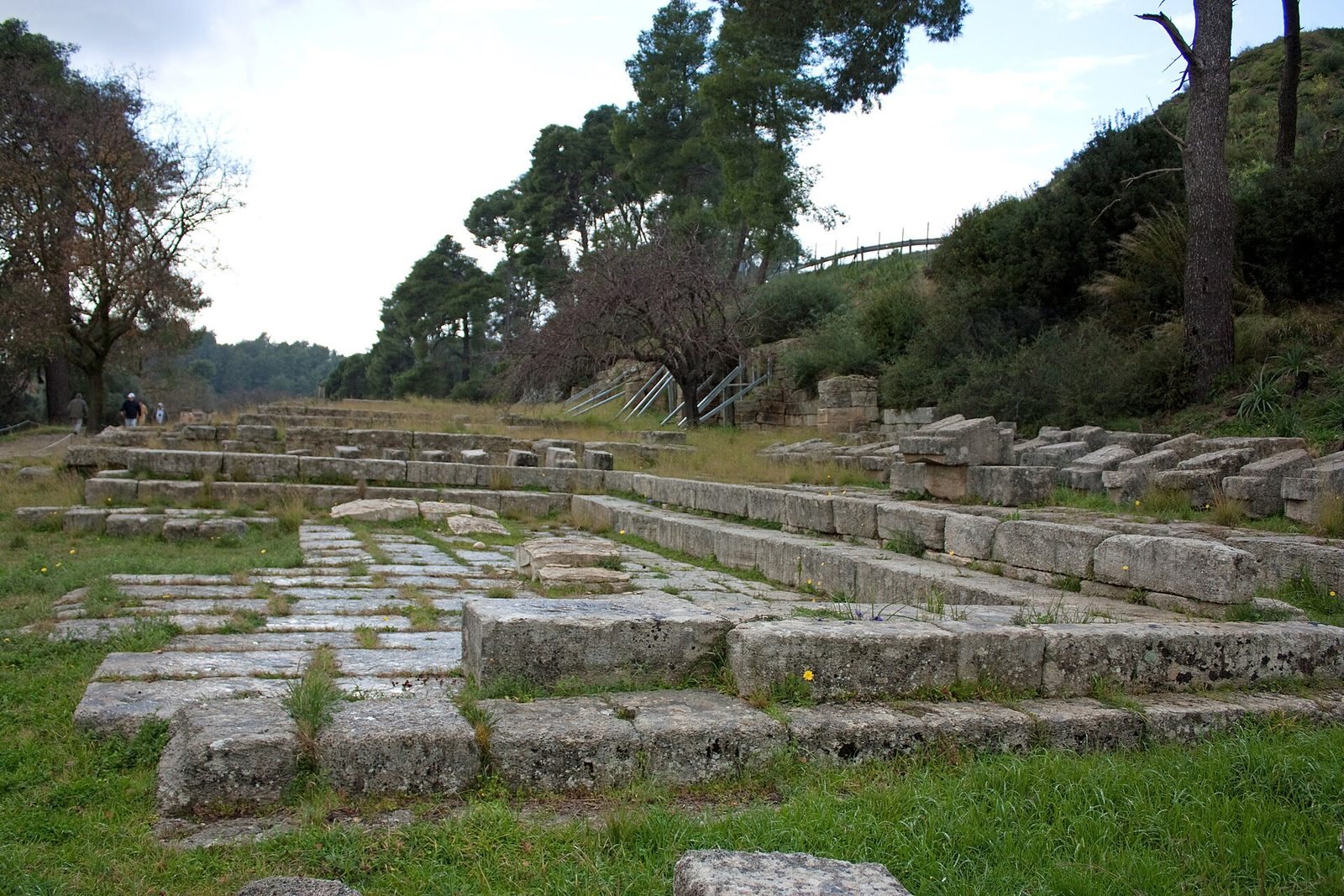
The treasuries occupied a natural terrace on the southern slopes of Mount Cronius, in the northwestern part of the Altis between the Nymphaeum, a monumental fountain or shrine associated with nymphs, and the stadium. The platform stood about three metres above the Altis’s average level. From west to east, the named dedications were Sicyon, Syracuse, Epidamnus, Byzantion, Sybaris, Cyrene, Selinus, Metapontum, Megara, and Gela. Most buildings resembled small temples, with a rectangular inner chamber and an entrance porch formed by two Doric columns between antae, the thickened ends of walls framing an entrance. Doric and Ionic are Greek architectural orders distinguished by their forms. Interiors were generally single rooms, with Gela described as an exception. Some triangular façade pediments carried reliefs or sculptural groups. The pediments at Byzantion, Epidamnus, and Cyrene were particularly rich in sculpture.
Porous-stone steps provided access to the terrace and were probably added around 330 BCE, after the treasuries had been built. A wall behind the steps separated the buildings from Mount Cronius. It was built after the main group of treasuries to restrain earth and landslides, and also closed a possible entrance into the sanctuary at that point. Excavations exposed foundations for twelve buildings; five have been securely identified as those of Sicyon, Selinus, Metapontum, Megara, and Gela.
Individual treasuries and their contents
Sicyon
Built between the late sixth and early fifth centuries BCE, the Sicyon treasury was made of limestone. Its interior measured 6.40 metres across and 11.78 metres deep, and its façade columns were 3.85 metres high. A marble ceiling inside was a luxury otherwise associated at Olympia only with the Temple of Zeus. Pausanias described two bronze chambers, one Doric and one Ionic. He was unsure whether the bronze came from Tartessus, an ancient place in southwestern Iberia, as the Eleans claimed.
Objects associated with the treasury included three discs for the pentathlon, a bronze shield painted on its inner face, a helmet, and greaves. An inscription on the weapons identified them as first-fruit offerings, the initial portion of something dedicated to a deity. Other recorded objects were a sword attributed to Pelops, a legendary hero and king, with a gold hilt, and a horn of Amalthea, a figure linked with Zeus’s infancy and the horn of plenty, offered by Miltiades. Pausanias also described a boxwood statue of Apollo, the god of prophecy, music, and healing, with a gilded head. The Locrians dedicated it, and Patrocles, son of Catilo of Croton, made it.
Syracuse
The Syracuse treasury was built of white stone brought from Syracuse and is the most recently discovered of the group. Its position and shape suggest that it fitted into a gap between other buildings. It may have been demolished before the later retaining wall was built behind the terrace.
Epidamnus
Pyrrhus and his sons Lacrates and Hermon built the Epidamnus treasury. Its offerings may have included cedar-wood representations of Atlas, a Titan who bore the heavens, and Heracles, a heroic figure, supporting the world. Other possible cedar figures showed the Hesperides, nymphs associated with golden apples, and their apple tree, with a serpent coiled around it.
Byzantion
The Byzantion treasury belonged to the group with especially rich sculptural work on its pediment. Its position beside the Sybaris treasury places it within the sequence of dedications along the terrace.
Sybaris
The Sybaris treasury stood beside the building from Byzantion. Its place in the terrace’s west-to-east sequence followed Byzantion and preceded Cyrene.
Cyrene
The Cyrene treasury contained statues of Roman emperors and had a richly sculpted pediment, like those at Byzantion and Epidamnus.
Selinus
A statue of Dionysus, the god of wine and festivity, was kept in the Selinus treasury. Its face, hands, and feet were made of ivory.
Metapontum
The Metapontum treasury stood beside that of Selinus. Its contents included an ivory representation of Endymion, a youth associated in myth with eternal sleep, shown without ivory clothing, as well as many kinds of gold and silver cups.
Megara
Small cedar figures inlaid with gold showed Heracles struggling with Achelous, a river god. The group also included Zeus, Deianira, Heracles’s wife, and Ares, the god of war, who aided Achelous. A Gigantomachy, a mythological battle between the gods and the Giants, was carved on the pediment. Its figures were painted blue and their weapons red. A shield above the pediment bore an inscription stating that the Megarians dedicated the treasury after defeating the Corinthians.
Pausanias also saw a statue of Athena, goddess of wisdom and warfare, portrayed as Heracles’s ally beside the Hesperides at the Heraion, the sanctuary of Hera, a goddess associated with marriage and queenship.
Gela
At the eastern end of the terrace, near the passage to the stadium, the Gela treasury may have been the most complete and best-built of the group. It had an entrance hall. The entrance originally faced west, but was later turned south and given a portico as part of an effort to align the buildings along the terrace. Pausanias saw the dedicatory inscription.