San Pietro in Vincoli: The Parish Church of Madignano, Italy
Site at a Glance
- Popularity
- Very Low
- Country
- Italy
- Primary era
- Medieval
- Eras represented
- Medieval, Early Modern, Modern
- Civilizations
- Duchy of Milan, Habsburg, Holy Roman Empire, Italian, Spanish
- Site type
- Religious
- Remains
- Church
On this page12 sections
History
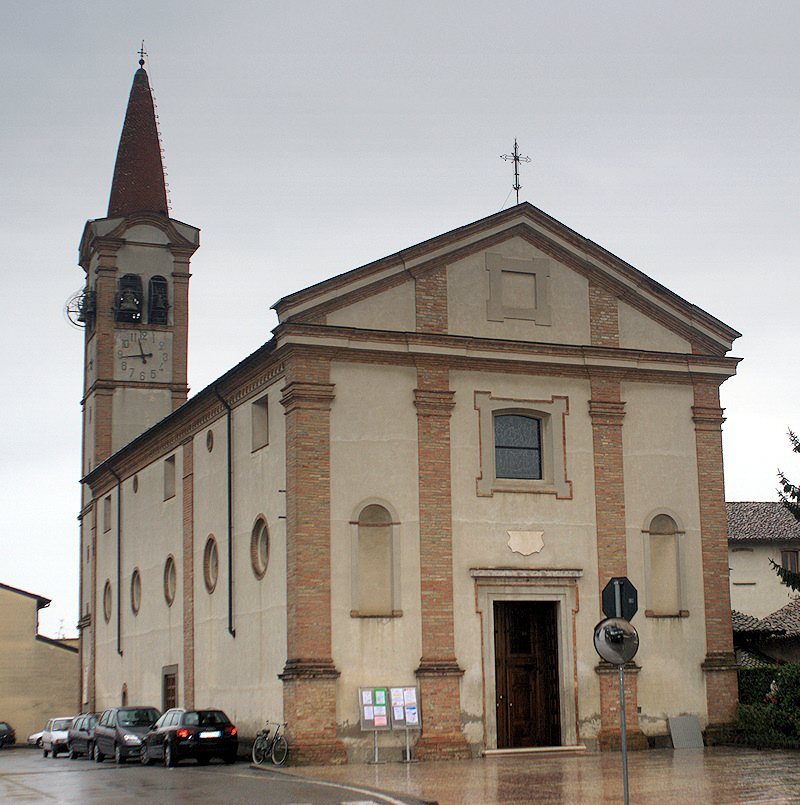
San Pietro in Vincoli is the Catholic parish church of Madignano, Italy, dedicated to St Peter in Chains. The dedication refers to the Christian tradition that the apostle Peter was imprisoned in chains. The present church began to take shape in 1494, following an earlier Benedictine church on the site.
The earlier church and rebuilding
The Benedictine church had fallen into disrepair when Cardinal Giulio Della Rovere supported substantial work on a new building. Construction began in 1494, and parts of the earlier church were incorporated into the later structure.
Seventeenth-century expansion
The church underwent no further alterations until the second half of the seventeenth century. In 1686, Cardinal Marcello Durazzo became its commendatory holder, an ecclesiastic entrusted with administering a church benefice and its revenues. His appointment began a renewed period of prosperity. From 1695, the church was enlarged and restored, gaining two bays and a new façade.
Restoration of the apse
Work in 1972–73 revealed remains of the earlier church. In November 1972, restorers removed the apse structure built in 1856, which had a polygonal end beneath a sail vault, a dome-like vault rising from supports at the corners. The work aimed to recover the apse’s presumed earlier rectangular form. The apse was restored in 2003.
The organ
A request for an organ appears in a document dated 19 August 1793, and the Serassi firm built the instrument in 1795. About ninety years later, Cavalli of Lodi rebuilt it, reusing much of the original material; a plaque gives the date 1885. The organ was used until 1963 and abandoned the following year. In the mid-1970s, parish priest Giovanni Terzi promoted its restoration. The Tamburini firm of Crema began work in 1980, and the organ is again used regularly during church services.
Remains
The church’s surviving features include earlier masonry at the side façade, side chapels, the presbytery, the apse, and furnishings and artworks within the building. The church stands apart from Madignano’s historic center and forms a focal point of the old urban core, in the district known as dal doss.
Earlier fabric and interior
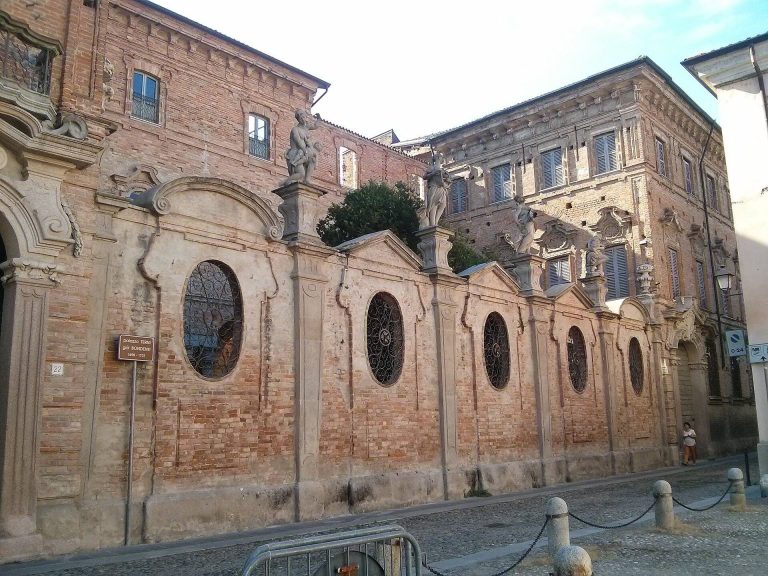
Remains of an earlier structure at the side façade rise to about five metres. Built of stone and flat tiles laid in a herringbone pattern, the structure had a gabled roof and may predate the arrival of the Benedictine monks. Inside, terracotta cornices and stucco decoration give the church a unified appearance. Iron railings enclose the altars in the side chapels, while a marble balustrade separates the presbytery, the area around the altar.
Paintings, frescoes, and sculpture
Village painting and chapel frescoes
Holy Trinity among Saints Roch, Sebastian, John the Baptist, and Peter, painted in 1633 by Gian Giacomo Barbelli of Crema, shows the church in its late-fifteenth-century appearance alongside the nearby lazaretto, an isolation hospital for people with contagious diseases. The church and lazaretto occupy the canvas’s centre, framed by Saints Roch and Sebastian, traditionally invoked for protection against plague. The painting is an important visual record of the village in the seventeenth century and Barbelli’s earliest documented work. Frescoes in the fifth chapel on the left are attributed to the sixteenth-century school of Bernardino Luini. They show the Annunciation, God as creator, and four saints, including Paul and Bernardine of Siena.
Presbytery paintings
Two seventeenth-century oil paintings hang on the walls around the presbytery. One depicts Saint Jerome and the other King David. Giuseppe Preti of Como made their stucco frames. The paintings show the influence of Caravaggio through naturalistic modelling, drapery, and strong contrasts of light and shadow.
Stained glass and statue
A stained-glass window depicting St Peter Enthroned is set into the inner face of the façade. Leone Lodi of Soresina made it in 1960. A nineteenth-century statue of St Peter stands in the second chapel on the left.
Organ and choir loft
The organ is about four metres wide and occupies the upper part of the church’s fifth bay on the right. Its pipes sit within a broad arched frame between two fluted pilasters. Gilded Corinthian capitals, ornate column tops, support a tall decorative band; above it, an arched ornamental gable surrounds a semicircular panel. The choir loft, a raised gallery for singers or musicians, has a wooden front divided into three panels. Gilded musical instruments decorate the two smaller square panels. The instrument has a chromatic keyboard of 58 keys and a straight pedalboard with 16 pedals. Bellows and an air-supply wheel are housed at the rear, and an electric motor has operated the mechanism since 1956.