Basilica of Sant’Eufemia: Early Christian Church in Grado, Italy
Site at a Glance
- Popularity
- High
- Country
- Italy
- Primary era
- Medieval
- Eras represented
- Classical, Medieval, Modern
- Civilizations
- Byzantine, Italian, Venetian
- Site type
- Religious
- Remains
- Cathedral
On this page14 sections
History
The Basilica of Sant’Eufemia is an Early Christian and Romanesque church in Grado, Italy, commissioned by Archbishop Elijah after he fled the Lombard invasion of 568. Its construction is generally placed in the late sixth century. The church was probably consecrated on 3 November 579, and its completion is also dated to 580.
Foundation and Church Division
An earlier basilica stood on the site, though its date is uncertain. It may have been commissioned by Nicetas, Aquileia’s metropolitan bishop from 454 to 485, during the invasion of Attila, the fifth-century ruler of the Huns. The Lombards, a Germanic people, invaded northern Italy in the sixth century.
Elijah proclaimed himself patriarch in 571 and dedicated the new church to Saint Euphemia of Chalcedon, an early Christian martyr associated with the Council of Chalcedon. Held in 451, the council affirmed a statement of Christian doctrine to which Elijah sought to show his adherence. This position took on importance amid the Three Chapters controversy, a dispute over condemning writings associated with three theologians, and Elijah’s conflict with Pope Pelagius II.
From the sixth century into the early seventh, the basilica served the pro-Roman and pro-Byzantine branch of a divided church. Grado became a counterpart to Aquileia in 606–07. The final separation followed in 717, and the Patriarchate of Grado was established in 739.
Venetian Control and Later Church History
As Venetian control over Grado increased, the basilica became the mother church of Venetian territory, a principal church serving a wider ecclesiastical area. It was also drawn into repeated military clashes arising from rivalry with the patriarchs of Aquileia. Its decline began around 1105, when Patriarch Giovanni Gradenigo moved his residence to the church of San Silvestro in Venice. The basilica remained the patriarchal see after the pope recognized the patriarchs’ Venetian residence in 1177.
In 1451 the Patriarchate of Grado was suppressed and the Patriarchate of Venice established. The basilica joined the new diocese and lost its cathedral title, which passed to San Pietro di Castello in Venice. Since 1818 it has belonged to the Archdiocese of Gorizia and served as a parish church. On 22 September 1888, Archbishop Luigi Mattia Zorn consecrated its altar to Saints Hermagoras and Fortunatus. Alterations made in the seventeenth and nineteenth centuries were partly removed during restorations in the mid-twentieth century. The church remains a Roman Catholic parish of the Roman Rite.
Remains
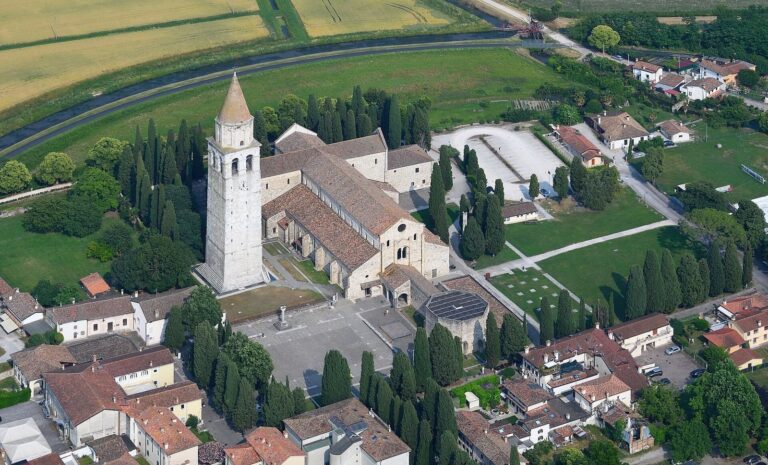
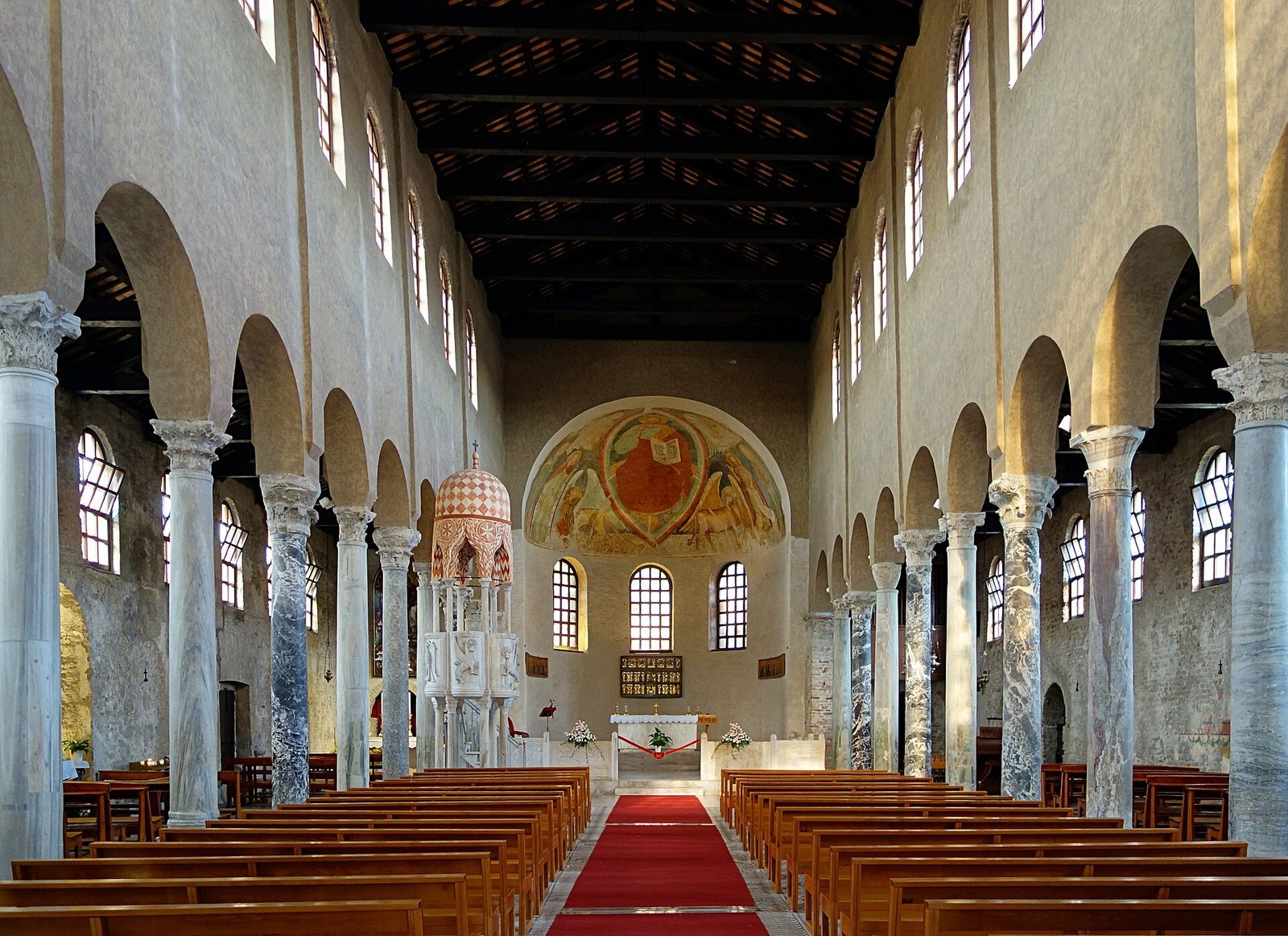
The basilica stands on the square of Grado’s former patriarchal city, beside its baptistery and bell tower. The church, with Early Christian and Romanesque features, has three interior aisles beneath a timber roof framework. The baptistery and tower form distinct structures alongside it.
The Basilica
Exterior and interior layout
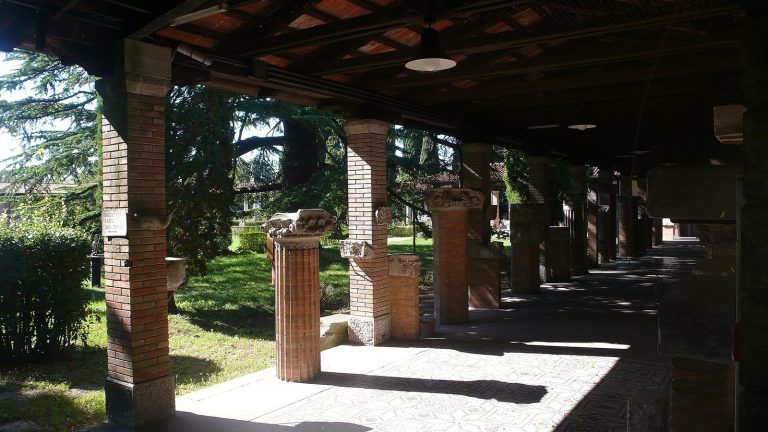
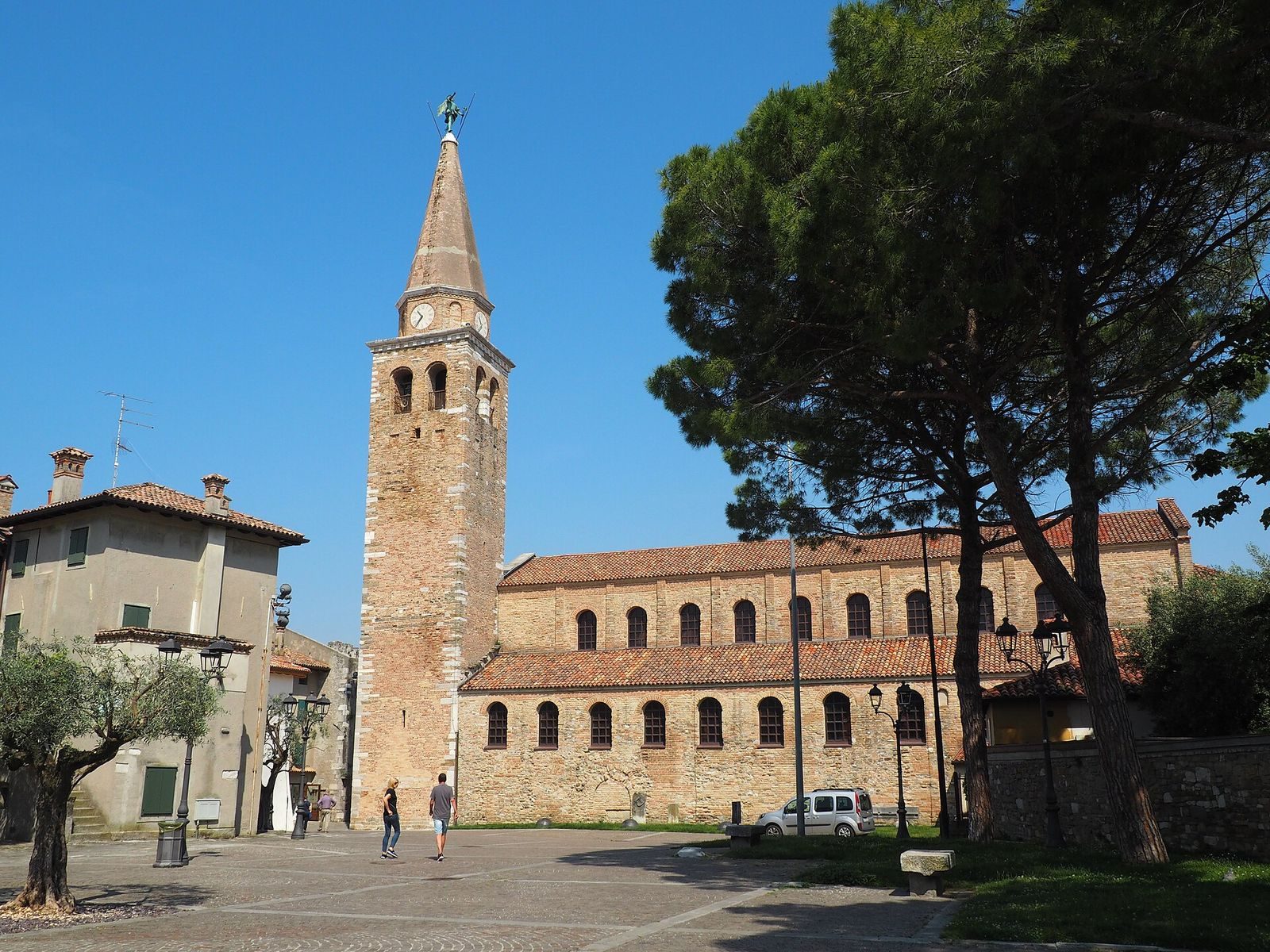
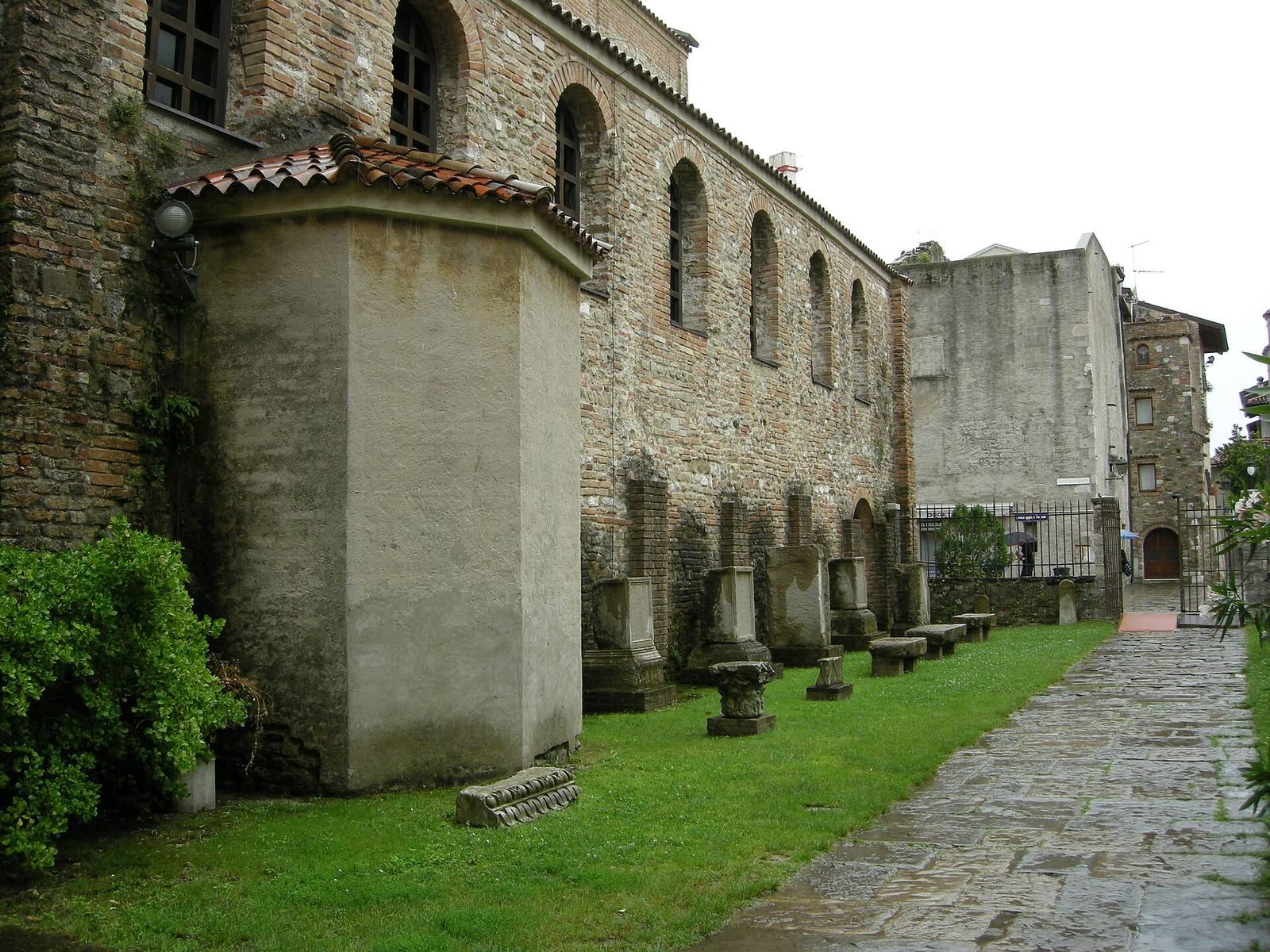
Exposed brick and sandstone form the exterior, with shells incorporated into a sand mixture in much of the brickwork. Facing Piazza del Patriarcato, the façade has stepped sections and pilasters, shallow wall projections resembling columns. Three large windows are set above traces of the vanished narthex, an entrance space at the west end of a church. Inside, multi-colored marble columns and capitals support the arches dividing the aisles; some columns and capitals date to the Roman period. Large windows in the upper walls and around the perimeter bring light into the church.
Earlier fabric and floor mosaics
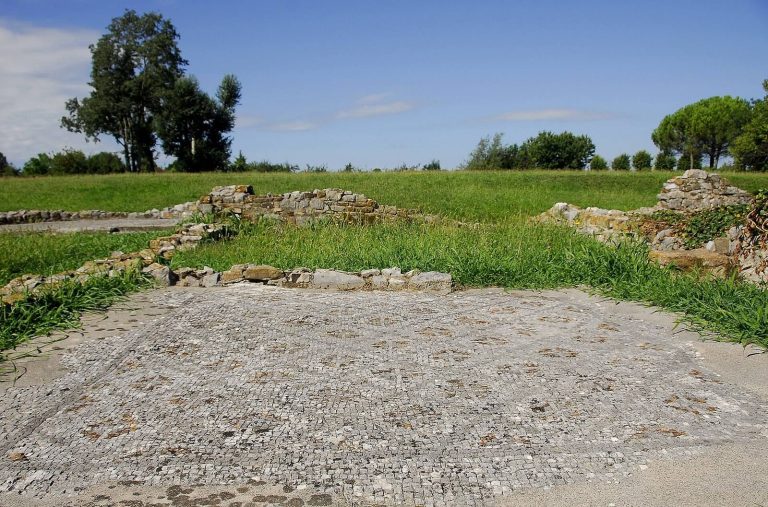
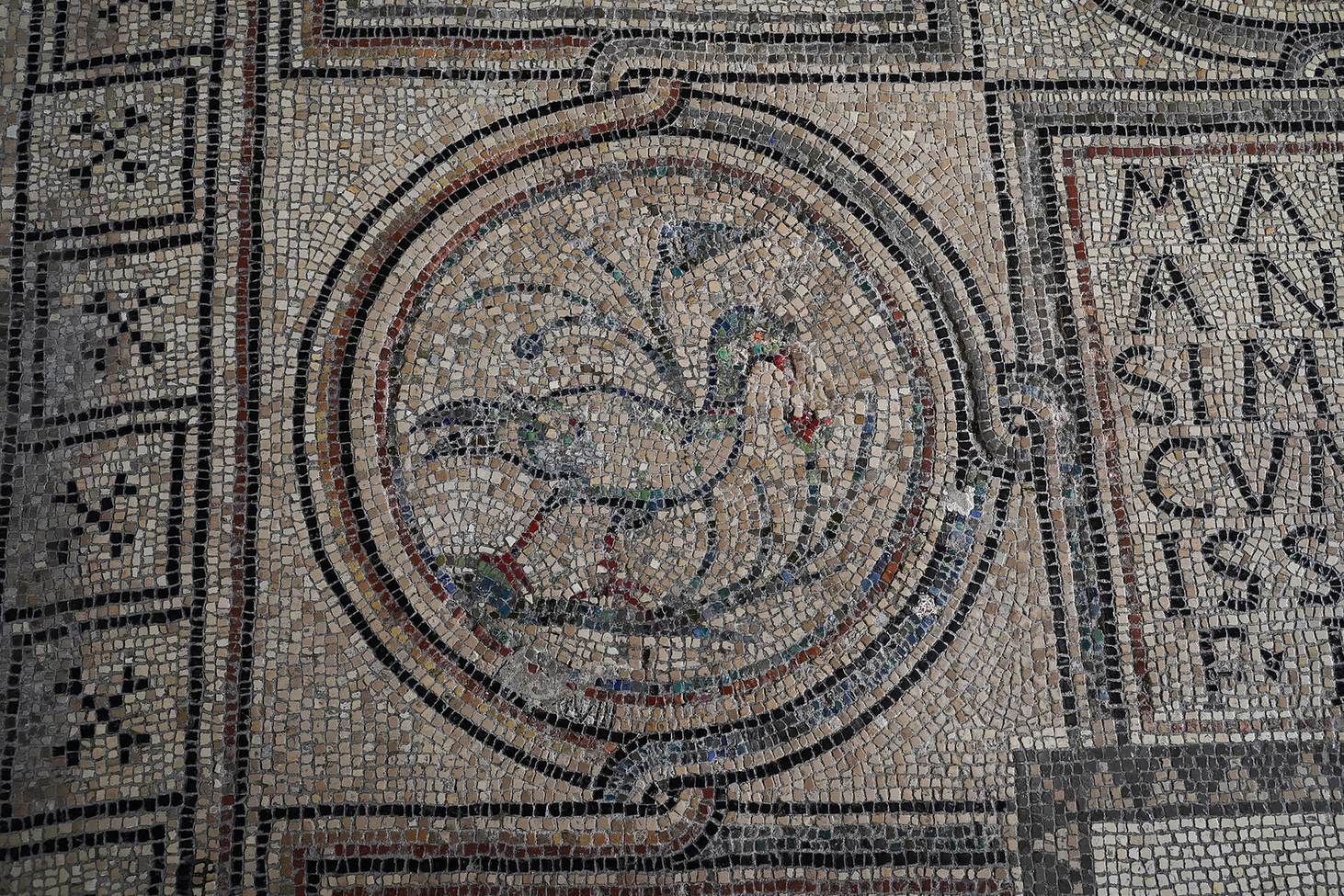
In the nave, a fragment of floor mosaic and a Corinthian capital, an ornate column top with acanthus-leaf decoration, survive from the earlier basilica. The large floor mosaic of the present church dates to the late sixth century. Its geometric designs include Latin inscriptions naming donors. The early Christian mosaics are unusually well preserved.
Ambo and painted decoration
A tall, hexagonal ambo, a raised pulpit for reading or preaching, stands on the left side of the central nave. Its style is described as Moorish, a broad art-historical term for forms associated with Muslim societies of North Africa and Iberia. Sculptural decoration on its canopy has an Islamic appearance and dates to the thirteenth century or possibly the early fourteenth. The preacher’s enclosure bears symbols of the four Evangelists, the traditional authors of the Gospels.
The half-dome over the apse, a recess at the end of the church, carries a thirteenth-century Gothic fresco of Christ enthroned. Frescoes from the fifteenth century decorate the upper part of the presbytery, the area around the main altar.
Golden Altarpiece
The presbytery contains the Golden Altarpiece, donated in 1372 by the Venetian noble Donato Mazzalorsa. It is made of silver shaped by hammering from the reverse and refined from the front. Its three registers use frames with multiple rounded lobes. The upper register shows the Annunciation, Christ, and symbols of the Evangelists; the lower one places saints beneath arches. In the central register, Christ is enthroned and Saint Mark celebrates Mass.
Organs and Marian image
The current Mascioni pipe organ, opus 684, was built in 1953 and substantially enlarged in 2000–02. It stands at the rear of the right aisle inside a swell box, an enclosure with movable shutters that control sound volume. The electronically operated organ has 20 stops, which control sets of pipes, 1,124 pipes, two hand keyboards, and a pedalboard. An earlier organ, made by Callido in 1784 and altered by Pietro Zanin in 1892, was removed in May 1939. Its pipes were incorporated into a new Zanin organ for the church of Santo Stefano in Blessano.
The basilica also houses the statue of the Madonna of the Angels. During the Perdon di Barbana festival, the statue is carried across the lagoon to the sanctuary on Barbana Island.
Bell Tower
Attached to the right side of the façade, the 42-metre tower was built in 1455 and has a Venetian-style spire. Its copper weathervane, shaped by hammering from the reverse, dates to 1462. It is identified as the archangel Michael, although the lily it holds, a symbol of the Annunciation, points to Gabriel in Christian iconography. The statue has become a symbol of Grado. Illuminated clock faces appear on all sides of the tower. Its bells include two cast by G. B. De Poli of Udine in 1860, one made by Francesco Broili of Gorizia in 1896, and a smaller bell cast by Broili in 1865. Stability problems have kept the bells from swinging for about forty years; electric strikers sound hours and melodies, while loudspeakers play recordings of a swinging peal.
Baptistery and Forecourt
Baptistery
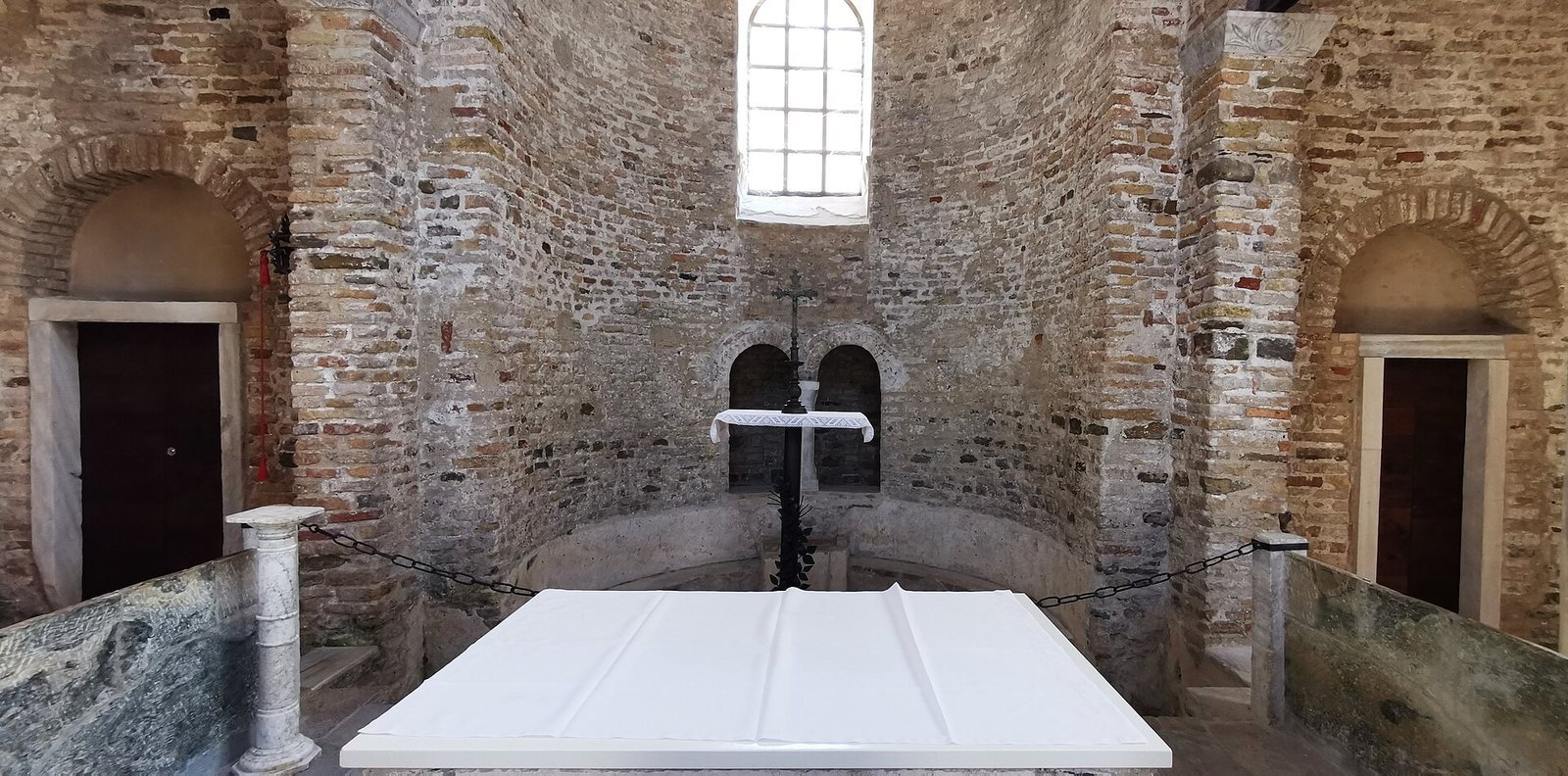
The octagonal baptistery stands to the left of the basilica and dates to the second half of the fifth century. Altered several times, it has an apse projecting northeast on the same axis as the church. Its sixth-century floor mosaics survive, as does a small altar now placed in the apse at the far end of the entrance. The hexagonal font is a large dipping basin faced with green cipollino, a veined marble. Work in 1928 removed the Baroque floor and lowered the floor level by about 2.20 metres, exposing the mosaics. It also reopened the original windows and restored the former street level in front of the building.
Forecourt sarcophagi
Ancient Roman sarcophagi found in Grado stand in the forecourt before the baptistery.