Chiesa di Sant’Antonio: A Hyblean Baroque Church in Ferla, Italy
Site at a Glance
- Popularity
- Low
- Country
- Italy
- Primary era
- Early Modern
- Eras represented
- Early Modern
- Civilizations
- Habsburg, Kingdom of Sicily, Spanish
- Site type
- Religious
- Remains
- Church
On this page15 sections
History
Chiesa di Sant’Antonio is a Catholic church in Ferla, Italy, dedicated to Saint Anthony Abbot, an early Christian ascetic associated with the beginnings of monasticism. The present church is a work of Hyblean Baroque, a regional style of southeastern Sicily, designed by Michele La Ferla, a friar who also worked as an engineer.
Destruction and rebuilding
An earlier church stood in Ferla’s lower quarter, opposite the Church of the Carmine. The 1693 Val di Noto earthquake destroyed it completely. The replacement was built at the present site in the southwestern part of Quattro Canti, within the town’s new center. Construction began in 1693 and was completed in 1760, after more than half a century of work.
Earthquake damage and continuing use
The 1908 Messina earthquake brought down the church’s bulbous dome and the body of its left bell tower, damaging part of the adjoining façade as well. The church remains a place of worship in the Roman Catholic rite. It belongs to the Archdiocese of Syracuse, the Vicariate of Palazzolo-Floridia, the Archpriesthood of Ferla, and the Parish of Saint James the Greater Apostle. A marble plaque marks its inclusion among Italy’s national monuments of particular historical and artistic value.
Remains
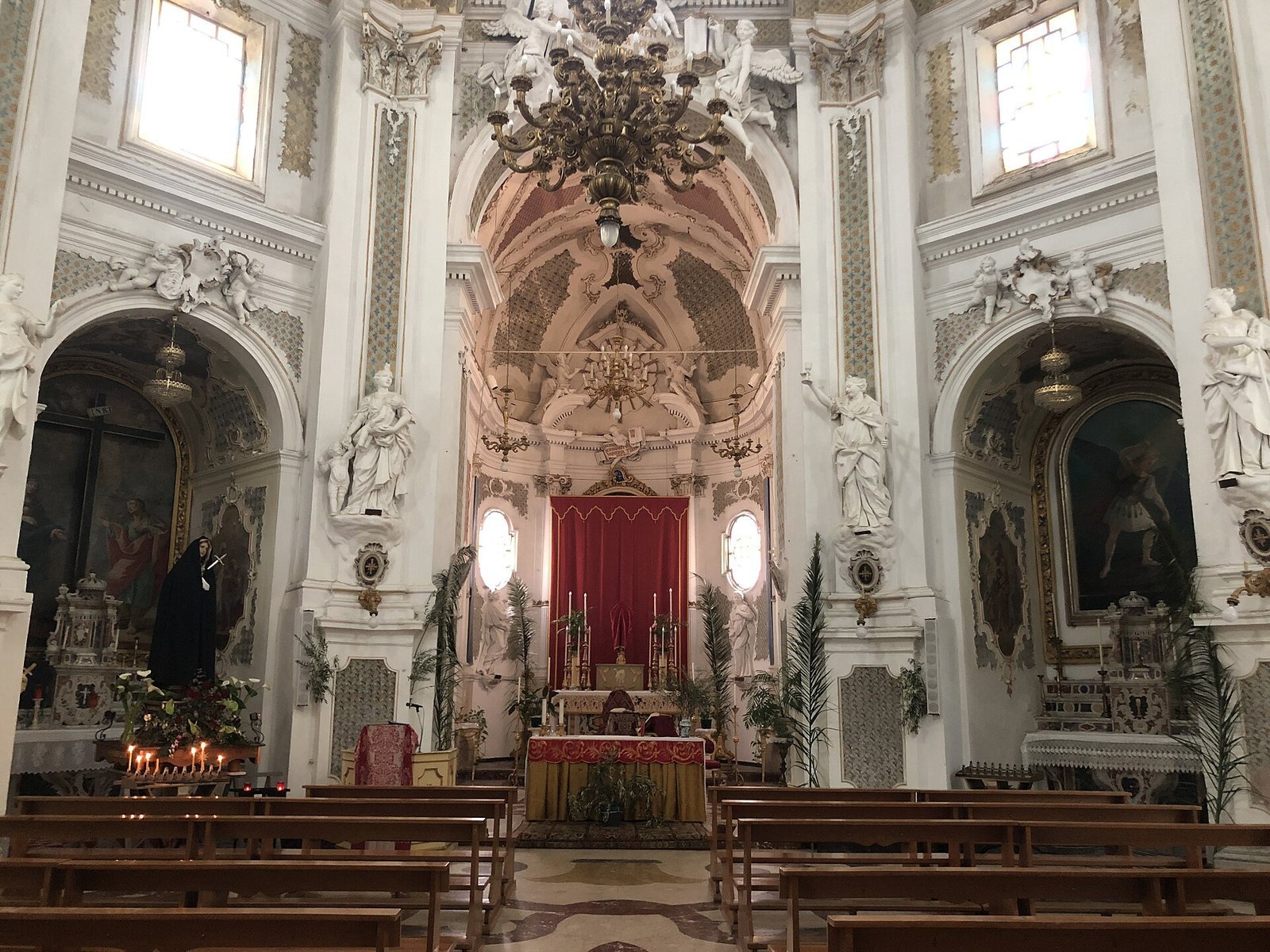
The church has a Greek-cross plan, with four equal arms meeting at the center, and each axis measures 33 metres. It stands on Via Vittorio Emanuele in the Quattro Canti area. Its exterior and interior combine shaped architectural details, painted decoration, sculpture, and altars.
Plan and exterior
Façade
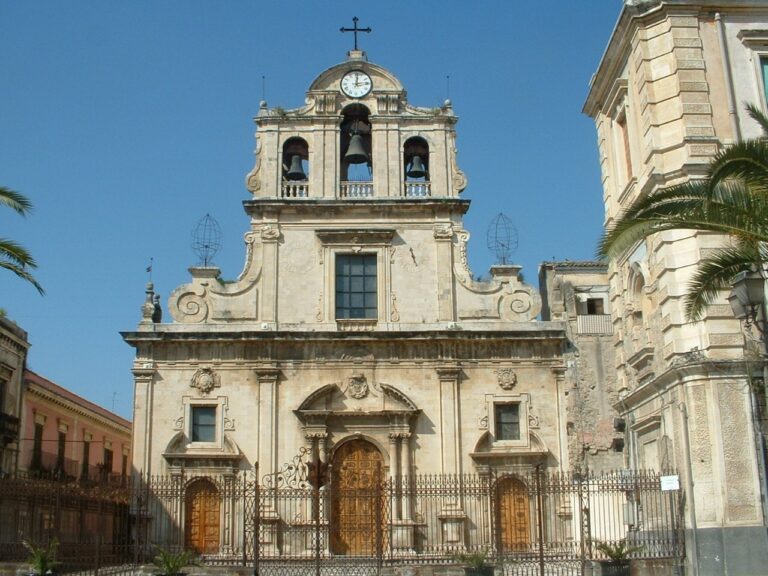
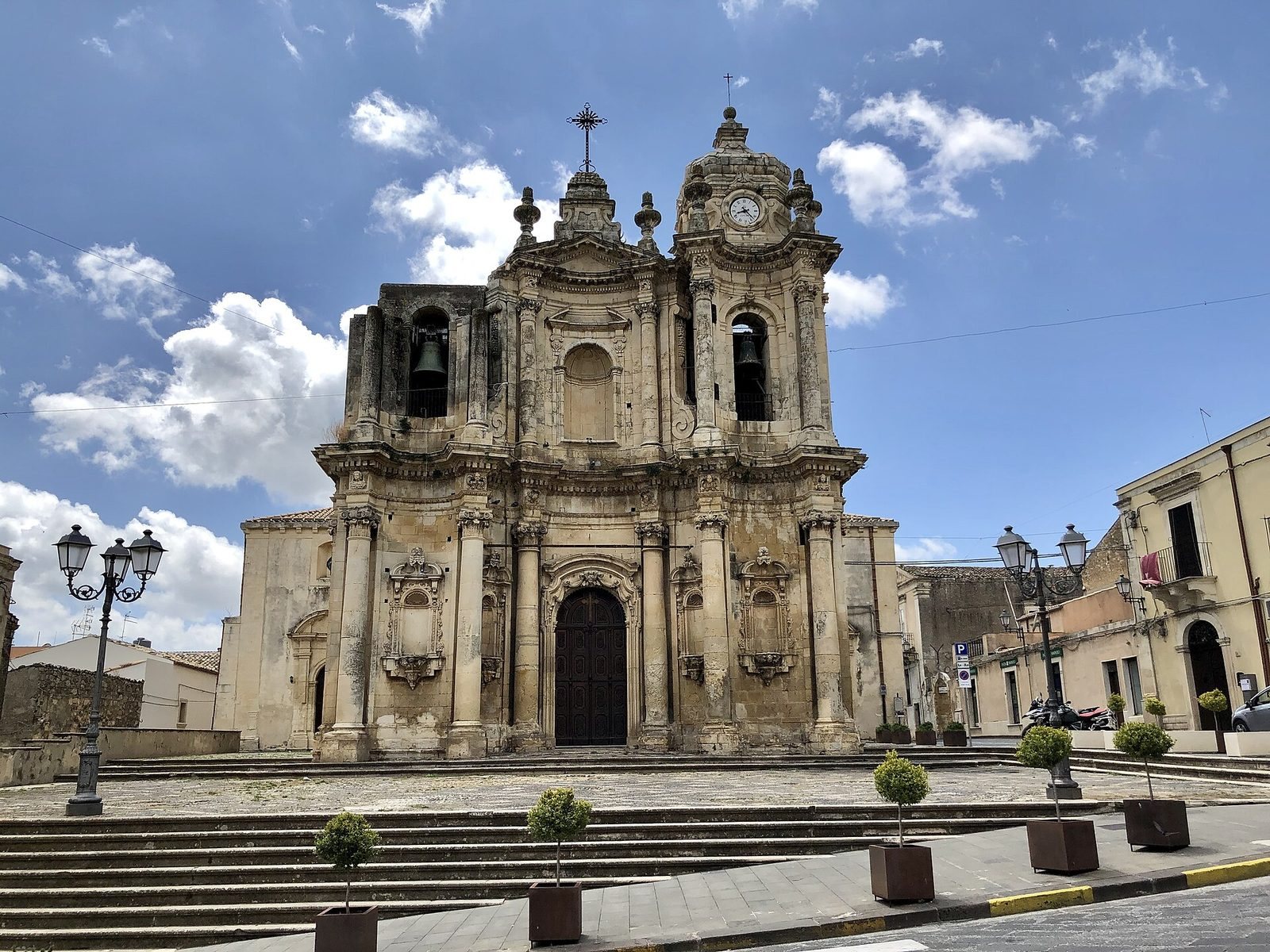
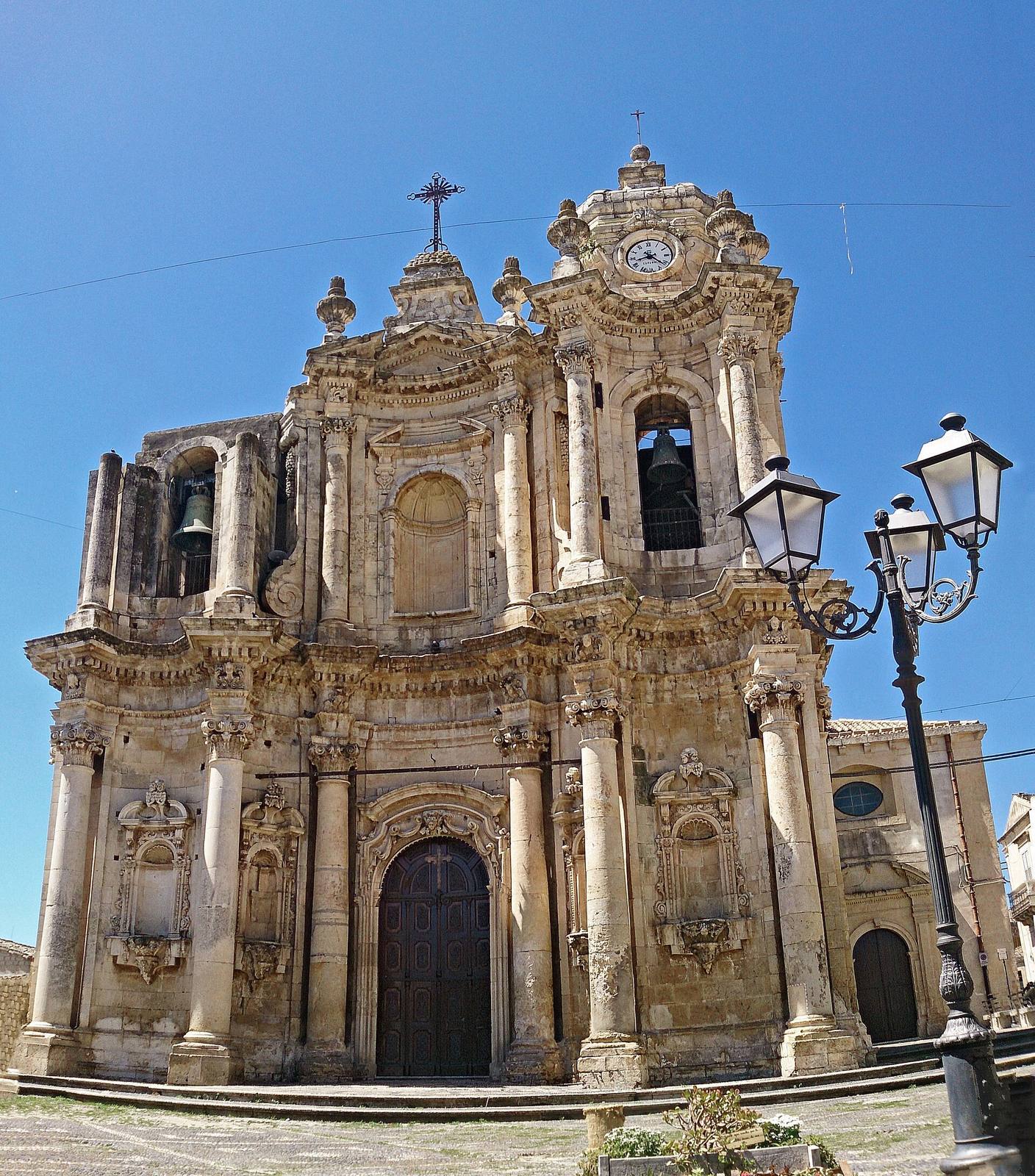
The façade is divided into three tall, concave sections, with paired columns arranged in semicircles emphasizing the recessed center. Ionic columns with Corinthian-style capitals rise from massive bases across its first two levels. The only entrance is the central portal, set between the inner columns and crowned by a curtain-like ornament beneath an arched pediment, a shaped architectural crown. Framed niches occupy the façade and its outer recessed sections; their decoration includes scroll-shaped curls, shells, broken arched crowns, and pairs of childlike figures known as putti.
A projecting decorative band separates the first two levels. Its upper section carries geometric, plant, and human-form reliefs, while a large framed recess above it has panels and segmented divisions within. The façade’s crown combines overlapping concave forms, two large cup-shaped ornaments, and a pyramidal pinnacle decorated with scrolls and topped by an iron cross with radiating details. Large scrolls and garlands flank the composition.
Bell towers
The towers have single-window openings on their sides. The right-hand tower retains a small square, bulbous dome with clipped corners and a pointed top. Circular openings in its base are arranged for clock faces, and a mechanical clock sits above the entrance-facing side. Two cup-shaped ornaments crown its cornice. The left-hand tower is ruined following its collapse in the 1908 earthquake, which also damaged the adjoining façade.
Dome and interior
Dome and main hall
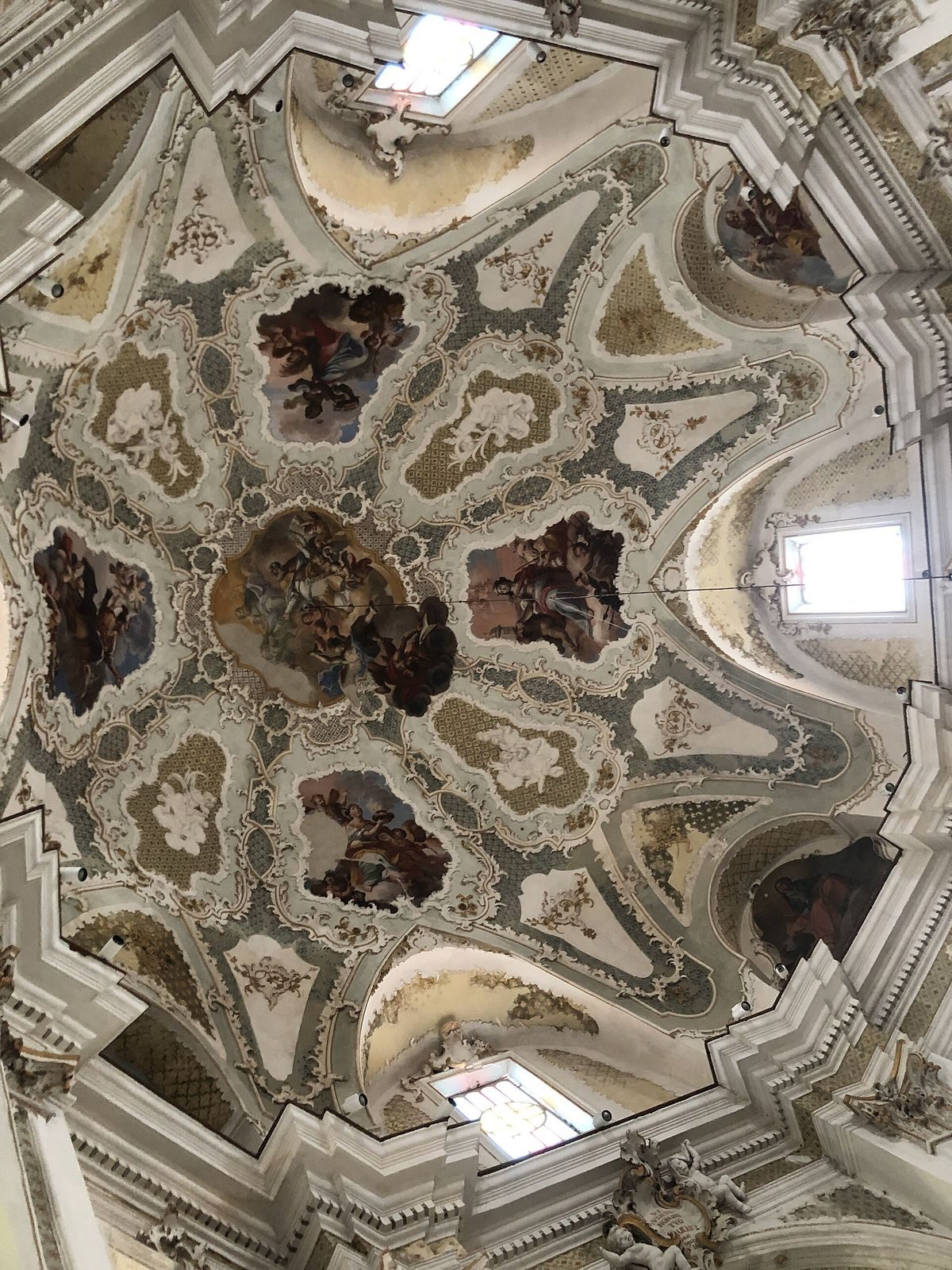
An octagonal dome rises over the crossing, the central space where the arms of the church meet. Inside, Giuseppe Crestadoro’s fresco depicts the Triumph of Saint Anthony across the four continents of the world, divided into four sections. Decorative bands and colored plasterwork are attributed to an artist associated with the Serpotta school, known for sculpted plaster decoration. Sculpted details chiefly represent the Four Evangelists, the traditional authors of the four Gospels.
The interior has three chapels on the arms of the cross and four more set along the axes between them. Two additional chapels, each with an altar, and two oratories are also part of the interior arrangement. The main hall has elaborate plasterwork, a series of frescoes and paintings, and plaster and wooden statues. Fourteen plaster sculptures portray allegorical virtues, including Fortitude, Justice, Prudence, Temperance, Charity, Faith, and Hope. Eight stand beneath the dome, while three pairs frame the altars in the cross’s arms. Above the arch leading toward the sanctuary, angels and putti hold a large scroll bearing a Latin inscription.
High altar
The high altar is made of multicolored marble, with columns supporting a broken arched crown. In the semi-domed recess at the church’s end, a radiating ornament surrounds a dove representing the Holy Spirit; angels occupy the upper ledges, and a childlike figure holding a scroll stands at the center. Two statues flank the altar. Crestadoro’s 1777 altarpiece depicts Saint Anthony disputing with the Arians, early Christians whose teachings differed from the Nicene belief in Christ’s full divinity. A niche behind the altar contains a wooden statue of Saint Anthony Abbot made in 1741 and covered with gold leaf.
Chapel of Our Lady of the Dying
In the right arm, this chapel has a Baroque composition crowned by a broken pediment decorated with crenellations. A central figure of God the Father is surrounded by angels. The small shrine contains an altarpiece showing Our Lady of the Dying.
Chapel of the Assumption of Mary
The chapel in the left arm has a broken arched crown containing a plaster group called the Glory of the Redeemer. Putti praise the scene, while angels recline on the ledges above. The altar holds an Assumption painting by an unidentified artist, and a recess behind it contains a wooden statue of the Virgin of the Assumption.
Chapel of Saint Michael
The chapel dedicated to Saint Michael the Archangel has an altar with a small, temple-shaped marble structure. Behind a painting of Michael is a wooden statue depicting the leader of the heavenly hosts.
Chapel of the Holy Crucifix
In the left chapel arranged around the central space, a papier-mâché crucifix stands over a painting of the Virgin Mary and Saint John the Evangelist. The marble altar structure is shaped like a columned temple and topped by a small dome.
Chapels near the entrance
The chapel on the right has an altar with a painting of the Resurrection. Opposite it, the Chapel of the Virgin also has an altar with a painting.