Noul Neamț Monastery: An Orthodox Monastic Complex in Chițcani, Moldova
Site at a Glance
- Popularity
- Medium
- Country
- Moldova
- Primary era
- Modern
- Eras represented
- Modern
- Civilizations
- Russian
- Site type
- Religious
- Remains
- Monastery
On this page18 sections
History
Noul Neamț Monastery is an Orthodox monastic complex in Chițcani, Moldova, founded in 1864 by monks who had left Neamț Monastery in Moldavia. Its churches combine Neo-Byzantine forms with decorative features of Moldavian architecture. The monastery is Moldova’s largest religious architectural complex and the largest monastery of the Moldovan Orthodox Church by number of monks; it is also an unofficial symbol of Transnistria.
Founding and establishment
The founders objected to the confiscation of monastic estates and the adoption of Romanian, rather than Church Slavonic, for worship. In 1861, ten monks left Neamț with their confessor, Andronik, and 22 others joined them later. The Chițcani and Copanca estates had been granted to Neamț in 1429 by Alexander the Good, a medieval ruler of Moldavia. Ottoman authorities later confiscated the land, which Russian authorities returned to the monastery in 1860. The monks reached Chițcani in December 1862. Before establishing themselves there, they lived in two houses beside a church in Nemțeni.
On 25 January 1864, Russian Emperor Alexander II approved a plan for a cenobitic monastery, where monks share worship, meals, and property. The Most Holy Governing Synod, the Russian Orthodox Church’s central body under the Russian Empire, approved the foundation on 17 February. The community was to follow Neamț’s prayer rule and remain connected with Neamț and Secu, two historic Orthodox monasteries in Moldavia. Those monasteries were also to be consulted about the choice of its superior. The monks’ request for lavra status, a distinction granted to certain monasteries, was refused. Teofan was elected superior in April 1864 and formally appointed abbot the following year.
Expansion and leadership
The community took over Chițcani’s parish church of St Nicholas in 1865 and soon began a major building campaign. Teofan traveled to Russian cities to seek donations. Local opposition arose when the monastery took over part of the village, and the Bessarabian governor responded by forcibly removing residents and demolishing their homes.
In 1875, the Synod removed Teofan from his post after judging his handling of construction funds unsatisfactory. He remained influential among the monks and continued to raise money. After his death in 1884, Andronik became superior and carried on the expansion. Archbishop Paul of Chișinău provided substantial financial help, including 93,013 rubles for buildings and the water supply. Under Andronik’s successor, German, development continued, and the community established a missionary center led by graduates of the Kyiv Theological Academy.
Romanian rule and the world wars
At the outbreak of the First World War, 47 monastery residents were conscripted into the Russian army. Another 21 men who had not yet taken permanent monastic vows were called up afterward. In 1918, Bessarabia, the region between the Prut and Dniester rivers, joined Romania. The monastery came under the Romanian Orthodox Church, and Romanian became its liturgical language. Romanian authorities confiscated some of its property, leaving the monks with 50 hectares of arable land and 35 hectares of orchards and gardens.
The community numbered 103 monks and novices in 1929 and 159 in 1936. Some departed with superior Melchizedek when he was transferred to Neamț that year. In 1939, the monastery was honorarily named for Romanian Patriarch Miron, who belonged to the same family as Teofan.
During the Second World War, Bessarabia passed from Soviet to Romanian control in 1941, then returned to the Soviet Union in 1944. A Soviet air raid in 1942 set the Ascension Cathedral alight. During the 1944 fighting around the nearby Chițcani bridgehead, the bell tower became a command post for the Soviet 3rd Ukrainian Front, a military formation active on the southern front.
Soviet rule, closure, and revival
After the Soviet annexation, the monastery again fell under the Russian Orthodox Church. Soviet authorities seized most of its land, along with its hospital, mill, and workshops. In 1945, superior Auxentius was forced out and sentenced to ten years in a labor camp. The authorities accused him of giving money to the Romanian army and sending 30 monks and valuable church furnishings to Romania before the Soviet advance. He died in the camp. The community also resisted Soviet demands to restore Church Slavonic as its language of worship.
A Soviet decree in 1946 ordering the return of previously confiscated monastic lands helped the monks sustain the community through their work. Under Gregory in the 1950s, the monastery briefly prospered, developing its farm and orchards and drawing pilgrims again. As many as 3,000 people attended its annual feast. In 1957, seven young monks went to Saharna Monastery to help prepare it for monks arriving from Finland. By 1960, Noul Neamț had 160 monks and novices and two retired bishops.
Soviet authorities decided to close the monastery in 1959. Monks were gradually sent away, and the community was dissolved on 16 May 1962. The buildings became a tuberculosis hospital, sports hall, club, and military museum, while churches were used for storage. Some icons and the most valuable relics were taken to St Theodore Tiron Cathedral in Chișinău. The library holdings went to the State Archives there.
The Dormition church reopened as a parish in 1989. In 1990, Patriarch Alexy II decreed the restoration of the monastic community, led by Bishop Vincent of Bender and Dorimedont, its first restored superior. Theological studies began at the monastery that year, and the school became a seminary in 1991. A leadership dispute led to the seminary’s transfer to Chișinău in 2001. Bishop Justinian of Tiraspol and Dubossary arrived with a Cossack unit and police but was refused entry. A proposed mediation by Moldovan President Vladimir Voronin failed when Transnistrian border guards prevented him from entering the region.
In 1992, during the war in Transnistria, monks assisted Moldovan soldiers. A shell struck the bell tower but did not explode. Dorimedont established a dependent skete, a smaller monastic settlement linked to a larger monastery, for Saints Vincent and Dorimedont about six kilometres away in 1993. He also initiated a second skete dedicated to St George; it became an independent monastery in 1998. Eight men who had lived as monks at Noul Neamț founded a monastery at Zăbriceni in 1999. Dorimedont became a bishop in 1998 and appointed Paisius as his successor at Noul Neamț.
The monastery remains under the authority of the Metropolitan of Chișinău, a senior bishop, although it lies within the Diocese of Tiraspol and Dubossary, an administrative district of the church. Since 1995, the Metropolitan of Chișinău has held the honorary position of superior. Services are conducted in both Romanian and Church Slavonic.
Remains
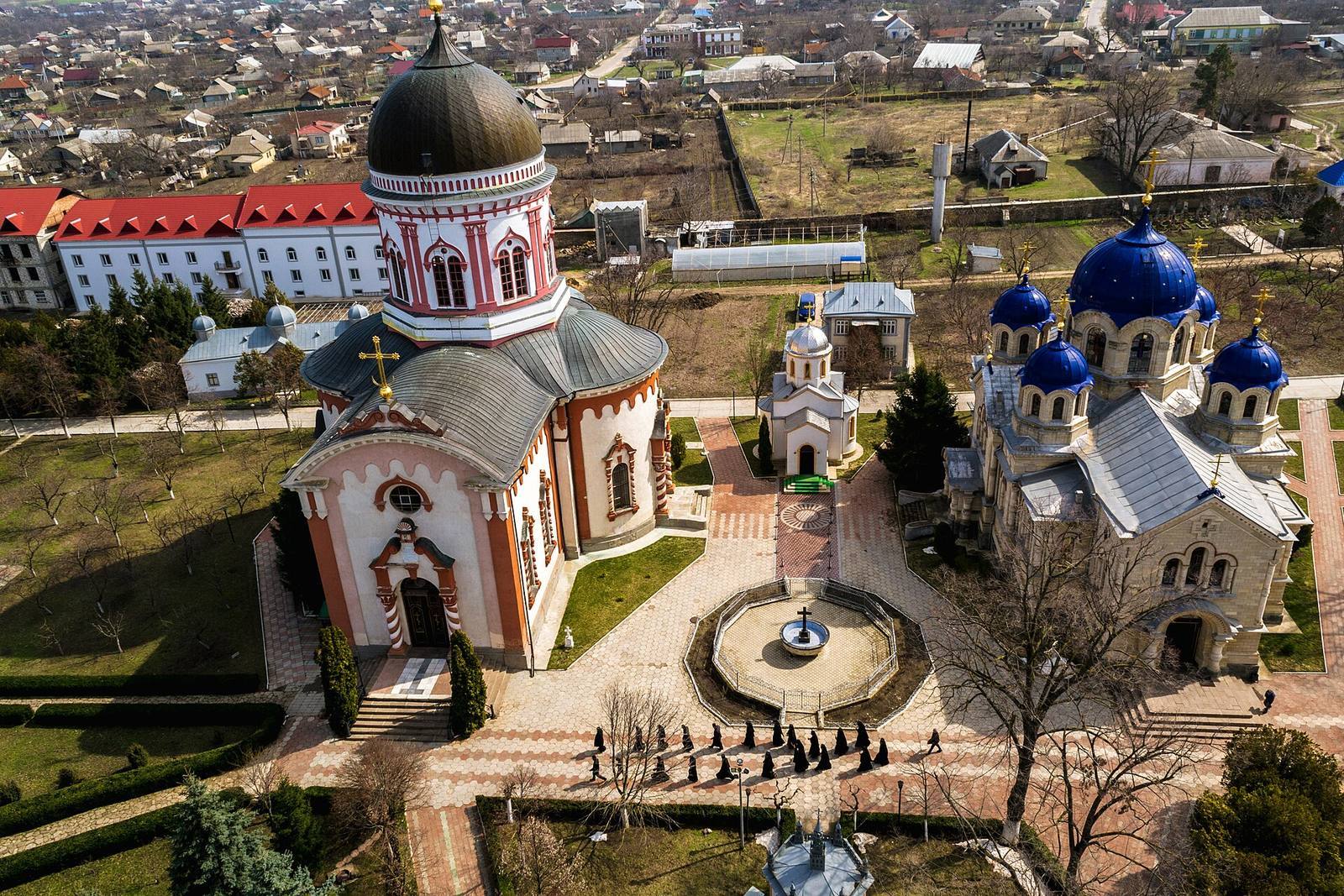
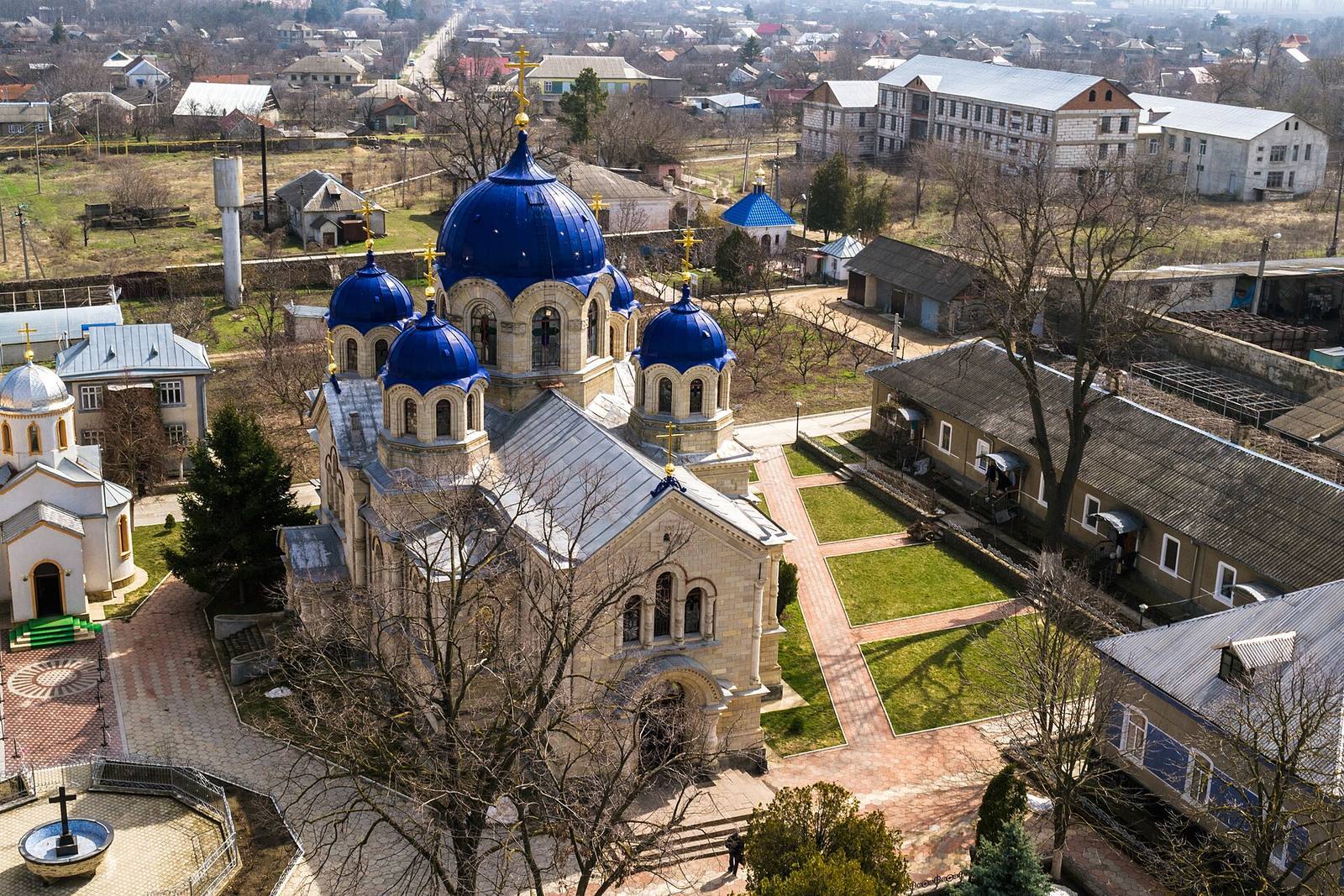
The monastery occupies a low rise in central Chițcani on the right bank of the Dniester. Its brick buildings bring together monumental churches with residential and service structures. Four principal churches form the heart of the complex, with other buildings, a surrounding wall, and grounds that include chapels and a linden avenue.
Churches
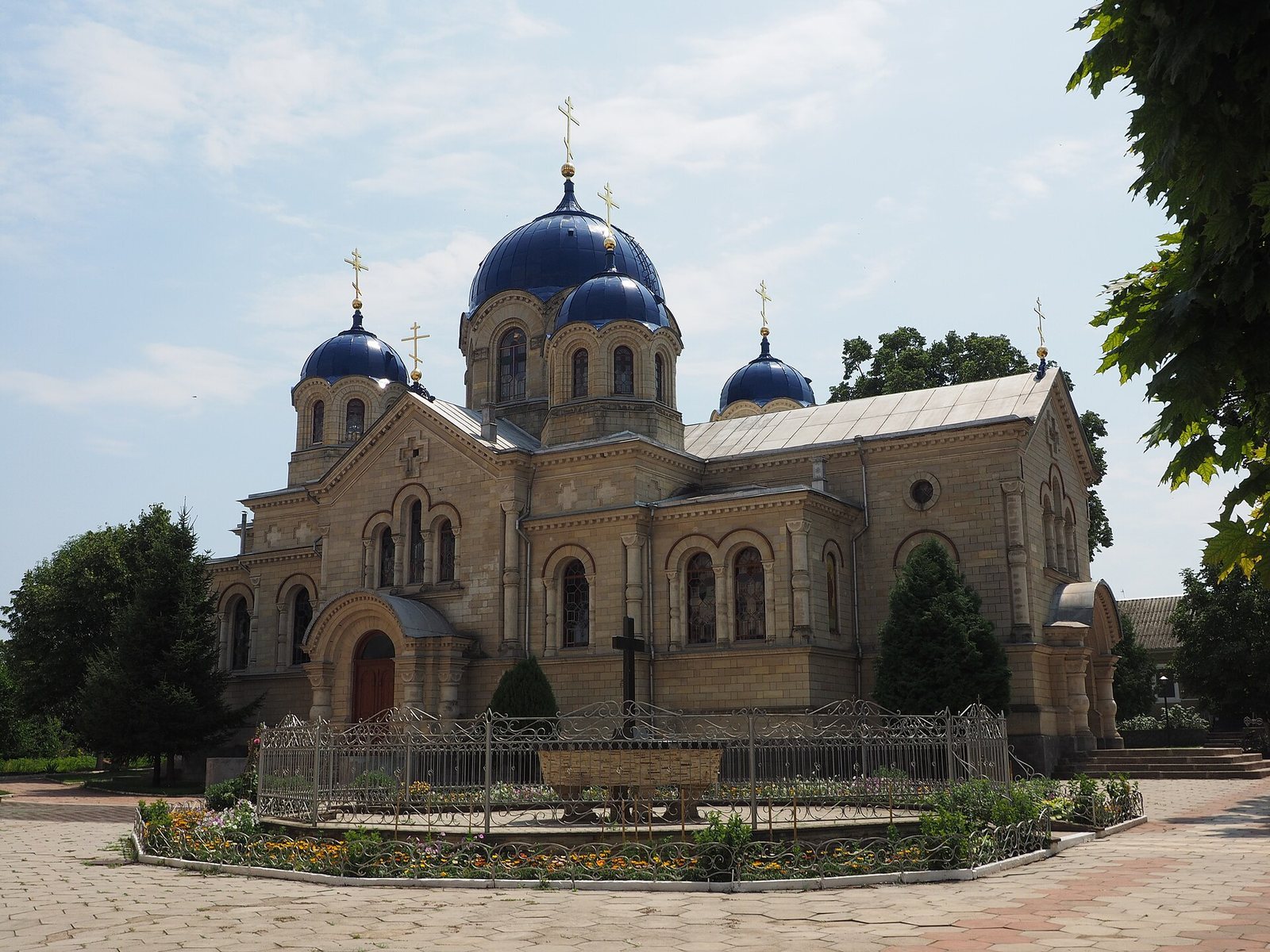
Ascension Cathedral
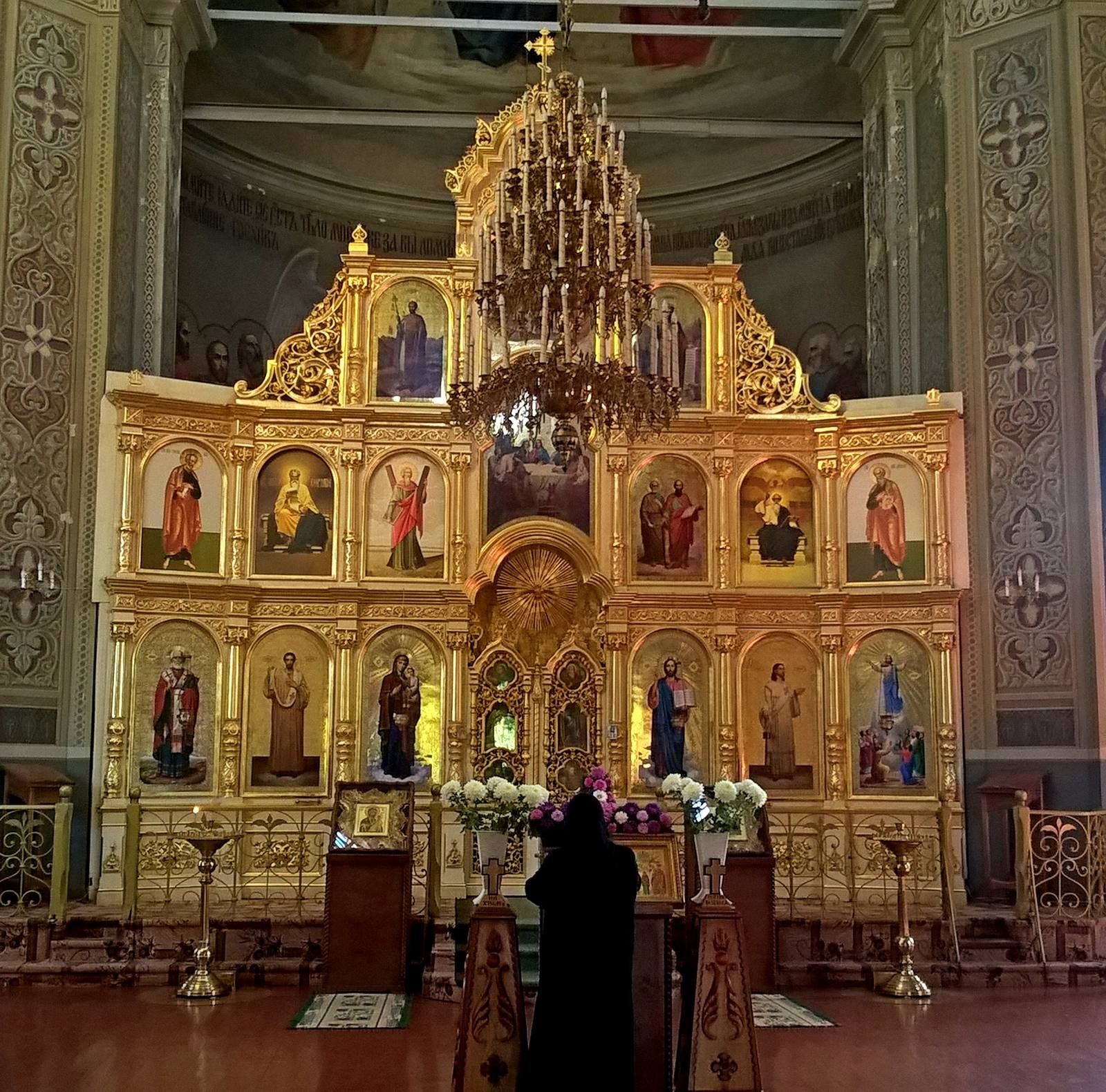
Construction of the Ascension Cathedral began in 1867, and it was consecrated in 1878. It serves as the monastery’s summer church and has a three-tier iconostasis, a screen of icons separating the sanctuary from the main worship space. The cathedral was repaired after the 1942 fire. Graves beneath it were looted and desecrated after the monastery closed.
Dormition church
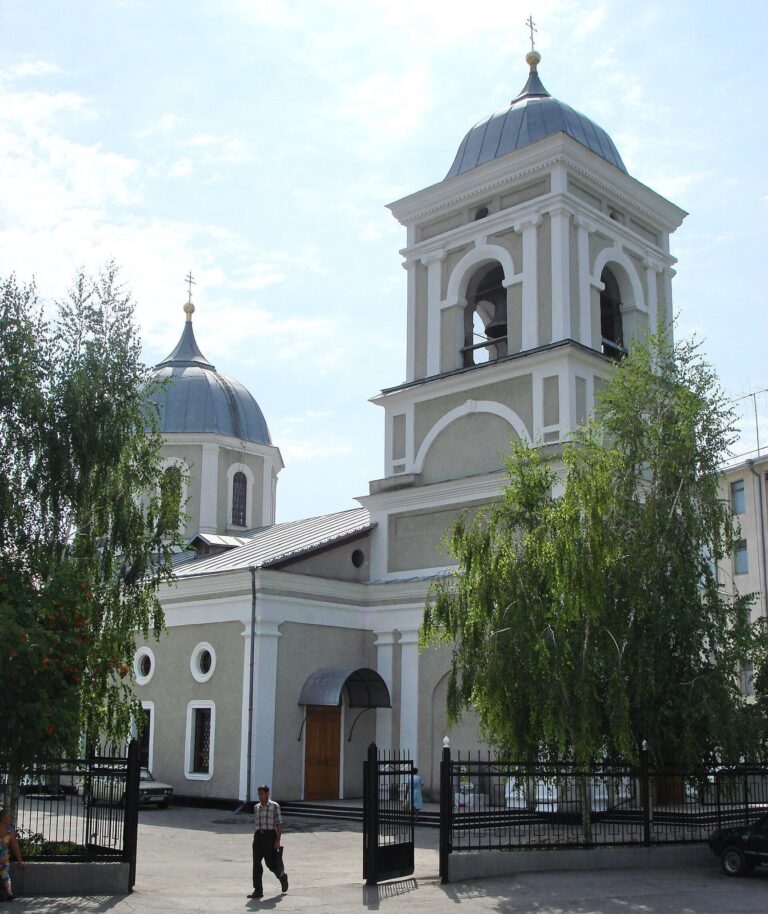
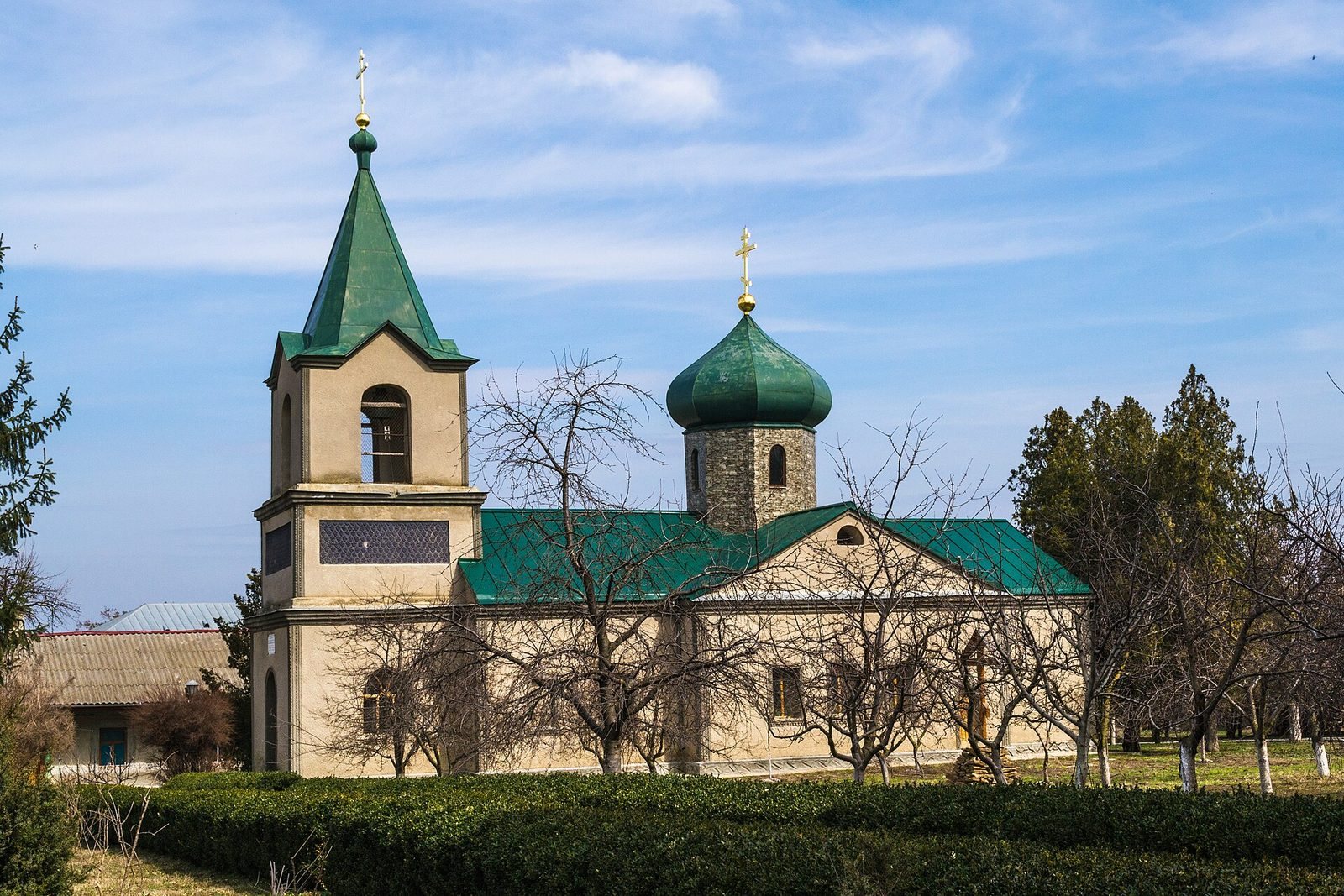
The Dormition church, named for the Orthodox feast commemorating the Virgin Mary’s death and bodily assumption, was built from 1902 to 1905 as the winter church. During the monastery’s closure, it served as a store for medicines. A linden avenue leads to the church.
St Nicholas church
Built from 1830 to 1834 as a parish church, St Nicholas predates the monastery. Its late Moldavian design includes a two-tier neoclassical iconostasis, based on the architecture of ancient Greece and Rome. The church is associated with the seminary. After the monastery closed, its roof collapsed; it was repaired and reconsecrated in 1991.
Church of the Exaltation of the Holy Cross
Built in the late nineteenth century, the Church of the Exaltation of the Holy Cross serves as the refectory church, a church associated with a monastery’s communal dining hall.
Bell tower
Designed by Alexander Bernardazzi and built from 1913 to 1914, the bell tower rises 69 metres across five tiers. It was the tallest structure of its kind in Bessarabia. Following its restoration in 1994, twelve bells were installed, including one that weighs 8.7 tonnes.
Enclosure and service buildings
A wall around the complex was constructed from 1882 to 1883 with a 20,000-ruble grant from the Russian Ministry of Foreign Affairs. Other buildings included a hospital, a library, a stone kitchen, two monk residences, a mill, and a workshop building. The monastery also had a water supply. Its present facilities include an icon-painting workshop and a printing press.
Library and museum
In 1884, the library held 2,272 printed books in several languages and 146 manuscripts in Church Slavonic, Moldavian (Romanian), and Greek. The restored library building now houses a museum on the monastery’s history. The monastery library retains documents, miniatures, and old books dating from the fifteenth to nineteenth centuries.
Chapels and sacred objects
Chapels
A chapel dedicated to the miraculous Noul Neamț icon was begun in the monastery grounds in 1994 for the Small Blessing of Waters, an Orthodox rite for blessing water. A separate chapel is dedicated to the Protection of the Mother of God. Dorimedont was buried there.
Icons
A Romanian-made copy of the Mother of God of Noul Neamț, based on the image venerated at Neamț, is kept at the monastery. The monastery grounds also include a church museum.
Relics and devotional objects
The monastery’s relics include a silver-gilt cross containing a fragment of the True Cross, a piece of stone from the Holy Sepulchre, and relic fragments of Saints Modest of Jerusalem and Charalampius. Patriarch Cyril II of Jerusalem gave these objects to the monastery in 1866. In 1881, Patriarch Joachim III of Constantinople presented a reliquary containing relic fragments of various saints.
A staff belonging to Paisius Velichkovsky, an eighteenth-century Orthodox monk and monastic reformer associated with Neamț, was given to the monastery in 1994. It is kept in the altar area of the Dormition church and brought out for major ceremonies. Dorimedont also oversaw the making of a reliquary in 1997 containing relic fragments of many saints, particularly monks associated with the Kyiv Pechersk Lavra.