San Damiano: Franciscan Church and Former Convent near Assisi
Site at a Glance
- Popularity
- Very High
- Country
- Italy
- Primary era
- Medieval
- Eras represented
- Medieval, Early Modern, Modern
- Civilizations
- Papal States
- Site type
- Religious
- Remains
- Monastery
On this page14 sections
History
San Damiano is a Catholic church and former convent south of Assisi, Italy, whose origins are placed in the sixth or seventh century; the church’s masonry construction dates to the twelfth century. Its history became closely bound to Francis of Assisi and Clare of Assisi.
Early history and Francis
In 1205, tradition says that Francis was praying at San Damiano when Christ called on him three times to repair the ruined church. Francis sold cloth belonging to his father and began restoring the building. He later understood the appeal as a call to renew the wider Catholic Church as well.
Francis established a monastery beside the church and settled Clare and her first companions there. He also used San Damiano as a retreat from the activity of Assisi, composing the Canticle of the Creatures there in 1224–1225.
Clare’s community
Around 1212, Clare founded the first community of the Order of Saint Clare, a contemplative women’s order in the Franciscan tradition. Its earliest members were called Damianites, and the community later became known as the Poor Clares. Clare’s sister Agnes and their widowed mother joined them.
Clare died at San Damiano in 1253. The community stayed until 1260, when the convent was exchanged with the canons of San Rufino, clergy attached to Assisi’s cathedral, for the chapel of San Giorgio. Clare was buried in the Church of San Giorgio.
Catholic tradition connects Clare’s life at the convent with miracles, including bread multiplying, oil being provided, exorcisms and healings, and attackers fleeing from the cloister, a covered walkway around a courtyard. In another tradition, Pope Gregory IX, head of the Catholic Church from 1227 to 1241, asked Clare to bless loaves, and crosses appeared on them.
Franciscan memory and recognition
After Francis died, his funeral procession stopped at the convent so that the Poor Clares could say farewell. San Damiano remains a pilgrimage site associated with both Francis and Clare. Its relative preservation, together with that of the nearby Franciscan hermitage Eremo delle Carceri, has been regarded as offering insight into Francis’s simple, solitary life close to nature.
San Damiano forms part of the UNESCO World Heritage property Assisi, the Basilica of San Francesco and Other Franciscan Sites, inscribed in 2000. The church is associated with the Friars Minor, the male Franciscan order, through the Seraphic Province of Saint Francis of Umbria and Sardinia, a regional administrative division. It also belongs to the Diocese of Assisi-Nocera Umbra-Gualdo Tadino, a church territory overseen by a bishop.
Remains
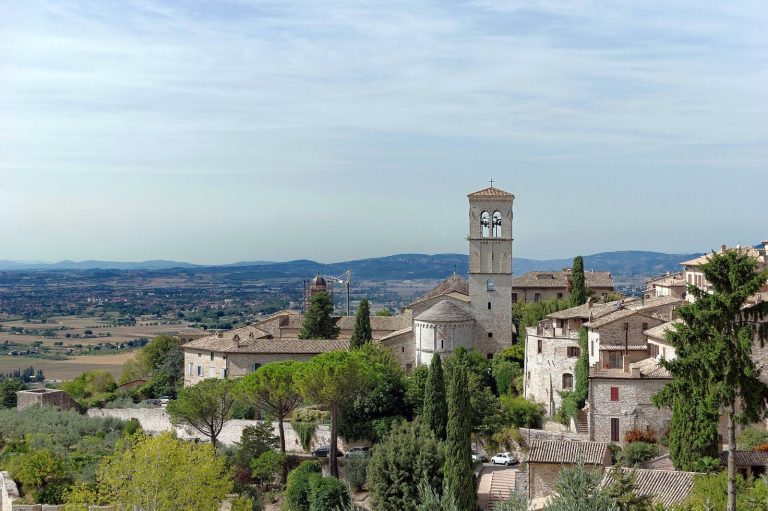
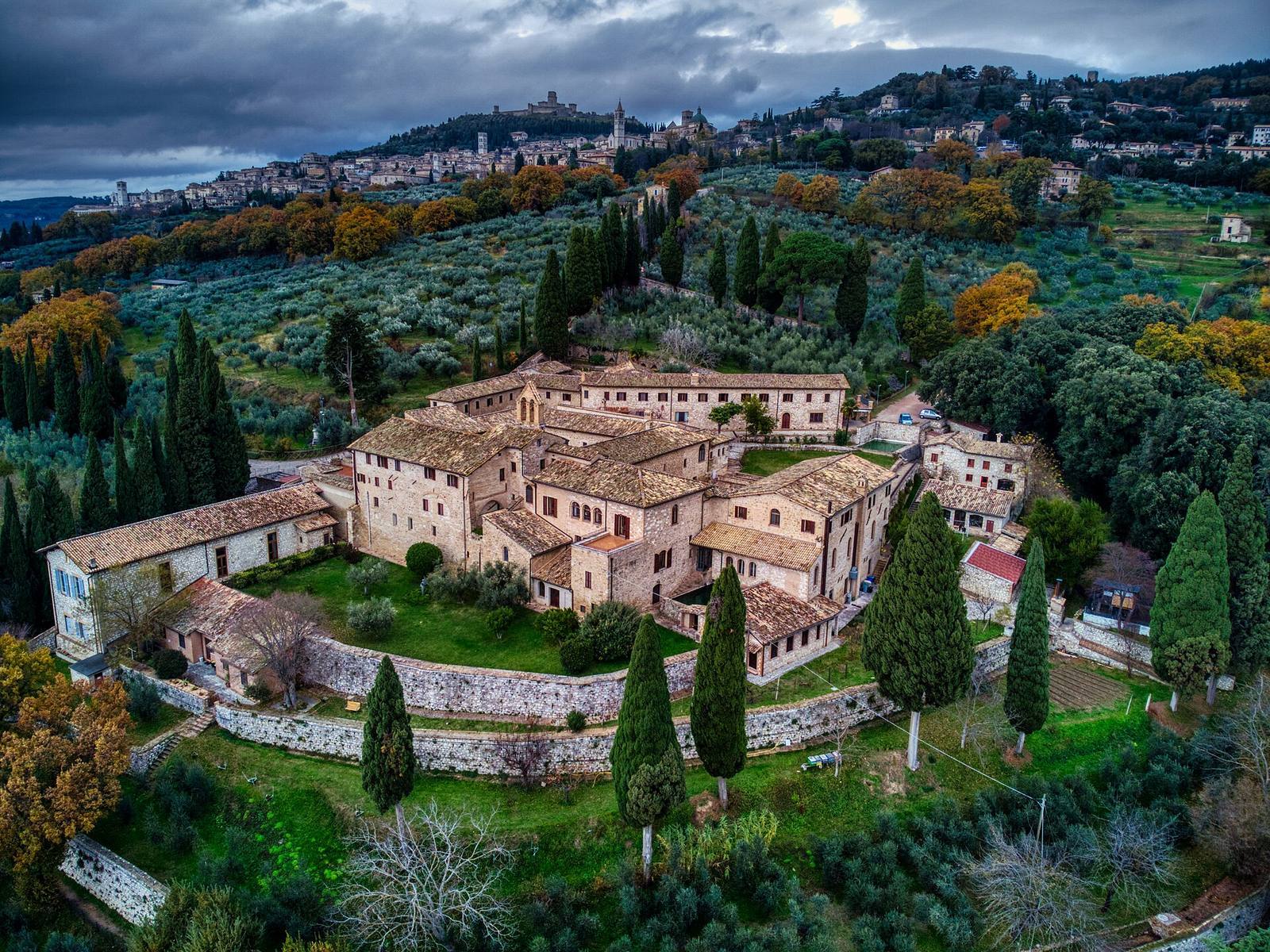
The church and former convent stand among fields and olive trees south of Assisi, and much of the complex retains its earlier character. The church, adjoining rooms, and convent buildings form a connected group, with a stairway beside the altar leading toward the cloister and courtyard.
The church
Façade and nave
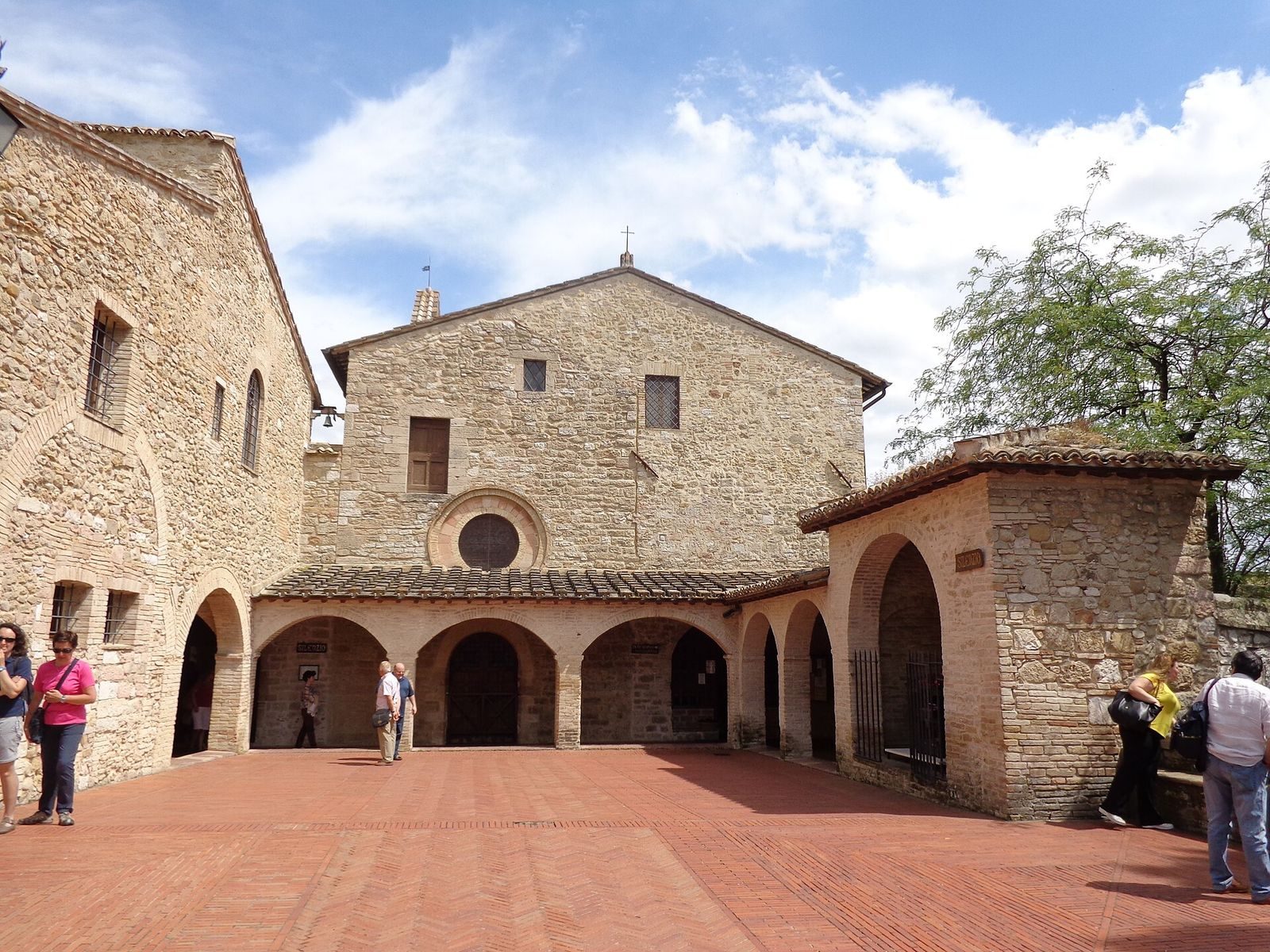
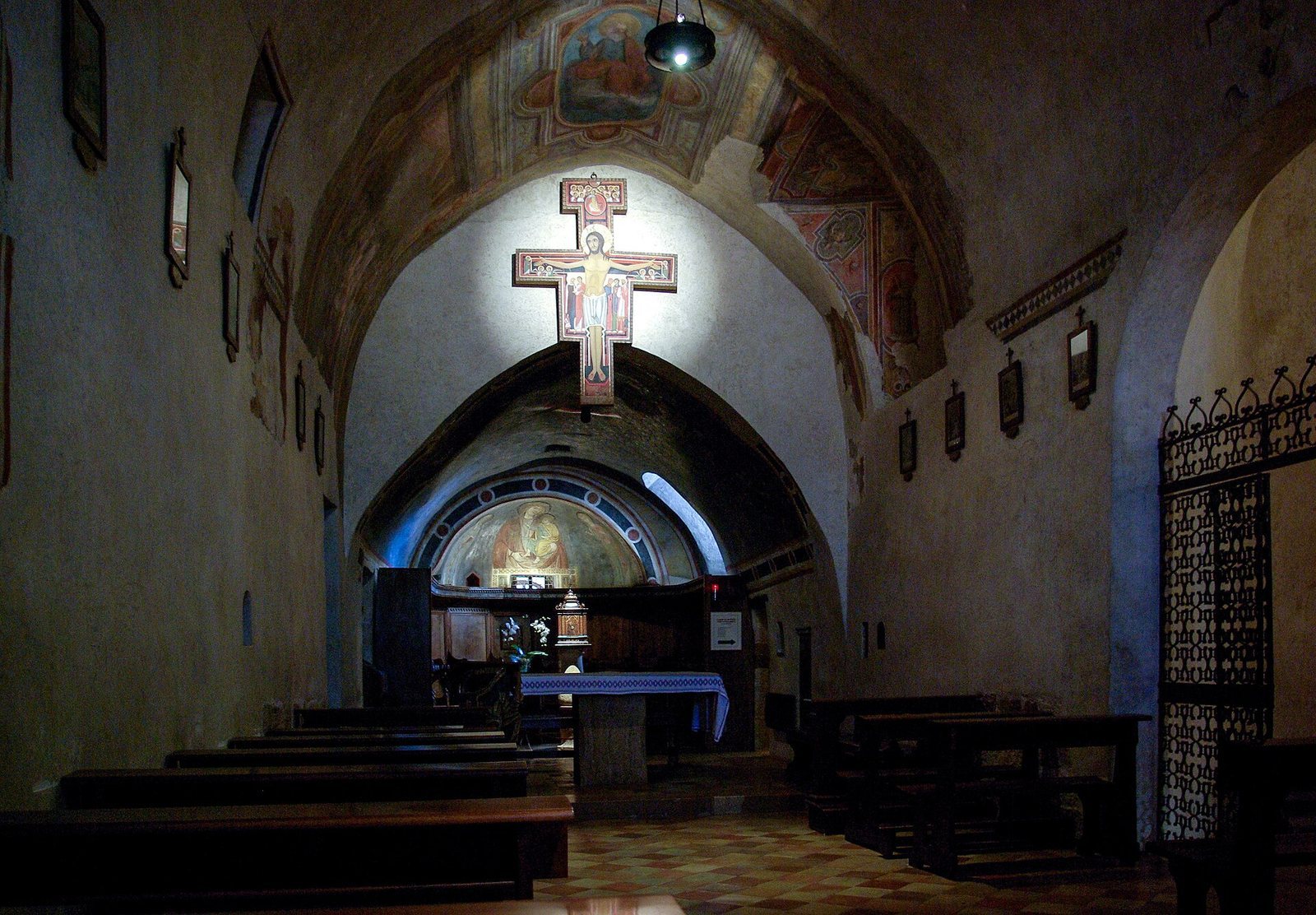
The church façade sits within a larger gabled frontage. A low porch at the entrance has three round arches supported by brick piers, with a rose window, a circular window, above the central arch. Inside, the single nave, or main body of the church, is covered by a pointed barrel vault, a curved ceiling with a pointed profile.
Side chapels
A rectangular chapel opens from the nave’s right wall halfway along its length. Its altar holds a wooden crucifix made and signed by Innocenzo da Petralia in 1637. The separate Chapel of Saint Jerome stands to the right of the entrance vestibule; its wall paintings date to 1520 and were made by Tiberio d’Assisi.
Apse
The nave ends in a deep apse, the recessed end of the church, whose ceiling is lower than the nave’s. It contains a modern stone high altar, a wooden tabernacle, a receptacle for the consecrated Eucharist, and the monks’ choir. A fourteenth-century wall painting shows the Virgin Mary and Child between Saints Rufinus and Damian.
Paintings and the San Damiano crucifix
Fragmentary wall paintings at the start of the nave include a figure representing God, an episode from Clare’s life, and grotesque figures around a recessed window. Vincenzo Giorgetti painted them in 1591. Other church paintings, including scenes from Francis’s life, date to the early fourteenth century. The original San Damiano crucifix is now in the Basilica of Saint Clare in Assisi; a copy stands on the arch above the apse. Christ is shown with open arms and without an expression of suffering, almost upright on the cross.
Organ
The pipe organ was built in 1957 by the Tamburini firm of Crema. Balbiani Vegezzi-Bossi restored it and installed a new console in 1989. Its electric action uses electrical mechanisms to operate the controls. The instrument has 17 stops, or sets of pipes, two keyboards, and a pedalboard played with the feet.
The former convent
Cloister and communal rooms
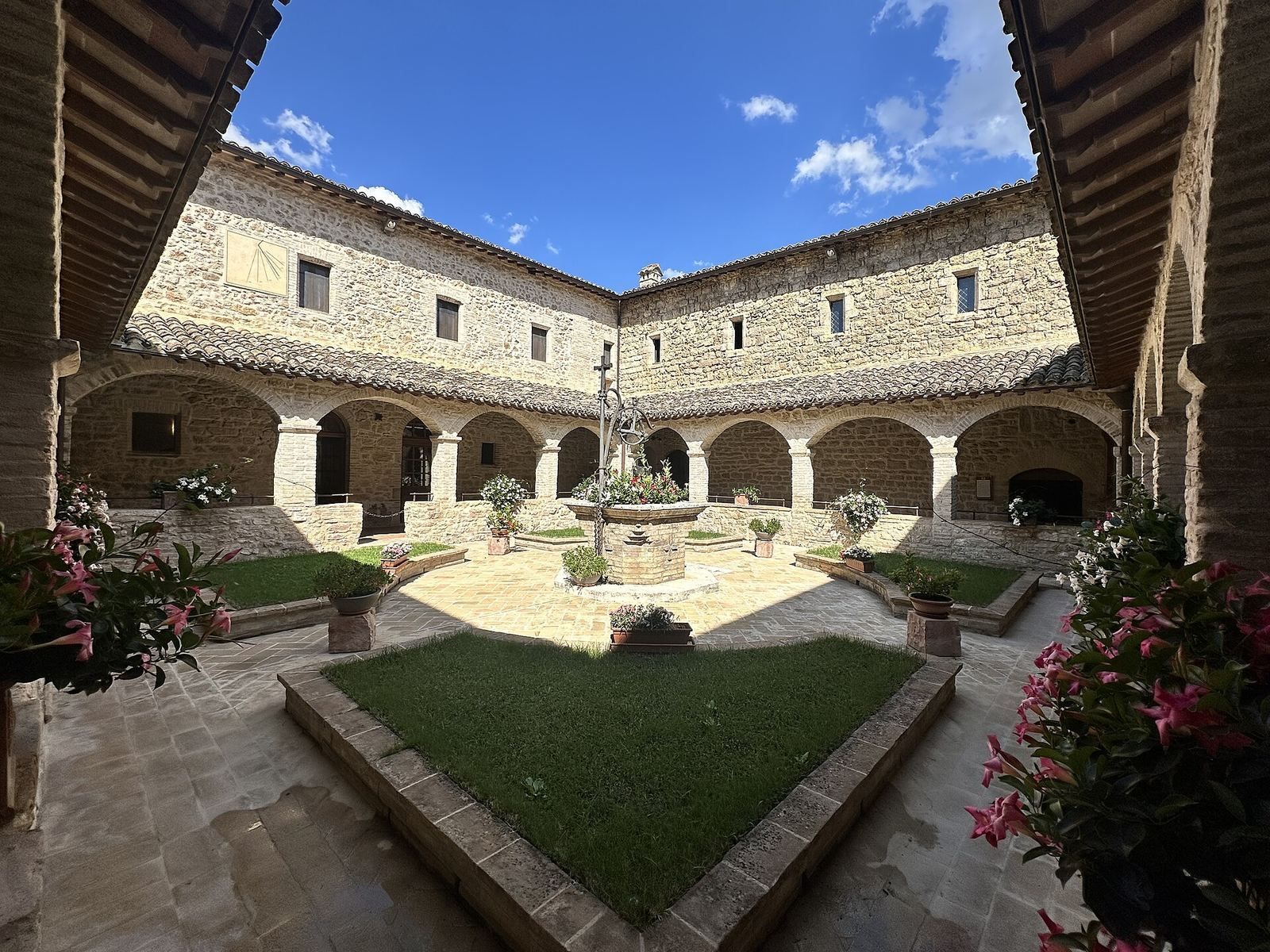
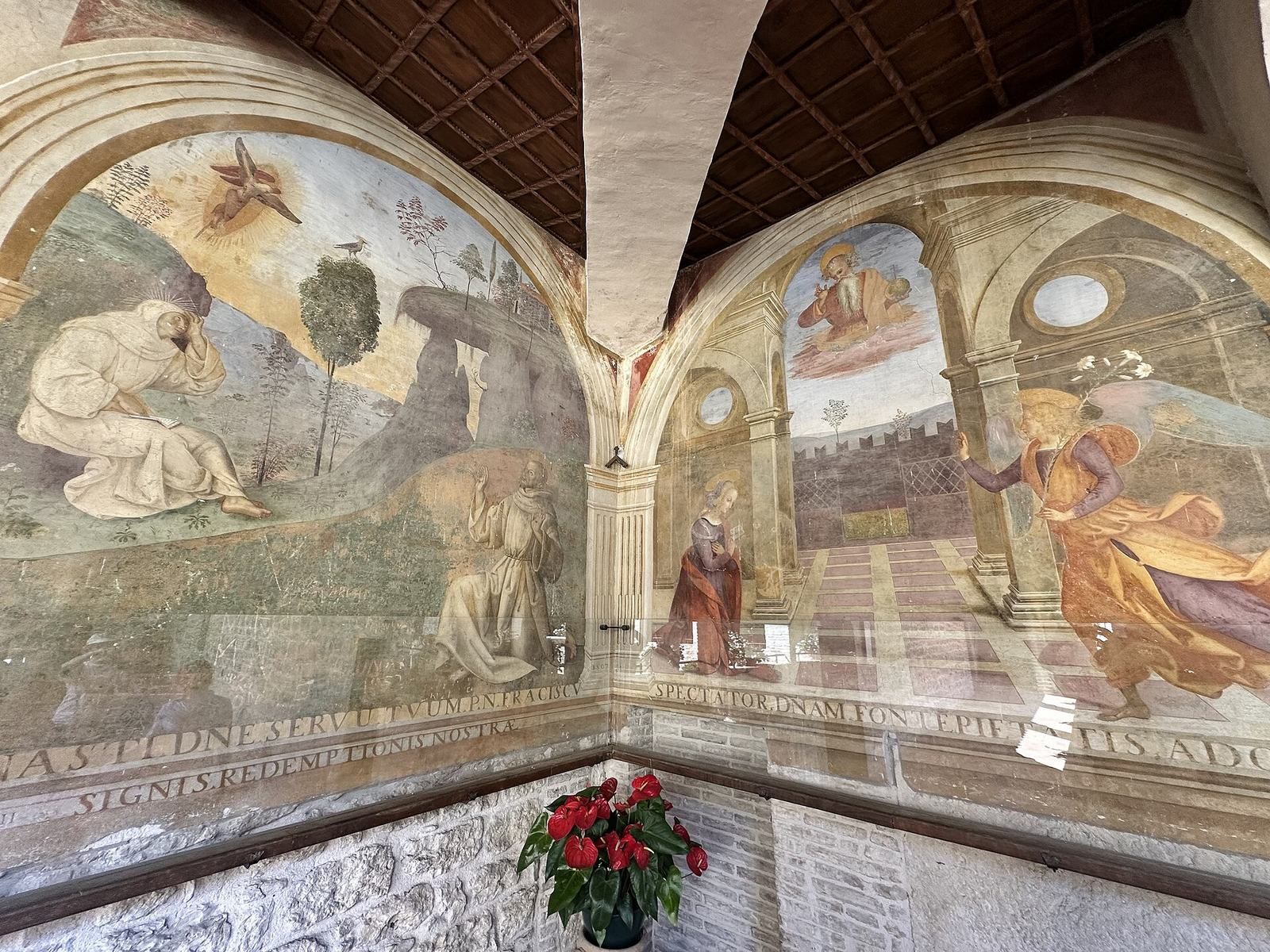
A stairway to the right of the altar leads to the cloister, courtyard, and other convent buildings. A 1482 wall painting of the Crucifixion by Pier Antonio Mezzastris stands along the stairway. The cloister has wall paintings by Eusebio da San Giorgio dated 1507. The refectory, or communal dining room, retains much of its original condition and contains paintings by Dono Doni.
Clare’s Oratory and dormitory
Upstairs, Clare’s Oratory, a small place of prayer, held the Blessed Sacrament, the consecrated Eucharist. The dormitory is beside it, and a cross marks the place where Clare died.