Aleksin Kremlin: A Fortified Precinct in Russia
Site at a Glance
- Popularity
- Low
- Country
- Russia
- Primary era
- Modern
- Eras represented
- Early Modern, Modern
- Civilizations
- Russian
- Site type
- Military
- Remains
- Citadel
On this page12 sections
History
The Aleksin Kremlin was a fortified central precinct in Russia, first established probably in the 13th century as a wooden watch fortress associated with the Principality of Tarusa. Its defenses and later rebuilding reflect Aleksin’s position on the Oka during centuries of conflict along Russia’s southern frontier.
Early defenses
The first fortress stood on Ilyinskaya Hill, about 2 km from the present city center. An earlier settlement of the Vyatichi, an East Slavic tribal group, occupied the hill. In 1348, Tatar forces led by Temur, a murza or Tatar noble and military leader, attacked. The fortress held, although the settlement outside its defenses was burned. In 1361, Algirdas, the Grand Duke of Lithuania, devastated Aleksin.
Moscow rule and the Battle of Aleksin
By the early 15th century, the fortress had become part of the Principality of Moscow. In 1472, Khan Akhmat of the Great Horde, a polity that succeeded the Golden Horde, besieged it during the Battle of Aleksin. A small garrison with few firearms resisted for several days before the fortress burned. The timing is uncertain. It may have burned before troops sent by Ivan III, Grand Prince of Moscow, and his brothers arrived from Kolomna. The defense may have helped the Russians prevail on the left bank of the Oka, allowing the arriving troops to stop Akhmat’s army from crossing. Alternatively, Aleksin may have burned after the Russian troops reached the area, while forces watched from the opposite bank.
Rebuilding and military conflict
Soon after 1472, a new wooden fortress was built about 2 km from the first, on a triangular promontory where the Mordovka meets the Oka. In 1521, Crimean Tatars under Khan Mehmed-Giray, ruler of the Crimean Khanate, attacked it. The Right Hand Regiment, a senior Muscovite army formation named for its position on the army’s right wing, was permanently stationed at Aleksin and ranked second in importance in the Russian state.
In 1607, government troops under Vasily Shuisky besieged and captured the fortress, where supporters of the Bolotnikov uprising had taken control. In 1611, Zaporizhian Cossacks, a military community associated with the lower Dnieper, captured and burned Aleksin while fighting for the Polish-Lithuanian Commonwealth, a state formed by the Polish Crown and the Grand Duchy of Lithuania. The fortress was rebuilt after the Time of Troubles, a period of political crisis and conflict in Russia in the early 17th century.
Renewal and decline
In 1654, Paul of Aleppo, an Orthodox archdeacon and travel writer, described a large wooden fortress on a hill and a second adjoining enclosure below it. The Kremlin was renewed in 1656-1658. In the 1680s, its deteriorated defenses were rebuilt, with an outer wooden stake wall replaced by a wall assembled from log sections. The precinct also housed a military governor’s compound, an administrative office, a prison, a powder magazine, and other state buildings.
As Russia’s southern frontier advanced, Aleksin’s defenses lost their strategic value. A major fire destroyed the fortifications in 1768. The Aleksin Kremlin is now designated a cultural heritage site of federal significance in Russia.
Remains
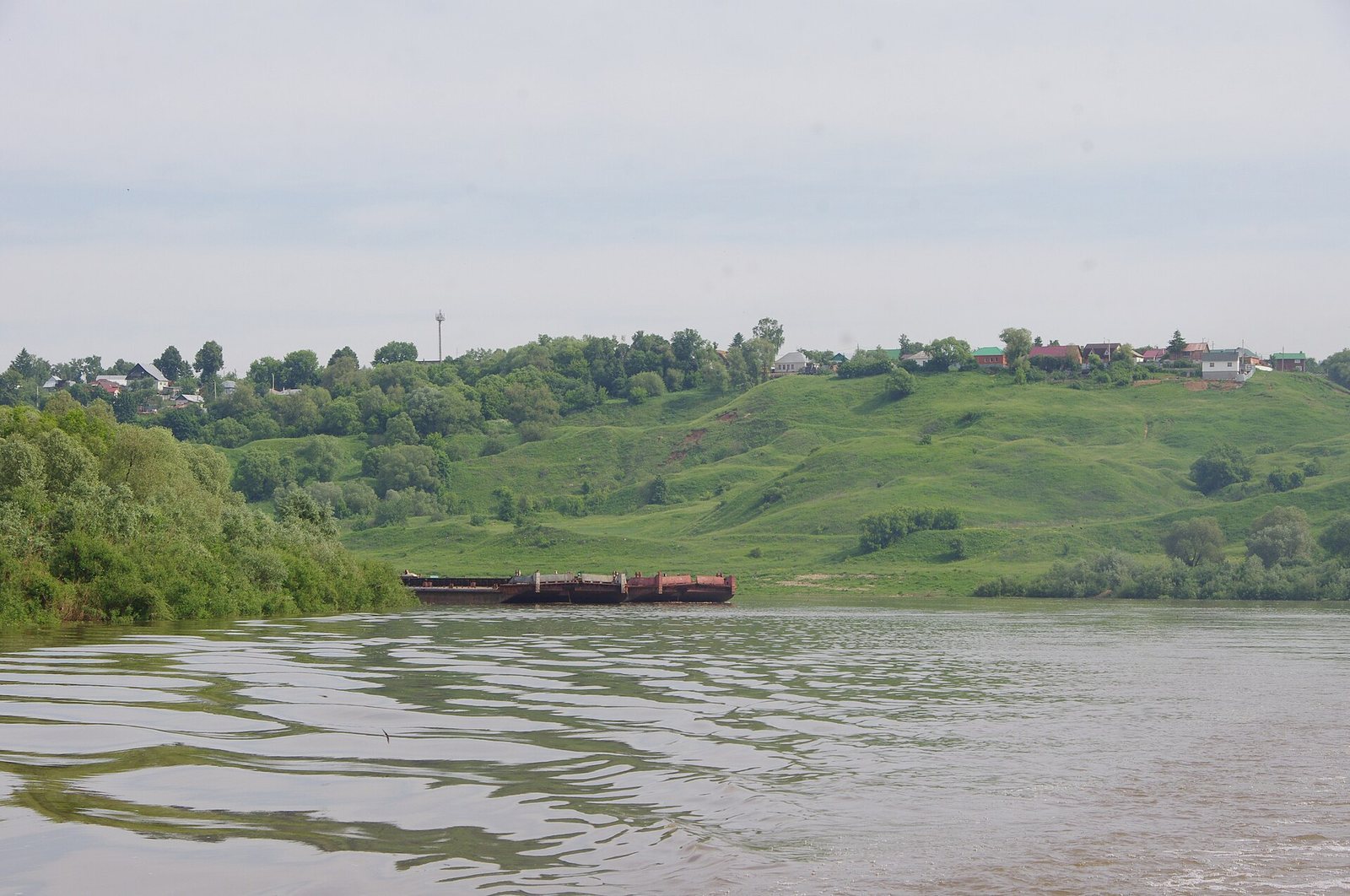
The remains relate to two defensive sites: the earlier hilltop fortress on Ilyinskaya Hill and the later Kremlin on the southern bank of the Oka. The first occupied elevated ground, while the later precinct developed as a timber enclosure with towers and gates, alongside a separate enclosure protecting its water supply.
The first hillfort
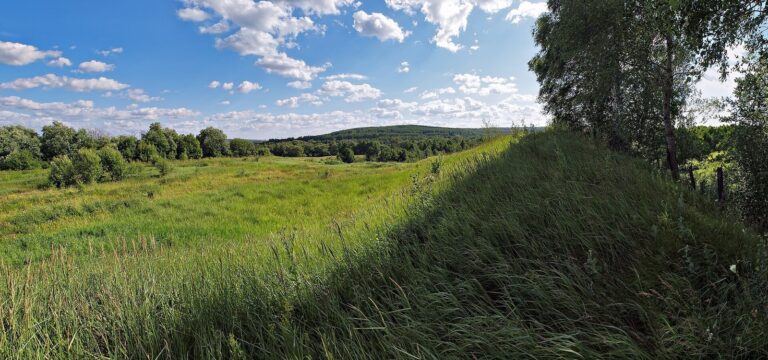
The first site is an archaeological hillfort, a settlement or fortified place on elevated ground. Its trapezoid-shaped plan measures between 25 and 75 m by 40 m. Quarrying has substantially damaged the site, though parts of a ditch survive on its northern and eastern sides. A memorial stone marks the location of the old fortress.
The later Kremlin enclosure
Timber defenses and earthworks
The later fortress’s first enclosure had seven towers, including two gate towers and a signal tower, with walls extending 817 m. In the 1656-1658 layout, the trapezoid-shaped Kremlin was surrounded by a wooden palisade, a defensive wall of stakes, 543.5 m long. An adjoining wooden enclosure had 273 m of walls and guarded the water sources. The rebuilding in the 1680s retained seven towers, two with passage gates. Its main entrance occupied the only hexagonal tower, at the southeast corner; another gate stood in a tower on the Oka side.
Excavated wall and ditch
In the northeastern part of the later hillfort, excavation exposed a fortress wall made from horizontally laid logs and dated to the 15th-16th centuries. A ditch can also be traced along the Kremlin’s northern side.
The brick Assumption Cathedral
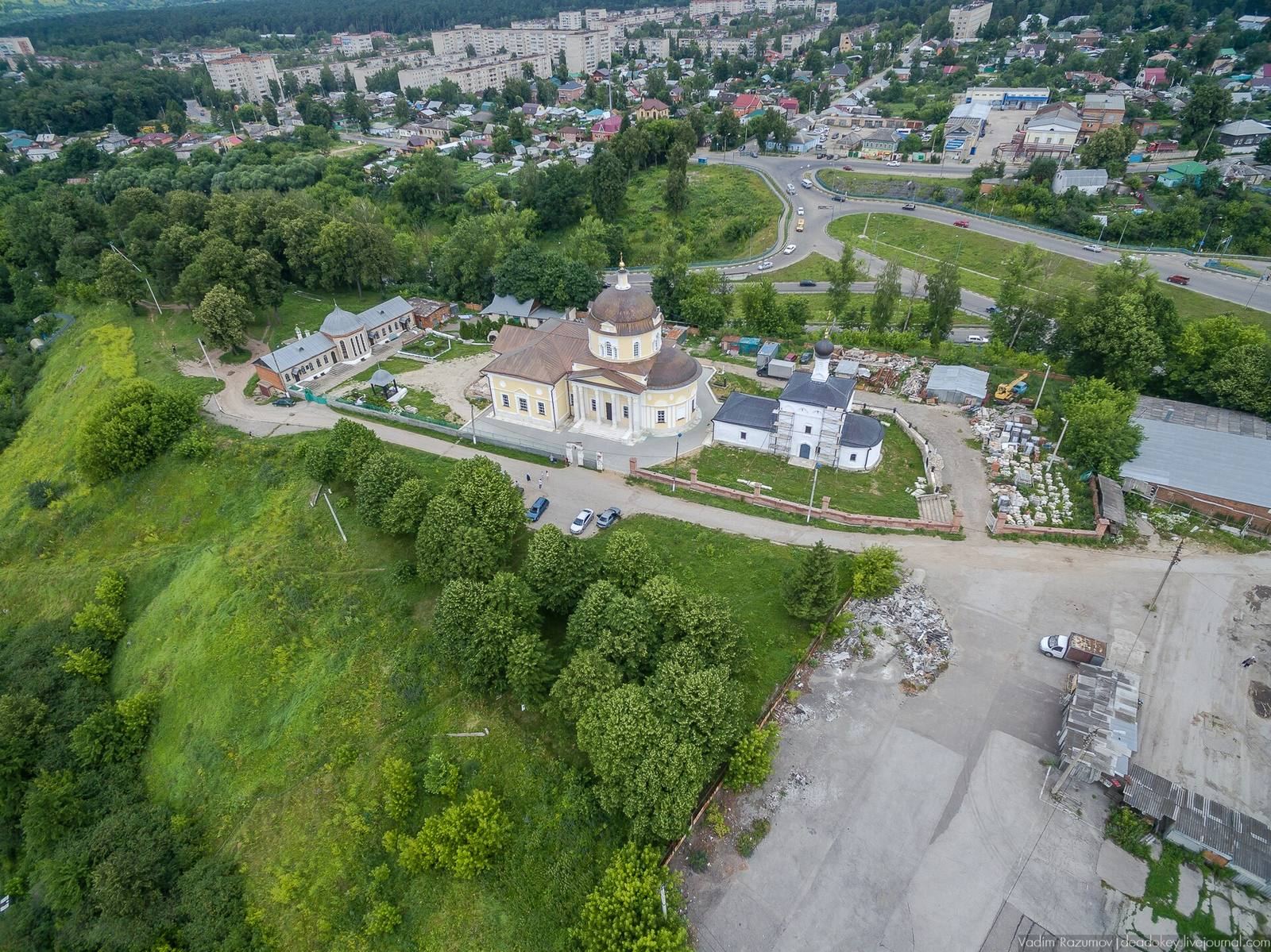
The brick Assumption Cathedral, built in 1688 to replace a wooden church, survives within the Kremlin. It was the city’s first stone building. The Assumption is the Orthodox feast commemorating the Virgin Mary’s death and bodily assumption into heaven.
The later cathedral and bell tower
A second Assumption Cathedral was built beside the older building in 1806-1812 in the Classical style, which draws on ancient Greek and Roman forms. A bell tower was added in 1829.