Rostislavl-Ryazansky: A Medieval Fortified Town in Russia
Site at a Glance
- Popularity
- Medium
- Country
- Russia
- Primary era
- Medieval
- Eras represented
- Iron Age, Medieval
- Civilizations
- Golden Horde
- Site type
- City
On this page9 sections
History
Early occupation and foundation
Paleolithic sites are known along the Oka’s right bank. In the first millennium BCE, a fortified settlement of the Dyakovo culture, a prehistoric culture of settlements in central Russia’s forest zone, occupied the ground later used by Rostislavl-Ryazansky.
The Nikon Chronicle credits Prince Rostislav Yaroslavich of Ryazan with founding the town in 1153. It says he established it beside the Oka and named it after himself. In May 1183, Rostislavl became a meeting place for Russian princes preparing a campaign against Volga Bulgaria, a medieval state along the Volga. Vsevolod the Big Nest, grand prince of Vladimir, led the campaign.
Political role in the Ryazan principality
A struggle over power in Ryazan shaped the town’s fortunes in the fourteenth century. In 1340, Prince Ivan Ivanovich Korotopol killed his relative Alexander Mikhailovich of Pronsk. Two years later, Alexander’s son Yaroslav received a charter granting him authority over the Ryazan principality from Jani Beg, khan, or ruler, of the Golden Horde, a Mongol successor state that governed much of the western Eurasian steppe. Yaroslav also received Tatar troops. After taking Pereyaslavl and driving out his uncle Ivan, he moved the capital to Rostislavl. He apparently did not wish to remain in a city captured with Tatar help. Rostislavl probably served as the capital until Yaroslav’s death in 1344.
Decline, abandonment, and later use
Moscow annexed the Great Principality of Ryazan in 1521, and Rostislavl lost its standing as a major center to nearby Zaraysk, where a brick fortress was built by 1531. During the conflict with Crimean Tatar forces, Rostislavl formed part of a line of Oka fortifications. It was probably devastated more than once and declined as a result. A geographical work compiled in 1627 still placed Rostislavl on the Oka but did not describe it as a town. Its worst devastation came during the Time of Troubles, a period of political crisis and conflict in Russia in the late sixteenth and early seventeenth centuries. A force led by ataman Zarutsky, a Cossack host leader, devastated the settlement. The town was abandoned during the seventeenth century.
Local peasants were cultivating the site in 1874. Gardens and, later, an apple orchard occupied it during the twentieth century. Large-scale archaeological work began in 1994, and since 2000 an annual expedition of the Institute of Archaeology of the Russian Academy of Sciences has worked there under V. Yu. Koval. Russia recognizes Rostislavl-Ryazansky as a cultural heritage site of federal significance.
Remains
Fortifications and settlement layout
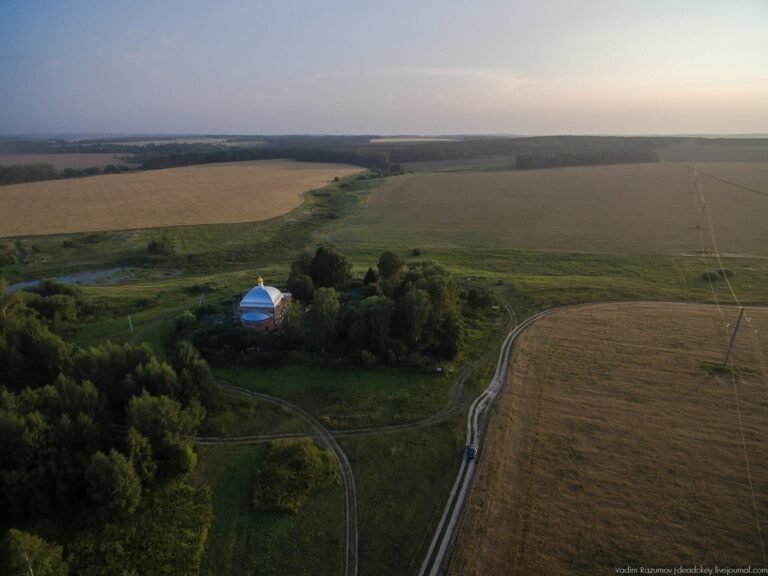
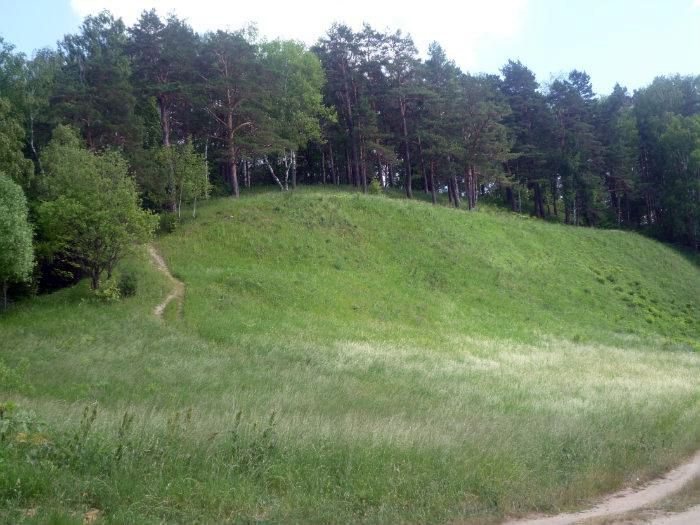
The remains occupy a promontory formed by the Oka’s high right bank and a ravine, near the modern village of Sosnovka. Its platform is close to triangular and stands 35–40 m above the river. A landward rampart, about 150 m long, runs from the slope toward the Oka valley and the ravine; the former fortress walls extended about 350 m in total. The rampart reaches 16 m across at its base and up to 5 m in height, with a ditch as wide as 15 m before it. The main gate pierced this rampart and was probably guarded by a wooden tower. Within the defenses, a small citadel, the principal fortified inner enclosure, occupied the promontory’s tip. A smaller rampart separated it from the outer town, which had the main gate and an outer rampart. An unfortified settlement lay beyond the defenses. In the late thirteenth century, the town’s earth-and-timber walls stood about 2 m high and were later made taller and wider. Woodland partly covers the site, while grass extends across most of the platform.
Archaeological finds
Inscribed stone cross
A fragment of a white-stone cross from before the Mongol period carries an inscription naming a person called Komlyata.
Inscribed pot
An excavated pot bears writing scratched into its clay while it was still wet. The maker used Cyrillic letters in a formal style resembling book writing. The writing and archaeological context place the pot no later than the first half of the thirteenth century. Its incomplete message appears to present the vessel from an unknown giver to an otherwise unidentified Yuri, and to curse anyone who stole it.
The warning recalls a motif in a traditional East Slavic heroic song about the hero Danube. In the song, an inscription on a drinking cup forbids others to drink from it and threatens death for anyone who disobeys. Related examples include an eleventh-century ceramic storage jar from Kyiv and a toast cup belonging to Vladimir Davydovich, prince of Chernihiv from 1139 to 1151. A birch-bark basket from Novgorod, inscribed in the first quarter of the twelfth century, names its owner and writer and curses anyone who bewitches it.