Schloss Oberrain: A Former Farm and Tavern in Unken, Austria
Site at a Glance
- Rating
- 5
- Popularity
- Very Low
- Country
- Austria
- Eras represented
- Early Modern
- Civilizations
- Holy Roman Empire
- Site type
- Domestic
- Remains
- Manor House
On this page8 sections
History
Farm, tavern, and estate
Schloss Oberrain is an estate in Unken, Austria, first recorded as a farm in the fourteenth century. By about 1400, the farm and a tavern stood in separate buildings. The license to serve as an inn was first attached to the farm and later transferred to the tavern. The property was known as the Seidlgut after the Seydl family, who lived there until the mid-sixteenth century.
Georg Entgruber owned the property by 1564. In 1575, the farm and tavern were sold separately; Konrad Leyrer, an innkeeper in Unken, later reunited them. The estate then passed through the Leyrer family to the family of Matheus Metzger, which held it for about 200 years. Nikolaus Rainer acquired it in 1819. The Archbishopric of Salzburg, an ecclesiastical territory ruled by an archbishop, retained manorial authority over the estate until 1848. This authority gave the landholder rights over the property.
Despite its name and castle-like appearance, Schloss Oberrain was never an aristocratic residence. It is grouped among Salzburg’s castles because of its appearance and elevated position.
Spa and institutional use
By 1890 the estate had become a well-known spa. Johann Mayergschwenter and Johann Stainer acquired it that year, but it passed to German fertilizer manufacturer Hermann Schmidtmann within about six months. He renovated the building in 1891, giving it the appearance it retains.
Schmidtmann’s daughter, Florence von Poser, inherited the estate in 1923 and later became heavily indebted. In 1940, the National Socialist People’s Welfare, a Nazi-era welfare organization, requisitioned the property and made it a convalescent home for mothers. After the Second World War, the headquarters of the U.S. 101st Airborne Division, an American military formation trained for airborne operations, briefly occupied the building. It was then returned to von Poser.
The Salzburg provincial government acquired the property in 1956 and renovated and enlarged it for use as a children’s convalescent home, holiday camp, and youth training center. Since 1960, a rehabilitation association has operated there, helping young people with disabilities prepare for greater independence in working and private life. The current operator is anderskompetent GmbH, a limited-liability company. The Austrian Republic has protected Schloss Oberrain as a monument since 1993.
Remains
Setting and main building
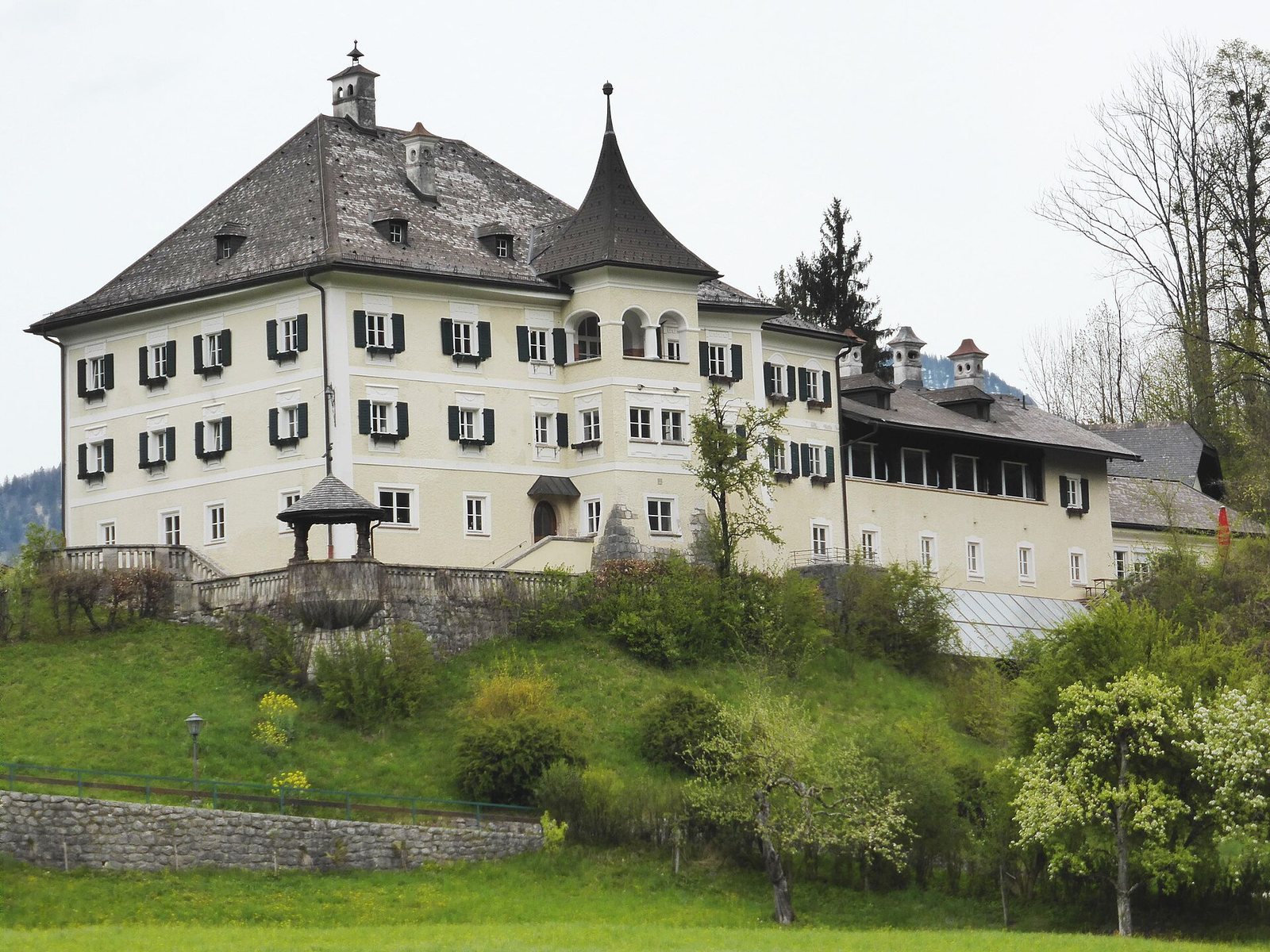
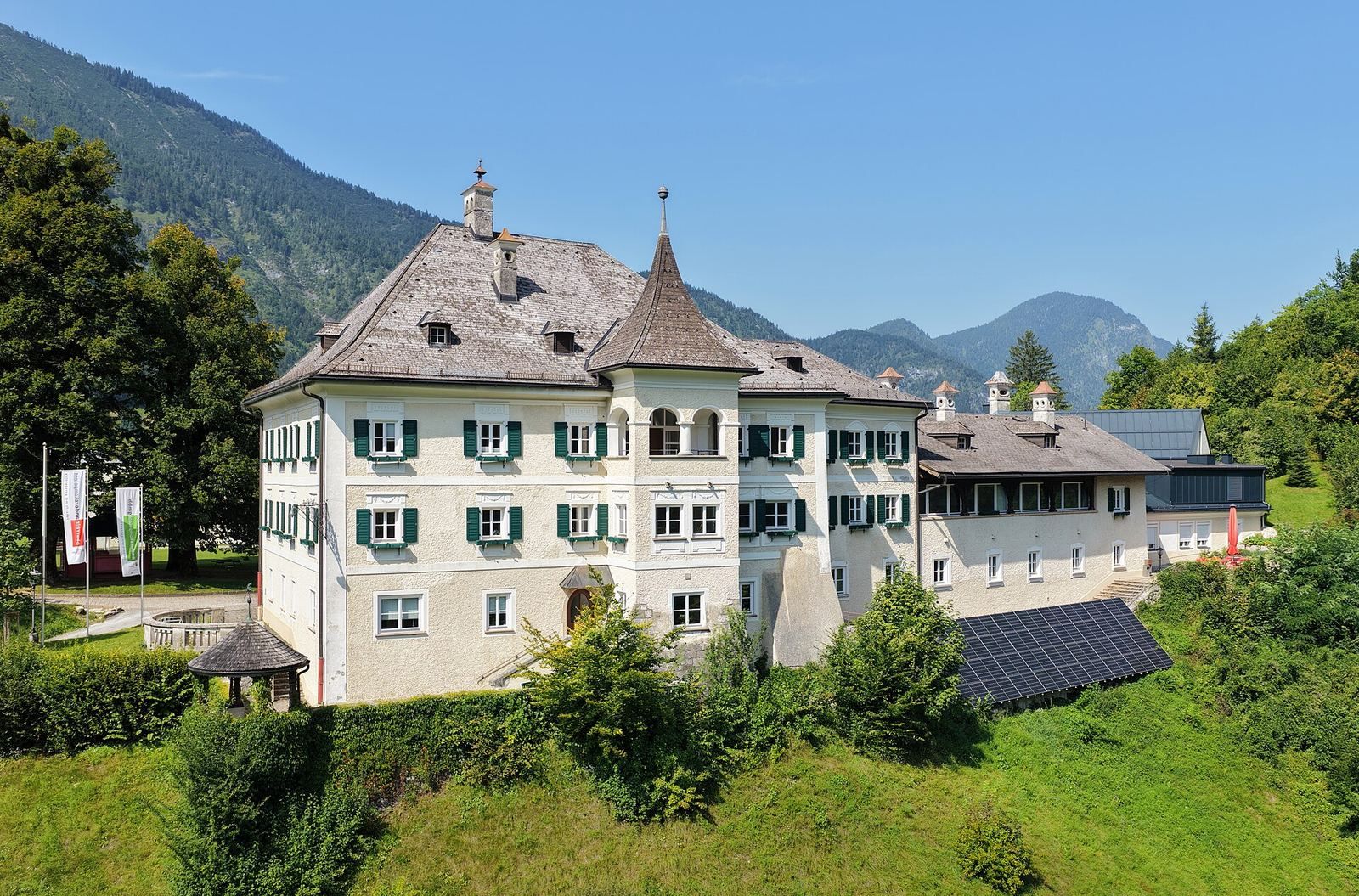
The site occupies a rise in southern Unken above the Saalach valley, overlooking Federal Road 1 between Lofer and Salzburg. Until 1830, a country road connecting the area with Bavaria ran between the farm and tavern. The surviving building is the former tavern, a three-storey structure beneath a high roof sloping on all four sides. Its interior has been substantially altered from its original form.
Exterior
South facade
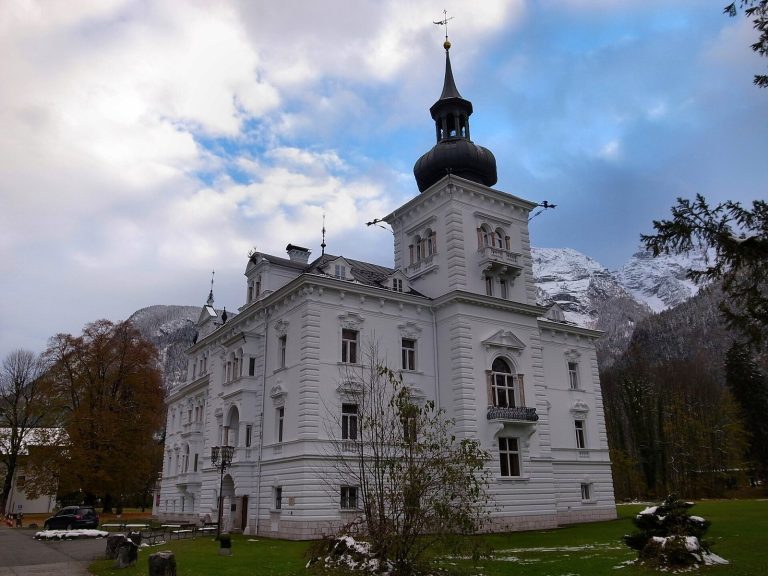
The south facade, which faces the valley, has a slightly off-center tower porch about two windows wide. Its upper storey forms an open gallery with two round arches separated by a central column, and the tower is capped by a roof with flared sides. Light-colored stucco, or decorative plaster, frames the windows in patterns that vary from floor to floor. Green wooden shutters and simple plaster bands dividing the storeys complete the facade.
Entrance and extensions
An arched entrance gate has a small sheltering porch. Above the entrance are the Salzburg state arms, the date 1796, and an inscription asking God to protect the building from lightning, storms, thunder, and other misfortunes. A two-storey extension on the left side of the main wing has a projecting round tower with a tent-shaped roof. On the north side, a terrace leads into a garden.