St Mark’s Campanile: Bell Tower of St Mark’s Basilica in Venice
Site at a Glance
- Popularity
- Very High
- Country
- Italy
- Primary era
- Medieval
- Eras represented
- Medieval, Early Modern, Modern
- Civilizations
- Italian, Venetian
- Site type
- Military
- Remains
- Tower
On this page13 sections
History
St Mark’s Campanile is the bell tower of St Mark’s Basilica in Saint Mark’s Square, Venice, Italy. It belongs to the Catholic church under the Patriarchate of Venice, and its origins lie in a watchtower probably begun during the rule of Doge Pietro Tribuno, Venice’s elected head. Construction of the tower itself appears to have started under Doge Pietro Participazio (939–942).
Origins and medieval construction
Magyar raids into northern Italy in 898 and 899, followed by Venice’s victory over the raiders at Lido of Albiola on 29 June 900, exposed the city’s vulnerability to attack from the sea. Slavic pirates also threatened Venetian shipping in the Adriatic. During Tribuno’s rule, Venice strengthened its defenses with a waterfront wall and an iron chain across the Grand Canal near San Gregorio. A large watchtower in the square probably helped defend the city and guide ships into its harbor, which then extended into part of the area now occupied by the square.
Work on the tower’s foundations continued under Tribuno’s successors, Orso II Participazio and Pietro II Candiano. Building materials were difficult to obtain, and construction methods may have contributed to delays. Some bricks used in the early work had been salvaged from mainland ruins and date to the late Roman Empire. Construction of the tower above the foundations began under Pietro Participazio but made little headway. Political conflict during the rules of Pietro III and Pietro IV Candiano then halted progress. Work resumed under Pietro I Orseolo and advanced substantially under Tribuno Memmo.
No further additions are recorded until Doge Domenico Selvo’s rule (1071–1084). By then the tower had reached a height useful for controlling access to the city. Selvo raised it to about 40 metres, the level of its fifth window. Doge Domenico Morosini (1147–1156) brought it up to the belfry, the chamber containing the bells. The architect Buono di Napoli directed this work, drawing on bell towers at Aquileia and, especially, San Mercuriale in Forlì. The first belfry was added during the rule of Doge Vitale II Michiel (1156–1172).
The belfry was repaired and the spire rebuilt around 1329. Lightning set the wooden spire on fire on 7 June 1388; it was reconstructed with gilded copper covering so that ships far out in the Adriatic could see it. A bonfire celebrating Venice’s victory over Genoa at the Battle of Modon destroyed the spire in 1403, and it was rebuilt in 1405–1406.
Rebuilding and changing uses
Lightning struck the tower on 11 August 1489, setting the spire alight. It fell into the square, the bells dropped onto the belfry floor, and cracks opened in the tower’s masonry. The procurators of Saint Mark, officials responsible for public buildings around the square, asked their architect and buildings manager, Giorgio Spavento, to redesign the belfry and spire in masonry to reduce fire risk. Venice’s financial difficulties after the wars in Lombardy delayed the work. Spavento instead oversaw repairs, a temporary tiled roof, and the rehanging of intact bells. The Italian Wars, which began in 1494, caused further delay.
An earthquake on 26 March 1511 damaged the tower and opened a long crack on its north side. At the initiative of procurator Antonio Grimani, the temporary roof and belfry were removed so Spavento’s design could proceed. Pietro Bon, who had succeeded Spavento in 1509, directed the work. Repairs to the tower were complete by 1512, and work on a new belfry of Istrian stone was under way. Structural work ended in June 1514, with the remaining tasks, including gilding the spire, finished by October.
A statue of the archangel Gabriel was set atop the spire in 1513, serving both as a religious figure and as a weather vane. Its choice recalled the traditional claim that Venice was founded on 25 March 421, the Feast of the Annunciation. This was a legend, traceable to the thirteenth century, which cast the city’s birth as a Christian republic as an act of divine grace. The Venetian writer Francesco Sansovino suggested that the weather-vane idea drew on the ancient Roman architect Vitruvius’s description of the Tower of the Winds in Athens.
In the fifteenth century, the procurators built a covered wooden gallery, called a loggetta, against the tower. It provided a meeting place for the procurators and nobles conducting government business, and a post for sentries guarding the Doge’s Palace during meetings of the Great Council, Venice’s major political assembly. Storms and earthquakes repeatedly damaged it. After lightning struck on 11 August 1537, the sculptor and architect Jacopo Sansovino was commissioned to rebuild it; it was completed in 1546. Wooden retail stalls on the tower’s other three sides helped fund the upkeep of buildings in the square. They were removed in 1873–1874.
Lightning repeatedly damaged the tower. Jacopo Sansovino directed repairs after strikes in 1548, 1562, 1565, and 1567; further damage followed in 1582. The architect Baldassarre Longhena oversaw repairs after a 1653 strike. On 23 April 1745, falling stone from cracked masonry killed four people in the square. Further strikes damaged the tower in 1761 and 1762. On 18 March 1776, physicist Giuseppe Toaldo installed Venice’s first lightning rod. Wind and rain also eroded the structure, and the statue of Gabriel was replaced in 1557 and again in 1822, when a new version was designed by Luigi Zandomeneghi.
The bells and Venetian public life
A bell was probably installed during Vitale II Michiel’s rule, although written evidence begins in the thirteenth century. In 1244, the Great Council set rules for ringing a summons bell for morning and afternoon meetings; the bell also appears in an ironmongers’ guild statute of 1271. The number of bells changed over time. At least six were present in 1489, and four remained during the sixteenth century until a fifth was added in 1569. A bell brought from Crete after the Ottoman conquest of the island was installed in 1678. It fell to the belfry floor in 1722 and was not rehung.
The five bells came to be known as Maleficio, also called Renghiera or Preghiera; Trottiera, also called Dietro Nona; Meza-terza, also called Pregadi; Nona; and Marangona. After St Mark’s Basilica became Venice’s cathedral in 1807, Marangona and Renghiera, together with the Crete bell and bells from other churches, were recast into two larger bells in 1808–1809. Those bells were melted down with Meza-terza, Trottiera, and Nona in 1820 to make a new set of five. Trottiera had itself been recast in 1731 and twice more before its tone harmonized with the older bells.
The bells regulated work, religious observance, government, and civic life. At dawn, Meza-terza and then Marangona sounded repeated series of strokes. Marangona signaled the opening of St Mark’s Church and the loggetta, the opening of the gates to the Jewish Ghetto, and the start of preparations for the working day. After a half-hour pause, Meza-terza rang continuously for half an hour, marking the start of Mass and of work for Arsenal laborers, heavy mechanical trades, and public officials. Late workers did not receive full pay. The bell’s name referred to the liturgical Third Hour, between sunrise and midmorning; Marangona also marked that hour.
At midday, Nona announced the work break, and Trottiera signaled the return to work after a pause. The bells also marked evening prayer and the close of the working day. After sunset, Meza-terza, Nona, and Marangona successively summoned the night watch, signaled that letters should be taken to Rialto for dispatch, and marked the beginning of the watch. Marangona also marked midnight. A separate bell, Realtina at San Giovanni Elemosinario in Rialto, governed some shop hours and guild working times and signaled when household fires should be extinguished.
Marangona announced meetings of the Great Council. Trottiera provided an initial summons, while Marangona and Trottiera also sounded at length before afternoon meetings. When the second summons ended, the council-room doors closed and latecomers were excluded. Trottiera also announced Senate meetings, followed by Meza-terza, then called Pregadi after the Senate’s earlier name. On solemn occasions, all the bells rang together, including for a doge’s election or a pope’s coronation. Their peals also marked deaths in the ruling family, church, and government, and the deaths of cardinals and foreign ambassadors.
The smallest bell, Renghiera, Maleficio, or Preghiera, signaled public executions. It had formerly been in the Doge’s Palace and was associated with the 1355 execution of Doge Marin Falier for treason; it was moved to the campanile in 1569. Its names referred to court proceedings, the crime, and prayers for the condemned. The Council of Ten, Venice’s senior state and security body, used its ringing to signal executions ordered by that council. Executions ordered by the criminal court or the officials responsible for nighttime policing and justice followed a different bell sequence.
The tower also retained a strategic and ceremonial role. Foreign dignitaries could visit only with permission from the Signoria, Venice’s executive governing body, preferably at high tide, when navigable channels in the lagoon were hard to distinguish. On 21 August 1609, Galileo Galilei demonstrated his telescope from the belfry to procurator Antonio Priuli and other nobles. Three days later, he presented it to Doge Leonardo Donato from the loggia of the Doge’s Palace.
Collapse and reconstruction
After the retail stalls were removed in 1873–1874, the tower’s base was found to be in poor condition, although repairs addressed only surface damage. Excavations in the square in 1885 raised concerns about the foundations. Inspections in 1892 and 1898 judged the tower safe, and subsequent repairs were sporadic.
In July 1902, repairs to the loggetta roof required removing a beam where it met the tower, leaving a fissure at the tower’s base. The structure trembled as workers installed a replacement beam on 7 July. Crack indicators broke, and by 12 July a large crack extended almost the full height of the north side. Although a technical commission saw no immediate danger, falling mortar prompted barricades, closure of the tower, and limits on bell-ringing to reduce vibration. On 14 July, after the indicators had broken and the maximum crack recorded since the previous day reached 0.75 centimetres, the square was evacuated at 9:30 a.m. Stones began falling at 9:47, and the tower collapsed at 9:53.
An investigation found that the access ramps between the inner and outer parts of the tower had failed. The upper ramps fell onto those below, and the unsupported outer part collapsed against the inner one. The tower fell vertically and damaged the loggetta, a corner of the Marciana Library, and the porphyry column known as the pietra del bando, from which laws had been proclaimed. The custodian’s cat was killed. That evening, Venice’s communal council voted unanimously to rebuild the tower “where it was and how it was.”
Fragments of the loggetta, including columns, reliefs, capitals, and bronze statues, were inventoried and moved to the Doge’s Palace courtyard. Reusable bricks were salvaged, while rubble was carried by barge into the open Adriatic. By spring 1903 the site had been cleared and the remaining tower stump demolished. The medieval foundation piles were found in good condition and required only moderate reinforcement.
Reconstruction formally began on 25 April 1903. Giuseppe Sarto, then Patriarch of Venice and later Pope Pius X, blessed the work, and Prince Vittorio Emanuele, Count of Turin, laid a cornerstone on behalf of King Victor Emmanuel III. Architects Luca Beltrami and Gaetano Moretti designed the new tower, and engineer Giovanni Antonio Porcheddu’s firm built its reinforced-concrete structure. The tower was completed on 3 October 1908, followed by work on the belfry and attic. Work on the spire began in 1911; the restored Gabriel statue was raised on 5 March 1912, and the rebuilt campanile was inaugurated on 25 April that year.
The recovered Justice figures were reassembled and restored, while the winged lions, damaged beyond repair after they were chiselled away during the first French occupation of Venice in 1797–1798, were remade. Marangona and fragments of the four bells broken in the collapse were preserved. The four replacement bells, personally financed by Pope Pius X, were cast in 1909, blessed in 1910, and raised to the new belfry on 22 June that year. The bell mechanism was changed to reduce vibration and the risk of damage.
Cracks appeared by 1914 as the old and enlarged foundations settled at different rates. Monitoring installed in 1995 found that the tower leaned by 7 centimetres. From 2007, Venice’s public-works authority reinforced the foundation with four titanium cables; that work was completed in April 2013. An earlier plan for a permanent elevator, proposed in 1892, had been abandoned over concerns about stability. The elevator was installed in 1962. The campanile is also associated with the Carnival “flight of the angel,” in which a performer descends from the tower. After a period when a wooden dove took the performer’s place, a human performer returned in 2001, descending to the Doge’s Palace loggia in a ceremony marking the start of Carnival.
Remains
Overall form
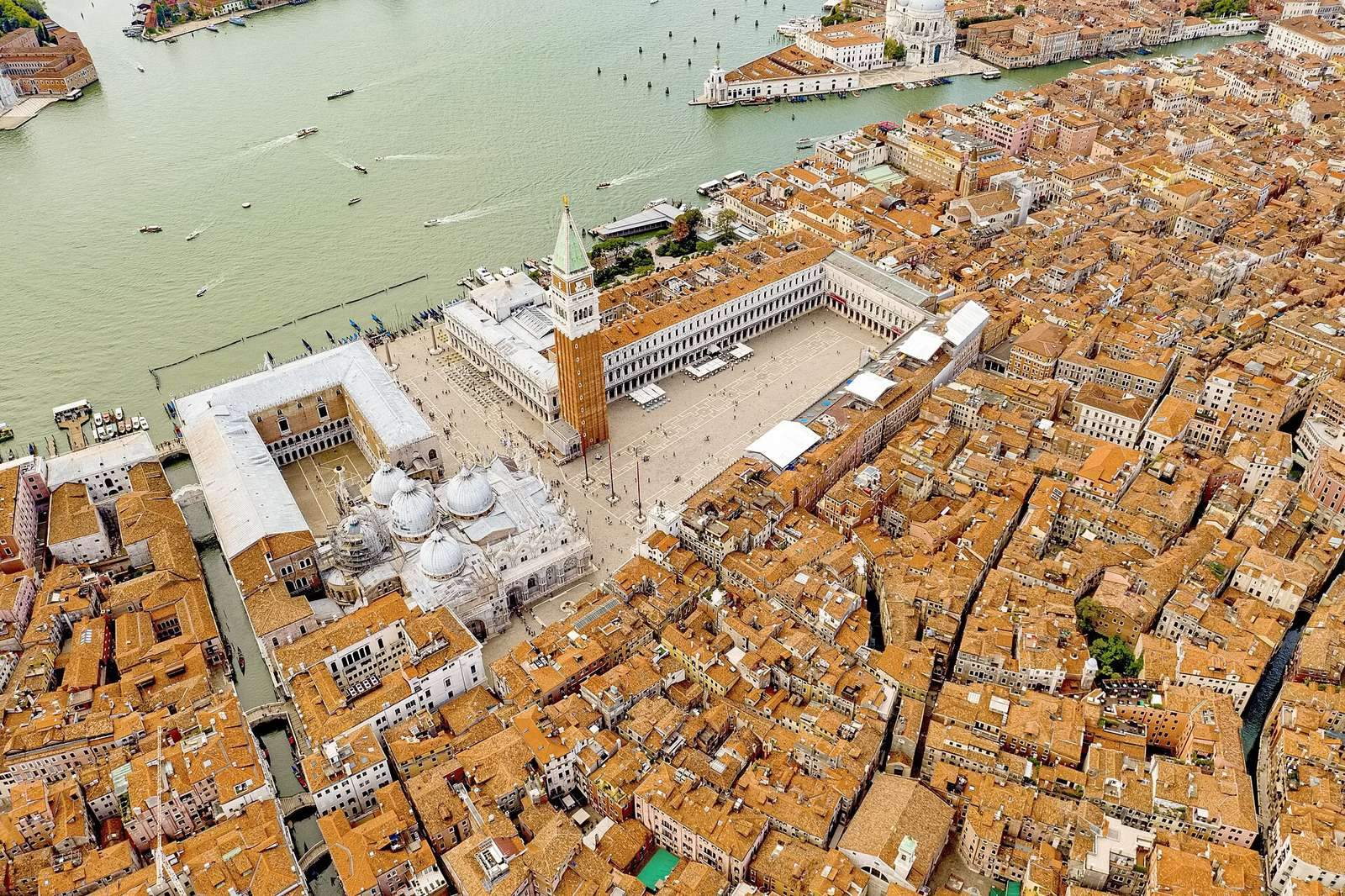
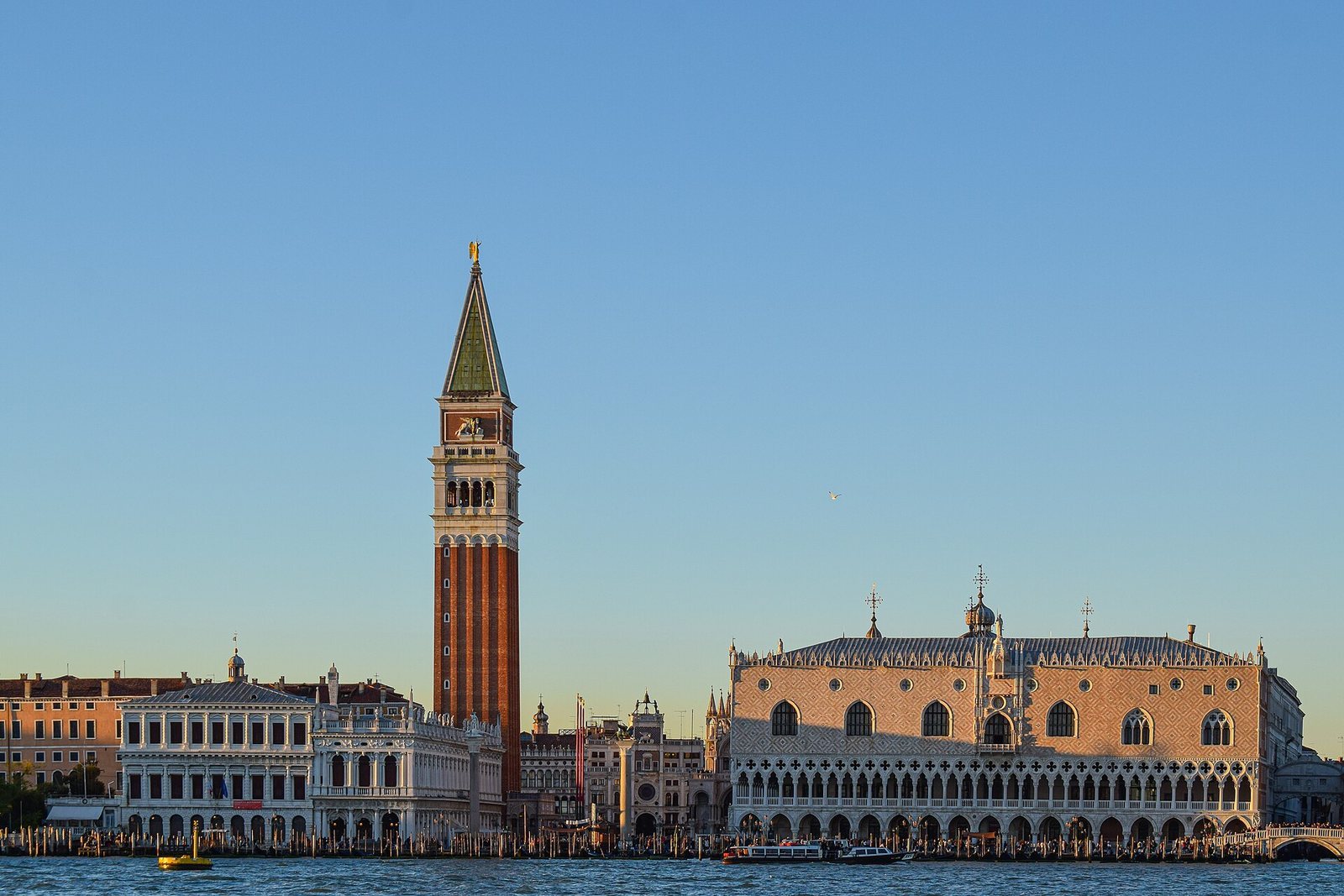
The campanile stands by itself in Saint Mark’s Square, near the facade of St Mark’s Basilica and the mouth of the Grand Canal. It is 98.6 metres tall and is the highest structure in Venice. Its square brick shaft measures 12 metres on each side and has shallow vertical strips of masonry, called lesenes, on its walls. Above the shaft are the belfry, an attic, and a pyramidal spire.
Foundations and structure
The medieval foundation rested on piles about 1.5 metres long and 26 centimetres in diameter, driven into dense clay about five metres below the surface. Oak planking and layers of stone were laid over them. In the reconstruction, the foundation was enlarged from about 220 to 410 square metres, extending roughly three metres beyond its former limits on each side. Its 3,076 larch piles are about 3.8 metres long and 21 centimetres in diameter. Oak planking and eight layers of Istrian stone blocks form the base above them. The wider foundation was designed to spread the tower’s weight, reducing the stated load from 9 to 4 kilograms per square centimetre.
In the rebuilt tower, reinforced-concrete beams connect its inner and outer shafts and carry the ramps between them. The ramps were also rebuilt in concrete, and the stone support for the spire was replaced with reinforced concrete to distribute its weight across both shafts. The shaft was completed in 1908 at a height of 48.175 metres. Four titanium cables now reinforce the foundation. Two lie 40 centimetres below the square’s surface, 20 centimetres apart inside a protective polyethylene tube, and are anchored at the foundation’s corners by titanium pillars. Two more cables are set 2.3 metres deep and held by granite blocks; they can be monitored and tightened.
Upper stages
Belfry and attic
The belfry rises above the brick shaft and is capped by a brick attic decorated with high-relief sculptures in Istrian stone. On the east and west sides, Venice is personified as Justice, seated on a throne supported by lions and holding a sword and scales. The other faces carry the winged Lion of Saint Mark. The reconstructed Justice figures incorporate recovered fragments; the lions were remade.
Spire
A pyramidal spire rises above the attic and carries a gilded statue of the archangel Gabriel on a turning platform, allowing it to indicate wind direction. The statue is wooden with a copper covering. The original was replaced in 1557, a later version was installed in 1822, and the restored statue was raised onto the reconstructed spire in 1912.
Loggetta and tower base
The loggetta was attached to the base of the campanile on the side facing the basilica. Jacopo Sansovino rebuilt it, and it was completed in 1546. The 1902 collapse destroyed it, but recovered columns, reliefs, capitals, and bronze statues were preserved. The Justice figures restored from recovered fragments form part of the attic sculpture. Wooden retail stalls formerly stood against the tower’s other three sides.
Bells and access
Five bells hang in the belfry, ordered from smallest to largest as Renghiera or Maleficio, Trottiera, Meza-terza, Nona, and Marangona. Marangona, cast by Domenico Canciani Dalla Venezia in 1819–1820, is the original bell in the present set. It measures 180 centimetres across, weighs 36.25 quintals (a quintal is 100 kilograms), and is pitched at A2. The other four were cast in 1909. Nona measures 156 centimetres across, weighs 25.56 quintals, and is pitched slightly flat at B2. Trottiera measures 138.5 centimetres, weighs 18.07 quintals, and is pitched slightly flat at C-sharp 3. Meza-terza measures 129 centimetres, weighs 13.66 quintals, and is pitched slightly flat at D3. Renghiera or Maleficio measures 116 centimetres, weighs 10.11 quintals, and is pitched slightly flat at E3.
A grooved wheel and rope replaced the former rope-and-lever system to limit vibration. A permanent elevator inside the inner shaft travels from ground level to the belfry in 30 seconds.